On-Page SEO for Rubber, Plastics & Silicone Products: Titles, H1s & Internal Links

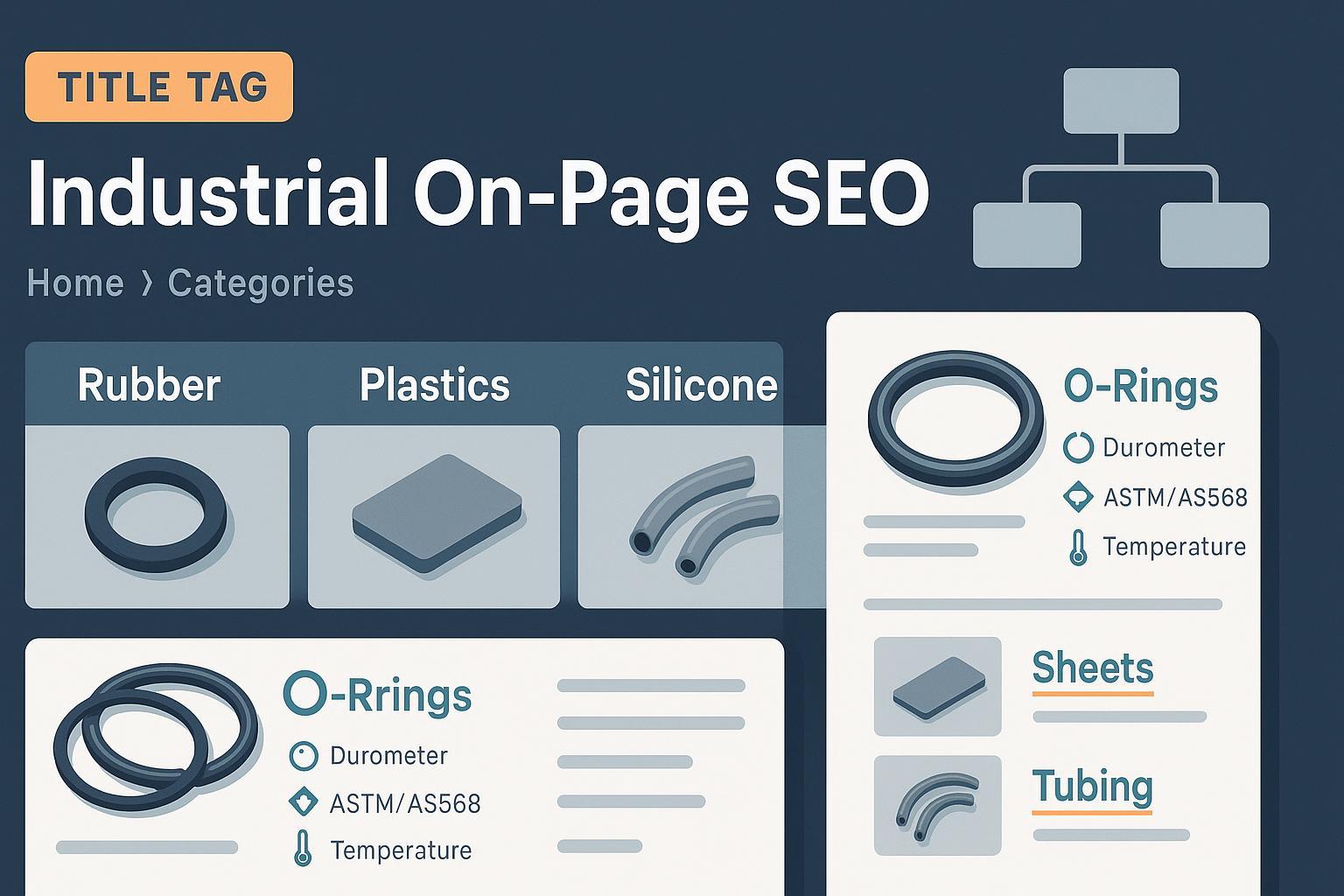
If you manage catalogs for O‑rings, sheets, tubing, gaskets, or molded parts, you’ve felt the tension between technical accuracy and search clarity. The playbook below distills field-tested patterns for industrial product and category pages—specifically for rubber, plastics, and silicone—so your Titles, H1s, and internal links drive both discovery and qualified RFQs.
What “good” looks like in industrial on-page SEO
From experience, high-performing product and category pages share three traits:
- Titles and H1s front‑load the material + item type and one differentiating spec/standard.
- Headings mirror how engineers search (standards, durometer, temperature, compliance), not marketing slogans.
- Internal links form a predictable hierarchy (Category → Subcategory → Product), reinforced with breadcrumbs and contextual anchors.
These principles align with Google’s guidance to use clear, descriptive titles and structured headings for users and crawlers, not boilerplate or stuffing, as outlined in the Google SEO Starter Guide.
Title tags that win industrial intent
Title length is not a fixed rule; clarity is. Google can truncate or even rewrite unhelpful titles, and rewrites are more likely when titles are very long, very short, duplicative, or mismatched—patterns highlighted in Zyppy’s large-scale title rewrite study.
Practical patterns for product pages:
Formula: <Material + Item> – <Key qualifier> , <Spec/Standard> | <Brand>
Examples you can adapt:
- Silicone O‑Rings – FDA Grade, AS568 Sizes (Shore A 70)
- EPDM Rubber Sheets – 60A Durometer, −40°F to 250°F, ASTM D2000
- UHMW Polyethylene Rods – Food‑Grade, 1/2" to 4" Dia, NSF
Tips that consistently help:
- Front‑load the core term engineers type (material + item). See the clarity emphasis in the Google SEO Starter Guide.
- Add only one or two differentiators in the title (a standard and one spec), move the rest into H1/intro to reduce rewrite risk per the patterns seen in Zyppy’s title rewrite study.
- Avoid boilerplate repetition across variants (e.g., repeating “Rubber Products” everywhere). Use variant specifics (size/grade/standard) to keep titles unique.
Category page title patterns:
Formula: <Category + Material> – <Primary use/compliance> , <Key selection criteria>
Examples:
- Silicone Tubing – Medical Grade, USP Class VI, Peroxide/Platinum Options
- Industrial Rubber Gaskets – Oil‑Resistant (NBR/Nitrile), ANSI/ASME Sizes
Trade‑off note: Short titles can’t carry all specs engineers want, but long titles invite rewrites. Pick the one or two specs that most influence selection (often standard + durometer) and push the rest into the H1/above‑the‑fold copy.
H1s and headings that align with buyer tasks
H1s should closely match the title while being fully human‑readable. Headings exist to create a logical structure for people and search engines, a core principle in the Google SEO Starter Guide.
Recommended patterns:
H1 (Product): <Material + Item>, <Compliance/Standard>, <Key Spec>
H1 (Category): <Material + Category>: <Use Case> & <Selection Criteria>
Examples:
- Silicone O‑Rings, FDA‑Compliant, AS568 Standard Sizes
- Viton (FKM) Rubber Sheets – Chemical‑Resistant, 70A
- Silicone Tubing: Medical‑Grade Options & Specifications
Use H2/H3 blocks to match the evaluation process:
- Material properties (durometer, tensile strength, temperature range)
- Standards and compliance (ASTM D2000, FDA CFR 21, USP Class VI)
- Size and tolerance ranges
- Applications and compatibility
This alignment reduces title rewrites (better consistency) and improves scannability on mobile, which remains critical under Google’s mobile‑first paradigm referenced throughout the Google SEO Starter Guide.
Internal linking architecture that scales
A resilient industrial catalog puts every important product within two to three clicks of the homepage and uses descriptive, crawlable anchors—guidance echoed in Google’s Make your links crawlable and reinforced by Ahrefs’ overview of internal links for SEO.
Core components:
- Siloed hierarchy: Home → Rubber → Silicone → O‑Rings → Product. Keep cross‑links purposeful (e.g., material substitutes or compatible components).
- Descriptive anchors: Prefer “AS568‑214 silicone O‑ring” or “food‑grade silicone sheets” over “view” or “details.”
- Related modules: Add “Substitutes” (e.g., EPDM vs. Silicone), “Complements” (adhesives, gaskets), and “Compatible sizes.”
- Standards hub: Create explainers for ASTM D2000, FDA CFR 21, USP Class VI. Link to and from relevant categories/products to establish topical clusters.
- PDF/CAD hub: Centralize spec sheets/CAD files; link from each product page to the relevant files and reciprocate back links to the product for discovery.
Breadcrumbs pull double duty—helping users and clarifying site hierarchy for search engines. Implement visible breadcrumbs and structured data; Google documents the markup in Breadcrumb structured data. For a practical take on user/navigation value in ecommerce, see OWDT’s concise e‑commerce SEO checklist.
Structured data boosts eligibility for rich results on product pages (when requirements are met), a point summarized by Conductor’s academy overview of product page SEO. For variant families common in industrial catalogs, Google added ProductGroup support (e.g., hasVariant, variesBy) in 2024—see the official product variants update.
Faceted navigation without index bloat
Large catalogs need filters (size, durometer, color, compliance) but not every combination should be indexable. Practical controls:
- Canonical and indexing rules: Point thin parameter pages to the core category via rel=canonical and/or apply meta robots noindex on low‑value combinations. SEJ’s overview of URL parameter handling captures the trade‑offs.
- Parameter hygiene: Normalize parameter order and naming to avoid unintentional duplicates contradicting canonicals.
- AJAX filtering: Where possible, use client‑side filtering to prevent infinite URL permutations; Shopify’s guide on faceted navigation outlines practical patterns.
- Link equity: Keep primary navigation pointing at core categories; don’t flood templates with links to transient filter URLs.
PDFs, spec sheets, and CAD files
Engineers often land on PDFs. Make that work for you:
- Prefer HTML product pages as canonical destinations; when a PDF duplicates the content, use an HTTP header rel=canonical from the PDF to the product page, per Google’s guidance on consolidating duplicate URLs.
- Keep PDFs text‑based (indexable), with meaningful titles/metadata. For localization, relate translated PDFs with hreflang via HTTP headers—see Google’s localized versions.
- Always cross‑link between PDFs and their corresponding HTML product pages.
Multilingual and multi‑regional catalogs
For global buyers, separate URLs per language/region with mutual hreflang references and self‑referencing canonicals. Google’s documentation on localized versions and consolidating duplicate URLs provides the implementation details.
Execution tip: Internal links should point to the in‑cluster canonical for that language/region to avoid cross‑language cannibalization.
Measurement that ties to RFQs, not just rankings
Track the outcomes that matter in B2B:
- Session‑to‑lead (RFQ/form) conversion rate, add‑to‑quote clicks
- Spec/CAD downloads
- Assisted conversion paths from internal link modules
As a pragmatic baseline, B2B conversion benchmarks suggest 2–3% session‑to‑lead conversion is common (Databox, 2023). See the concise summary in Databox’s B2B marketing benchmarks for context.
Also keep an eye on quality signals: In March 2024, Google folded “helpful content” signals into core systems and strengthened spam policies, reiterating people‑first content. The overview is in Google’s March 2024 core update & spam policies. And for performance, INP replaced FID as the responsiveness metric in Core Web Vitals on March 12, 2024—details in Google’s Introducing INP.
Common pitfalls (and how to fix them)
- Boilerplate titles across variants cause rewrites and cannibalization. Fix: Inject differentiators (standard/size/grade) into titles; vary H1s accordingly.
- Orphaned product pages from thin category linking. Fix: Ensure every product appears in its parent ItemList and has at least one contextual internal link.
- Facet index bloat competes with core categories. Fix: Canonical/noindex non‑valuable combos; prefer AJAX filtering.
- PDFs outranking their HTML counterparts. Fix: Canonical from PDF to HTML and strengthen internal links to the product page.
- Generic anchors (“view,” “details”) dilute relevance. Fix: Use material/spec‑specific anchor text.
Implementation workflow (repeatable by your team)
- Research intent
- Map primary term (material + item) and the one or two selection specs with demand (standard, durometer). Align with how engineers search.
- Draft Titles and H1s
- Apply the formulas above. Front‑load core terms; add one or two differentiators.
- Structure headings
- Add H2/H3 sections for material properties, standards/compliance, sizes/tolerances, applications.
- Wire internal links
- Place descriptive anchors to subcategories, related products (substitutes/complements), and standards hubs. Ensure crawlable links.
- Add breadcrumbs and schema
- Visible breadcrumbs + BreadcrumbList markup. Product schema on products; ItemList on categories. For variants, consider ProductGroup.
- Control facets
- Define indexable facet combinations; apply canonical/noindex rules; prefer AJAX filtering patterns.
- Handle PDFs/specs
- Ensure text‑based PDFs; canonicalize to HTML where duplicative; link both directions.
- Localize correctly
- Separate URLs per language/region; mutual hreflang clusters; self‑canonicals; internal links reinforce in‑cluster canonicals.
- QA and ship
- Validate structured data; crawl for orphan pages; click‑path test (≤3 clicks to products); check INP responsiveness.
- Measure and iterate
- Track RFQs, spec downloads, and internal link assists. Adjust anchors/modules where users stall.
Quick reference: anchor text conventions
Good (descriptive):  "AS568‑214 silicone O‑ring", "FDA food‑grade silicone sheets"
Weak (generic):      "view", "details", "learn more"
Contextual links:    Within spec/compliance copy ("USP Class VI silicone tubing")
Module labels:       Substitutes | Complements | Compatible sizes | Standards
Tools (neutral)
For audits and execution at scale: SEMrush for keyword/SERP analysis, Screaming Frog SEO Spider for internal link mapping, and QuickCreator for drafting and optimizing content blocks efficiently. Disclosure: This is our own product mention alongside alternatives for parity.
By applying these repeatable patterns—clear titles, human‑readable H1s, and disciplined internal linking—you’ll surface the right SKUs, reduce cannibalization, and guide engineers to spec‑fit options without sacrificing crawl efficiency.
