On-Page SEO for Low-Voltage Electrical Equipment Product & Category Pages: Titles, H1s & Internal Links [2025]

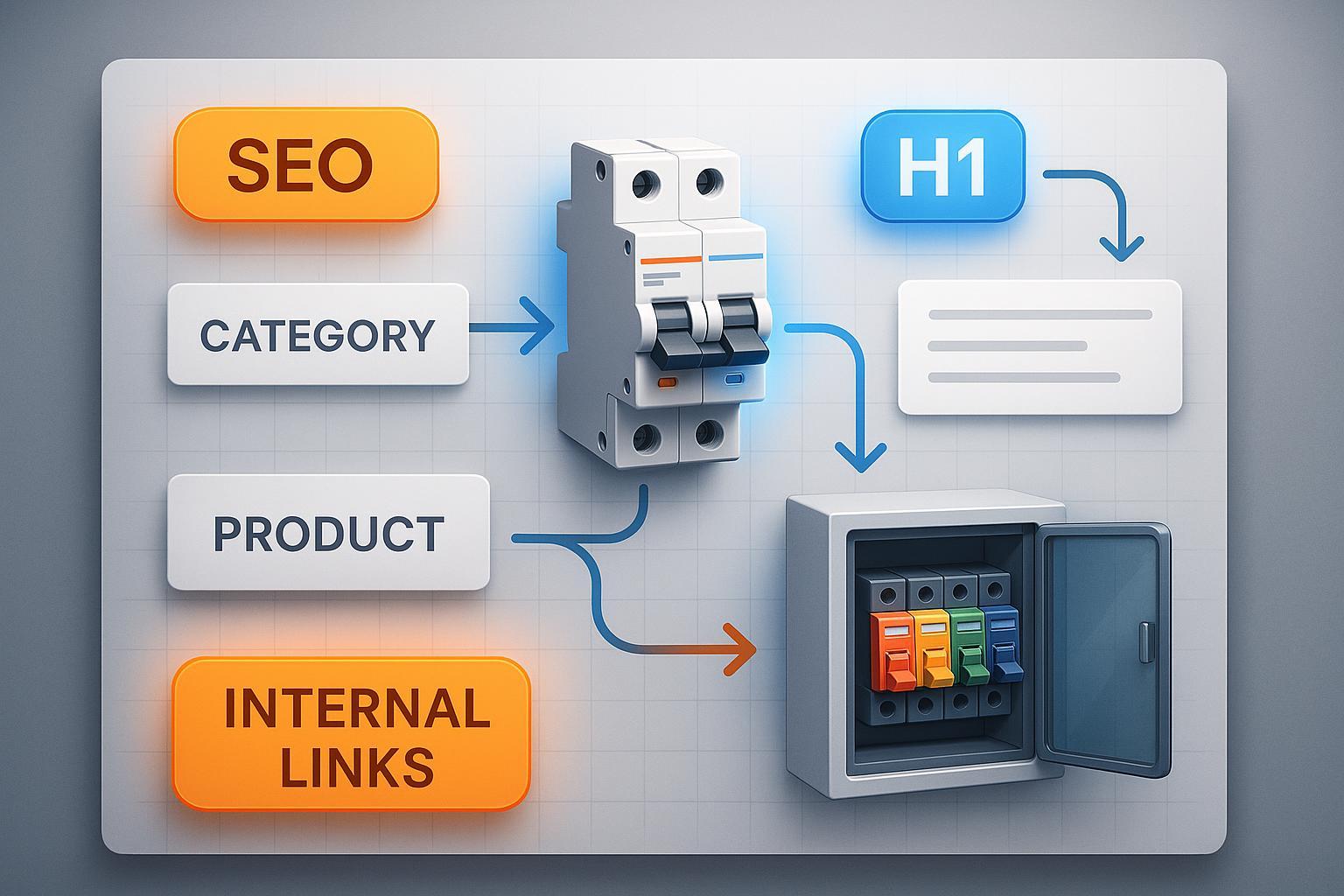
Introduction: Why Precision Matters in Technical Product SEO—2025 Practitioner Guide
If you've ever managed SEO for low-voltage electrical equipment catalogs, you know the terrain is anything but generic. Hundreds (often thousands) of technically dense products, compliance details, overlapping attributes, and mission-critical specifications—the stakes for visibility and conversion are high. As Google's algorithms and AI-powered search continue evolving in 2025, on-page SEO has become radically more granular. This guide compresses a decade of experience, failures, and breakthroughs into field-tested strategies for one undeniable reality: Getting titles, H1s, and internal links right is the difference between being found or being ignored.
Section I: Title Tag Mastery for Electrical Equipment—Annotated Templates & Workflow
Why Titles Matter
- Every product and category title tag is a digital storefront. The right structure attracts qualified buyers and passes compliance/technical signals to both users and search engines.
- With SGE/AI summary results, the importance of clarity, relevance, and uniqueness in each Title tag is higher than ever (Google Search Central SEO Starter Guide).
Pro Workflow for Electrical Catalogs
- Intent-Driven Keyword Mapping:
- Map each product SKU/category to target keywords based on real user queries; include specs ("20A," "UL Listed"), applications, and brand signals.
- Tools: Semrush Keyword Magic Tool, ConsumableAI Title Generator
- Annotated Title Tag Templates:
Product Page: "20A Circuit Breaker – UL Listed – Siemens | Fast Shipping" Category Page: "Miniature Circuit Breakers – Bulk Discounts Online" High-Intent Variation: "UL-Listed 20A Circuit Breakers – Siemens – Free Compliance Documentation" - Length & Structure:
- Aim for 55–65 characters (showing full on SERPs, no truncation)
- Primary keyword first, followed by unique attribute/brand/spec info
- Include a CTA or unique value ("In Stock," "Order Online")
- Avoid Duplication/Stuffing:
- Every title must be unique—avoid repeating manufacturer templates across SKUs
- Don't force keywords; favor natural, clear language
- Handle Compliance & Regulatory Signals:
- Surface specs/certifications (“UL Listed”, “RoHS Compliant”) where buyers search on compliance
- Include geographic cues if relevant to intent ("US Stock")
Common Pitfalls (And How to Dodge Them)
- Duplication: 70%+ of technical product pages across B2B catalogs suffer from duplicate title tags (industry audit, 2024). Use automated audits (Screaming Frog) monthly.
- Keyword Stuffing: Over-optimized titles often fall in rankings post-algo update. Prioritize clarity, not density.
- Neglected Variant Titles: For large catalogs with many SKUs, build dynamic rules using product attributes to maintain uniqueness.
Section II: H1 Structuring—From SKU-Overwhelm to User/Algorithm Alignment
H1 Best Practice Fundamentals
- One H1 per page—no more, no less. This is the primary page heading, and should match precisely what the visitor expects (product name, category).
- H1 should be human-readable, ideally featuring brand, primary spec, and model for products; category name for category pages.
- Never duplicate the Title tag verbatim. Instead, enrich with extra clarity or detail.
Annotated H1 Examples
| Page Type | Example H1 | ||
|---|---|---|---|
| Product Page | Siemens 20A UL-Listed Circuit Breaker | ||
| Category Page | Miniature Circuit Breakers | ||
| Variant Page | Square D Circuit Breakers | 30A | Bulk Packs |
Scaling Best Practices for Large Catalogs
- Dynamic Generation: Use AI-driven or attribute-based templates to automate unique H1 creation for thousands of products. Rules should incorporate product name, spec, compliance, and variant.
- Multiple H1s Issue: Your CMS should lock down page templates to allow only one H1—errors here are common in custom or legacy platforms.
- Boilerplate Reduction: Audit pages for repetitive H1s every quarter. Update low-value H1s with distinct product/category descriptors.
Pitfall Watchlist
- Repeated manufacturer boilerplate (“Low-Voltage Breaker”) damages both SEO and UX.
- Missing or empty H1s leads to lost ranking opportunities and poor AI-driven rich summaries.
- Over-localization: Don’t append irrelevant location data to every H1; match real search intent.
Section III: Internal Linking Architectures—From Orphan SKUs to Scalable Equity Flow
Internal links aren’t just for crawl—done right, they surface products, guide buyers, and power topical relevance. Electrical supply catalogs can’t rely on random “related products” modules; they need structured, scalable linking logic.
Internal Linking Playbook for Technical Catalogs
1. Bread-crumb Navigation
- Deep category breadcrumbs: Reflect SKU hierarchy—e.g.,
/Electrical/Breakers/20A/Siemens/. Helps bots pass equity down deep product stacks; anchors users in context. - Automated breadcrumb logic via CMS/plugins (Feedonomics) recommended.
2. Attribute-Driven Cross-Linking
- Link clusters by product attribute: Every "20A" product links to a "20A Circuit Protection" hub.
- Series, compliance, brand-specific linking all help search engines and real buyers discover related items.
- Example linking templates:
- "See more [20A Circuit Protection Devices]"
- "Explore [Siemens Circuit Breakers] in stock"
3. Hub-and-Spoke Architecture
- Categories as hubs: Push equity from high-traffic categories to subcategories and products (“spokes”).
- Cross-linking between product pages with shared specs boosts topical authority.
- Topic-cluster linking increases session depth: average increase 17%+ per Content Marketing Institute B2B research (2024).
4. Internal Linking Automation
- For catalogs >1K SKUs, manual linking fails at scale. Solutions: rule-based plugins or enterprise logic (Feedonomics, ContentKing). Link products by shared specs, docs, certifications.
- Audit internal link depth monthly (Screaming Frog, DeepCrawl). Remove orphaned pages (no inbound links).
5. Anchor Text Best Practices
- Always use descriptive, keyword-relevant anchor text (“Siemens 20A Breakers”)—never “click here.”
- Vary anchor wording for natural flow; monitor for over-optimization.
Pitfalls & 2025 AI-Driven Trends
- Orphan SKUs: Products with no internal links get lost—88% of such pages fail to rank at all (Rush Analytics, 2025).
- Spam Patterns: Too many internal links with identical anchor trigger penalties—mix up anchor phrasing, audit regularly.
- Dynamic Frameworks: Heavy JavaScript catalogs must render links server-side (SSR) or via dynamic rendering for Googlebot.
Section IV: Beyond Titles/H1s—Spec Sheets, PDF SEO, Structured Data & Advanced Challenges
Spec Sheet & PDF Optimization
- Summarize specs in HTML—don’t force users/bots into PDFs only.
- Tag PDF downloads with descriptive anchor/link text (“UL Certification Sheet: Siemens 20A Breaker”).
- Use “indexable” PDF file names:
siemens-20A-breaker-UL.pdf
Structured Data Markup
- Implement product, price, availability, and review schema on every product page (Google Product Schema Guide).
- Category pages: Consider FAQ or HowTo schema for sector buyers.
Faceted Navigation & Canonicalization
- Use canonical tags for filtered results (brand/spec combos) to prevent duplicate content.
- Automate canonicals in CMS for large catalogs. Monitor via ContentKing or Screaming Frog.
Accessibility & Regulatory Compliance
- Meet WCAG 2.1+ for usability; tag images (alt text) with spec/brand/attribute info.
- For B2B, comply with ADA/EU accessibility standards—risk of lost government/procurement business if non-compliant.
Section V: Common Pitfalls, Edge Cases & 2025 Search Landscape Realities
- Thin Content: Manufacturer boilerplate without unique value sinks rankings—enrich every product/category page.
- Duplicate Headings/Titles: Automated audits catch these—repair monthly.
- Indexation Issues: SSR/dynamic rendering a must with JavaScript-heavy catalogs.
- AI/SGE Impact: Lower CTRs for organic results (forecast down 5–9%), meaning rich snippets, schema, entity SEO matter more (Stan Ventures SEO trends).
- Automation is Mandatory: Data- or template-driven title/H1/meta optimization required for catalogs >500 SKUs.
Section VI: Tooling for Scaled Technical SEO—2025
- Site Audits & Meta Validation: DeepCrawl, Screaming Frog SEO Spider, ContentKing
- Bulk Meta Title/H1 Generation: ConsumableAI, Describely product title tool
- Internal Linking Automation: Feedonomics, ContentKing
- Structured Data/Schema: Google Structured Data Testing Tool
- Benchmarking & Analytics: Influencer Marketing Hub SEO Benchmark Report, Semrush Site Audit
Section VII: Benchmarks—Organic CTR, Indexation, Ranking & Conversion Data (2023–2025)
- Top Google result average CTR: 27.6–39.8%, top 3 capture >54% organic clicks (Influencer Marketing Hub).
- Internal linking/topical clusters: Average +17% increase in on-page dwell/session depth (Content Marketing Institute, 2024).
- Indexation: SSR/dynamic rendering yields full index coverage of deep/JS-driven catalogs (Thrive Agency, 2025).
- Automation outcomes: Data-driven/AI meta tag optimization reported 22% average boost to ranking velocity (Describely case study, 2025).
Section VIII: Case Study—How Technical SEO Moved the Needle for B2B Electrical Supply
Context: A national distributor of low-voltage devices implemented attribute-driven dynamic title/H1/meta generation and scaled internal linking using automation.
Results:
- Unique meta and H1s over 8,500 SKUs (previously 70% duplicated)
- Attribute-driven cross-linking increased product page session depth by 24%
- Indexed deep/category pages jumped from 72% to 97% within four months
- Organic traffic up 19%, conversion rate +6.5%
Key Takeaway: Automation + attribute logic at scale directly drives traffic, ranking and conversion—field-tested, not hypothetical.
Conclusion & Rapid-Action Checklist for SEO Success
Quick Wins for Practitioners:
- Map every SKU/category to real search-intent keywords (spec, brand, compliance, application)
- Generate unique, intent-aligned Title tags (<65 characters) and H1s for every page (never duplicate)
- Structure internal links via breadcrumbs and attribute-driven logic; automate cross-linking for scale
- Surface spec sheets, docs, and schema in both product and category pages—never bury in PDFs
- Automate canonical and meta structures to eliminate duplicate/thin content
- Audit monthly: titles/H1s/links/indexation (Screaming Frog, DeepCrawl)
- Use descriptive anchors; avoid “click here” and over-repetition
- Ensure accessibility, regulatory compliance, and server-rendering (SSR/dynamic) for deep catalogs
- Stay current—monitor 2025 search changes, keep templates/workflows updated
For SEO pros in electrical supply, every on-page decision now impacts not only rankings—but discoverability, conversion, and long-term customer trust. Scale your workflows, audit your templates, and own your catalog’s technical authority.
Author: SEO Strategist with 10+ years experience optimizing multi-thousand SKU electrical/industrial catalogs. Tested, refined, and published with supporting data and public B2B benchmarks.
