On-Page SEO for Textiles & Functional Fabrics Product & Category Pages (2025): Titles, H1s & Internal Links

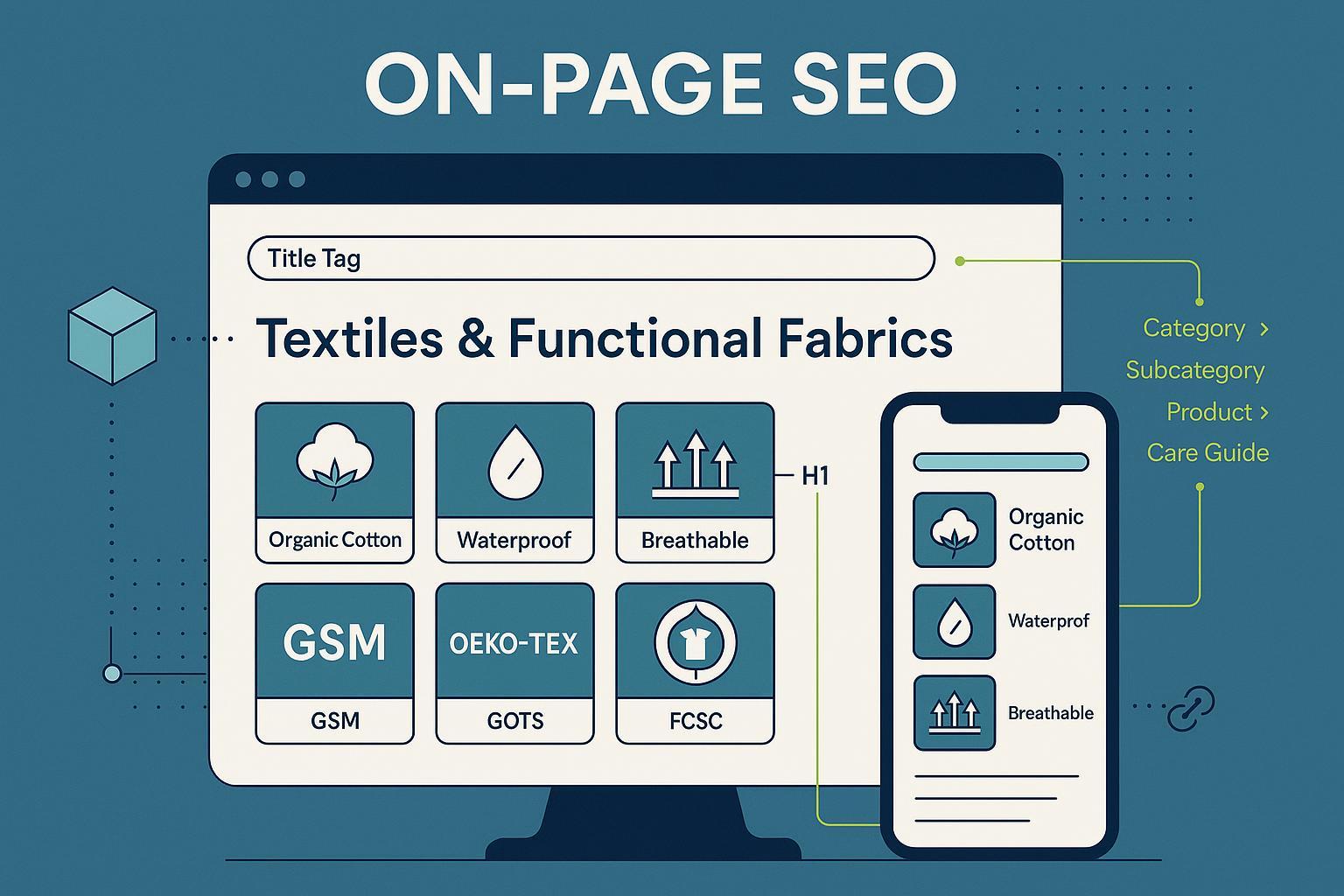
If you manage SEO for textiles or functional fabrics, the revenue levers live in plain sight: the Title, the H1, and the internal links that stitch category pages to product detail pages (PDPs), buying guides, and certification hubs. This playbook distills what consistently works on fabric sites—from “GOTS organic cotton jersey” to “10k waterproof breathable shell fabrics”—so you can implement it this week.
1) Title & H1 Alignment That Earns Clicks (and Doesn’t Get Rewritten)
Google still rewrites poorly formed titles. Your job is to make the Title and the main on-page heading (H1) crystal-clear and closely aligned.
- What Google expects in 2025:
- Unique, descriptive Titles; avoid boilerplate and stuffing. Google may pull from your H1 or other prominent text if Title quality is weak, per the official guidance in Google’s “Title links in search results” (2024–2025).
- Use headings to convey structure and the main topic; they help search engines understand the page and can be a title source when needed, as referenced by Google Search Central’s Title link documentation (2024–2025).
- Practitioner coverage also tracks title rewriting nuances; see Search Engine Land’s title tag best practices (2024).
Practical constraints that matter:
- Think pixels, not characters. Aim to keep Titles visually scannable. Industry practice typically keeps Titles around 50–60 characters to avoid truncation, but precision matters less than clarity and uniqueness as noted in Search Engine Land’s title length guidance (2024).
- Match the Title and H1 intent closely. Minor variations are fine, but don’t bait-and-switch.
Title/H1 patterns that work for textiles and technical fabrics:
- Category (B2C/B2B):
- Title: Organic Cotton Jersey Fabric | GOTS Certified | Free Swatches
- H1: Organic Cotton Jersey (GOTS)
- Category (attributes forward):
- Title: Waterproof Breathable Fabrics | 10k/10k | Seam-Sealable Materials
- H1: Waterproof & Breathable Fabrics (10k/10k)
- PDP (material + use):
- Title: Recycled Polyester Fleece 250 GSM | OEKO-TEX® STANDARD 100
- H1: Recycled Polyester Fleece — 250 GSM
- PDP (performance spec forward):
- Title: Nylon Ripstop 40D | DWR Finish | Ultralight Tent Fabric
- H1: 40D Nylon Ripstop with DWR
Five-step workflow (do this per template or at scale):
- Identify the primary intent (e.g., “organic cotton jersey fabric”).
- Add 1–2 high-signal modifiers buyers care about: GSM, denier, finish (DWR), certification (GOTS/OEKO-TEX), use case (“activewear”).
- Draft a Title that’s unique and readable; draft an H1 that mirrors the same concept in human language.
- Check for duplication/boilerplate across similar SKUs and variants.
- QA in SERP preview, then monitor whether Google rewrites the Title.
Evidence to keep on hand for stakeholders:
- Well-formed titles/H1s increase CTR and reduce rewrite risk as covered by Google’s Title link guidance (2024–2025) and summarized by Search Engine Land’s title guide (2024).
2) Internal Linking Maps That Move Rankings (and Buyers)
Internal links are your relevance and discovery engine. Keep them HTML, crawlable, and descriptive. Google reiterates that links must be standard elements to be discoverable; see Google’s crawlable links documentation (2024–2025). Practitioner guidance reinforces using contextual links thoughtfully, per Search Engine Land’s internal links best practices (2024).
Build a textile-specific linking fabric:
- Global nav and breadcrumbs
- Expose top collections (e.g., Organic Cotton, Waterproof, Breathable, Fleece). Implement BreadcrumbList structured data on all PDPs and categories per Google’s structured data guidance (2024–2025).
- Category → Subcategory → PDP
- On “Waterproof & Breathable Fabrics” link to sub-collections like “10k/10k Shell,” “3-Layer Laminates,” “Seam Tape & Tools.”
- From subcategory pages, link to bestsellers and new arrivals.
- Attribute hubs (high-intent, evergreen hubs)
- Create hubs for “GOTS Organic Cotton,” “OEKO-TEX Certified,” “Moisture-Wicking,” “UV-Resistant,” “Antimicrobial.”
- From attribute hubs, link down to relevant categories and pivotal PDPs; from PDPs, link back up to attribute hubs using descriptive anchors.
- Cross-link care and buying guides
- From “Organic Cotton Jersey” category to “How to Sew Organic Jersey: Needles, GSM, Stretch.”
- From PDPs, link to certification details (GOTS scope, OEKO-TEX label type) and care instructions.
- Avoid over-linking
- Excessive in-body links dilute value and overwhelm users. Keep link density purposeful; audit quarterly.
Anchor text rules (practical):
- Be specific: “250 GSM recycled polyester fleece” beats “learn more.”
- Keep accessibility: anchors should make sense out of context, per Search Engine Land’s accessibility-focused guidance (2024).
Health checks:
- Crawl-based orphan page report quarterly.
- Verify every PDP is reachable in ≤3 clicks from the homepage.
- Fix redirect chains; keep crawlable per Google’s crawlable links guidance (2024–2025).
3) Variants, Faceted Filters, and Pagination: Stay out of Cannibalization Traps
Textiles are variant-heavy (color, GSM, finish, width). Use rules to avoid duplicate content and cannibalization:
-
Variants
- Consolidate variants under one master PDP with self-referencing canonical unless a variant has unique demand (e.g., “white PFD cotton poplin” vs. “dyed poplin”) per Google’s ecommerce guidance hub (2024–2025).
- If a variant warrants its own indexable URL, differentiate copy and internal links around that variant’s search intent (e.g., “OEKO-TEX® 100 baby-safe cotton jersey”).
- For structured data, consider ProductGroup with hasVariant to model variants accurately, as announced in Google’s product variants structured data update (Feb 2024).
-
Faceted navigation (attributes like moisture-wicking, denier, finish)
- Limit indexation to combinations with unique value and search demand; others should canonical to the parent category or use noindex, guided by Google’s ecommerce site structure recommendations (2024–2025).
-
Pagination (deep categories like “Activewear Fabrics”)
- Do not canonical page 2+ to page 1. Use self-referencing canonicals and crawlable pagination links; Google no longer uses rel=prev/next, as summarized in Search Engine Land’s pagination guidance (2025) and reflected in Google’s ecommerce structure docs (2024–2025).
4) Structured Data: Make Your Fabric Catalog Machine-Readable
- Product (PDPs): Include Product with nested Offer, Review, AggregateRating when appropriate, keeping data consistent with on-page and Merchant Center feeds per Google’s Product structured data documentation (2024–2025).
- Variants: Use ProductGroup and hasVariant/variesBy for sizes, colors, GSM, width when applicable, per Google’s product variants update (Feb 2024).
- Categories: Implement BreadcrumbList; optionally add ItemList to represent product listings on category pages, consistent with Schema.org’s ItemList and BreadcrumbList.
- FAQs: If you host care or certification FAQs on the PDP/category, consider FAQPage markup where guidelines are met; keep answers concise and consistent with visible content per Schema.org FAQPage type.
5) Mobile-First and INP: Filters and Menus Must Feel Instant
Shoppers explore via filters, swatches, and accordions. Responsiveness is now measured by INP (Interaction to Next Paint), which replaced FID as a Core Web Vital on March 12, 2024. See web.dev’s INP Core Web Vitals update (2024) and launch details (2024).
- Why it matters to fabric ecommerce:
- Slow filters or laggy swatch changes degrade experience and can impact rankings and conversions. A performance case on web.dev shows Ray-Ban’s CWV improvements correlated with higher mobile conversions and lower exits on PDPs; see the web.dev Ray-Ban case study (2024).
- Fashion ecommerce remains heavily mobile; trend coverage continues to stress mobile-first execution, reflected in Woosper’s 2025 fashion ecommerce SEO tips.
Tactical fixes:
- Minimize main-thread blocking JS; lazy-load non-critical UI.
- Preload critical CSS; defer non-essential scripts.
- Prefetch next-page results for category pagination.
- Measure INP with field data (CrUX/PSI) quarterly.
6) Micro Examples from Real Implementation
These snippets show decision logic and copy patterns without fabricated uplift claims.
-
GOTS organic cotton jersey category
- Before Title/H1: “Cotton Jersey Fabrics | Shop Now” / H1: “Cotton Jersey”
- After Title/H1: “Organic Cotton Jersey Fabric | GOTS Certified | Free Swatches” / H1: “Organic Cotton Jersey (GOTS)”
- Rationale: Adds certification trust signal and shopping friction reducer (swatches). Aligns better with how Google understands the main topic per Google’s Title link guidance (2024–2025).
-
Waterproof/breathable shell fabrics category
- Before internal links: Generic links “View All,” “Learn More.”
- After internal links: “3-Layer Laminates,” “10k/10k Shell Fabrics,” “Seam Tape & Tools,” “How to Seam-Seal at Home.”
- Rationale: Descriptive anchors aid discovery and relevance; see Search Engine Land’s internal link best practices (2024).
-
Variant handling for recycled polyester fleece (multiple GSMs)
- Choice: One master PDP with variant dropdown for 200/250/300 GSM; self-canonical.
- Copy: Feature a comparison table within the PDP; link to an attribute hub “Recycled Polyester Fleece Guide.”
- Rationale: Avoids thin duplicate PDPs; channels link equity to the master page per Google’s ecommerce hub (2024–2025).
7) Toolbox: Implement Faster with the Right Stack
- QuickCreator can generate and optimize Titles/H1s and propose internal link opportunities based on SERP context, then publish to your CMS or WordPress. Disclosure: We have a relationship with QuickCreator; recommendations remain unbiased and based on research and practice.
- Shopify SEO tools (native and apps) are strong when you want tight integration with collections, metafields, and bulk edits—ideal for Shopify-first teams handling faceted catalogs, as reflected in Shopify’s ecommerce SEO practices (2024–2025).
- SEMrush excels at research, auditing, and monitoring competitor SERP positions; pair it with your CMS workflow to validate keyword mapping and track cannibalization.
When to choose what:
- All-in-one content + publishing flow: QuickCreator.
- Platform-native bulk changes and canonical control: Shopify tools.
- Deep keyword research, audits, and SERP tracking: SEMrush.
8) Micro-Example Workflow: “Recycled Polyester Fleece 250 GSM”
Here’s a neutral, replicable flow you can mirror in any stack.
- Input seed: “recycled polyester fleece 250 gsm” and related intents (OEKO-TEX; care; warmth rating).
- Drafts: Title “Recycled Polyester Fleece 250 GSM | OEKO-TEX® STANDARD 100” and H1 “Recycled Polyester Fleece — 250 GSM,” aligned per Google’s title link guidance (2024–2025).
- Internal links: From the PDP body, add links to “Recycled Fleece Care Guide,” “OEKO-TEX® STANDARD 100 Explained,” and parent “Fleece Fabrics.” Ensure crawlable links per Google’s crawlable links documentation (2024–2025).
- Validate schema: Product with Offer; consider ProductGroup if listing 200/250/300 GSM variants per Google’s Product variants update (Feb 2024).
- If using QuickCreator, run a SERP-context optimization pass and export to your CMS with one click; review for brand voice, certification accuracy, and no over-optimization.
9) Certification Signals: Use Trust Terms Correctly
- GOTS (Global Organic Textile Standard): If you reference organic cotton, ensure your claims align with scope and documentation; the 2024 annual report underscores growing certification reach and verification innovations, per the GOTS Annual Report 2024 and GOTS AI satellite project update (2024).
- OEKO-TEX: If you mention STANDARD 100 or MADE IN GREEN, mirror the official terminology and avoid unsupported claims; see OEKO-TEX new regulations for 2025 and the MADE IN GREEN standard overview.
How to implement on-page:
- Include certification fields in PDP metafields; surface in Title or H1 only when verified.
- Link out to a certification explainer page on your site; from that page, link to relevant categories/PDPs (attribute hub pattern).
10) Common Pitfalls (and How to Avoid Them)
- Boilerplate titles: “Shop Fabrics Online” across dozens of pages invites rewrites. Use unique descriptors per Google’s Title link guidance (2024–2025).
- Variant bloat: Duplicating PDPs for every GSM/finish without unique demand fragments equity. Consolidate per Google’s ecommerce hub recommendations (2024–2025).
- Facet index explosions: Indexing every filter combination cannibalizes categories. Canonical/noindex per Google’s ecommerce structure doc (2024–2025).
- Pagination mis-canonicals: Pointing all pages to page 1. Use self-referencing canonicals; see Search Engine Land’s pagination guidance (2025).
- Thin categories: Zero copy and no internal links to guides or attribute hubs. Add 80–120 words of unique intro and purposeful links per Shopify’s product/category SEO practices (2024).
- Accessibility-neglect anchors: “Click here” everywhere. Use descriptive anchors; see Search Engine Land’s internal linking accessibility advice (2024).
11) Implementation Checklist (Copy this into your sprint)
Titles & H1s
- Map a primary intent + 1–2 textile modifiers (GSM, denier, finish, certification).
- Keep Titles unique, concise, and aligned to H1. Monitor for rewrites.
- Avoid redundant boilerplate across variants.
Internal Links
- Ensure every PDP is ≤3 clicks from the homepage.
- Add attribute hubs (e.g., GOTS, Waterproof, Moisture-Wicking) and link bidirectionally.
- Link to care/certification guides from categories and PDPs with descriptive anchors.
- Quarterly crawl: fix orphan pages, redirects, and broken links.
Variants, Facets, Pagination
- Consolidate variants under master PDP unless unique demand exists.
- Restrict indexation to valuable facet combinations; self-canonicalize paginated pages.
Structured Data
- Product + Offer + AggregateRating where applicable; BreadcrumbList on PDPs/categories.
- ProductGroup for variants when appropriate; ItemList on categories.
Mobile & Performance
- Audit INP for filter/swatch interactions. Defer non-critical JS and prefetch pagination.
Trust & Compliance
- Only surface certification claims you can verify (GOTS, OEKO-TEX). Link to your certification explainer page.
Business Context
- Track conversions by category type. Apparel averages hover around ~2% with top stores >3.2%, per Shopify’s conversion benchmarks (2024–2025) and CRO statistics (2024–2025). Use as sanity checks—not targets.
12) What to Measure (and When to Pivot)
- Click-through rate (by page type) after Title/H1 updates. If CTR doesn’t move and Titles get rewritten, your descriptors are likely too generic or duplicative.
- Crawl stats: orphan rate, average click depth to PDPs, and internal link distribution per hub.
- Cannibalization: look for overlapping category/facet URLs ranking for the same queries; consolidate.
- INP and conversion rate on mobile for filter-heavy categories; correlate to changes in script weight and interaction latency using PSI and CrUX data per web.dev’s INP guidance (2024).
13) Next Steps
- Audit 10 priority categories and 30 PDPs with the checklist above. Update Titles/H1s and add attribute hub links first. If you want an assist, you can draft and publish optimized Titles/H1s and internal link suggestions using QuickCreator in a single workflow, then review for brand tone and certification accuracy.
By applying these steps, textile and functional fabric teams can make measurable gains in discoverability and user experience without boiling the ocean—tight, trustworthy Titles and H1s, clear internal paths, and fast interactions where buyers actually click.
