On-Page SEO for Two-Wheeler & Micromobility Product & Category Pages: Titles, H1s & Internal Links (2025)

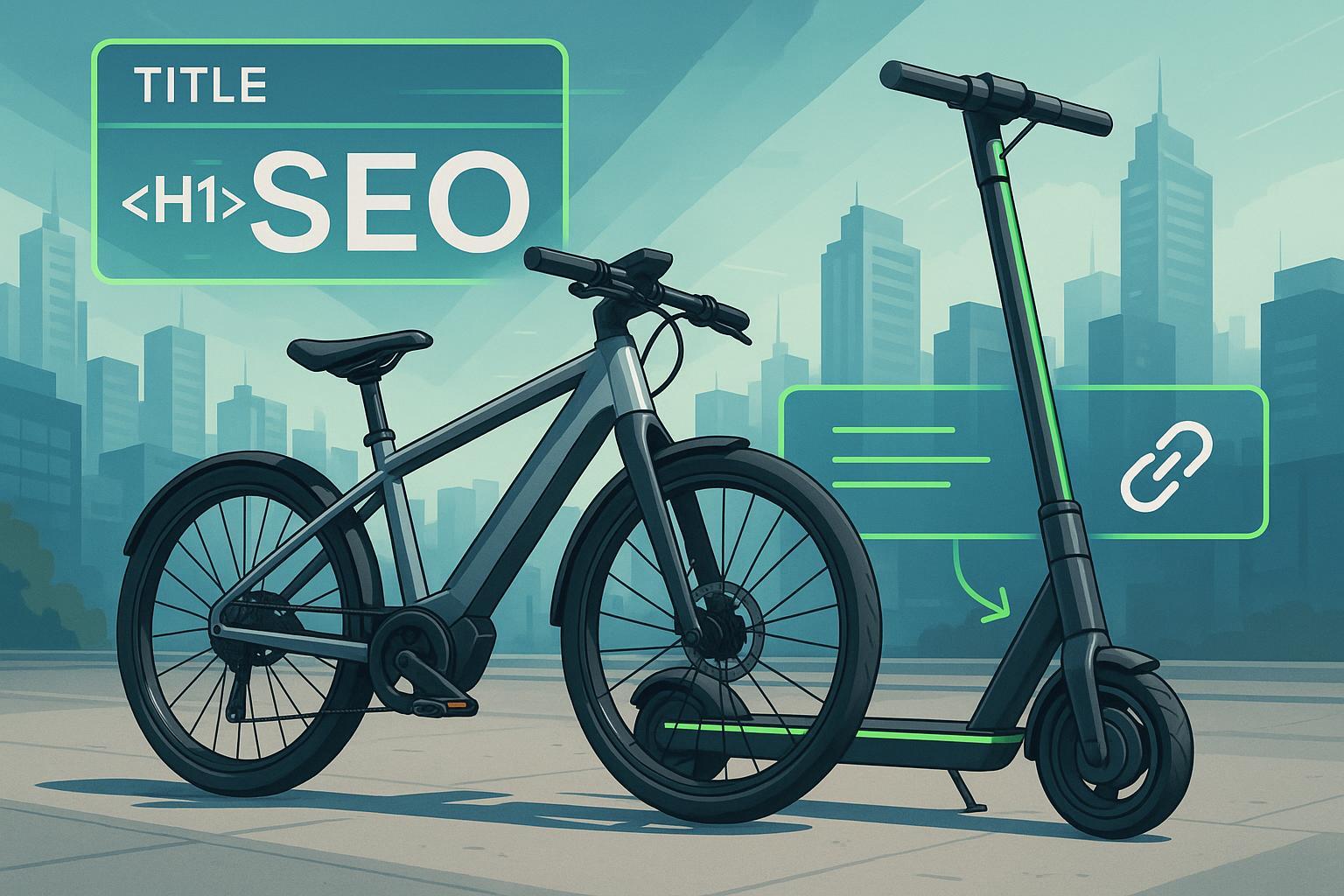
Why On-Page SEO for Micromobility Product & Category Pages Demands 2025-Proof Tactics
Micromobility—e-bikes, e-scooters, and related two-wheeler products—has exploded in both consumer searches and competition. Standard e-commerce SEO advice doesn’t cut it in this sector: user intent, technical specs, local and mobile-first discovery, and voice/AI search all shape how Google and buyers value your pages. This guide consolidates what really works in 2025, focused on the three foundational levers—title tags, H1s, and internal linking—with tactical depth for practitioners optimizing product and category pages.
1. Title Tags: Crafting High-Performance Headlines for Product & Category Pages
What Works in 2025
-
Front-load main keywords. Begin your titles with target terms, not brand modifiers. Example for a product:
Electric Mountain Bike for Adults – Lightweight E-Bike | BrandName
-
Include year and primary spec where relevant. “2025” signals freshness; technical attributes (battery size, range, speed, city or terrain) boost clickthrough and relevance:
Best Folding E-Scooters for City Commute 2025 | BrandName
-
Keep titles <60 characters. Google truncates beyond this; clarity wins over keyword stuffing. Shopify 2025 Ecommerce SEO Checklist
-
Every page: unique title. Never copy/paste template titles across bikes, scooters, or rental category pages. Unique titles raise relevance and authority, a deciding factor for Google in saturated verticals, as outlined by SearchLogistics On-Page SEO.
-
Local & transactional intent: For high-conversion, combine “near me,” “in stock,” or “online rental” with target keywords, especially for geo-specific or time-sensitive offerings.
Category Page Example
Electric Bikes for Adults 2025 | Lightweight, Long Range E-Bikes
Product Page Example
Lightweight Foldable E-Scooter with 25 Mile Range – Urban Commuter
Pro Tip: Use “Best,” “Top,” or “Guide” where appropriate on category/collection pages to capture researching buyers. CTR can materially increase: recent sector benchmarks show up to 10–20% organic traffic lifts within three months of targeted on-page SEO improvements (ShelfTrend Online Marketplace Insights).
2. H1 Tags: Structure for Clarity, Intent & Ranking Power
Key Principles for 2025
-
One H1 per page. No exceptions: clarity for both bots and users.
-
Align H1 to user/search intent, NOT duplicate your title tag. The H1 should be actionable, using the main keyword naturally but hinting at specifics for the page:
- Category:
Shop Premium Electric Bikes for City & Off-Road – 2025 Models - Product:
Lightweight Urban E-Scooter – 25 Mile Range, Fast Charging
- Category:
-
Avoid generic or redundant H1s. Never use “Welcome” or just “Products.” Get specific for micromobility:
- Bad:
Electric Bike - Good:
Electric Bike for Adults – 500W Motor, 2025 Urban Series
- Bad:
-
Use H2/H3 for supporting points: Features, regulatory notes (maximum speed, legal requirements), and specs. Structured subheaders drive scannability for long product pages and help voice/AI search extraction (Google 2025 Ecommerce SEO Documentation).
Common Pitfalls
- Auto-generated H1s from CMS templates lead to duplicate headers and SEO cannibalization—manually review each page.
- Don’t ignore locale or seasonal cues. “Summer 2025” or “NYC Rentals” turn generic listings into target-rich answers for buyers and Google alike.
3. Internal Linking: Building Site Authority & Conversion Funnels for Micromobility
Tactical Framework for 2025
-
Create product/category clusters. Link similar products, upsell accessories, and connect guides or reviews (how to choose a bike, maintenance tips):
- Category page → product page (“See our top-rated folding e-bikes for commuters”)
- Product page → accessory: “Pair with the fast-charging portable battery”
- Product → guide: “Read our 2025 e-scooter safety tips”
-
Anchor text must be descriptive AND natural. Avoid keyword stuffing. Example:
- Good:
Lightweight e-bike for city travel - Bad:
Electric bike lighter best city travel electric bikes 2025
- Good:
-
Audit for broken, orphaned, or duplicate links monthly. Tools like ScreamingFrog, Semrush, and Ahrefs can automate crawl diagnostics (SiegeMedia Internal Linking Structure).
-
Use navigational, contextual, and editorial links:
- Menus and breadcrumbs for easy site travel.
- In-content links for topical relevance and authority building.
- Cross-reference alternative SKUs, rental options, or accessories to combat out-of-stock friction or variant overload.
-
Cluster pillar model: Organize around core topics like "micromobility guides," "e-bike reviews," "local rental zones," and “accessory finder.” Working internal links in these clusters funnel equity and drive conversion across highly saturated categories (6thman Digital Internal Linking Best Practices for 2025).
Real-World Results & Benchmarks
- Optimized internal linking structures in the e-commerce vertical reliably deliver 15–25% conversion rate increases within half a year (HedgesCompany Offroad Parts SEO Case).
4. Sector-Specific On-Page Nuances for 2025: Micromobility Edition
Mobile-First & Voice Search
- Most searches and transactions in this space now originate on mobile. Responsive image sizing, fast loading (CDN, compression, lazy loading), and voice-friendly headers (“What is the best e-scooter for NYC in 2025?”) turn visitors into buyers (Thrive Agency SEO for 2025).
Structured Data & Schema
- Product, Offer, Review, FAQ, Breadcrumb, LocalBusiness, and AggregateOffer schemas yield SERP enhancements and help Google AI surface technical specs—crucial for performance-focused buyers. Use JSON-LD, validate regularly.
- Regulatory nodes, seasonality, and location-based info in schema and H2/H3 tags mean “findable” for AI and voice search. Svitla Structured Data Guide
Handling SKUs, Variants, and Out-of-Stock
- Canonicalize SKUs to focus on main models.
- Cross-link or redirect out-of-stock products to comparable alternatives or parent categories. Always add schema “availability” so Google and users know what’s active (HubTiger Key Trends for Repair Shops).
Faceted Navigation & Filters
- Use canonical tags and “noindex, follow” on duplicate/filter URLs from faceted navigation; prevents crawl waste and index bloat (HigherVisibility Ecommerce Best Practices).
5. Common Mistakes & Diagnostic Checklist
- Duplicate titles or H1s across models—kills ranking opportunity.
- Orphaned pages—no inbound internal links = no crawl or equity.
- Uncontrolled faceted navigation—leaves hundreds of near-duplicate pages.
- Slow load times—especially on mobile hurts ranking and conversion.
- Schema errors or omissions—miss out on rich results and AI/voice indexing.
- Ignoring local optimization—no localBusiness schema or “near me” targeting means missing the bulk of rental and repair intent traffic.
Solution:
- Manual & tool-based audits monthly. Scrutinize page-level uniqueness and link flow, check schema via Google Rich Result Test, monitor site performance via real mobile devices.
- Keep site frameworks flexible and scalable for new lines—don’t hard-code indexable URLs for each variant or ephemeral SKU/season.
6. Actionable Takeaways: Your 2025 Optimization Blueprint
- Titles: Unique, keyword-frontloaded, year/spec/intent specific, <60 chars, no stuffy templates.
- H1s: One per page, rich with product/category specifics; align with actual user intent, usable for voice/mobile/AI.
- Internal Links: Contextual, strategic, tailored clusters; monthly crawl/link audits; address both navigation and cross-sell.
- Schema & Tech: Comprehensive, error-free, regularly validated; support advanced features (availability, reviews, technical specs, location).
- Mobile-first: Fast, visually optimized, voice-ready; real-world speed checks, not just tool scores.
- Diagnostic Routine: Layer human and automated checks—uniqueness, crawl, indexation, schema, internal linking, and conversion tracking. Iterate from results, not gut feeling.
- Balance SEO with UX & conversion: Growth comes from disciplined testing and ongoing trade-off optimization.
Inline Reference List
- Shopify 2025 Ecommerce SEO Checklist
- Google 2025 Ecommerce SEO Documentation
- SearchLogistics On-Page SEO
- SiegeMedia Internal Linking Structure
- 6thman Digital Internal Linking Best Practices for 2025
- ShelfTrend Online Marketplace Insights
- HedgesCompany Offroad Parts SEO Case
- Thrive Agency SEO for 2025
- Svitla Structured Data Guide
- HigherVisibility Ecommerce Best Practices
- HubTiger Key Trends for Repair Shops
Final thought: On-page SEO for micromobility in 2025 is dense, dynamic, and rewards only disciplined, data-driven practitioners. Unique, intentional structure in titles, headings, and internal linking—supported by technical rigor and sector awareness—define sites that win visibility and conversions. Optimize, audit, and adjust tirelessly. That’s how brands in fast-moving markets stay ahead.
