On-Page SEO for Beauty & Personal Care Devices: Titles, H1s & Internal Links

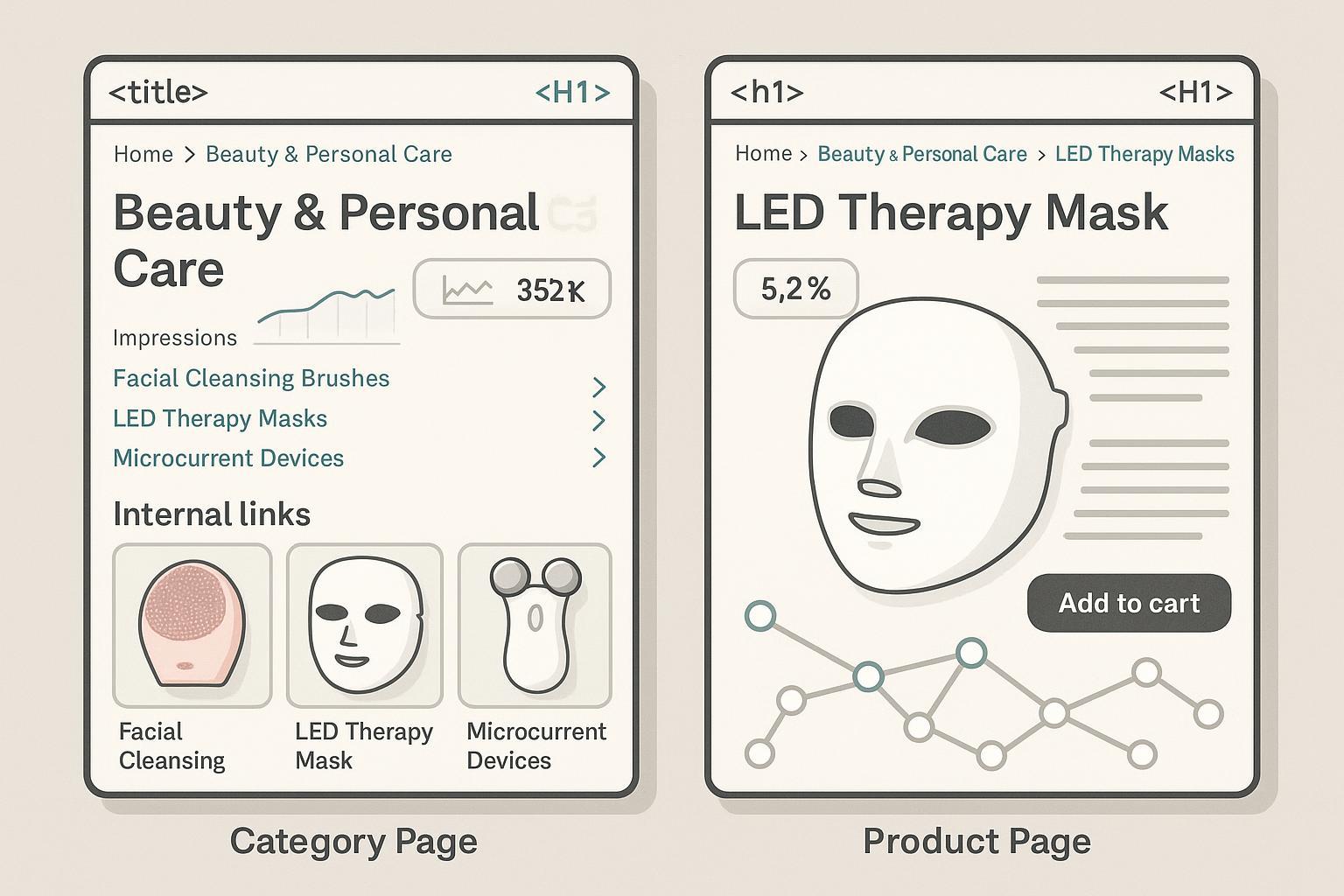
If you sell beauty and personal care devices, your product and category pages fight in one of the most competitive SERPs. What’s worked best for me across LED masks, microcurrent tools, IPL, and sonic cleansers is a ruthless focus on three levers you control on every page: the title tag, the H1, and your internal links. Everything else supports those three.
Below is a field-tested blueprint tuned for 2025 realities (AI Overviews, INP, visual-first shopping) and anchored in canonical guidance. I’ll show exactly how to structure titles and H1s for differentiation and clicks, how to wire internal links so PageRank flows to revenue SKUs, and how to avoid duplicate traps common in large beauty catalogs.
1) Page Titles That Win Clicks and Queries
Principles I keep returning to:
- Map one primary intent per page; avoid keyword stuffing. Google clarifies that titles should be descriptive and concise, not filled with unnecessary keywords, in its own documentation on page titles (Google, 2024).
- Write for the query + the click. Titles are not just ranking hints; they’re your ad copy.
- Make each page’s title unique; avoid near-duplicates across variants, per Google’s advice on duplicate content and canonicalization (Google, 2024).
Character width, not characters. I try to keep titles in the ~580–600px range to reduce truncation on desktop. Practically, that’s often 55–65 characters, but measure in pixels with your SERP preview tool.
Beauty device–specific title patterns you can lift:
- Product (core SKU): Brand + Device Type + Primary Benefit + Key Spec
- Example: “NuDerma Microcurrent Facial Toner – Lift, Firm & Sculpt (2 Intensity Modes)”
- Product (variant): Add variant determinant early (color, size, skin type) if it’s a search driver; otherwise, keep it at the end. Canonicalize to canonical SKU page if variants are thin (details in Section 4).
- Example: “DermaGlow LED Face Mask – Red/Blue Light (2025 Model)”
- Category (by concern): Concern + Device Type + Range/USP
- Example: “Acne LED Light Therapy Devices – FDA-Cleared Options”
- Category (by technology): Technology + Use Case + Range
- Example: “Microcurrent Facial Toning Devices – At-Home Lifting Tools”
- Category (brand collections): Brand + Devices + Key Benefit
- Example: “Foreo Facial Devices – Sonic Cleansing & Toning”
CTR boosters that don’t cross the line:
- Specific benefits (lift in 2 weeks, clinically tested) only if you can substantiate—beauty devices flirt with medical claims. Keep copy compliant; when in doubt, soften to “designed to” or “helps.”
- Numbers and differentiators: “FDA-cleared,” “2-year warranty,” “90-day returns,” “free tips included.”
- Avoid dynamic price-in-title unless stable; Google can rewrite titles and warns against misleading tricks in title link guidance (Google, 2024).
2) H1s that Align Relevance and Conversion
H1s set topical focus for users and assist structure. Google doesn’t require only one H1, but clear heading hierarchy is recommended per best practices for headings (Google, 2024). I still aim for a single clear H1.
How I differentiate H1 from Title:
- Title = broader query coverage and CTR device. H1 = on-page relevance and conversion language.
- Keep H1 natural, not stuffed. Include the primary intent phrase once.
H1 templates:
- Product: “Brand Device Name – Primary Outcome for [Skin/Concern]”
- Example: “DermaGlow LED Mask – Clearer Skin with Red/Blue Light”
- Category (concern): “LED Light Therapy for Acne” or “Microcurrent Devices for Lifting & Firming”
- Category (technology): “IPL Hair Removal Devices for At‑Home Use”
Support the H1 with H2 blocks for proof:
- “Clinically Referenced Benefits” (link to studies if applicable)
- “Who It’s For / Who Should Avoid It” (compliance-friendly)
- “How to Use” (summarized; full guide linked)
3) Internal Links: The Revenue Architecture
Internal links are how you declare what matters and help search engines discover and prioritize content. Google’s documentation explains that internal linking helps Google understand site structure and distribute ranking signals in guide to site structure and links (Google, 2024).
What works repeatedly in beauty device catalogs:
- Category → Product: Above-the-fold “Top Picks” grid linking to bestsellers with descriptive anchors like “LED Mask for Acne – Model X.” Avoid generic “View.”
- Product → Category: Persistent breadcrumb with markup, plus “Shop the Range” module. Use descriptive anchors. Implement Breadcrumb structured data as per Breadcrumb markup (Google, 2024).
- Lateral Product ↔ Product: “Compare with” links to siblings (same technology, different price/feature set). Helps reduce pogo-sticking.
- Category ↔ Guide/FAQ: Each category should link to: Buying Guide, How-To/Aftercare, Safety/Contraindications, and Troubleshooting. Guides link back to the top category and to named product SKUs with exact, natural anchors.
- Review/UGC hubs → Product: Curate “Results & Reviews” hubs with internal links to SKUs. Mark up reviews per Product structured data (Google, 2025).
Anchor text rules:
- Be specific and truthful: “Microcurrent device for jawline lift” beats “click here.”
- Mix exact and partial match; avoid repetitive anchors sitewide.
- Navigation links are not enough—add in-body contextual links where it helps users.
Pagination and facets:
- Use a clean canonical for the base category. For paginated series, avoid rel=prev/next (deprecated), and ensure each page is indexable if it adds unique value; see Google’s pagination guidance and duplicate URL consolidation (Google, updated 2024).
- For faceted navigation (color, price, concern), control crawl with parameter rules, noindex, or canonicalization depending on SEO value; reference Google’s URL parameters and canonicalization (Google, 2024).
4) Duplicate Content, Variants, and Canonicals
Beauty devices often have multiple variants (color, bundle, region plugs) with near-identical content. To consolidate signals:
- Designate a canonical URL for the primary SKU and point variants to it when differences are minor. Google explains how to consolidate duplicate URLs with canonicals (Google, 2024).
- If variants target distinct queries (e.g., “sensitive skin head” vs “normal”), consider standalone indexable pages with unique content blocks and user intent.
- Use consistent hreflang for international versions; see hreflang guidelines (Google, 2024).
- Avoid thin “color pages.” If you must index, add unique photography, FAQs, usage notes, and variant-specific reviews.
Programmatic uniqueness that actually helps users:
- Dynamic comparison tables (Model A vs Model B)
- “Who it’s for / not for” blocks per variant
- Contraindications and safety notes (important for devices)
5) Supporting On-Page Elements That Move the Needle
Structured data:
- Product: Price, availability, review count/ratings; follow Google Product structured data (Google, 2025). Ensure that markup reflects visible content to comply with Google’s guidelines.
- FAQ / HowTo: Add only if content is genuinely helpful on the page; see FAQ structured data and HowTo structured data (Google, 2024). Note that FAQ rich results eligibility may be limited for some sites as per Google’s 2023–2024 updates.
- VideoObject: For demonstrations; align with Video structured data (Google, 2024) and include key moments if applicable.
- Breadcrumb: Implement per Breadcrumb structured data (Google, 2024).
Images and media:
- Use descriptive alt text that describes the image function, not keywords. WCAG and Google both emphasize accessible, descriptive alt; see W3C’s alt text decision tree (W3C, accessed 2025) and Google’s image SEO best practices (2024).
- Provide high-res product images, usage angles, and before/after where compliant. Compress and lazy-load; ensure dimensions are predeclared.
Technical UX:
- Core Web Vitals: Interaction to Next Paint (INP) became a Core Web Vital in March 2024; target good thresholds per Google Chrome Web Vitals documentation (Google/Chrome, 2024). Image-heavy beauty catalogs often struggle with INP due to heavy JS; prioritize input delay fixes (defer non-critical JS, reduce third-party scripts, use server components/SSR where possible).
- Mobile: Mobile-first indexing is complete; assume Google primarily uses the mobile version for indexing. See Google’s mobile-first indexing guidance (Google, 2023, still applicable in 2025).
Compliance and claims:
- Be careful with medical or clinical language. If referencing clinical results, cite the specific device study on your page and avoid overpromising.
6) Out-of-Stock and Discontinued Products
You’ll face routine stock gaps with beauty devices. Best practice:
- Temporary OOS: Keep page indexable; show restock date or “email me” capture. Cross-link substitutes in a “Similar Devices” module.
- Discontinued: 301 to the nearest substitute if intent is the same; otherwise, keep page with a clear discontinued notice and links to successors. Google’s e-commerce guidance suggests preserving user intent and links rather than hard 404s; see practical advice in Shopify’s 2025 SEO checklist on product lifecycle (Shopify, 2025).
7) Beauty Device–Specific Copy Elements That Reduce Returns and Boost Conversion
What consistently helps both rankings and conversions:
- Clear contraindications and who should not use the device
- Expected timeline to results and how results are maintained
- “How to use” in 3–5 steps with time commitment
- Care/cleaning instructions
- Warranty, replacement parts availability
- Side effects and what to expect in the first week
These sections create unique, expert content that de-duplicates pages and earns internal links from help content.
8) Internal Linking Build-Out: A Step-by-Step Playbook
Week 1: Architecture and hubs
- Define concern hubs (Acne, Aging, Hyperpigmentation), technology hubs (LED, Microcurrent, IPL), and brand hubs. Each hub is a category or guide with a clean canonical.
- Ensure breadcrumbs reflect hierarchy and are marked up per Breadcrumb structured data (Google, 2024).
Week 2: Category modules
- On each category, add four modules: “Editor’s Picks,” “Compare Models,” “Who It’s For/Not For,” and “FAQ.” Link each model name to respective product pages; in FAQ, link to deeper guides.
Week 3: Product cross-linking
- Add “Compare with” to two lateral SKUs and “Shop the Range” back to category. Include a “How to Use” H2 with a link to a full How-To guide that links back.
Week 4: Blog and support integration
- Publish one buyer guide per hub; link to top SKUs and categories with descriptive anchors. On guides, add a sticky “Compare Top Devices” box linking to 3–5 SKUs.
Week 5: QA and crawl budget
- Use Search Console’s Coverage and Links reports to find orphans and low-internal-link pages. Strengthen internal linking where needed; Google details internal links’ importance within site structure guidance (Google, 2024).
9) Measurement and Iteration
- CTR and title tests: Track Search Console CTR by query. If impressions rise but CTR lags, test benefit-driven vs feature-driven titles. Google may rewrite, but you can still learn; see title link behavior in Google’s title link documentation (2024).
- INP and LCP: Monitor in CrUX and Search Console’s Core Web Vitals. Aim for <200ms INP and <2.5s LCP on mobile per Web Vitals guidance (2024).
- Internal link flow: Use a crawler (Screaming Frog, Sitebulb) to verify link depth to top SKUs is ≤3 clicks from the homepage.
- Duplicate signals: Validate canonicals, hreflang, and structured data with Rich Results Test and URL Inspection.
10) Common Pitfalls I Still See (Avoid These)
- Category pages with H1 identical to the title and no supporting copy—thin and undifferentiated
- Product variants spun into separate pages with only a color change—no unique value
- Over-reliance on faceted URLs being indexable, creating cannibalization
- Internal links hidden in carousels or JS that require interaction to render—hurts discovery and INP
- Aggressive medical claims without citations—risking manual actions and trust loss
Quick Checklists
Product page
- Title: Brand + Device + Primary Benefit + Key Spec/Proof
- H1: Natural, user-centric, matches intent
- Internal: Breadcrumbs, Compare, Shop the Range, How-To link
- Schema: Product (+ Review), Breadcrumb, VideoObject (if video)
- Media: Descriptive alt, compressed images, lazy-load
- Compliance: Contraindications, realistic claims, warranty info
Category page
- Title: Concern/Tech + Device Type + USP
- H1: Clear intent; support with copy blocks
- Internal: Top Picks, Compare, Who It’s For/Not For, FAQ; links to guides and back
- Facets: Canonical to base; control crawl on low-value parameter sets
Bottom line: In crowded beauty device SERPs, titles and H1s earn the click, and internal links earn the right to rank. Get those three right, then layer schema, performance, and compliant copy so users find, trust, and buy.
