Building E‑E‑A‑T for Two‑Wheeler & Micromobility Brands in 2025: Certifications, Specs & Compliance Pages That Win Trust

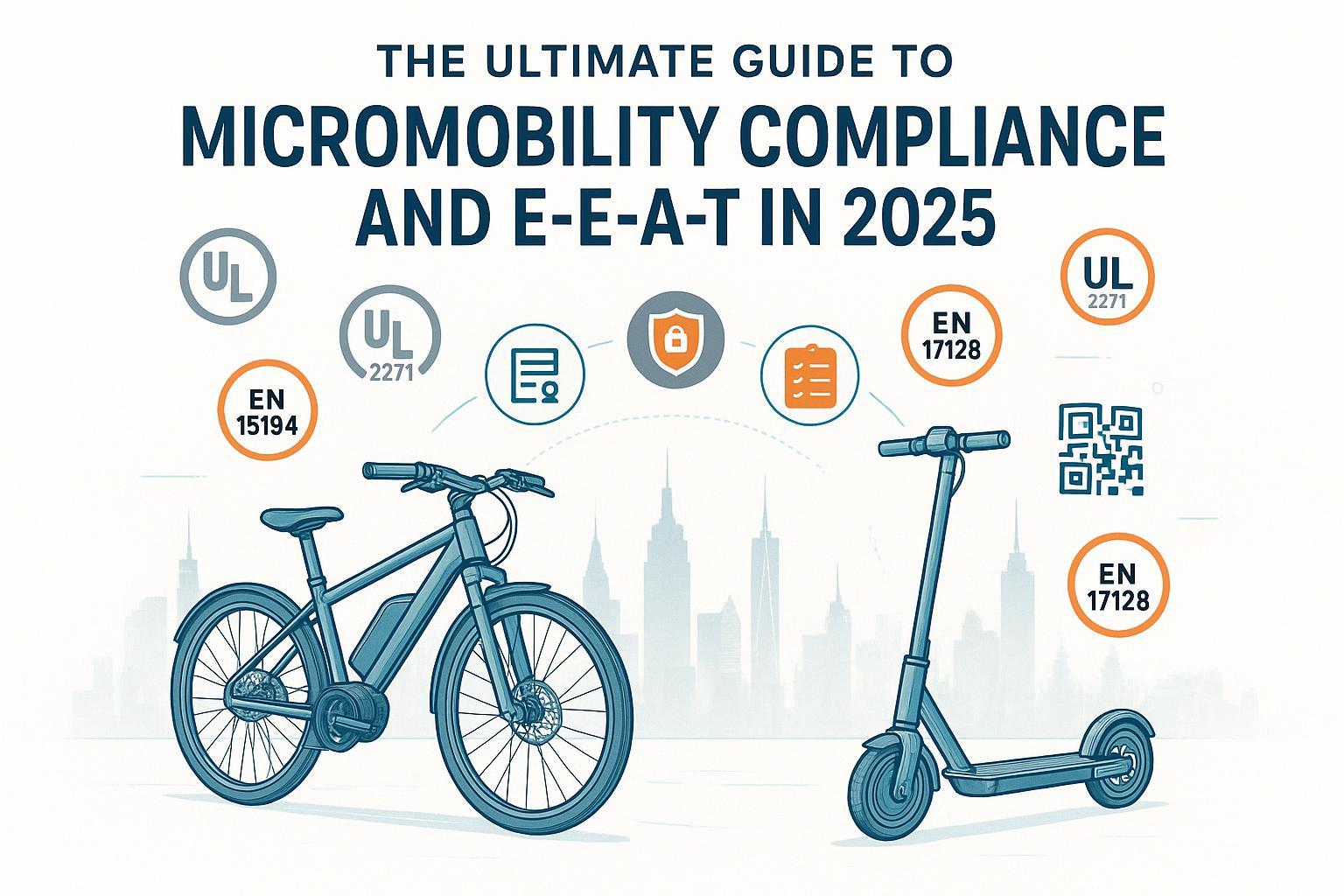
If you build or sell e‑bikes and e‑scooters, your website isn’t just a storefront—it’s your compliance dossier, your retailer pass, and your public safety statement. In categories that can literally catch fire when done wrong, E‑E‑A‑T (Experience, Expertise, Authoritativeness, and Trust) isn’t a buzzword; it’s your market access.
This guide is a practical playbook for founders, compliance/quality managers, SEO and ecommerce leads, and fleet buyers. We’ll map the certifications that matter in 2025 (UL 2849/2271/2272, EN 15194/17128, EU Battery Regulation 2023/1542, Machinery Regulation 2023/1230, EMC/RED/RoHS, UN 38.3, NYC Local Law 39) directly to on‑site modules, downloadable docs, schema markup, and governance. You’ll leave with copy‑and‑paste templates and checklists you can implement this week.
—
1) Why E‑E‑A‑T is make‑or‑break for micromobility in 2025
- NYC has ramped up enforcement. Local Law 39 of 2023 prohibits sale or distribution of powered mobility devices, batteries, and chargers in NYC without accredited certification—think UL 2849 for e‑bike systems, UL 2271 for batteries, and UL 2272 for e‑scooters. In October 2024, Local Laws 49 and 50 expanded padlock and closure powers for repeat violators, with rules effective Oct 12, 2024, tightening the screws on noncompliant sellers (see the official NYC law text in Local Law 39 of 2023 and the enforcement rules in the NYC Rules implementation of LL49/LL50 (2024)).
- Federal posture remains in flux, but the direction is clear. In 2025 the U.S. CPSC briefly advanced an NPR to make UL‑based standards mandatory for micromobility batteries, then withdrew it months later. Even with no final federal rule, aligning with UL 2849/2271/2272 is the pragmatic baseline to minimize recall risk and meet retailer expectations (see the CPSC Chair’s April 2025 statement on the NPR in the CPSC Commissioner Hoehn‑Saric statement (2025) and context on withdrawal via Keller and Heckman analysis (2025)).
- In the EU, the regulatory bar is rising. EN 15194:2017+A1:2023 for EPACs is harmonized, giving presumption of conformity for e‑bikes when applied; the Machinery Regulation (EU) 2023/1230 is rolling in; and the Battery Regulation (EU) 2023/1542 introduces due diligence, labeling, and a digital Battery Passport for LMT batteries, with key milestones from 2025–2028 and 2027 for the passport (see the OJEU citation in Commission Implementing Decision (EU) 2024/1329 and the regulation text in EU Battery Regulation 2023/1542).
What this means for your site: You need to demonstrate experience (real testing and field data), expertise (standards literacy), authoritativeness (linkable, verifiable certificates), and trust (transparent manuals, recalls, and maintenance). The rest of this guide shows exactly how.
—
2) Which certifications apply? A 2025 map by product and region
Think of certifications as layers: system, battery, charger, mechanical, EMC/RED, and transport. Here’s the straight talk.
2.1 E‑bikes (U.S.)
- System: UL 2849 (electrical systems for e‑bikes). UL Listing verified via UL Product iQ. Concise overview in UL’s micromobility certification page (UL Solutions overview, 2025). Link verifications through UL Product iQ database.
- Battery: UL 2271 (LEV battery packs). Abuse tests to prevent thermal runaway; list the battery pack model and file number.
- Charger: UL 1310 (Class 2) or UL 1012 (power units), model‑specific.
- Mechanical: ISO 4210 series for frames, forks, wheels, braking—reference in spec tables (see an overview in ANSI’s ISO 4210 brief (2023)).
- CPSC baseline: Bicycle safety requirements (16 CFR Part 1512) apply to bicycles; e‑bike applicability varies based on configuration, but referencing 1512 features (reflectors, braking) on your spec page reduces ambiguity.
2.2 E‑bikes (EU/UK)
- Core: EN 15194:2017+A1:2023 (EPACs: 250 W continuous, 25 km/h). Harmonized under EU law, conferring presumption of conformity when applied (see the 2024 OJEU citation in Decision (EU) 2024/1329).
- Battery safety reference: EN 50604‑1:2016+A1:2021 often cited within EN 15194 for rechargeable battery systems.
- CE legislation to declare: Machinery Regulation 2023/1230 (timing considered), EMC 2014/30/EU, RED 2014/53/EU if radios, RoHS 2011/65/EU. Use EU Blue Guide‑aligned DoC content structure (see the Commission’s Blue Guide 2022 principles in the EU Blue Guide (2022) excerpt).
2.3 E‑scooters and PLEVs (U.S.)
- System: UL 2272 (electrical systems for personal e‑mobility devices, commonly used for e‑scooters). See a scope summary in Intertek’s UL 2272 explainer.
- Battery: Often covered within system evaluation; separate UL 2271 for packs may be applicable depending on architecture and retailer requirements.
- Charger: UL 1310/1012; list model and certification.
2.4 E‑scooters and PLEVs (EU/UK)
- Technical reference: EN 17128 covers PLEVs up to 25 km/h, but as of 2025 it is not harmonized EU‑wide. You still must meet Machinery 2023/1230, EMC, RED (if radios), and RoHS. Some member states reference EN 17128 in national market or traffic rules (see context via the ETSC e‑scooter safety brief (2024) and Micromobility for Europe technical note). Be explicit about the legal basis on your CE DoC and clarify EN 17128 as a technical norm, not a harmonized standard.
2.5 Cross‑cutting: Transport and battery
- UN 38.3 test summary is mandatory in the supply chain for lithium batteries; host the summary for each battery model on your Compliance Hub. The 2025 IATA guidance reconfirms air transport obligations, while PHMSA consolidates U.S. domestic rules (see the IATA Lithium Battery Guidance Document 2025 and the PHMSA Lithium Battery Guide (Oct 2024)).
- EU Battery Regulation (EU) 2023/1542 classifies LMT batteries and sets timelines for due diligence (from Aug 18, 2025), the Battery Passport (from Feb 18, 2027), and recycled content disclosures (from Aug 18, 2028). Prepare your on‑site battery section and QR strategy now (see the EU Battery Regulation 2023/1542).
—
3) Trust‑by‑design product pages: the blueprint
When I audit micromobility product pages, I look for five trust pillars: certifications, battery specifics, safety usability, documentation, and provenance. Build your page modules to make these unavoidable.
3.1 Required fields and modules (annotated)
-
Hero trust strip (above the fold)
- Certification badges with file numbers: “UL 2849 (System) — UL File E123456. Verify on UL Product iQ.” Link to the UL Product iQ database and, if permissible, to your exact listing result.
- For e‑scooters: “UL 2272 Certified — UL File E654321.”
- Battery call‑out: “Battery pack certified to UL 2271; UN 38.3 test summary available.” Link to your Compliance Hub asset.
-
Specs table (core fields)
- Electrical system standard: UL 2849 / UL 2272 / EN 15194 / EN 17128 (as applicable)
- Battery: chemistry, capacity (Wh), nominal voltage, removable/replaceable (EU: note Art. 11(5) of EU 2023/1542 timeline), pack model ID, UL 2271 status, UN 38.3 summary link
- Charger: model and UL 1310/1012 status; connector type; charge time
- Motor: nominal power and peak; assistance class (e‑bikes: Class 1/2/3 for US); cutoff speeds
- Mechanical: brake type (two independent), frame/fork materials, tire size; ISO 4210 compliance note
- IP rating: e.g., IPX4 for splashes; be honest—do not inflate ratings
- Load/fit: max rider weight and cargo rating; dimensions and folded size (scooters)
- Radios: Bluetooth/GPS presence; RED compliance statement (EU)
-
Safety & compliance accordion
- CE/UKCA declarations (EU/UK): downloadable DoC PDFs, stating Machinery, EMC, RED (if radios), and RoHS with applied standards (EN 15194 or EN 17128 as technical ref)
- UL certificates: links or instructions to verify on UL Product iQ with file numbers
- UN 38.3 test summary and SDS: direct links
- NYC compliance note (if selling in NYC): “Certified to standards required by NYC Local Law 39.” Link to certificate proof and retain records for 3 years per DCWP (DCWP inspection checklist, 2024)
-
Manuals & maintenance
- User manual PDF (latest version), maintenance intervals, charging/storage instructions reflecting FDNY/DCWP guidance; changelog with dates
-
Provenance & verification
- Lab names (UL, TÜV, Intertek) and scope, certificate validity dates; QR on packaging that lands on this product’s Compliance Hub panel
3.2 Sample copy you can paste
-
Certification statement (U.S. e‑bike): “This e‑bike’s electrical system is certified to UL 2849 (UL File E123456). The removable battery pack is certified to UL 2271. The included charger is UL 1310 Class 2. You can verify our listings in UL Product iQ by searching for our company name and file number.”
-
Certification statement (EU EPAC): “This EPAC complies with EN 15194:2017+A1:2023 and the requirements of the Machinery Regulation (EU) 2023/1230, EMC Directive 2014/30/EU, and, where applicable, the Radio Equipment Directive 2014/53/EU and RoHS 2011/65/EU. See our CE Declaration of Conformity for the full list of applied standards.”
-
NYC store banner: “NYC Customers: We sell only certified powered mobility devices, batteries, and chargers compliant with NYC Local Law 39 of 2023. Proof of certification is available; we keep records for inspection.”
-
Battery safety note: “Charge only with the supplied UL‑certified charger on a non‑flammable surface. Do not charge unattended or overnight. Inspect the battery for damage or unusual heat. See our UN 38.3 test summary and SDS for technical details.”
3.3 What not to do (hard‑won lessons)
- Don’t publish a generic “UL compliant” badge without the exact standard and file number. Retailers and inspectors verify.
- Don’t claim EN 17128 “CE harmonized” status—it isn’t harmonized EU‑wide as of 2025.
- Don’t bury manuals and DoCs. If a buyer can’t find them in 2 clicks, you invite returns and support load.
- Don’t use old battery manuals after a pack revision. Tie manuals to product SKUs and firmware versions with a visible changelog.
—
4) Your Compliance Hub: the single source of truth
Create a dedicated Compliance Hub linked from every product page. Treat it like your online technical file index—public‑facing parts only.
4.1 Information architecture (IA)
- Product selector (e‑bike models, e‑scooter models)
- For each model: tabs or sections for Certificates, Declarations, Manuals, Battery & Transport, Change Log, Retailer Pack
4.2 Document checklist (public pack)
-
Certificates
- UL 2849 / UL 2272 certificates (or Product iQ verification instructions) with file numbers and scope
- UL 2271 battery listing evidence
-
Declarations
- EU CE Declaration of Conformity (Machine/EMC/RED/RoHS) following EU Blue Guide content principles (see the Commission’s 2022 Blue Guide overview in the EU Blue Guide reference)
- UKCA Declaration if relevant
-
Battery & Transport
- UN 38.3 Test Summary (per battery model) and SDS
- Shipping guides (IATA 2025 quick reference; PHMSA 2024 U.S. domestic) with links to authoritative docs (IATA 2025 guidance; PHMSA guide 2024)
-
Manuals & Safety
- Current user manual; quick‑start safety sheet; warranty terms; maintenance schedule
-
Change Log
- Version history: certificates renewed, firmware updates affecting safety, manual revisions, battery pack revisions, dates and responsible reviewers
-
Retailer/Fleet Pack
- One‑zip download of above items plus spec sheet, sales compliance statement, NYC compliance note, and contact for technical questions
4.3 Minimal CE Declaration template (inline)
Paste into your CE DoC (adapt fields as appropriate):
- Manufacturer: [Legal name, address]
- Product: [Model, type, serial range]
- Statement: We declare under our sole responsibility that the product listed above conforms with the following Union legislation: Machinery Regulation (EU) 2023/1230; EMC Directive 2014/30/EU; Radio Equipment Directive 2014/53/EU (if applicable); RoHS Directive 2011/65/EU.
- Applied standards: EN 15194:2017+A1:2023 (for EPAC), EN 50604‑1:2016+A1:2021, EN 301 489‑1/‑17 (if RED), EN 62368‑1 (if applicable modules), and other harmonized standards as listed in the technical documentation.
- Notified Body: [Name, number] (if applicable under RED)
- Place/Date/Signature: [City, YYYY‑MM‑DD], [Name, Title]
For structure guidance, align with the EU Blue Guide 2022 description of DoC contents (reference above).
—
5) Batteries, shipping, and the EU Battery Regulation: what to show and where
If there’s one area to over‑communicate, it’s batteries. Here’s a tight framework.
5.1 On each product page
- Battery specs block: chemistry (e.g., NMC, LFP), capacity (Wh), voltage (V), removable/replaceable status, cycle life expectations.
- Safety standards: UL 2271 status and certificate/file number; EN 50604‑1 reference (EU), UN 38.3 test summary link.
- Charging: charger model, UL 1310/1012 status; max charging current; ambient temperature range.
- Care & storage: concise bullets plus link to full safety manual.
5.2 On the Compliance Hub
- UN 38.3 Test Summary (PDF) for each battery. The UN Manual of Tests and Criteria Rev. 8 (2023) spells out T.1–T.8 test matrix and summary content requirements (see UNECE Rev. 8, Section 38.3).
- SDS (Safety Data Sheet) for each battery/cell chemistry.
- EU Battery Regulation positioning: a short explainer stating LMT classification and timelines—due diligence from Aug 18, 2025; Battery Passport from Feb 18, 2027; recycled content disclosures from Aug 18, 2028—with a link to the regulation text (EU 2023/1542).
- QR code plan: A landing page per battery model where the QR on the pack will point to the Battery Passport (when live) and current documents.
—
6) Structured data and E‑E‑A‑T signals Google won’t miss
You can be right and still be invisible. Schema makes your trust signals machine‑readable.
6.1 Product page schema
- Product: include name, model, brand, GTIN/SKU, dimensions, weight, energy content (as additionalProperty), max speed, class (as additionalProperty), IP rating, braking type.
- Offer: availability, price, condition.
- Review/Rating: if applicable and compliant.
- Claim substantiation: If you state “Certified to UL 2849,” mirror it in an additionalProperty like { name: "Certification", value: "UL 2849 — UL File E123456" }.
- SameAs: link to your UL Product iQ company page if available, and to Notified Body certificate pages.
6.2 TechArticle/HowTo for Compliance Hub entries
- Use TechArticle or HowTo schema for manuals and safety guides, with author and reviewer properties.
- Organization schema: include contactPoint for product safety, recalls, and compliance inquiries.
6.3 Author/reviewer attribution pattern
- Byline: “Reviewed by [Name], Compliance Manager (ex‑UL/TÜV), last updated 2025‑08‑27.”
- Credentials and affiliations in an author bio page; link via sameAs to LinkedIn and professional organizations.
—
7) Governance: keep it true, current, and audit‑ready
Trust erodes when pages fall out of sync with certificates. Build a lightweight governance model.
-
Roles
- Compliance Manager: owns certificates, CE/UKCA DoCs, NYC documentation, and battery transport docs.
- Product Manager: owns spec changes and supplier inputs; triggers re‑testing when required.
- SEO/Ecommerce Lead: owns on‑site placement, schema, and UX.
- Legal/QA: final review for claims and labels.
-
Cadence
- Quarterly compliance review meeting; monthly content diff for product pages and Compliance Hub.
- Triggers: new firmware affecting thermal management, battery pack revision, supplier change for cells/BMS, standard updates (e.g., EN 15194 A1 transitions).
-
Versioning
- Use semantic versioning for manuals (e.g., v1.3.2) and tie to SKU/firmware.
- Maintain a change log on each product’s Compliance Hub page.
-
Certificate verification
- Verify UL listings quarterly via UL Product iQ. Keep screenshots/file numbers in your internal technical file and public pointers on the site.
-
NYC documentation
- Follow the DCWP inspection checklist: keep proof of certification on file for 3 years; ensure chargers are certified; avoid refurbished batteries without proper certification (see the DCWP checklist PDF).
—
8) Checklists by persona (print‑friendly)
8.1 Founder / VP Product
- Decide target markets (US, NYC, EU/UK) and map mandatory vs. retailer‑expected certifications.
- Select test labs (UL/TÜV/Intertek) and plan for UL 2849/2271/2272 and EN 15194/EMC/RED/RoHS.
- Lock a compliance budget and timeline before DV/EVT; don’t retrofit at DVT.
- Require suppliers to deliver battery SDS, UN 38.3 test reports/summaries, and cell provenance.
- Approve the Compliance Hub IA and product page trust modules early.
8.2 Compliance/Quality Manager
- Build technical files: certificates, DoCs, test reports, risk assessments.
- For EU: draft CE DoCs aligning to the Blue Guide; verify harmonized standards status (EN 15194 yes; EN 17128 not harmonized as of 2025).
- For NYC: ensure UL certification evidence is current; maintain 3‑year records; train retail staff on proof of certification.
- Publish UN 38.3 summaries and SDS per battery model; confirm IATA/PHMSA shipping instructions.
- Run quarterly certificate verification on UL Product iQ; update file numbers on site as needed.
8.3 SEO/Ecommerce Lead
- Implement the product page blueprint: badges, spec fields, safety accordion, manuals, provenance.
- Add schema for Product, Organization, and TechArticle/HowTo; mirror certification claims in additionalProperty.
- Set up author/reviewer bios and last‑updated stamps.
- Link product pages to Compliance Hub and vice versa; add QR on packaging to the live model page.
- Track “compliance content” KPIs: doc downloads, time on compliance tabs, CTR on verification links; use insights to refine.
8.4 Fleet Buyers / Procurement
- Require a digital compliance pack: UL certificates/verification instructions, CE DoC, UN 38.3 summary, SDS, maintenance/warranty policy, and NYC compliance note (if relevant).
- Confirm charger certification and compatibility; request spare parts lists and battery replacement procedure.
- Ask for recall process and incident response contact points.
—
9) Common pitfalls and how to fix them
- Pitfall: Claiming “UL compliant” without a listing. Fix: Publish the exact standard and UL file number; link to Product iQ.
- Pitfall: One generic DoC for the whole brand. Fix: Issue model‑specific DoCs listing the precise applied standards and firmware ranges.
- Pitfall: Missing UN 38.3 docs for replacement batteries. Fix: Host summaries per battery model and tie to SKU; add to retailer pack.
- Pitfall: EU pages that cite EN 17128 as harmonized. Fix: Rephrase to “meets the requirements of Machinery 2023/1230, EMC, RED, RoHS; EN 17128 used as a technical reference.”
- Pitfall: Out‑of‑date manuals after a rev change. Fix: Version manuals and publish a change log; sync on packaging QR.
—
10) FAQ quick hits
- Do I need a Notified Body for EPACs? Typically no, if you fully apply harmonized standards like EN 15194. Use a Notified Body under RED only if radio modules require it. See presumption of conformity via Decision (EU) 2024/1329 and DoC content via the EU Blue Guide 2022.
- Are UL 2849 and UL 2271 both needed for e‑bikes? Yes: 2849 is system‑level; 2271 covers the battery pack. List both on site and provide verification paths (see UL Product iQ).
- Is EN 17128 mandatory in the EU? It’s a CEN standard used widely as a reference, but not harmonized EU‑wide as of 2025. You must comply with Machinery 2023/1230, EMC, RED, RoHS regardless; cite EN 17128 as a technical reference and follow national requirements (see ETSC 2024 brief).
- What’s the UN 38.3 “Test Summary” I keep hearing about? A standardized summary of test results required in the lithium battery supply chain; shippers and inspectors will ask for it. Requirements are defined in the UN Manual of Tests and Criteria Rev. 8 (2023) (see UNECE Rev. 8).
—
11) Implementation timeline you can run this quarter
- Week 1: Inventory certificates and create a private technical file index; extract file numbers, model IDs, lab names, expiry dates.
- Week 2: Build the Compliance Hub IA and upload PDFs (UL certificates/verification, CE DoCs, UN 38.3 summaries, SDS, manuals). Draft NYC banner copy.
- Week 3: Update product pages with the trust‑by‑design modules; add schema and author/reviewer patterns.
- Week 4: Launch the retailer/fleet pack; add QR codes to packaging and labels pointing to the model’s Compliance Hub panel. Train support on verification flows.
Ship it, then keep it fresh with a monthly micro‑review and a quarterly deep dive.
—
12) Source notes and further reading
- NYC certification mandate and enforcement powers: Local Law 39 of 2023 (NYC); NYC Rules implementing LL49/LL50 (Oct 2024); DCWP inspection checklist PDF (2024)
- UL standards and verification: UL Product iQ database; Intertek UL 2272 explainer
- EU framework: EN 15194 harmonization via Decision (EU) 2024/1329; EU Blue Guide principles (2022); Machinery Regulation (EU) 2023/1230
- Battery and transport: EU Battery Regulation 2023/1542; UNECE UN 38.3 Rev. 8 (2023); IATA Lithium Battery Guidance 2025; PHMSA Lithium Battery Guide (Oct 2024)
—
Author and editorial note: Reviewed by a compliance manager with experience coordinating UL and CE programs for micromobility brands. Last updated: 2025‑08‑27.
