7 Local SEO Audit Tools to Transform Client Results

You help local businesses get found in search. Proving your local SEO impact is a challenge for many businesses. A superior local SEO strategy begins with a better audit. Strategic tool selection powers this audit. The right local seo audit tools let you perform a deep audit. This detailed audit helps you transform client results. These local seo tools show businesses their visibility in search. The right tools and a smart audit will help businesses win in local search. These tools make your local SEO strategy clear for all businesses. A strong audit helps businesses in search.
The Top 7 Local SEO Audit Tools

Choosing the right local SEO audit tools is the first step toward a winning strategy. Your agency needs a mix of specialized instruments to diagnose every facet of a client's online presence. This section breaks down the top 7 tools. You can use them to build a comprehensive audit process that delivers transformative results for businesses.
1. AgencyAnalytics: Top Agency Local SEO Tools
AgencyAnalytics serves as your central command center. It pulls data from over 80 other marketing platforms into one unified dashboard. This makes it one of the best seo tools for agencies managing multiple clients. Its primary strength is simplifying complex data into clean, white-label reports.
Key Audit Features: The platform's Google Business Profile integration is a core feature for your initial audit. You can track crucial metrics to establish a performance baseline.
- Direct vs. discovery searches
- Impressions in search and maps
- Website clicks and direction requests
- Phone call clicks
- Average rating and total reviews
This integration allows you to combine Google Business Profile data with insights from Google Analytics, Google Search Console, and call tracking tools. You get a complete picture of how local search visibility drives real-world actions. The built-in rank tracker and site audit tools further expand your audit capabilities.
Ideal Use Case: You should use AgencyAnalytics when you need to consolidate reporting and prove ROI without juggling multiple logins. It is perfect for creating automated, branded reports that keep clients informed. This tool helps you manage data from multiple Google Business Profile locations in a single dashboard, making it ideal for businesses with several branches.
Pro Tip: Start your client relationship with a comprehensive audit report generated from AgencyAnalytics. This report will showcase all initial performance metrics. It sets a clear benchmark for measuring your future success.
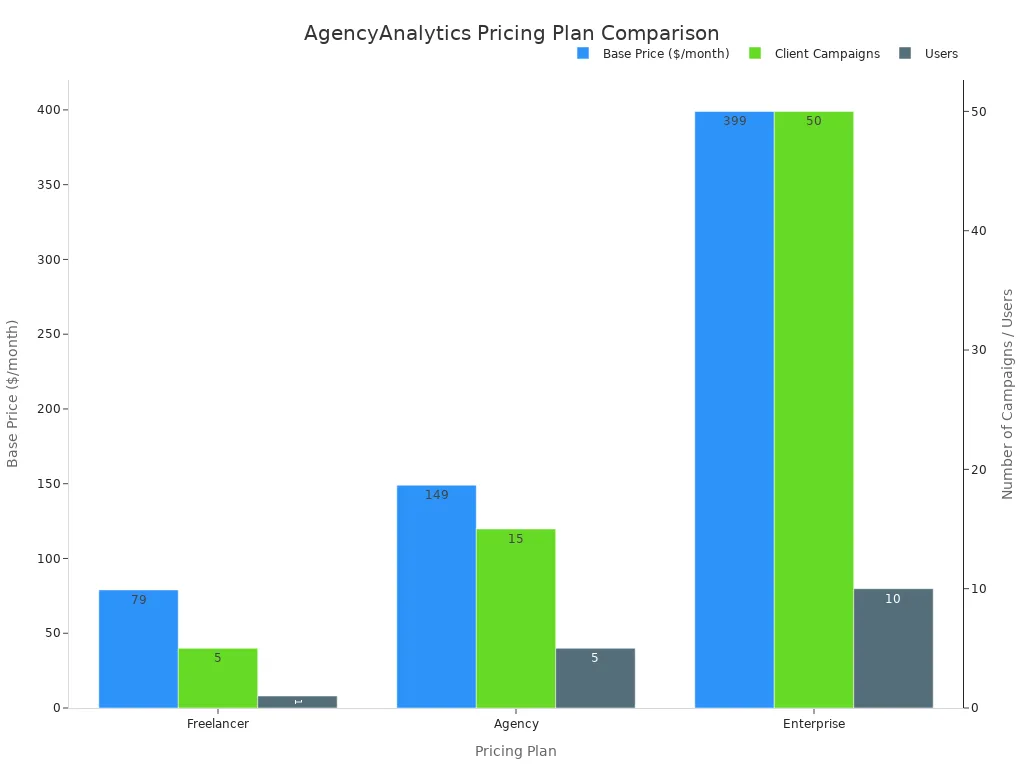
The platform offers several plans tailored to agency size.
| Plan | Base Price | Client Campaigns | Users | Notable Limits |
|---|---|---|---|---|
| Freelancer | $79/month | 5 | 1 | Limited to 5 client campaigns. Best for individual consultants or small agencies with a few clients. |
| Agency | $149/month | 15 | 5 | Includes 15 client campaigns and 5 users. Suitable for growing agencies with a moderate client base. |
| Enterprise | $399/month | 50 | 10 | Offers 50 client campaigns and 10 users. Designed for larger agencies with extensive client portfolios and teams. |
| Custom | Contact Sales | Varies | Varies | For agencies with unique needs, requiring more than 50 client campaigns or custom features. Pricing is tailored. |
2. BrightLocal: Local Data & Citation Platform
BrightLocal is a powerful specialist among local SEO tools. It excels at citation and reputation management. An audit with BrightLocal gives you a granular view of a client's listings and reviews across the web. This focus is essential for building trust and consistency, two pillars of strong local SEO.
Key Audit Features: BrightLocal offers several dedicated audit reports. The Local Search Audit provides a high-level overview of rankings, reviews, on-page SEO, and local pack results. For a deeper analysis, the Google Business Profile Audit and Citation Tracker are invaluable. These tools help you:
- Audit and track citation consistency.
- Uncover incorrect or missing listings.
- Monitor online reviews from various sources.
- Analyze Google Business Profile performance.
The platform's strength lies in turning this audit data into actionable campaigns. You can build and fix citations, manage reviews, and even schedule Google Business Profile posts directly within the tool.
Ideal Use Case: You should use BrightLocal when your audit reveals significant issues with citation consistency or a poor online reputation. It is the go-to tool for businesses needing to clean up their online data, build a stronger citation profile, and proactively manage their reviews. Its detailed audit functions make it one of the best seo tools for identifying foundational local SEO problems.
3. Moz Local: Business Profile Optimization
Moz Local streamlines the complex task of managing online business listings. Its core strength is automated data distribution. You enter a client's information once. Moz Local pushes it across a network of search engines, directories, and data aggregators. This ensures accuracy and consistency with minimal manual effort.
Key Audit Features: The Moz Local dashboard is a clean, centralized workspace for your audit. It simplifies Google Business Profile optimization by pulling everything into one place. From this dashboard, you can:
- Monitor Listing Health: An audit with this tool quickly identifies incomplete profiles and required actions.
- Manage Reviews: You can view star ratings, reply rates, and sentiment analysis for all reviews. This helps you understand customer feedback.
- Ensure Data Consistency: The tool continuously syncs data, flagging any changes or discrepancies that could harm local search visibility.
This automated approach to an audit reduces human error and frees up your team for more strategic work. The platform also offers AI-powered suggestions for responding to reviews, further improving efficiency.
Ideal Use Case: You should choose Moz Local for businesses that need active, ongoing location data management. It is one of the best seo tools for multi-location businesses struggling with data consistency. If your initial audit shows widespread listing inaccuracies, Moz Local provides an efficient solution to correct and maintain that data over time, which is crucial for appearing in local pack results.
4. Whitespark: Citation Audit & Building Specialist
Whitespark is a laser-focused tool renowned for its citation-building capabilities. While other tools offer citation management, Whitespark specializes in finding new opportunities. It helps you perform a deep competitive audit to dominate the local search landscape. It is one of the most effective local SEO tools for citation-focused strategies.
Key Audit Features: The star of Whitespark is the Local Citation Finder. This tool is essential for any in-depth citation audit. It works by:
- Analyzing Competitors: You can input a competitor's information to see exactly where they are listed online.
- Discovering Opportunities: The tool searches websites, directories, and blogs to find citation sources you are missing. You can even search by phone number to discover existing citations.
- Prioritizing Efforts: It ranks opportunities by authority and relevance, helping you focus on the most impactful listings first.
Whitespark's team of human specialists also offers a manual listing service. They audit each listing for Name, Address, and Phone (NAP) consistency, remove duplicates, and build new, high-quality citations. This combination of an automated audit tool and a manual service ensures maximum citation consistency.
Ideal Use Case: You should use Whitespark when a client is in a highly competitive market. If your basic audit shows that citation volume and quality are key differentiators, the Local Citation Finder is non-negotiable. It is one of the best seo tools for agencies looking to build a superior backlink and citation profile for their clients to improve their position in local pack results.
5. Local Falcon: Geo-Grid Ranking Intelligence Tools
Local Falcon provides a unique and powerful way to visualize local search performance. It moves beyond simple rank tracking to show you exactly where a business ranks on a map. This is one of the most insightful ranking intelligence tools for understanding proximity-based ranking.
Key Audit Features: Local Falcon's main feature is its Geo-Grid Scan. This scan creates a heatmap of a client's rankings for a specific keyword across a geographic area. An audit using this tool reveals:
- True Ranking Reach: See where a business ranks #1 and where its visibility drops off.
- Share of Local Voice (SoLV): Measure market share against competitors in the local pack results.
- Proximity-Based Ranking Issues: Identify specific neighborhoods or service areas where optimization is needed.
The reports include key metrics like Average Rank Position (ARP) and provide direct links to the Google Business Profile. This visual audit is incredibly effective for explaining local SEO performance to clients. These ranking intelligence tools are essential for a modern local SEO audit.
Ideal Use Case: You should use Local Falcon to perform a proximity-based ranking audit. It is perfect for businesses that serve a specific geographic area, like plumbers, restaurants, or retail stores. Use its ranking intelligence tools to benchmark performance, monitor competitors, and identify expansion opportunities. The visual nature of the audit makes it one of the best seo tools for client presentations. The ranking intelligence tools help businesses understand their local pack visibility.
6. Screaming Frog: Technical SEO Auditor
Screaming Frog SEO Spider is a desktop-based website crawler. It is one of the most powerful technical audit systems available. For local SEO, it is essential for auditing the on-page elements that search engines use to understand a business's location and services. A technical audit is foundational for all other efforts.
Key Audit Features: You can configure Screaming Frog to perform a detailed local technical audit. It helps you analyze:
- Local Business Schema: Use its structured data extraction to crawl the entire site and audit schema implementation. You can find missing properties, incorrect formatting, or the use of generic
Organizationmarkup instead of specificLocalBusinesstypes. This ensures consistency with your Google Business Profile. - NAP Consistency on-site: While it doesn't check external directories, you can use the custom search feature to crawl your client's website and ensure the Name, Address, and Phone number are consistent on every page.
- Location Page Issues: The tool identifies orphan pages, broken links (404s), and improper redirects that can harm your location pages' ability to rank in local search results.
An audit with Screaming Frog uncovers the deep technical issues that can prevent a website from ranking effectively in local search.
Ideal Use Case: You should use Screaming Frog at the beginning of any local SEO campaign to conduct a thorough technical audit. It is indispensable for multi-location businesses that need to validate schema consistency across hundreds of pages. If a client's site is not performing in local search despite having good citations and reviews, a technical audit with this tool will likely reveal the root cause. It is one of the best seo tools for deep analysis.
7. Google Analytics: Foundational Performance Analysis
Google Analytics is the ultimate source of truth for website performance. While not exclusively a local SEO tool, it is a non-negotiable part of any digital marketing audit. It helps you connect your local SEO efforts to tangible business outcomes, like leads and sales.
Key Audit Features: For a local SEO audit, you must configure conversion tracking in Google Analytics. This allows you to measure the actions that matter most to local businesses. You can set up goals (or 'Conversions' in GA4) to track:
- Click-to-Call: Users clicking a phone number.
- Contact Form Submissions: Leads generated through your website.
- Directions or Map Clicks: Users seeking to visit a physical location.
By setting up these conversions, your audit can move beyond rankings and traffic. You can analyze which traffic sources drive the most valuable actions. This helps you demonstrate the direct ROI of your local SEO strategy and your Google Business Profile optimization efforts.
Ideal Use Case: You must integrate Google Analytics into every audit you perform. It provides the foundational data for measuring success. Use it to establish baseline conversion metrics before starting a campaign. Then, use its reports to show clients how your work on their Google Business Profile and website is generating real leads and customers. It is one of the best seo tools for proving value. These local seo audit tools, when combined, provide a complete view of performance.
A 3-Step Workflow to Transform Client Results
Having the right local SEO audit tools is only half the battle. You need a structured workflow to turn audit data into measurable success. This 3-step process provides a repeatable framework. You can use it to diagnose problems, demonstrate value, and ultimately transform client results. This system helps you manage local SEO performance effectively for all businesses.
Step 1: Establish a Baseline with a Comprehensive Audit
Your first action for any new client is to perform a comprehensive local SEO audit. This initial audit creates the benchmark for all future work. It uncovers high-impact issues and informs your entire local SEO strategy. A thorough audit gives you a clear roadmap. You need the right tools to conduct a deep audit.
A complete baseline audit must cover several key areas. Your audit should provide a full picture of the client's current local search visibility.
- Google Business Profile Analysis: You should examine the client's Google Business Profile. Check for NAP (Name, Address, Phone) consistency, profile completeness, and correct category selection. An audit of photos, services, and Q&A content is also essential.
- Website Check: Your audit must assess the client's website. Look for location-specific pages and content that communicates local relevance. This helps you understand how the site supports local search.
- Local Citations Audit: You need to verify the consistency of business details online. This audit checks directories, review sites, and social platforms. Strong citation consistency is vital for ranking in local pack results.
- Online Reviews Assessment: An audit of online reviews is critical. You should evaluate the quantity, quality, and recency of reviews on Google and other platforms. Your audit should also check response patterns.
- Competitor Analysis: You must examine what top competitors are doing. An audit of their Google Business Profile, website, and citation profile reveals opportunities for your client to get ahead in local search results.
This foundational audit, powered by tools like Screaming Frog and Whitespark, gives you the audit data needed to build a winning plan. It ensures you address foundational problems before moving forward.
Step 2: Track Performance and Visualize Progress
After the initial audit, your focus shifts to tracking progress. Consistent monitoring helps you measure the impact of your work. It also allows you to spot new problems before they affect local search visibility. You need to track the right metrics to show clients how your efforts improve their local SEO performance.
Key metrics provide a clear view of your campaign's success. These indicators connect your actions to real-world results for businesses.
- Local Keyword Rankings: Tracking local intent keywords shows your client's visibility in search. This is a direct measure of your impact on their position in local search results.
- Google Business Profile Metrics: Monitor user engagement with the listing. Track views, discovery methods, and actions like direction requests and calls. These metrics show buying intent and are crucial for local pack results.
- Customer Reviews and Star Ratings: The frequency, average rating, and response time for reviews influence both rankings and conversions. Good reviews are essential for local pack results.
- Local Citation Consistency: Ongoing monitoring ensures NAP consistency across the web. Maintaining this consistency builds trust with search engines and improves local search visibility.
- Website Traffic from Local Search: Use Google Analytics to see how many users visit the site from local search. This directly evaluates your comprehensive local SEO success.
Visualizing this progress is key to client communication. Tools like Local Falcon are perfect for showing proximity-based ranking changes with heatmaps. This makes complex audit data easy to understand. For overall local ranking improvements, you can use other visual aids.
We found that our clients needed a nice visual report that clearly showed the improvements in traffic and keyword rankings each month. AgencyAnalytics offers reports that are simple to understand for clients with zero SEO knowledge. They can still see how our work has helped benefit their website. — Guy Hudson, Founder, Bespoke Marketing Plans
Use line graphs to show long-term trends and bar charts to compare performance. These visuals turn your audit data into a compelling story of success. This helps businesses see the value you provide.
Step 3: Report on ROI and Refine Your Strategy
The final step connects your local SEO performance data to revenue. This is where you prove the value of your services. Effective reporting and strategic refinement separate average agencies from exceptional ones. Your reports should be clear, concise, and focused on business outcomes. You can use different report templates for different needs. A local SEO report, for example, focuses on Google Business Profile performance and lead generation. A technical SEO audit report highlights site health improvements.
Calculating return on investment (ROI) is the ultimate way to demonstrate value. You need to track all costs and measure the revenue generated from your local SEO efforts.
The formula is simple: ROI = [(Revenue - Costs) / Costs] × 100
To use this, you must track your expenses and the value of conversions.
| Expense Category | What It Covers |
|---|---|
| SEO Tools | Software for tracking, monitoring, and analysis. |
| Professional Services | Your agency's fees for strategy and implementation. |
| Content Creation | Costs for writing blog posts and service pages. |
| Citation Management | Services for updating and managing business listings. |
Next, you must track the revenue. Use Google Analytics to track conversions like form fills and calls. This audit data, combined with data from a client's CRM, connects your work directly to their bottom line. This process proves how your work on local pack results generates real income for businesses.
Finally, you must use your audit data to refine your local SEO strategy. If your audit shows low rankings in a key service area, you can adjust your content and citation-building efforts. If proximity-based ranking is strong but conversions are low, you might need to optimize the client's landing pages. Continuous monitoring and refinement based on performance data ensure long-term success and strong local search visibility. This iterative process, driven by a cycle of audit and action, is how you deliver consistent, high-impact results for your clients.
You must move beyond a single-tool dependency. A multi-tool local seo strategy is what separates average agencies from exceptional ones helping businesses in search. You can combine specialized local seo tools for reporting, visualization, and citations. This delivers more precise results for businesses in search.
Start with an audit of your current local seo audit tools. This audit helps businesses in search. A thorough audit of your tools helps businesses in search. Your local seo strategy helps businesses in search. This audit helps businesses in search. An audit helps businesses in search. Your audit helps businesses in search. This audit helps businesses in search.
FAQ
How many tools do I really need for my agency?
You do not need all seven tools. You should first audit your current process. This helps you find your biggest gap. Choose one or two new tools to help businesses. This focused approach helps businesses improve their local search presence. These tools help businesses in search.
Why are online reviews so important for local search?
Online reviews build trust for businesses. Positive reviews signal quality to search engines and customers. Responding to all reviews shows active management. Good reviews help businesses stand out in local search. Managing reviews is vital for all businesses.
What is the most critical factor for local SEO success?
Data consistency is a top priority. Your client's name, address, and phone number must be identical everywhere online. This single factor builds immense trust with search engines. It is foundational for businesses to rank in local search. This helps businesses in search.
How do these tools help businesses that are not ranking in search?
These tools diagnose why businesses are not in search. They find technical errors, citation issues, and poor reviews. The tools provide a clear path to fix these problems. This helps businesses improve their visibility in search.
See Also
Your 14-Step Guide to a Comprehensive SEO Audit Process
Elevate Your Website Rankings with Top SEO Content Tools
Unlocking Business Growth: The Essential Benefits of an SEO Audit
Optimizing Content: A Deep Dive into SEO Writing Tools
Transform Your Website Using Advanced SEO Content Creation Tools
