Local SEO Audit Tools That Deliver Real Client Results

You want local SEO audit tools that actually move the needle for your business. The right tools help you spot what matters most—like your Google Business Profile, local citations, and reviews—so you can boost your local presence fast. Check out these stats:
| Statistic Description | Key Data Point |
|---|---|
| 8 in 10 consumers search for local businesses weekly | 80% |
| Complete Google Business Profile boosts reputation | 2.7x more likely |
| 50% more likely to be considered for purchases | 50% |
When you use proven local SEO audit tools, you see real results: higher rankings, more leads, and more calls. These tools make every audit count.
Why Local SEO Audit Matters

Business Impact
You want your business to stand out in local search results. A local SEO audit gives you the power to see what works and what needs fixing. When you run regular audits, you spot gaps in your local SEO strategy and take action fast. This leads to better local rankings and more local traffic.
Let’s look at how a local SEO audit can change your business:
- A small café in Chicago updated its Google Business Profile, added keywords, and replied to reviews. In six months, local search visibility jumped by 300%. More people walked in, and revenue grew by 40%.
- A plumbing company in New York focused on getting more Google and Yelp reviews and fixed local citations. Website traffic went up by 50% in three months. Customer calls rose by 30%, which helped the business grow.
- A boutique in San Francisco used local SEO strategies like writing blogs about local events and working with local influencers. Over a year, organic traffic increased by 70%, and sales went up by 60%.
These stories show that local SEO audits lead to real results. You get more visibility in local search, more customers, and higher revenue.
Tip: Regular audits help you stay ahead of your competition in local search results.
Key Audit Components
A strong local SEO audit checks every part of your local presence. You want to make sure your business shows up in local search results and attracts the right customers. Here are the main things you should look at during your audit:
- Google Business Profile: Make sure your profile is complete, accurate, and updated. This boosts your visibility in local search results.
- Local Citations: Check that your business name, address, and phone number are the same everywhere online. Consistent local citations help your local SEO performance.
- Reviews and Reputation: Respond to reviews on Google and other sites. Good reviews improve your local rankings and build trust.
- Local Listings: List your business on important local directories. This increases your chances of showing up in local search results.
- Technical SEO: Fix website errors, improve loading speed, and make your site mobile-friendly. These steps help your local search performance.
When you focus on these key parts, your local SEO audit will drive better local search visibility and stronger local SEO performance.
Choosing Local SEO Audit Tools
When you want to get the best results from your local SEO audit, you need the right local SEO audit tools. There are many options out there, but not all tools work the same way. Some focus on technical SEO, while others help you track local rankings or manage reviews. Let’s break down what you should look for and how to pick the best local SEO tools for your business.
Essential Features
You want local SEO audit tools that cover all the bases. The best tools help you crawl your site, check for technical issues, and make sure your Google Business Profile shines. Look for features like:
- Local keyword tracking and custom reports for map and organic rankings.
- SERP screenshots to see how your business appears in local search.
- Integration with Google Analytics for tracking landing page performance.
- Call tracking to measure real customer calls.
- Easy access to metadata, headers, and schema for quick audits.
- Manual SERP checking by simulating different locations.
- Tools for capturing screenshots to document changes and share with clients.
A strong local SEO toolkit should also let you compare your business to competitors, check your site speed, and make sure your site works well on mobile devices. You want an intuitive interface so you can run audits quickly and understand the results.
Evaluating Effectiveness
Not all local SEO audit tools fit every business. You need to think about your budget, the features you need, and how easy the tools are to use. Here’s a quick way to compare your options:
| Criteria | What to Consider |
|---|---|
| Budget | Does the tool fit your budget? Are there free trials or scalable plans? |
| Features | Does it offer keyword research, backlink checks, and competitor analysis? |
| Ease of Use | Is the interface simple? Are there guides or support if you get stuck? |
| Integration | Can you connect it with Google or other marketing tools you already use? |
| Business Needs | Does it help with technical SEO, local visibility, and benchmarking? |
| Free vs Paid | Free tools give you basics. Paid tools offer advanced audits and deeper insights. |
Some of the most effective local SEO audit tools for 2025 include BrightLocal, GMB Everywhere, Greater Leads, Search Atlas, Birdeye, SEOptimer, Localo, Moz Local, and SEMrush. Each tool brings something unique to your local SEO audit process. Try a few, compare their results, and see which ones help you reach your local goals faster.
Best Local SEO Audit Tools

Choosing the right local SEO audit tools can make your job much easier. You want tools that help you see what works, fix what doesn’t, and boost your local search results. Let’s look at the best options for 2025 and see how they fit your needs.
All-in-One Platforms
All-in-one local SEO audit tools give you everything in one place. You don’t have to jump between different apps or export data. These platforms save you time and help you focus on what matters most—getting your business seen in local search results.
Here’s what makes all-in-one platforms stand out:
- You get keyword research, rank tracking, site audits, citation tracking, and review management all in one dashboard.
- These tools track your keyword rankings from specific locations, so you know how you show up in different neighborhoods.
- They check your business info (name, address, phone) across hundreds of directories and spot mistakes fast.
- You can see all your reviews from Google, Yelp, Facebook, and TripAdvisor in one place. This makes it easy to reply and build trust.
- Some tools even show you a map of your local search visibility, so you know where you’re strong and where you need to improve.
Let’s compare some of the most popular all-in-one local SEO audit tools:
| Tool Name | Key Features | Pricing Model / Notes |
|---|---|---|
| BrightLocal | Citation building, listing management, local SEO audits, review management | Free 14-day trial; custom pricing based on usage |
| WhiteSpark | Reputation management, citation discovery, rank tracking, GBP management | Pay per service; $1/month/location for GBP |
| TrackRight | Local rank tracking, competitor analysis, GBP management | 7-day free trial; paid plans start at $25 |
| Google Business Profile (GBP) | Essential for local 3-pack visibility, review collection, Q&A feature | Free to use; critical for local search presence |
BrightLocal stands out for its easy-to-use dashboard and deep local SEO audit features. You can track your rankings, manage your listings, and respond to reviews without leaving the platform. WhiteSpark helps you find new citation opportunities and manage your reputation. TrackRight gives you a clear view of your local rankings and your competitors. Google Business Profile is a must-have for every business. It helps you show up in the local 3-pack and collect reviews. Google Business Profile influences 42% of clicks in Google local searches, so you can’t ignore it.
Tip: All-in-one platforms help you save money by replacing several local SEO tools with one subscription. This is great if you manage many locations or clients.
Free Tools
You don’t always need to spend money to get started with local SEO audit tools. Free tools give you a solid foundation and help you spot basic issues. They work well if you have a small business or want to try out local SEO before investing in paid tools.
Some of the best free local SEO tools include:
- Google Business Profile: Claim and manage your listing, reply to reviews, and post updates. This tool is essential for local search results.
- Google Search Console: Check your website’s performance, fix errors, and see which keywords bring you traffic.
- GMB Everywhere: See how your business appears in Google Maps and local search results. This browser extension helps you audit your Google Business Profile quickly.
- Moz Local (Free Version): Scan your business listings and find out where your info is missing or wrong.
Free tools help you cover the basics. You can check your local listings, see your rankings, and fix simple problems. But free tools often miss advanced features like competitor tracking, deep citation audits, or review management across many platforms.
Note: Free local SEO audit tools are great for quick checks, but you may need paid tools for deeper insights and better local search visibility.
Specialized Tools
Sometimes you need local SEO audit tools that focus on one thing and do it really well. Specialized tools help you dig deep into a single area, like reviews, citations, or technical SEO.
Here are some top specialized local SEO tools:
- Birdeye: This tool helps you collect, manage, and reply to reviews from over 150 sites. You can send review requests and track your reputation in real time.
- SEOptimer: Run fast, simple audits to find technical SEO issues that hurt your local search results. SEOptimer gives you clear action steps.
- Localo: This tool shows you how your business ranks in Google Maps for different keywords and locations. You can see your local search visibility on a map.
- Search Atlas: Get detailed reports on your backlinks, citations, and local rankings. Search Atlas helps you spot gaps in your local SEO strategy.
- Greater Leads: Focus on lead generation and tracking. This tool helps you see which local SEO efforts bring in real customers.
- SEMrush: While SEMrush is known for general SEO, it also offers local SEO tools like listing management, local rank tracking, and competitor analysis.
Specialized tools work best when you want to fix a specific problem or add extra power to your local SEO audit. You can use them with all-in-one platforms or free tools to get a complete picture.
Callout: Mix and match local SEO audit tools to fit your business goals. Start with an all-in-one platform, add free tools for quick checks, and use specialized tools for deep dives.
With the right mix of local SEO audit tools, you can boost your local search results, fix problems fast, and grow your business. Try different tools, see what works for you, and keep your local SEO strategy strong.
Local SEO Audit Process
Ready to boost your local search results? Let’s walk through a local SEO audit step by step. You’ll use the best tools and follow proven methods to improve your local rankings and get more customers.
Google Business Profile
Start your audit with your Google Business Profile. Make sure every detail is correct—business hours, phone number, address, and services. A complete profile helps you show up in local search results and builds trust. Update your profile often to keep up with new features. Tools like BrightLocal and GMB Everywhere make this easy. Respond to reviews quickly. Google says businesses with complete profiles get more engagement and better local search performance.
Tip: Set up email alerts so you never miss a new review or question on your profile.
NAP Consistency
Next, check your NAP (Name, Address, Phone) across all local citations and directories. Search engines trust businesses with consistent info everywhere. If your details don’t match, your local search results can drop. Use Moz Local or SEMrush to scan for errors. Fix any mistakes right away. Consistent NAP helps you appear in the Google Maps Pack and keeps customers from getting confused.
Reviews & Reputation
Review management is a huge part of your local SEO audit. User reviews help you rank higher in local search results. Look at the number, quality, and recency of your reviews. Respond to both good and bad feedback. Ask happy customers to leave new reviews. Reviews with photos and keywords about your services or location boost your local optimization. Birdeye and Google Business Profile help you track and reply to reviews fast.
Note: Responding to at least 75% of reviews can increase your local search visibility by 15%.
Citations & Listings
Audit your local citations and listings on sites like Yelp, Facebook, and industry directories. Make sure your business info matches your Google Business Profile. More accurate citations mean better local rankings and more trust from search engines. Tools like Moz Local and BrightLocal help you find and fix problems fast.
Technical SEO
Don’t forget on-page SEO and technical checks. Look at your website’s speed, mobile-friendliness, and local keyword optimization. Use Google Search Console and SEOptimer to spot errors. Add local schema markup and update meta tags with your city or neighborhood. On-page SEO helps search engines understand your business and improves your local search results.
Callout: Run a full local SEO audit every quarter. Regular audits keep your local search performance strong and help you catch issues before they hurt your rankings.
Common Mistakes in Local SEO Audits
When you run a local SEO audit, it’s easy to miss important details. Even the best tools can’t catch everything. Let’s look at the most common mistakes people make during audits and how you can avoid them.
Overlooking Key Factors
Many people skip over the basics in a local SEO audit. You might think your business info is correct everywhere, but small errors can hurt your rankings. Here’s a quick look at which factors get missed the most and why they matter:
| Local SEO Factor | Percentage Impact on Local Rankings | Common Overlooked Issues | Impact of Overlooking Factor |
|---|---|---|---|
| NAP Data (Name, Address, Phone) | 28% | Inconsistent or inaccurate information across platforms | Confuses Google, lowers trustworthiness, decreases rankings |
| Google Business Profile (GBP) | 21% | Incomplete or outdated profile, poor posting strategy | Reduced visibility in Local Pack and Google Maps, missed customer engagement opportunities |
| Local Backlinks | 19% | Lack of high-quality, authoritative local backlinks | Lower credibility and ranking, fewer referral visitors |
| Customer Reviews | 11% | Poor management, ignoring negative feedback | Signals low relevance or quality, damages reputation, lost customer trust |
| Behavioral Signals | 9% | Low click-through rate, high bounce rate, poor engagement | Indicates low user satisfaction, leading to lower rankings and reduced local search visibility |
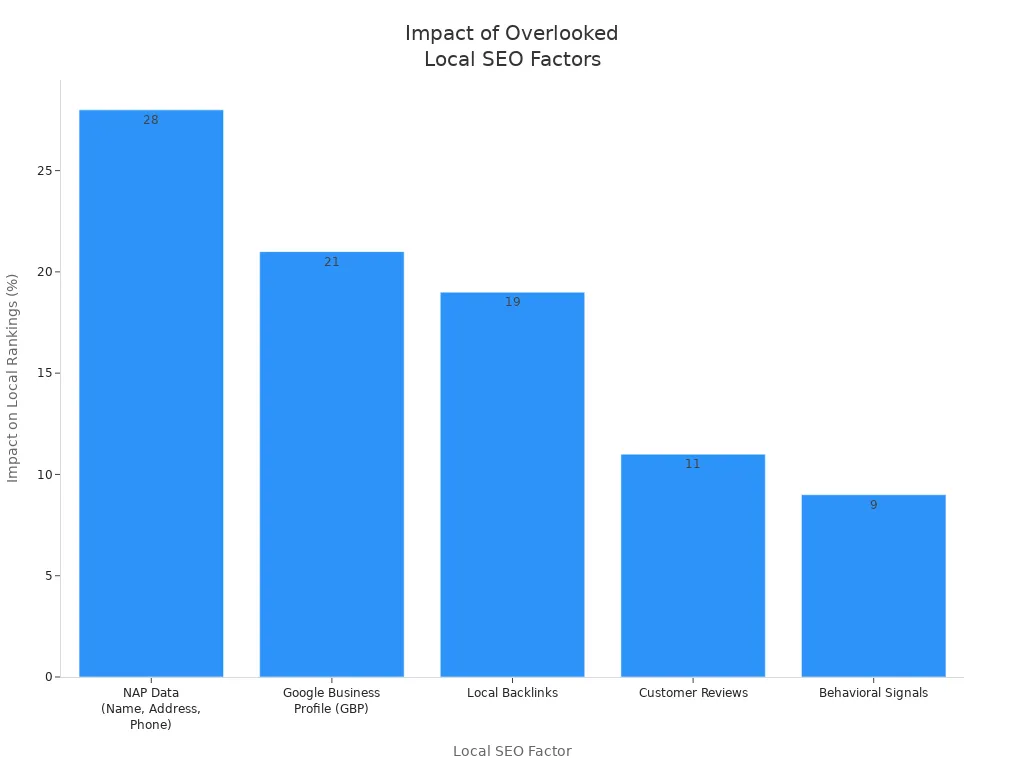
If you skip on-page checks or forget to update your Google Business Profile, your local SEO results can drop fast. Always double-check your NAP data and review management during every audit.
Tool Overreliance
You might love using SEO tools for your audits. They save time and catch many issues. But if you rely only on automation, you miss out on the human touch that makes local SEO work. A case study showed that manual local SEO work increased local traffic by 25% in six months. Here’s what can go wrong if you depend too much on tools:
- Automated tools can lower content quality and originality.
- AI-generated content may lead to duplication or plagiarism.
- Tools often miss user intent and local context.
- Too much automation means less creative strategy.
- The best results come from mixing AI with your own ideas.
Tip: Use tools for on-page checks, but always add your own insights to every audit.
Ignoring Insights
You can run audits all day, but if you ignore what the data tells you, your local SEO won’t improve. Look at your audit results and take action. Fix on-page errors, update your listings, and respond to reviews. When you use both tools and your own judgment, your local SEO gets stronger with every audit.
Maximizing Local SEO Tools
Setting Goals
You want your local SEO audit tools to deliver real results. Start by setting clear goals. Use the SMART method—make your goals Specific, Measurable, Achievable, Relevant, and Time-bound. Check your current local rankings, organic traffic, and conversion rates. This gives you a baseline. Look at what your competitors are doing. Break big goals into smaller steps so you do not feel overwhelmed. Set targets for technical SEO, content, conversions, and brand visibility. Track things like the number of keywords in the top 10, average keyword position, and local traffic. Review your goals often and update them as your business grows or as search engines change.
Audit Scheduling
You need a schedule to keep your local SEO audit tools working for you. The right timing depends on your business size and how often your site changes. Here’s a quick guide:
| Site Type / Complexity | Recommended Audit Frequency | Notes |
|---|---|---|
| Small Local Business Sites | Annual audit + quarterly mini-audits | Yearly deep dive and quarterly checks catch issues early |
| Growing SMBs | Twice a year | More updates mean more audits to keep up |
| Large E-commerce & Publishers | Quarterly audits | Frequent changes need regular reviews |
| News Sites & Competitive Niches | Monthly spot checks + quarterly audits | Fast-moving sites need constant attention |
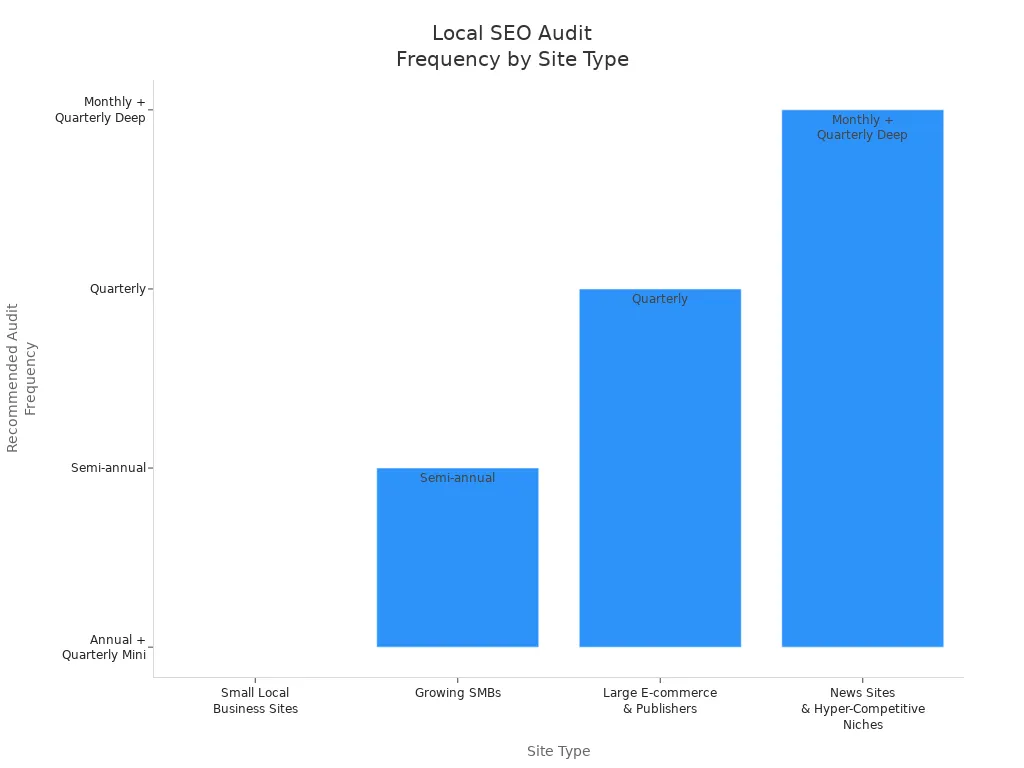
If your site changes a lot or your industry moves fast, run audits more often. This keeps your local SEO performance strong.
Actionable Steps
After you run your local SEO audit, take action right away. Here’s what you can do:
- Claim and update your Google Business Profile for every location.
- Make sure your NAP (Name, Address, Phone) is the same everywhere online.
- Fix any mistakes in your local citations.
- Respond to all customer reviews on Google, Yelp, and Facebook.
- Build local backlinks by working with other local businesses.
- Make your website mobile-friendly and fast.
- Add local schema markup so search engines understand your business.
- Improve technical SEO—check site speed, fix errors, and keep your site secure.
- Review your content for local keywords and keep it fresh.
- Track your progress with local SEO audit tools like Google Analytics and rank trackers.
- Prioritize tasks by impact and effort, and assign clear owners for each job.
When you follow these steps, you boost your local search performance, increase visibility, and drive more local traffic. Local SEO audit tools help you stay on track and measure your success. Businesses that use these strategies see more reviews, higher engagement, and better local rankings. Your local SEO strategy gets stronger with every audit.
Choosing the right local SEO audit tools helps you build trust and stand out in your community. When you run regular audits, you spot problems early and keep your local business strong. Many companies see big gains, like more traffic and higher sales, after using these tools.
Start your local SEO audit today. Use the steps and tools from this guide to boost your local search results and grow your business.
| Business | Results After Local SEO Audit Tools Use |
|---|---|
| Avis Car Rental | First-page rankings for 213 new keywords, more leads |
| Regional Dental | 140% more organic traffic, more appointments |
FAQ
What is the best free local SEO audit tool for beginners?
You can start with Google Business Profile. It is free and easy to use. You can check your business info, reply to reviews, and see how you show up in search results. This tool helps you get the basics right.
How often should you run a local SEO audit?
You should run a local SEO audit at least once every quarter. If your business changes often or you add new locations, check more often. Regular audits help you catch problems early and keep your rankings strong.
Can you use more than one local SEO audit tool?
Yes! You can mix tools to get better results. Try an all-in-one platform for most tasks. Add a free tool for quick checks. Use a specialized tool if you want to dig deeper into reviews or citations.
Do local SEO audit tools work for multi-location businesses?
Absolutely. Many tools let you manage several locations from one dashboard. You can track rankings, update listings, and reply to reviews for each spot. This saves you time and keeps your business info consistent everywhere.
