Can you reach Google’s first page by keyword stuffing in low‑competition scenarios?

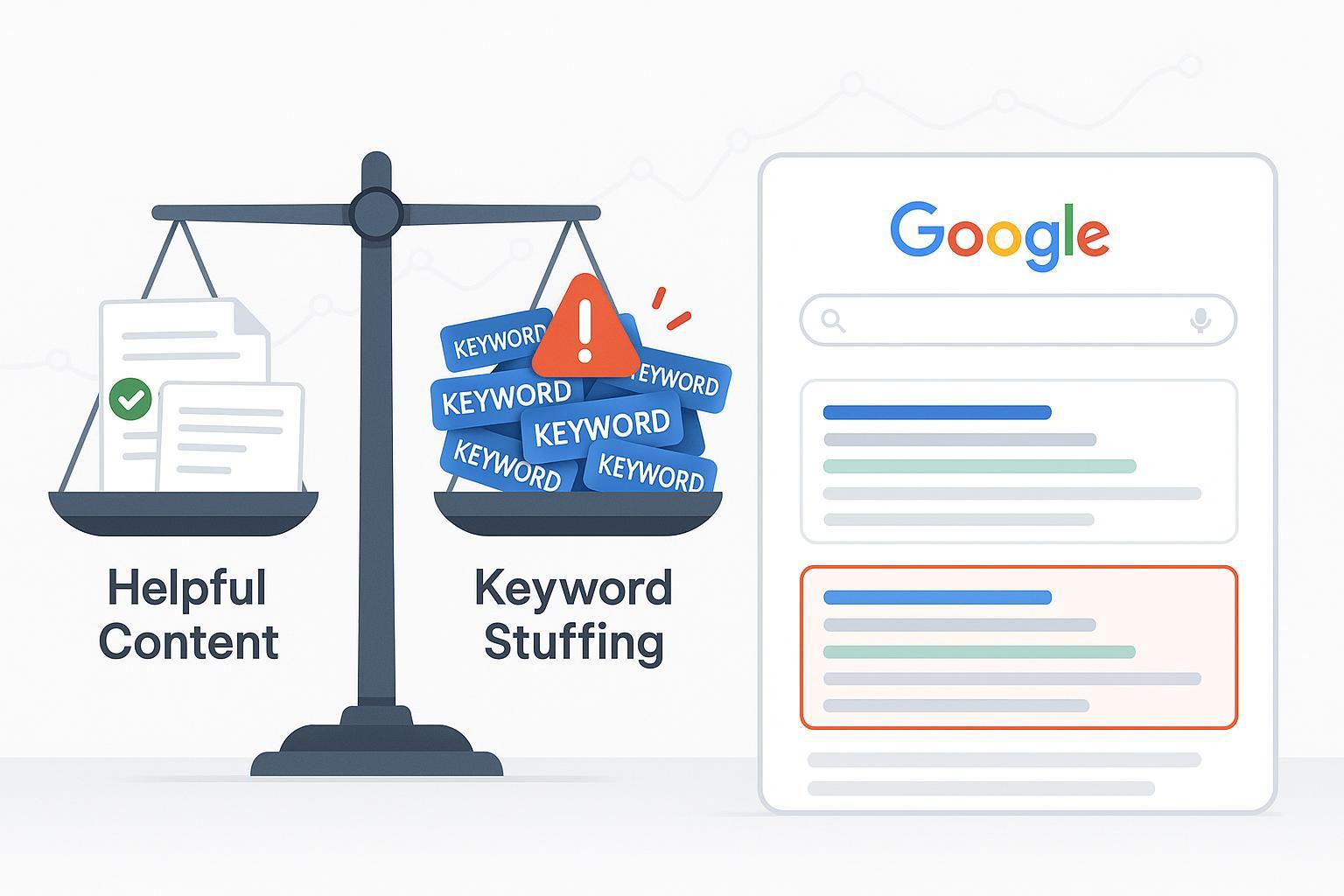
If you’re chasing quick wins in an easy niche, keyword stuffing can look tempting. Based on current policy and what we’ve seen in practice, it’s a losing bet. Google classifies keyword stuffing as spam and applies that standard universally—regardless of how competitive the SERP looks. Pages can be demoted or removed, and recovery is slower than most realize. The reliable path to fast traction in low‑competition spaces is helpful, semantically rich content plus clean on‑page SEO.
Below is a practitioner’s guide: what “stuffing” really is in 2025, how enforcement works, and the step‑by‑step workflow that consistently wins low‑competition SERPs without risking penalties.
What keyword stuffing means today (and why it fails even in easy SERPs)
Google’s policy defines keyword stuffing as filling a page with keywords or numbers to manipulate rankings. Examples include repeating the same phrase unnaturally, listing strings of synonyms, or cramming keywords into alt text and metadata. The enforcement language is clear: violations can lead to demotion or removal from search results, via algorithmic systems or manual actions, with no carve‑outs for “easy niches.” See Google’s policy in the official Spam Policies for Google Web Search (ongoing) and the broader starter guidance in the Google SEO Starter Guide (maintained).
Since 2024, Google has doubled down on removing low‑quality, unoriginal, and manipulative content. In the March 2024 update announcement, Google stated it aimed to reduce low‑quality, unoriginal content in search by 40% and later reported achieving around a 45% reduction after rollout completed in April 2024; see the Google Search update announcement (March 2024) on the Google blog. Subsequent core updates in August and November 2024 reiterated the focus on people‑first content—summarized in Google’s guide to core updates (living document). In short: if a tactic’s goal is to manipulate, expect reduced visibility.
Optimization vs stuffing: the line in practice
In low‑competition SERPs, the temptation is to “turn up the density.” Don’t. Think in terms of clarity and coverage, not repetition. A quick litmus test I use:
- If you removed the exact keyword and the paragraph stops making sense, you’re probably fine; if it still reads like a shopping list of variations, it’s stuffed.
- If your headings, alt text, and internal links look like keyword inventories, you’re not optimizing—you’re signaling spam.
- If you’re repeating the same exact‑match phrase in every paragraph, you’re optimizing for a machine from 2010, not 2025 search.
Patterns to emulate vs avoid
| Area | Optimized (good) | Stuffed (bad) |
|---|---|---|
| H1/Title | “How to repair a bike chain (step‑by‑step for beginners)” | “Bike chain repair fix bike chain how to repair bike chain guide” |
| Intro | Defines the problem, mentions the main term once naturally, sets expectations | Repeats target term 3–5 times in 2–3 sentences |
| Body copy | Uses natural synonyms and related entities (derailleur, master link), answers sub‑questions | Exact‑match phrase in nearly every paragraph; synonym strings |
| Alt text | “Close‑up of a bike chain master link during repair” | “repair bike chain fix bike chain repair bike chain guide” |
| Internal links | Descriptive anchors aligned with context | Exact‑match anchors everywhere |
For policy context and examples, refer to Google’s Spam Policies page on keyword stuffing.
The low‑competition playbook: how to rank fast without stuffing
Low‑competition doesn’t mean low standards. It means fewer strong competitors, so solid fundamentals pay off quickly. Here’s a workflow I’ve used repeatedly.
1) Define a micro‑niche and nail the search intent
- Collect 10–20 very specific long‑tails around one problem set. Manually inspect the top 10 results to confirm intent (informational vs transactional) and content depth.
- Look for gaps: missing how‑to steps, outdated screenshots, or thin answers you can outperform quickly.
2) Build topic clusters that “cover the problem,” not repeat a phrase
- Create one pillar page (1500–2500 words) answering the primary question comprehensively.
- Add 4–6 supporting articles (600–1200 words each) covering distinct sub‑questions. Link them to the pillar and laterally where helpful.
- Avoid duplicative “keyword‑spun” posts; duplication cannibalizes and risks thin content signals.
3) Draft for semantic coverage, not density
- Use plain language and related entities. If the topic is “indoor herb gardening,” include terms like grow light, drainage, potting mix, pruning—by teaching the topic, not listing synonyms. For an overview of semantic approaches, many practitioners refer to resources like Backlinko’s semantic SEO overview.
- Keep the primary term in the title/H1 and mention it as needed for clarity. If you find yourself forcing it, you’re over‑optimizing.
4) On‑page optimization that stays people‑first
- Title/H1: Put the primary topic once; write for readers.
- H2/H3: Reflect sub‑topics and tasks; don’t pack keyword variants just to “cover.”
- Meta description: Promise value; skip keyword lists.
- URL slug: Short and descriptive.
- Alt text: Describe the image as if to a human; no lists.
- Add structured data only where relevant (Article, FAQ). Follow Google’s structured data policies to avoid spammy markup.
5) Internal linking and architecture
- From each supporting article, link back to the pillar using descriptive anchors that match context.
- Add lateral links where users naturally need the next step.
- Keep navigation simple—topical hubs beat deep, orphaned pages.
6) Publish, measure, iterate
- Track impressions, queries, and clicks in Search Console; watch for which sub‑topics attract impressions—expand those sections.
- Reread top pages quarterly and refresh examples, screenshots, and stats. This is aligned with Google’s guidance on “helpful content” maintenance; see the evolving Creating Helpful, Reliable, People‑First Content page.
7) Maintain E‑E‑A‑T signals appropriate to the niche
- Add an author bio explaining your real experience.
- Cite authoritative sources, and keep contact and policy pages visible.
- When using AI assistance, ensure your editing adds originality and accountability. For a deeper primer on balancing AI with originality, see our Comprehensive Guide to AI‑Generated Content (AIGC).
Example: operationalizing safe optimization with an AI editor
One efficient way to keep language natural is to draft with an assistant that highlights repetition and suggests entity coverage. In my workflow, I use QuickCreator to draft pillar pages with real‑time SERP context, then review the SEO audit to remove repetitive phrases and fix alt text and headings. I also use its internal linking hints to connect supporting posts naturally. Disclosure: I’m mentioning a product I use as an example only; this is not a guarantee of results.
If you prefer browser‑side helpers, lightweight extensions can also help you analyze SERPs and keep over‑optimization in check; here’s a practical list of best AI SEO Chrome extensions for 2025.
Measurement signals that tell you you’re on the right track
- Queries broadening around your topic (entity coverage improving) rather than just matching exact phrases
- Rising impressions for related long‑tails after you publish supporting posts
- Stable or improving time‑on‑page and scroll depth; fewer pogo‑sticks back to the SERP
- Headings map cleanly to sub‑tasks; no “keyword walls” in alt text or link anchors
If, instead, you see volatility spikes after heavy keyword edits, revisit your copy for unnatural repetition.
Recovery: what to do if you’ve stuffed or been demoted
You can recover, but it takes disciplined cleanup and patience.
-
Audit for stuffing patterns
- Find exact‑match phrases repeated in close proximity; check alt text, meta tags, and internal link anchors for lists.
- Prioritize landing pages and those with prior traffic.
-
Rewrite for clarity and topical coverage
- Replace repetition with explanations, examples, and synonyms that genuinely teach.
- Consolidate near‑duplicate posts; one strong page beats five thin ones.
-
Fix markup and linking
- Remove spammy structured data and keyword‑list schemas; follow the structured data policies.
- Reduce exact‑match anchors; use descriptive, context‑driven anchors.
-
Document your changes
- Keep a change log with before/after snippets and dates.
-
If you have a manual action
- Review the Manual Actions report in Search Console and follow the reconsideration process described in Google’s support documentation; the core approach is documented in the public guide to Google’s core updates and recovery considerations. Expect weeks for manual actions and multiple months for algorithmic reevaluation.
-
Monitor and iterate
- Watch coverage, indexing, and performance in Search Console. Iterate quarterly until stability returns.
For a practical toolset to inspect content quality and over‑optimization red flags, see this curated roundup of SEO content quality analysis tools. If you’re building from scratch, you might also weigh platform choices from this list of free blog sites for beginners.
Common myths about low‑competition SEO (and what reality looks like)
-
“Google doesn’t police easy niches.”
- Reality: The spam policy is global and evergreen. Keyword stuffing is listed explicitly with potential demotion or removal; see Google’s Spam Policies for Web Search.
-
“A little stuffing gets you indexed faster.”
- Reality: Indexing and ranking are separate. Over‑optimization can suppress visibility, especially after 2024 changes documented in the March 2024 Search update announcement.
-
“Density targets (e.g., 3–5%) are best practice.”
- Reality: There’s no official density metric in 2025. Focus on satisfying intent, semantic coverage, and readability, not percentages. Google’s living Creating Helpful Content guidance emphasizes people‑first writing.
-
“If it’s not competitive, shortcuts are safe.”
- Reality: Low‑competition SERPs still update and are swept by core and spam systems. Sustainable rankings come from clear, useful pages with credible signals, supported by internal links and occasional refreshes.
Quick checklist for publishing in low‑competition SERPs
- One page per primary question; no spun duplicates
- Natural title/H1 with the main topic once
- Headings mirror sub‑tasks and user questions
- Descriptive, human‑readable alt text and anchors
- Supporting articles that cover related sub‑questions
- Internal links to the pillar and between related articles
- Relevant structured data, valid and policy‑compliant
- Quarterly refresh cycle: update facts, examples, and links
Bottom line
No, keyword stuffing is not a shortcut to page one—even in low‑competition scenarios. It’s a universal spam signal with real downside risk. The fastest reliable route remains simple: publish focused, helpful content that cleanly covers the topic; structure it so users (and search engines) understand it; and improve it over time based on actual queries and engagement.
Next steps: If you want a guided way to avoid repetition while covering a topic thoroughly, consider drafting in a tool that surfaces over‑optimization and entity gaps as you write. Used well, that’s often the difference between “thin but repeated” and “complete and readable.”
