Best Practices for Keyword Placement and Keyword Density in Content (2025)

Why 2025 Keyword Usage Is Different
In 2025, keyword strategy is less about repeating phrases and more about covering the topic comprehensively, organizing information clearly, and aligning with AI-driven search experiences. Google’s refreshed guidance emphasizes writing unique titles and helpful snippets, not stuffing terms into pages. Their starter guidance explains how title links are generated from the page’s title element and headings and why concise, accurate wording helps users choose results, as detailed in the Google SEO Starter Guide (2024 refresh). For snippets, Google stresses short, unique meta descriptions and sourcing from page content when appropriate, per the Google meta descriptions documentation (2024–2025).
The practical implication: place keywords where they genuinely help users understand the page, cover related entities and questions, and keep language natural. Treat density as a diagnostic guardrail, not a ranking lever.
The Placement Framework: Exactly Where to Put Keywords (and Why)
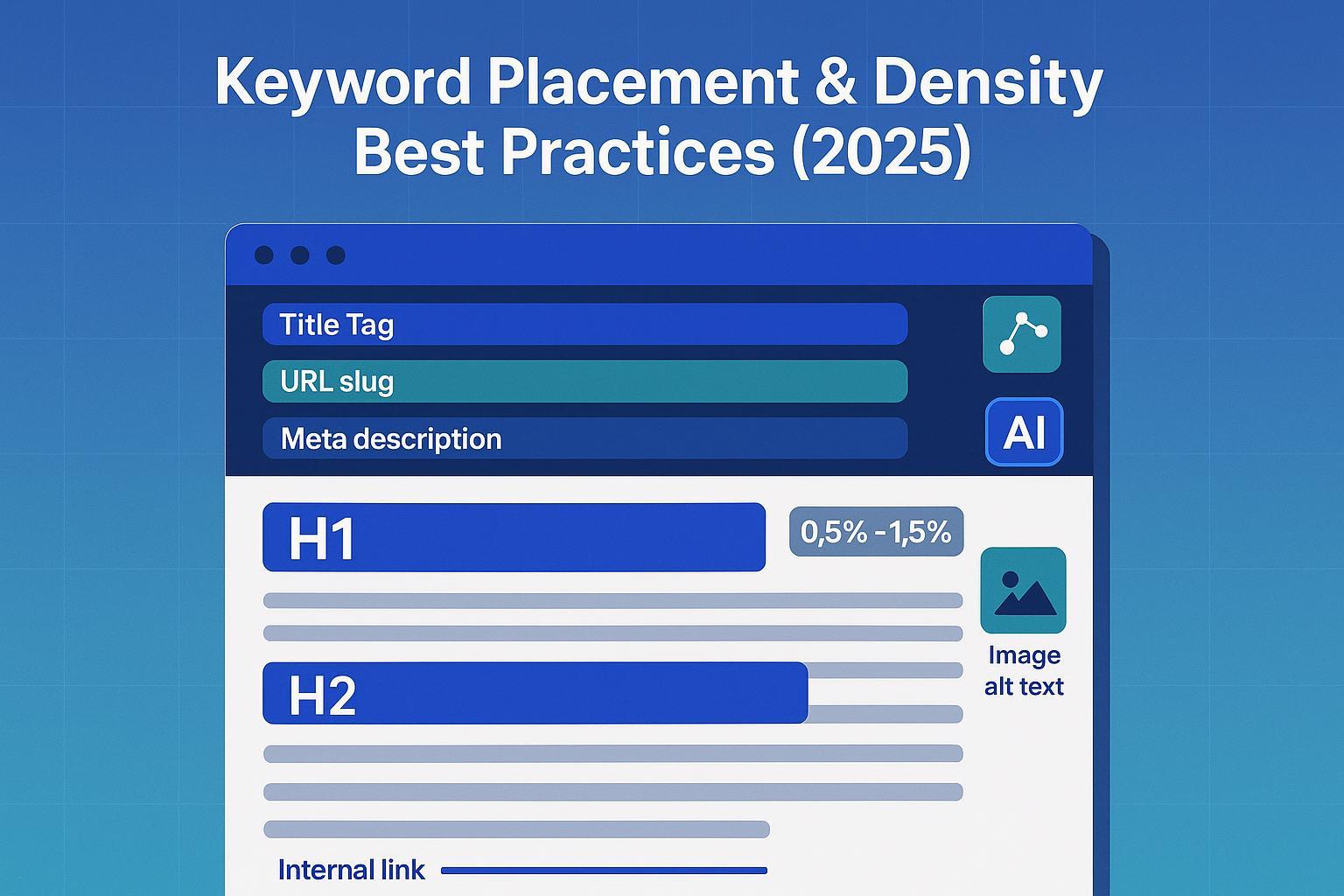
Use this checklist when briefing writers, editing drafts, or auditing existing pages. Each location includes rationale and a concise “do/don’t.”
Title tag
- What to do: Include the primary keyword naturally, ideally near the front, in a unique, clear, and concise title.
- Why: Title links are often generated from the
<title>and headings; clarity improves click decisions. See the Google SEO Starter Guide (2024). - Don’t: Stack multiple keyword variants; avoid redundancy or clickbait that misrepresents the content.
H1 (page headline)
- What to do: Reflect the page’s main topic; close or exact match of the primary term is fine if it reads naturally.
- Why: Reinforces page topic and helps users immediately understand relevance.
- Don’t: Use multiple H1s; keep it singular and strong.
H2/H3 (subheadings)
- What to do: Organize subtopics and include synonyms, related entities, and question-style headings where useful (e.g., “How does X work?”).
- Why: Improves scannability and topical coverage—both matter for user experience and AI-driven summaries.
- Don’t: Force exact-match phrases into every subheading.
First paragraph
- What to do: Provide a plain-language summary of the page’s promise and primary topic, using the core term once if natural.
- Why: Early clarity sets context for users and snippet generation.
- Don’t: Open with keyword lists or self-referential SEO text.
Meta description
- What to do: Write a short, unique description summarizing the most relevant points; let keywords appear naturally.
- Why: Google may display your meta description as the snippet; quality and uniqueness matter, per Google’s meta description best practices (2024–2025).
- Don’t: Stuff multiple variations; avoid duplicating descriptions across pages.
URL slug
- What to do: Use short, descriptive slugs with hyphens; include key terms once (e.g.,
/keyword-placement-best-practices). - Why: Clean slugs aid clarity and shareability.
- Don’t: Repeat the keyword or add filler words.
Internal links and anchor text
- What to do: Link to related pages using descriptive anchor text that reflects the target page’s topic.
- Why: Internal links help users and search engines understand structure; descriptive anchors improve relevance, as shown in industry guidance like Search Engine Land’s internal linking best practices (2024).
- Don’t: Use “click here” or force exact-match anchors repeatedly.
Images and alt text
- What to do: Write concise alt text that conveys an image’s purpose; use empty alt (
alt="") for decorative images. - Why: Accessibility and discoverability improve with meaningful alt text; these recommendations align with W3C WCAG 2.2 (2023) and WebAIM’s Easy Checks (2024).
- Don’t: Stuff keywords into alt text if they don’t describe the image.
Body copy
- What to do: Cover the topic comprehensively, naturally weaving in the primary term and variations where they add clarity. Bold important phrases sparingly for scannability.
- Why: In a 2025 corpus study, topical coverage showed a directional correlation with rankings, and naturally varied terms outperformed exact-match repetition, per the Surfer SEO ranking factors study (2025). Correlation isn’t causation, but coverage and clarity help users.
- Don’t: Repeat the same phrase mechanically; avoid thin content.
FAQs and conclusion
- What to do: Address common questions and reinforce key takeaways using natural language and related entities. Include one or two related terms if it reads well.
- Why: FAQs can help match “People Also Ask” style queries and AI summaries.
- Don’t: Add generic FAQs that don’t serve the reader.
Keyword Density: Guardrails, Not Goals
Google does not endorse a specific percentage; their spam policies define keyword stuffing as repeating terms so often that language sounds unnatural or listing keywords to manipulate rankings, per Google’s Spam Policies on keyword stuffing (2024–2025). Practitioners still use density as a QA check. A realistic guardrail for long-form content is roughly 0.5%–1.5% for the primary term—used as a diagnostic to catch over-optimization, not a target. Google’s John Mueller has repeatedly stated that keyword density is not a ranking factor; this stance is summarized in Semrush’s keyword density overview (2024).
How to calculate density (step-by-step)
Formula: density (%) = occurrences of the target term ÷ total words × 100.
- Single keyword example: A 1,500-word article uses “keyword placement” 12 times. Density = 12 ÷ 1,500 × 100 = 0.8%.
- Multiple keywords: Track primary and a few key variations separately. If “keyword placement” is 0.8% and “keyword density” appears 10 times (10 ÷ 1,500 × 100 = 0.67%), you’re still within natural ranges if the copy reads well.
- Short pages: On a 300-word product page, two uses of the primary term = 0.67%. One or two natural mentions can suffice; don’t force repetition.
Practical tip: If the page reads smoothly but a term appears frequently due to instructional context, prioritize readability. Use synonyms and rephrase sentences to avoid robotic repetition.
Semantic Variations, Entities, and Natural Language (2025)
Semantic alignment is about covering related concepts, synonyms, and entities that users expect within the topic. Build a keyword-to-section map that distributes variations across headings, body paragraphs, and FAQs.
A practical workflow:
- Collect variations: Use your favorite toolstack (e.g., Semrush/Ahrefs for keyword variations; Google Search results and “People Also Ask” for questions; free tools for related terms).
- Cluster by intent: Group navigational, informational, and transactional terms; map clusters to sections.
- Assign to headings: Place one variation or question per H2/H3 where relevant.
- Fill body copy naturally: Use synonyms and related entities to explain concepts clearly.
- Validate coverage: Scan for missing questions/entities; add answers where helpful.
For AI-driven search, completeness, clarity, and indexability are key. Google’s guidance on succeeding in AI Search emphasizes keeping content accessible to Googlebot, ensuring indexability, and focusing on high-quality, helpful content; see Google’s “Succeeding in AI Search” (May 2025). If your topic relies on AI summaries, consider deeper reading on structuring content for generative engines via Generative Engine Optimization.
Mini Case: Fixing Placement and Variation Without Over-Optimizing
A B2B how-to article (~2,000 words) initially used exact-match phrases in multiple H2s and repeated the primary term ~2.2%. We:
- Rewrote the title to be concise and unique.
- Consolidated redundant H2s and added entity-rich subheadings.
- Reduced exact matches, added synonyms and related questions.
- Adjusted alt text to describe images rather than echo keywords.
- Result: The draft read far more naturally; primary term density dropped to ~1.1%. Over the next content refresh, we focused on completeness (missing FAQs and examples). While correlation isn’t causation, pages with better coverage and cleaner structure tend to perform better—consistent with directional patterns reported in the Surfer SEO 2025 study.
Workflow and Tools: From Brief to Publish
A pragmatic stack for teams:
- Free baseline: Google Docs word count + “Find” to count occurrences; a free SERP analysis tool to gather variations; browser extensions for headings/structure checks.
- Pro options: Semrush/Ahrefs for clustering and questions; Surfer for topical coverage checks.
- Editorial QA: A simple spreadsheet for keyword-to-section mapping and density checks.
Example workflow using an AI blogging platform:
- Draft a brief with primary term, 5–8 variations, target questions, and placement checklist.
- Generate/structure the article, then review headings and early paragraphs.
- Run a density check: flag any section with repetitive phrasing; swap in synonyms and rephrase sentences.
- Map internal links with descriptive anchors.
In practice, platforms like QuickCreator can streamline keyword mapping and content review within a block-based editor, with multilingual generation and automatic on-page SEO prompts. Disclosure: QuickCreator is our product. Use any tool that fits your workflow, but keep the process disciplined: brief → structured draft → coverage and clarity checks → density diagnostic → accessibility pass.
SGE/AI Search Optimization Specifics
To increase your chances of being cited or summarized in AI-driven search experiences:
- Ensure crawlability and indexability (HTTP 200 responses, no accidental noindex), and keep content helpful and well-structured, per Google’s AI features and your website documentation (2025).
- Cover entities and subtopics comprehensively; include concise answers and summaries that an AI overview could excerpt.
- Use clear headings and question formats; add a brief FAQ with precise answers.
- Maintain accessibility (alt text, semantic headings) to help both users and machines.
For short-form scenarios like captions or descriptions, keyword clarity and audience-fit matter more than repetition. If you publish reels or shorts, see this practical guide on writing captions and descriptions for short video.
Mistakes to Avoid (and Quick Fixes)
- Keyword stuffing: If a phrase appears in every header or sentence, it’s likely unnatural. Fix by consolidating headings, using synonyms, and rewriting for clarity. Google flags unnatural repetition as manipulative, consistent with Google’s Spam Policies (2024–2025).
- Mismatched intent: Using transactional keywords on a purely informational page confuses users. Fix by recentering the brief on search intent and moving sales terms to product/service pages.
- Over-optimized anchors: Exact-match anchors repeated across many links look spammy. Fix by varying anchor text and linking only where the user benefits.
- Alt text misuse: Alt text should describe the image’s function, not echo page keywords. Fix by rewriting alt to explain the image succinctly, in line with W3C WCAG 2.2.
Reusable Checklists
Keyword Placement Checklist (editorial QA)
- Title: Unique, concise, natural primary term near front
- H1: Reflects main topic; natural phrasing
- H2/H3: Organized subtopics; variations/questions where helpful
- First paragraph: Plain-language summary; one natural mention
- Meta description: Short, unique, relevant points
- URL slug: Short, descriptive, single inclusion
- Internal links: Descriptive anchors to truly related pages
- Images: Informative alt text; decorative images use empty alt
- Body: Comprehensive coverage; natural synonyms; limited bolding
- FAQs/Conclusion: Answer real questions; reinforce relevance naturally
Density Diagnostic Table (simple process)
- Columns: Section | Target term | Occurrences | Word count | Density % | Notes
- Use “Find” or tool metrics to populate occurrences and word count per section. Add notes when phrasing feels repetitive and mark candidates for rewording.
If you want deeper guidance on audience-fit and natural language, see how to write a compelling blog-style essay.
Closing: The 2025 Mindset
In 2025, winning on-page SEO is about clarity, completeness, and trust. Put keywords where they help users, cover related entities and questions, and use density as a QA guardrail—not a target. Keep accessibility and internal linking tight, and refresh content based on user behavior and evolving SERPs. Follow Google’s official guidance for titles, snippets, and spam policy, and treat industry correlations as directional—not deterministic.
