The Definitive Keyword Map for Beauty & Personal Care Devices (2025): From TOFU to BOFU

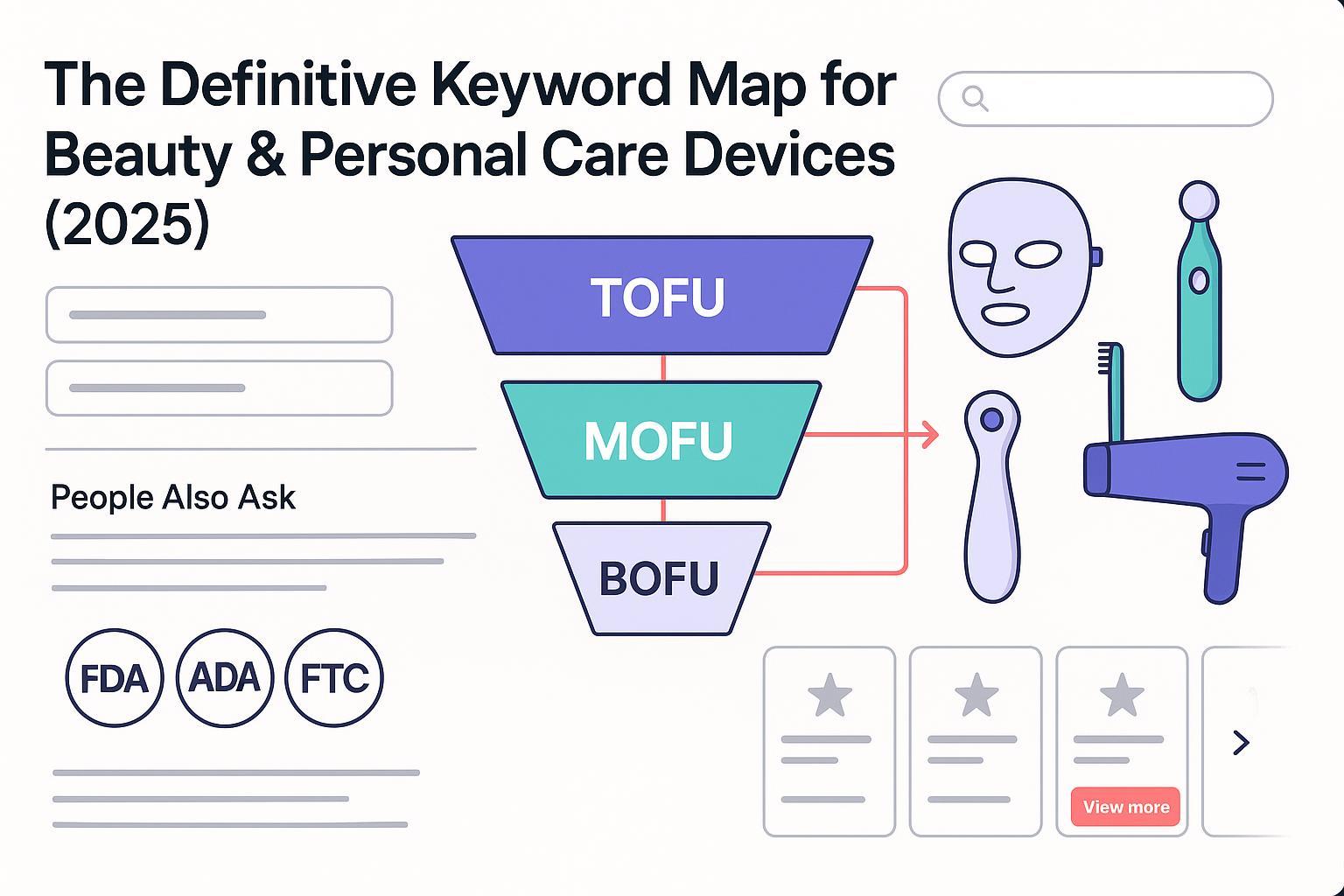
If you sell or review beauty and personal care devices—think IPL hair removal handsets, LED light therapy masks, microcurrent toners, electric toothbrushes, or even pro-grade hair dryers—your keyword strategy can’t be generic. In 2024–2025, Google’s SERPs changed, review quality signals tightened, and US compliance expectations got sharper. In my experience, the brands winning organic revenue have one thing in common: a full-funnel keyword map that is category-specific, regulatory-safe, and relentlessly practical.
This guide is your playbook. You’ll get device taxonomy, SERP-predicated mapping from TOFU to BOFU, claim-safe copy patterns for the US, and four worked examples you can copy.
Part I — Why full-funnel mapping for beauty devices in 2025
Three shifts make a funnel-first strategy non-negotiable:
- TOFU is losing clicks. Google’s AI Overviews and richer informational SERPs siphon a chunk of awareness traffic. Industry tracking in Aug 2024 showed AI Overviews trigger far less for ecommerce-style queries (especially for signed-out users), but their presence still dilutes classic informational clicks, pushing marketers to lean harder into MOFU/BOFU where AI snapshots show up less often, as summarized by the Search Engine Land analysis on AI Overviews behavior (Aug 2024).
- Helpful content + product review systems reward first-hand expertise. Google’s March 2024 changes aimed to reduce low-quality content by “about 40%,” raising the bar for originality and reviews with real testing, pros/cons, and comparisons—see Google’s March 2024 core update and reviews guidance and the reviews system documentation by Google developers.
- Shopping and rich results got smarter. Google rebuilt Shopping with Gemini models and is rolling out AI briefs and dynamic filters (US, late 2024+), which means your category and product pages need impeccable data and schema to surface—see the Google Shopping AI update (Oct 2024).
The takeaway: keep creating TOFU, but bias your resources to MOFU comparisons, buyer guides, and BOFU PDPs/category pages—where intent is hotter and AI Overviews less dominant. HubSpot and Ahrefs outline this classical funnel logic—educational at TOFU, evaluative at MOFU, transactional at BOFU—in their 2024 primers; see the HubSpot content-for-every-funnel overview (2024) and Ahrefs’ mid‑funnel content guide (2024).
Part II — Device taxonomy + problem/benefit matrix
Beauty device shoppers search in two intertwined ways: by device archetype and by the problem/benefit they want. Your keyword map should reflect both.
-
Core device archetypes (non-exhaustive):
- Hair removal: IPL (intense pulsed light) devices; at-home laser devices
- Light therapy: LED masks/panels (red, near-infrared, blue)
- Microcurrent/EMS: facial toning, lifting tools
- Cleansing/exfoliation: sonic brushes, microdermabrasion
- Oral care: electric toothbrushes, water flossers
- Hair styling/care: dryers with ionization, brushes with heat control
-
Problem/benefit intents to map:
- Acne management, wrinkle/texture support, hyperpigmentation appearance, hair reduction, gum health/plaque reduction, frizz control/heat damage mitigation
Safety/fit notes matter—and they are keyword opportunities. For instance, skin tone/ hair color suitability for IPL; contraindications for microcurrent (pacemakers, epilepsy), and oral care trust markers like ADA Acceptance. For category overviews and claim-safe safety framing, anchor to clinical and association guidance such as the American Academy of Dermatology’s consumer guidance on laser/at‑home hair removal (accessed 2025) and red light therapy basics from AAD (2025).
Part III — Build your keyword universe (methods that actually work in 2025)
My workflow is tool-agnostic and replicable:
- Seed expansion the right way
- Combine product terms, use-cases, and constraints: “at-home IPL for dark hair,” “LED blue light mask acne,” “microcurrent for jowls,” “ADA accepted electric toothbrush,” “ionic hair dryer for frizz.” A good refresher on ecommerce seed building is Backlinko’s ecommerce keyword research process (accessed 2025).
- SERP-first validation
- Manually check top queries. Note SERP features and page types winning. Use PAA (“People also ask”) to harvest long-tail question variants. Corroborate intent labels with a tool if you like (e.g., informational vs commercial). A concise overview is in Semrush’s search intent explainer (2024).
- Community and retailer mining
- Reddit, TikTok, YouTube comments; retailer Q&A sections; brand DMs. The language customers use (“is IPL safe on brown skin?” “blue light vs red for acne?” “iO 9 vs 10?”) becomes your long-tail. Search journeys are now multi-platform; see the Search Engine Land perspective on “search everywhere” behavior (2025).
- Structure for scale
- Create a spreadsheet with consistent tagging:
- Columns: Keyword, Stage (TOFU/MOFU/BOFU), Intent (info/commercial/transactional/navigational/local/video), Device Archetype, Problem/Benefit, Page Type, Priority (1–3), Notes (SERP features, compliance flags), URL (mapped), Internal Links (up/down-funnel), Schema Needs.
- Page types you’ll assign: Blog explainer, How-to, Comparison, Buyer guide, Category PLP, PDP, Review/test, FAQ hub.
- Schema and data readiness
- Before you publish, line up Product/Review schema for PDPs and reviews, and consider ProductGroup for variants. Google’s documentation in 2024–2025 is explicit; start with Product structured data by Google developers (2025) and the Product variants (ProductGroup) note from Feb 2024.
Pro tip: Refresh this universe quarterly. Core updates in 2024–2025 shifted what “helpful” looks like; Search Engine Land’s summaries of the March and June 2025 updates reinforce that trend—see the March 2025 core update coverage (2025) and the June 2025 completion note (2025).
Part IV — Cluster, tag, and map to page types (with IA and internal links)
Here’s the mapping logic I use on device sites:
-
Clustering
- Semantic: Group by device + benefit (e.g., “LED red light wrinkles,” “LED blue light acne”).
- Transactional granularity: Separate brand/model modifiers (“Oral‑B iO 9 vs 10”; “NuFACE Mini vs Trinity”).
- Constraints/suitability: Skin tone ranges for IPL; “for sensitive skin” cleansing queries; “ADA accepted” modifiers.
-
Intent tags and page types
- TOFU informational: “what is microcurrent,” “does red light help wrinkles,” → Blog explainer + video.
- MOFU commercial investigation: “best LED mask 2025,” “NuFACE vs Foreo Bear,” → Comparison/buyer guide/category hub with filters.
- BOFU transactional/navigational: “buy IPL device,” “Oral‑B iO price,” “LED mask sale,” → PDPs, bundle pages, retailer/brand navigational landers.
-
Information architecture (IA) example
- /devices/ (hub) → /devices/led-masks/ (category) → /devices/led-masks/best-led-masks-2025/ (MOFU guide) → /products/brand-model-led-mask (PDP)
- Cross-link horizontally between sibling comparisons (e.g., brand vs brand) and vertically TOFU→MOFU→BOFU.
-
Internal linking lattice
- From TOFU explainers, link to 1–2 buyer guides and 1 category page.
- From buyer guides, link down to PDPs and sideways to comparisons.
- From PDPs, link up to the buyer guide (benefit-focused) and to FAQ hubs.
-
On-page elements that move needles in 2025
- Original photos/video of testing (to satisfy the reviews system).
- Clear pros/cons and quantified measures where applicable.
- Safety suitability tables (skin tones, hair types, contraindications) with citations to associations like the American Academy of Dermatology’s preparation guidance for laser hair removal (accessed 2025).
Part V — SERP pattern playbook (2024–2025)
Patterns you should plan around:
-
TOFU
- Expect featured snippets, PAA, video carousels, sometimes AI Overviews on broad “benefits/how it works” queries. Publisher and health association sites dominate. Design posts to win the snippet (clear definitions, lists, schema where applicable) and embed short videos. Semrush’s guide is a solid refresher on feature types; review Semrush’s SERP features overview (2024).
-
MOFU
- “Best” lists, “vs” comparisons, and “review” queries feature rich snippets, star ratings (when eligible), and shopping carousels. Original testing and comparison tables help win. Google’s reviews documentation clarifies expectations for hands-on evidence; see Google developers on the reviews system (2024–2025).
-
BOFU
- Shopping ads, product carousels, local packs (when relevant), and PDPs with price/availability rich results. Implement Product and, if relevant, Review structured data, and keep variant data clean via ProductGroup. Start with Google’s Product snippet docs (accessed 2025) and the Product variants announcement (Feb 2024).
Strategic implication: Aim your highest-effort content at MOFU/BOFU clusters where rich results and revenue meet. TOFU should feed the buyer guides and categories that actually convert.
Part VI — Compliance & trust-by-design (US market)
Beauty and personal care devices often cross into “medical device” territory. Treat compliance as a ranking and conversion advantage—not just a legal checkbox.
-
FDA device vs. cosmetic
- If your product is intended to diagnose, treat, or affect the structure/function of the body, it likely qualifies as a device under the FD&C Act. Many at-home devices are Class II and require a 510(k) clearance for specific intended uses. You can search classifications and 510(k) clearances directly in the FDA databases: the FDA product classification database (accessed 2025) and the 510(k) database (accessed 2025).
-
Examples of relevant device categories (for orientation, not legal advice)
- IPL hair removal devices: typically Class II under 21 CFR 878.4810 with relevant product codes such as ONF/OHT; many cleared via 510(k). You can browse specific clearances (e.g., K221466, K211185) via the FDA 510(k) database (accessed 2025).
- LED masks for wrinkles/acne: Class II under 21 CFR 878.4810 with product codes OHS/OLP; multiple 510(k)s exist (e.g., K214101, K214103), searchable in the FDA 510(k) database (accessed 2025).
- Microcurrent facial toning: often Class II; known brands have clearances (e.g., NuFACE devices). Again, confirm in the FDA 510(k) database (accessed 2025).
-
MoCRA (cosmetics) context
- MoCRA regulates cosmetics, not devices; many device+topical ecosystems mix both. Keep claims for cosmetics separate and compliant. See the FDA’s MoCRA hub (accessed 2025).
-
FTC endorsements and reviews
- Disclose material connections (affiliates, gifted products). Avoid fake or manipulated reviews. Use clear, conspicuous disclosures per the FTC Endorsement Guides (2023). For health-related claims substantiation, consult the FTC Health Products Compliance Guidance (2022).
-
Third-party trust marks
- Oral care: The ADA Seal of Acceptance can be a powerful trust and keyword asset. Align claims strictly with accepted wording for each product. See the ADA Seal product search (accessed 2025) and the ADA chairside guide PDF (accessed 2025).
-
Claim‑safe phrasing examples
- IPL: “Helps reduce the appearance of unwanted hair with regular use. Results vary by individual. Not intended for all skin tones.” For background on cosmetics/device claim boundaries, see FDA’s cosmetics claims page (accessed 2025).
- LED mask: “Promotes a clearer-looking complexion. Not intended to diagnose, treat, cure, or prevent any disease.” AAD’s consumer piece summarizes what red light may and may not do; see the AAD red light therapy overview (accessed 2025).
- Microcurrent: “Supports facial toning for a more lifted appearance. Do not use if you have a pacemaker or epilepsy.” Contraindication lists typically derive from device IFUs and practitioner guidance; when in doubt, consult the device’s cleared labeling in the FDA databases (accessed 2025).
Compliance is not just legal; it’s conversion. Shoppers look for “FDA cleared,” “ADA accepted,” “dermatologist recommended”—make these verifiable and precise.
Part VII — Worked examples: full-funnel maps you can copy
Below are four archetypes mapped from TOFU to BOFU. Use them as scaffolds and adapt to your brand, evidence, and inventory. I’ll also note likely SERP features and recommended page types.
Important: Validate SERPs before publishing—features change by quarter. As Semrush’s 2024 feature guide notes, carousels/snippets vary widely; see Semrush’s SERP features overview (2024).
A) IPL Hair Removal Devices
-
TOFU (informational)
- what is IPL hair removal
- IPL vs laser hair removal
- is IPL safe for dark skin
- how often to use IPL at home
- IPL hair removal side effects
- likely SERP features: featured snippet, PAA, video carousel; dermatology/publisher dominance. Consider citing AAD preparation guidance such as the AAD laser hair removal prep page (accessed 2025).
- content type: explainer posts + short video; FAQ hub.
-
MOFU (commercial investigation)
- best at-home IPL 2025
- IPL for dark hair / for light/fine hair
- best IPL under $300
- IPL with skin tone sensor
- Philips Lumea vs Braun Silk-expert
- likely SERP features: review snippets, comparison tables, shopping carousel.
- content type: buyer guide + comparison pages; category PLP with dynamic filters.
-
BOFU (transactional/navigational)
- buy IPL hair removal device
- Philips Lumea price / Braun Silk-expert deals
- IPL hair removal device near me (local intent)
- brand + model + “warranty,” “manual,” “refill lamp”
- likely SERP features: shopping ads, product carousels, local packs, PDPs with price.
- content type: PDPs with Product/Review schema; store locator.
-
On-page/regulatory notes: Avoid medical treatment claims. If referencing device clearance, link to the model’s 510(k) record in the FDA 510(k) database (accessed 2025). Include suitability table for Fitzpatrick skin types and a safety disclaimer aligned with AAD consumer guidance (2025).
-
Sample titles/H1s
- TOFU: “IPL Hair Removal, Explained: How It Works, Safety, and Who It’s For”
- MOFU: “Best At‑Home IPL Devices (2025): Tested Picks by Skin Tone, Hair Color, and Budget”
- Comparison: “Philips Lumea vs Braun Silk‑expert: Which IPL Is Right for You?”
- BOFU PDP: “Brand Model IPL Hair Removal Device — Price, Specs, Skin Tone Sensor”
B) LED Light Therapy Masks
-
TOFU
- red light therapy mask benefits
- blue light mask for acne
- is LED light therapy safe for eyes
- red vs blue light for skin
- likely SERP features: AI Overviews (sometimes), featured snippets, PAA, video carousels.
- content type: explainer with wavelength basics; safety tips; video.
-
MOFU
- best LED light therapy mask 2025
- LED mask FDA cleared
- omnilux vs drx (insert real model names you stock)
- LED mask for sensitive skin
- likely SERP features: review snippets, shopping carousels.
- content type: buyer guide + comparison; category PLP with filter chips by wavelength (red/blue/NIR), session length, mask type.
-
BOFU
- buy LED mask
- LED mask sale
- brand + model + “review,” “price,” “coupon,” “warranty”
- likely SERP features: shopping ads, product carousels, PDPs with rich results.
- content type: PDP with original photos, test logs, Product/Review schema.
-
On-page/regulatory notes: Avoid disease treatment claims. Use claim‑safe language and, where appropriate, mention device clearance if accurate and linkable in the FDA 510(k) database (accessed 2025). For safety framing, see the AAD red light therapy consumer page (2025).
-
Sample titles/H1s
- TOFU: “Red vs Blue Light: What LED Masks Can (and Can’t) Do for Your Skin”
- MOFU: “Best LED Light Therapy Masks (2025): Our Hands‑On Picks by Skin Goal and Budget”
- Comparison: “Omnilux vs Dr. Dennis Gross: Which LED Mask Fits Your Routine?”
- BOFU PDP: “Brand Model LED Mask — Price, Wavelengths, Session Time”
C) Microcurrent Facial Toning Devices
-
TOFU
- what is microcurrent for face
- microcurrent before and after (expect image intent)
- microcurrent contraindications (pacemaker, epilepsy, pregnancy)
- how often to use microcurrent
- likely SERP features: featured snippets, images/video, PAA.
- content type: explainer + safety list; short demo video.
-
MOFU
- best microcurrent device for jowls
- NuFACE vs Foreo Bear
- microcurrent for sensitive skin
- microcurrent gel alternatives
- likely SERP features: review snippets, comparison tables, video.
- content type: buyer guide + detailed “vs” pages; accessories/bundle category.
-
BOFU
- buy microcurrent device
- NuFACE Mini price / Trinity Plus warranty
- brand + model + “review,” “manual,” “charger,” “replacement”
- likely SERP features: shopping ads, product carousels, PDP rich results.
- content type: PDP with accessories cross-sell; review schema.
-
On-page/regulatory notes: Call out contraindications clearly and keep claims appearance‑focused. If stating “FDA cleared” for a model, confirm and cite the specific record via the FDA 510(k) database (accessed 2025).
-
Sample titles/H1s
- TOFU: “Microcurrent for Facial Toning: How It Works, Who Should Skip It, and What to Expect”
- MOFU: “Best Microcurrent Devices (2025): Tested for Jawline, Lift, and Sensitivity”
- Comparison: “NuFACE vs Foreo Bear: Which Microcurrent Device Wins in 30 Days?”
- BOFU PDP: “Brand Model Microcurrent Device — Price, Attachments, Contraindications”
D) Electric Toothbrushes (Oral Care)
-
TOFU
- sonic vs oscillating toothbrush
- how to brush with an electric toothbrush
- do pressure sensors prevent gum damage
- likely SERP features: featured snippets, videos, PAA.
- content type: how‑to + video + dentist quotes.
-
MOFU
- best electric toothbrush for braces
- Oral‑B vs Sonicare 2025
- ADA accepted electric toothbrush list
- likely SERP features: review snippets, shopping carousels, “Top products” modules.
- content type: buyer guide; brand comparisons; ADA acceptance explainer with links to the ADA Seal product search (accessed 2025).
-
BOFU
- Oral‑B iO price / Sonicare DiamondClean deals
- buy electric toothbrush near me
- brand + model + “heads,” “charger,” “warranty”
- likely SERP features: shopping ads, local packs, PDPs with price/availability.
- content type: PDPs with Product schema; store locator; bundle pages.
-
Trust notes: If you claim ADA Acceptance, match the exact accepted benefits and timeframe; the ADA chairside guide (accessed 2025) explains usage and claims language.
-
Sample titles/H1s
- TOFU: “Sonic vs Oscillating: Which Electric Toothbrush Cleans Better and Why”
- MOFU: “Best Electric Toothbrushes (2025): Picks for Braces, Gum Care, and Travel”
- Comparison: “Oral‑B iO vs Sonicare DiamondClean: Which Head, App, and Pressure Sensor Wins?”
- BOFU PDP: “Brand Model Electric Toothbrush — Price, Modes, Pressure Sensor, Warranty”
Part VIII — Page execution: outlines, schema, and copy blocks
To operationalize your map, pair each cluster with a page outline and data requirements.
-
Buyer guide outline (MOFU)
- H1 with year and audience qualifier (“Best LED Masks 2025: For Acne, Wrinkles, and Sensitive Skin”)
- Top summary table (tested picks, price, wavelengths/modes, session time)
- Methodology (hands-on testing, duration, evaluation metrics)
- Picks by use-case (acne, anti-aging, sensitive skin)
- Safety & suitability (contraindications, eye protection; link to AAD)
- FAQs (PAA-derived)
- Internal links: category page, PDPs, comparisons
-
Comparison page outline (MOFU)
- H1 with exact models (“NuFACE Mini vs Foreo Bear”)
- Specs table (intensity levels, attachments, warranty)
- Hands-on findings (photos/video)
- Who should choose which (persona fit)
- Verdict + next steps (links to PDPs)
-
PDP essentials (BOFU)
- Unique images/video of the unit and in-use
- Clear intended use and claim-safe benefits
- Suitability table (skin tone/hair type; contraindications)
- Price, availability, warranty, returns
- Reviews with quantitative notes; Q&A
- Structured data: Product (+ Review if applicable), and ProductGroup for variants
-
Structured data snippets
Single Product (PDP) — JSON‑LD
{
  "@context": "https://schema.org/",
  "@type": "Product",
  "name": "LED Light Therapy Mask",
  "image": ["https://example.com/images/led-mask.jpg"],
  "description": "At-home LED mask designed to promote a clearer-looking complexion.",
  "sku": "LED-001",
  "brand": {"@type": "Brand", "name": "BrandName"},
  "offers": {
    "@type": "Offer",
    "url": "https://example.com/products/led-mask",
    "priceCurrency": "USD",
    "price": "299.00",
    "availability": "https://schema.org/InStock",
    "itemCondition": "https://schema.org/NewCondition",
    "seller": {"@type": "Organization", "name": "BrandName"}
  },
  "aggregateRating": {"@type": "AggregateRating", "ratingValue": "4.5", "reviewCount": "128"}
}
Product Variants (ProductGroup)
{
  "@context": "https://schema.org/",
  "@type": "ProductGroup",
  "name": "Microcurrent Facial Toning Device",
  "productGroupID": "MC-100",
  "variesBy": ["color"],
  "hasVariant": [
    {
      "@type": "Product",
      "name": "Microcurrent Device – White",
      "sku": "MC-100-W",
      "color": "White",
      "offers": {"@type": "Offer", "price": "249.00", "priceCurrency": "USD", "availability": "https://schema.org/InStock"}
    },
    {
      "@type": "Product",
      "name": "Microcurrent Device – Black",
      "sku": "MC-100-B",
      "color": "Black",
      "offers": {"@type": "Offer", "price": "249.00", "priceCurrency": "USD", "availability": "https://schema.org/InStock"}
    }
  ]
}
Editorial Review with Pros/Cons
{
  "@context": "https://schema.org/",
  "@type": "Product",
  "name": "IPL Hair Removal Device",
  "review": {
    "@type": "Review",
    "author": {"@type": "Person", "name": "Expert Reviewer"},
    "datePublished": "2025-08-15",
    "reviewBody": "In-depth hands-on testing across six weeks...",
    "positiveNotes": "Fast treatment time; skin tone sensor",
    "negativeNotes": "Not suitable for very dark skin tones; can be uncomfortable",
    "reviewRating": {"@type": "Rating", "ratingValue": "4", "bestRating": "5"}
  }
}
For eligibility and implementation details, use the official references from Google developers—Product structured data (accessed 2025), Product snippet guidelines (accessed 2025), and the Product variants (Feb 2024) note. Validate with the Rich Results Test before shipping.
Part IX — Internal linking blueprint (beauty device edition)
-
The “two hops to purchase” rule
- Any TOFU article should be two clicks from a PDP: TOFU → buyer guide → PDP. Ensure breadcrumbs reflect this path.
-
Role‑based hubs
- Create hubs by problem (e.g., “Acne devices hub”) and by device type (“LED masks hub”). Use these as MOFU gateways with prominent links to comparisons and category pages.
-
FAQ hubs as accelerators
- Collect PAA-style questions into evergreen FAQ pages that link contextually to buyer guides and PDPs. Keep answers brief and cite associations like the AAD laser hair removal consumer overview (accessed 2025) where appropriate.
-
Edge cases
- For oral care, interlink ADA‑Accepted product PDPs to an educational page explaining what the Seal means, citing the ADA chairside guide (accessed 2025).
Part X — Measurement, refresh, and governance
What you measure shapes what you build. In 2025, I recommend:
-
KPIs
- MOFU/BOFU share of organic sessions and revenue
- Organic conversion rate by page type (buyer guide, comparison, PDP)
- Assisted conversions from TOFU → MOFU → BOFU paths
- Rich result coverage (Product/Review), impressions, and CTR
- Content quality indicators (scroll depth, time on page, return visits)
- Technical: Core Web Vitals—INP, LCP, CLS—per Google’s ecommerce best practices; see Google developers’ ecommerce guidance (accessed 2025)
-
Cadence
- Monthly KPI reviews; quarterly content audits to refresh “best of 2025” pages, prune/merge overlapping clusters, and re-measure SERP features. For a practitioner’s view on user-centric KPIs, see Search Engine Land on SEO KPIs (2024) and a general KPI overview from Semrush’s SEO KPI guide (2024).
-
Governance
- Claims review: Legal/regulatory sign-off on benefits, suitability statements, and “FDA cleared/ADA accepted” mentions with links to canonical sources.
- Review quality: Require hands-on testing, original media, quantified observations—aligned with Google’s reviews system documentation (2024–2025).
Part XI — Your plug-and-play keyword map schema (copy this)
Create a master spreadsheet with these headers and rules:
-
Columns
- Keyword
- Stage (TOFU/MOFU/BOFU)
- Intent (info/commercial/transactional/navigational/local/video)
- Device Archetype (IPL, LED mask, microcurrent, electric toothbrush, etc.)
- Problem/Benefit (acne, wrinkles, hair removal, gum care, frizz control)
- Page Type (explainer, how‑to, buyer guide, comparison, category, PDP, review/test, FAQ)
- SERP Features (snippet, PAA, video, product carousel, local pack)
- Compliance Flags (FDA cleared mention? ADA? contraindications?)
- Priority (1 high, 2 medium, 3 low)
- Target URL (planned or live)
- Internal Links Up/Down (what it links to and from)
- Schema Needs (Product, Review, ProductGroup, FAQ)
- Notes (evidence needed, testing status, images/video status)
-
Rules
- Each target URL must own a unique primary keyword cluster.
- MOFU and BOFU clusters get priority 1 by default unless the TAM is tiny.
- Every TOFU page must list two MOFU targets and one BOFU target to link to.
- Add a “Refresh by” date (quarterly) for all “best of YEAR” pages.
Part XII — Common pitfalls (and what to do instead)
-
Pitfall: Chasing generic TOFU without a path to purchase.
- Fix: Only publish TOFU that feeds a buyer guide and category/PDPs you actually stock.
-
Pitfall: “FDA cleared” sprinkled loosely.
- Fix: Cite the specific model’s clearance and link to its entry in the FDA 510(k) database (accessed 2025). If uncertain, omit.
-
Pitfall: Thin reviews and affiliate roundups.
- Fix: Hands-on testing with photos, quantified measures, and side-by-side comparisons—aligned with Google’s reviews guidance (2024–2025).
-
Pitfall: Skipping schema.
- Fix: Implement Product, Review (if eligible), and ProductGroup for variants per Google developers’ product schema documentation (accessed 2025).
-
Pitfall: Ignoring oral care trust language.
- Fix: If leveraging ADA Acceptance, match the exact accepted claims and cite the ADA Seal resources (accessed 2025).
Quick reference: What most guides miss (my short list)
- Device-specific safety/suitability tables with authoritative citations (AAD, ADA)
- A governance step for claims and influencer disclosures (FTC)
- A quarterly revalidation of SERP features and “best of YEAR” refreshes
- ProductGroup usage for variant-rich PDPs
- Internal links designed to move users two hops to purchase
Final checklist (print this)
-
Strategy
- [ ] MOFU/BOFU clusters prioritized and mapped to page types
- [ ] TOFU only when it feeds buyer guides and PDPs
- [ ] Internal link lattice connects TOFU→MOFU→BOFU
-
Compliance & trust
- [ ] Claims reviewed; FDA/ADA references linked where applicable
- [ ] FTC disclosures standardized for reviews/influencers
- [ ] Safety/suitability tables included for relevant devices
-
Page quality
- [ ] Hands-on testing, original media, quantified pros/cons
- [ ] Schema implemented (Product, Review, ProductGroup)
- [ ] Core Web Vitals in budget; image compression and lazy-load
-
Measurement
- [ ] KPI dashboard by page type and funnel stage
- [ ] “Best of YEAR” pages scheduled for quarterly refresh
- [ ] SERP feature tracking for priority clusters
Cited resources (selected, canonical)
- Google updates and systems: Google’s March 2024 core update post (2024); Google developers on the reviews system (2024–2025); Product structured data docs (accessed 2025); Product variants (Feb 2024)
- SERP landscape and strategy: Search Engine Land on AI Overviews behavior (Aug 2024); Semrush search intent explainer (2024); Semrush SERP features guide (2024); Search Engine Land “search everywhere” behavior (2025)
- Shopping/UIs: Google Shopping AI update (Oct 2024)
- Regulatory/trust: FDA product classification database (accessed 2025); FDA 510(k) database (accessed 2025); FDA MoCRA hub (accessed 2025); FTC Endorsement Guides (2023); FTC Health Products Compliance Guidance (2022); ADA Seal product search (accessed 2025); ADA chairside guide (accessed 2025); AAD hair removal overview (accessed 2025); AAD red light therapy (accessed 2025)
