Keyword density: what it is, what’s appropriate, and how to determine it

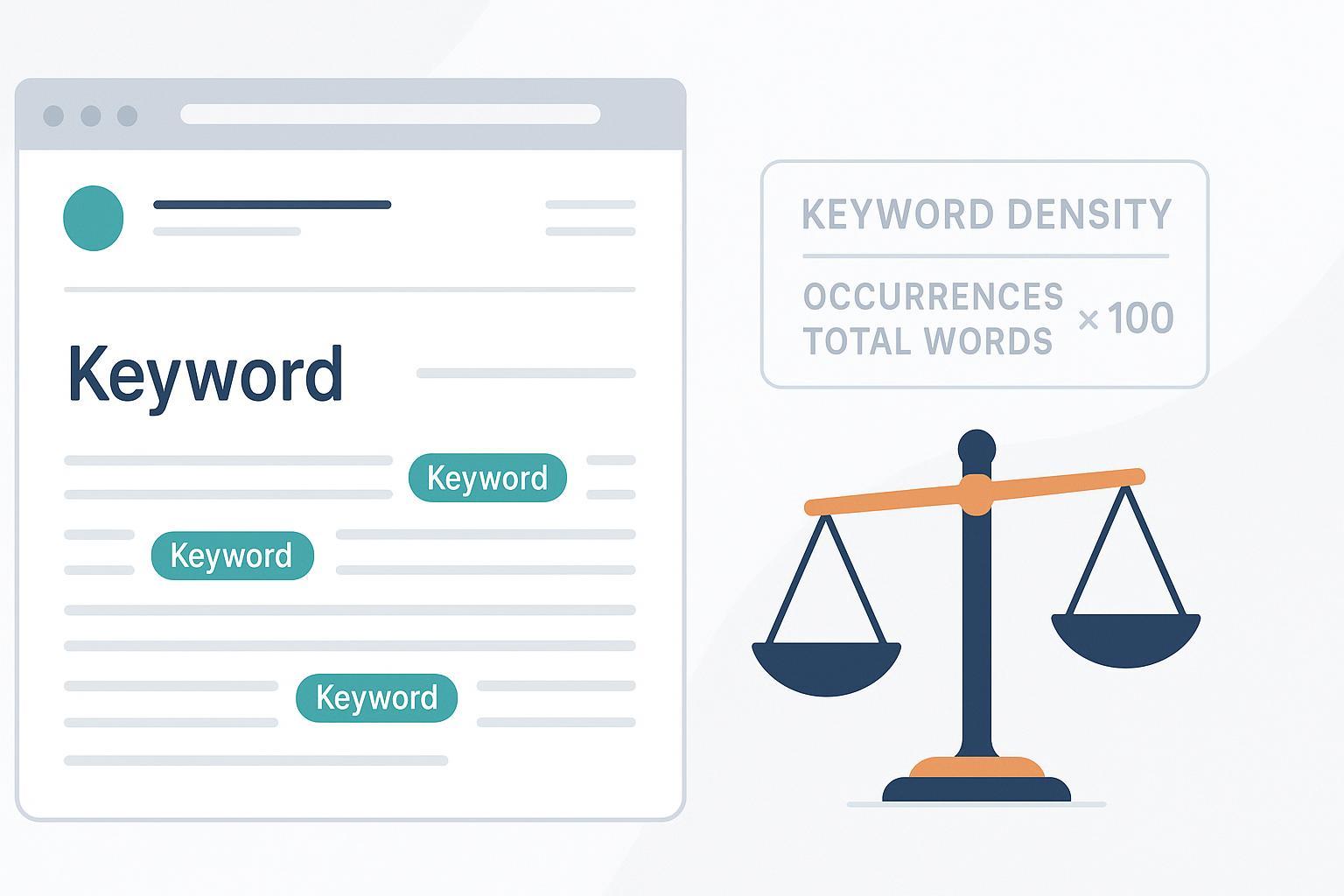
If keyword use is like seasoning a dish, keyword density is the taste test—enough to signal the flavor, not so much that it overpowers the meal. You might wonder: Is there a “right” percentage? Short answer: there’s no one-size-fits-all number, but there are simple ways to check that your usage is natural, clear, and aligned with search intent.
What is keyword density?
Keyword density is the percentage of times a target keyword (or exact keyphrase) appears on a page relative to the total word count. In simple terms:
- Keyword density (%) = (number of exact‑match occurrences ÷ total words) × 100
For example, if a 1,000‑word article uses the exact phrase “running shoes for women” 8 times, the density is (8 ÷ 1,000) × 100 = 0.8%.
Multi‑word phrases are counted as exact matches when the whole phrase appears. Partial matches and synonyms (like “women’s running sneakers”) are helpful for readers and relevance, but they don’t count toward the exact‑match density. This formulaic understanding is widely used in industry explainers such as the concise definition in the Semrush keyword density overview.
What keyword density is not
- It’s not a Google ranking knob. Google has not published an “optimal” percentage, and Googlers have reiterated that you don’t need to aim for a number. In the January 2023 Office Hours, John Mueller noted that Google doesn’t have a notion of an optimal density; focus on clarity and usefulness instead, as summarized in the Google SEO Office Hours transcript (Jan 2023).
- It’s not a license to repeat keywords. Excessive repetition to manipulate rankings is considered keyword stuffing under Google’s policies. See the “Keyword stuffing” section in Google’s Spam Policies (Search Essentials, 2024–2025 updates).
- It’s not the whole story for on‑page relevance. Modern SEO is about answering intent and covering the topic with clear language. Google’s 2024 refresh of the SEO Starter Guide encourages natural, descriptive wording and warns against tiring repetition. For a broader perspective on how keywords relate to topics, see What are keywords, topics, and differences?.
Related concepts you’ll hear about—prominence (where a term appears), proximity (how close related terms are), and TF‑IDF (a way to weigh terms across a corpus)—can be useful diagnostics. But none of these replace writing something genuinely helpful and easy to understand.
What’s an “appropriate” keyword density?
There is no official “right” number from Google. Many practitioners use density as a hygiene check—not a target. A common convention is to expect the exact‑match primary phrase to land somewhere around 0.5% to 2% if you’re writing naturally and covering the topic well. Treat this as a sanity check, not a rule. One industry example suggests roughly 1–2% as a loose guideline; see the explanation in the Outranking guide to keyword density (2023).
Use your judgment. Some pages (like technical specs or glossary entries) may naturally repeat terms more often; others won’t. If the content reads smoothly and answers the query thoroughly, you’re on the right track.
A practical workflow to decide how many times to use a keyword
Think “for readers first, then a light check.” Here’s a repeatable process:
- Clarify search intent and scope
- Identify whether the query is informational, transactional, or navigational. Outline the subtopics people expect. This aligns with the spirit of Google’s helpful-content approach emphasized in the 2024 SEO Starter Guide.
- Skim the SERP for topical coverage
- Review the top results to see how they explain the topic: Which subheadings, entities, and common questions appear? You’re not copying their counts—you’re learning the vocabulary and scope readers expect.
- Map entities, variants, and synonyms
- List the key entities (people, brands, places, features) and natural phrase variations you should include to be comprehensive.
- Tool example (neutral): You can use QuickCreator to surface related entities and phrase variants while drafting. Disclosure: QuickCreator is our product.
- Draft for humans; place keywords where they help clarity
- Naturally use the primary term in the title/H1 and early in the introduction. Use close variants in relevant H2/H3s and body copy. Avoid repetitive, list‑like phrasing.
- Run a light placement checklist
- Primary term or a close variant appears naturally in: title/H1, early paragraph, one or two relevant headings, meta title/description, and image alt text if an image truly depicts the concept. Keep the URL slug concise if it makes sense. Google’s 2024 SEO Starter Guide encourages clarity over repetition.
- Optional density sanity check (after writing)
- Calculate exact‑match density: occurrences ÷ total words × 100. If your content reads well and density sits roughly in the 0.5–2% neighborhood, you’re likely fine. Don’t chase a percentage; adjust only if the copy sounds awkward or repetitive. If you’re still evaluating which keywords to prioritize before drafting, a broader selection workflow like the Use the Win Rate tool to evaluate the win rate of keywords guide can help, separate from density.
Mini example: putting it all together
Imagine a 1,200‑word guide targeting “best hiking shoes for flat feet.”
- Natural placements
- Title/H1: “Best Hiking Shoes for Flat Feet: How to Choose Supportive Footwear”
- Intro: Mention the exact phrase once to establish context.
- Headings: Use natural variants like “arch support,” “motion control,” “stability features,” “wide toe box,” or “insoles for overpronation.”
- Body: Mention the exact phrase a handful of times when it helps clarity; otherwise rely on variants and entities.
- Entities and details to cover
- Brands (e.g., well‑known hiking brands), materials (EVA midsoles, Vibram outsoles), features (rock plates, heel counters), fit considerations (overpronation, arch height), and common user questions (break‑in time, waterproof vs. breathable).
- Density check
- Suppose the exact phrase appears 10 times in 1,200 words. Density = (10 ÷ 1,200) × 100 = 0.83%. That’s within a typical hygiene range while keeping the article readable. If it felt repetitive, you’d reduce exact repeats and lean more on variants.
Red flags to avoid (aligned with Google’s policies)
- Blocks of repeated keywords or city/keyword lists aimed at manipulating rankings
- Hidden or visually tiny keyword‑stuffed text
- Over‑optimized internal anchors that repeat exact phrases unnaturally
- Repeating the same phrase in every heading without adding new information
Each of these patterns aligns with behavior described under keyword stuffing in Google’s Spam Policies (Search Essentials) and the general guidance to avoid tiring repetition in the SEO Starter Guide (2024 refresh).
Bottom line
Use keyword density as a light, optional sanity check—not a target. Write for people, cover the topic thoroughly with clear language, and place important terms where they help readers most. Google has not published an optimal percentage, as reiterated in the Google SEO Office Hours transcript (Jan 2023). When in doubt, reread your draft aloud: if it sounds natural and answers the query, you’re doing it right.
For more context on how density fits into the bigger picture of search, you can continue with SEO Explained: A Comprehensive Overview of Search Engine Optimization.
