Industrial Manufacturing Content Calendar Examples (U.S.) for 2025

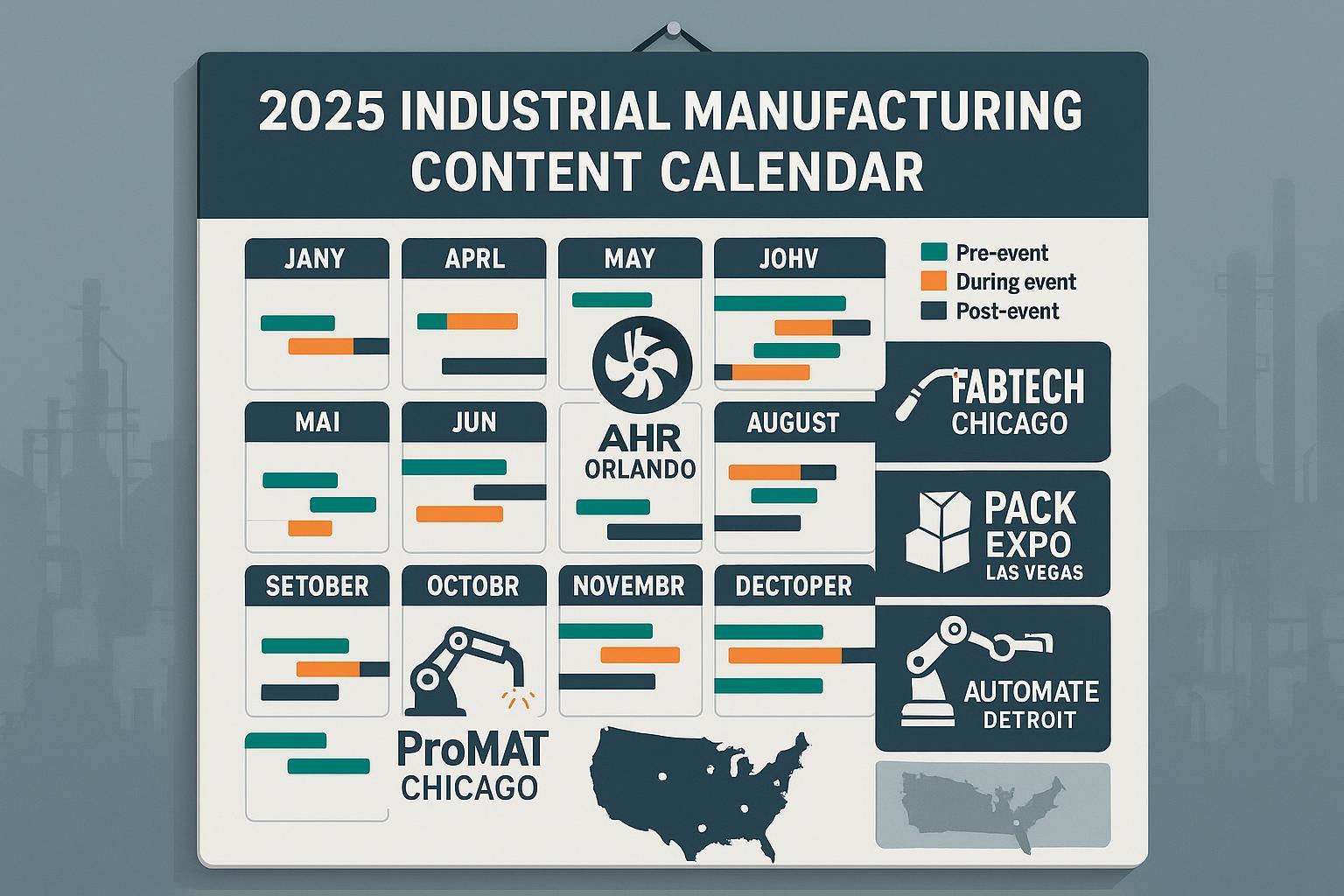
Industrial buying cycles are long, technical, and committee-driven. Your 2025 content calendar has to flex around trade shows, product validation gates, and compliance reviews—without overwhelming a lean team. Below are 12 practical, plug-and-play calendar examples tailored to U.S. manufacturers. Each one clarifies cadence, governance, and event anchors so you can execute with confidence.
Note on events: All dates and venues are subject to change—always confirm via official pages before publishing or booking.
How to use these examples
- Pick the one or two examples that match your main 2025 growth bets (trade shows, launches, or compliance).
- Add approval gates for Engineering, Quality, and Legal. Define SLA days to avoid bottlenecks.
- Use T-minus blocks (T–12, T–6, T–1 weeks), onsite (Day 0–3), and post-show (+48 hours, +2 weeks) for event items.
- Define metrics up front (marketing-sourced pipeline, influenced revenue, OEE impact claimed, MQL→SQL conversion) and tag content accordingly.
1) FABTECH-anchored calendar (metal fabrication, welding, finishing)
What this optimizes for: Concentrated demand capture around FABTECH in Chicago (September), with pre/during/post content momentum.
Key traits
- Cadence: Biweekly before June, weekly July–September, daily micro-content during show week
- Channels: Blog, email to named accounts, LinkedIn, sales enablement one-pagers
- Anchors: Demos, application notes, booth map and speaking sessions
Best for / Not for
- Best: Metal fabrication OEMs, welding/finishing suppliers with demos
- Not for: Teams without booth presence or newsworthy updates in Q3
How to implement
- T–12 weeks: Publish a save‑the‑date blog and open meeting scheduler; pitch media/partners for booth demos.
- T–6 weeks: Release a customer application note; launch targeted emails to named accounts.
- T–1 week: Share your booth map and “top 3 demos” teaser; finalize follow-up email templates.
- During show: Post short video recaps daily; tag leads by interest level for tailored nurture.
- +48 hours: Send personalized recap emails with the most relevant asset; book demos.
- +2 weeks: Host a webinar debrief; compile a sales kit with FAQs and demo clips.
Evidence: Confirm 2025 dates and Chicago venue on the official “Plan Your Visit” hub for FABTECH (2025) via the FABTECH plan your visit page.
2) PACK EXPO Las Vegas calendar (packaging and processing)
What this optimizes for: Launch and buyer education cycles culminating at PACK EXPO Las Vegas in late Q3.
Key traits
- Cadence: Monthly thought leadership Jan–Jun; weekly Aug–Oct; daily social during show
- Channels: Sector landing page, demo videos, buyer’s guide PDF, booth signage assets
- Anchors: Persona-specific demos (food, pharma, CPG) and post-show ROI stories
Best for / Not for
- Best: Packaging machinery and materials vendors with verticalized solutions
- Not for: Firms with zero presence or pipeline in West/Southwest regions in 2025
How to implement
- T–12 weeks: Publish a vertical landing page and collect pre-booked meetings.
- T–6: Release a “What’s new at PACK EXPO” video; activate paid retargeting to site visitors.
- T–1: Share your floor location and live-demo schedule; prep same-day follow-up sequences.
- During: Capture 30–60 second demo clips; post highlights and customer quotes (approved).
- +48 hours: Send persona-specific recap emails linking to the right demo clip.
- +2 weeks: Publish a recap blog and a “what we learned” webinar.
Evidence: Show info and 2025 hall updates are listed on PACK EXPO Las Vegas — The Show.
3) ProMat-anchored calendar (material handling, warehousing, supply chain)
What this optimizes for: Early-year demand generation aligned to ProMat (March) with follow-through into Q2.
Key traits
- Cadence: Weekly Jan–Mar; post-show nurture through April
- Channels: Application notes, calculators (throughput, pick rates), live demo invites
- Anchors: Pre-booked tours, customer walk-throughs, quick-win case studies
Best for / Not for
- Best: AS/RS, conveyors, AMRs, WMS providers with live demonstrations
- Not for: Teams without implementation stories or ROI proof points ready
How to implement
- T–12 weeks: Publish a sector trend brief; open scheduling for booth tours.
- T–6: Release a conversion calculator; coordinate SDR sequences around demos.
- T–1: Publish a floor guide and “must-see routes” for your tech.
- During: Post daily “booth learnings” and short AMR/conveyor clips; tag leads by use case.
- +48 hours: Send tailored follow-ups with calculator links and case studies.
- +2 weeks: Run a webinar on “Lessons from ProMat: Designing for peak throughput.”
Evidence: For cadence context (odd-year ProMat vs. even-year MODEX), see the 2024 MHI note on alternating schedules and MODEX 2026 dates in MHI Solutions magazine.
4) AHR Expo calendar (HVACR)
What this optimizes for: HVACR demand at the start of the year with coordinated technical and code-compliance content.
Key traits
- Cadence: Weekly Jan–Feb; post-show nurture through March
- Channels: Spec sheets, COP/SEER explainer blogs, installer training videos
- Anchors: Code updates, efficiency claims with engineering validation
Best for / Not for
- Best: OEMs and component suppliers with clear performance data
- Not for: Teams without compliance approvals for public performance claims
How to implement
- T–8 weeks: Publish “what’s changed” code/standards brief; add glossary for COP/SEER.
- T–4: Launch training video series for installers/service teams.
- T–1: Share booth map, new product teaser, and session appearances.
- During: Record micro-demos and interviews with product managers.
- +48 hours: Send recap emails segmented by contractor vs. engineer audience.
- +2 weeks: Host a Q&A webinar on common installer challenges.
Evidence: Confirm 2025 Orlando dates and venue in the AHR Exhibitor Manual’s Dates & Locations page (2025).
5) Automate calendar (robotics and automation)
What this optimizes for: Accelerated education and demo-led engagement ahead of Automate (May) to build late-Q2 pipeline.
Key traits
- Cadence: Biweekly Feb–Apr; daily snippets during show; webinar series in June
- Channels: Integrator spotlight videos, safety briefings, ROI calculators (labor offsets)
- Anchors: Live demos, cobot safety content, integration partner stories
Best for / Not for
- Best: Robotics OEMs, vision systems, integrators with demo capability
- Not for: Teams without safety/compliance clarity for public claims
How to implement
- T–10 weeks: Publish an “Automation readiness checklist” and open demo bookings.
- T–4: Release a cost/benefit calculator and a customer mini-case.
- T–1: Share floor plan and “meet the integrators” schedule.
- During: Post daily highlights and short demo clips; capture FAQs.
- +48 hours: Send tailored follow-ups with the checklist and relevant clips.
- +2 weeks: Run a “Lessons from Automate” webinar featuring an integrator guest.
Evidence: Dates and Detroit venue are confirmed on the U.S. Commercial Service’s Automate overview (2025 reference).
6) Product launch calendar with PPAP gates (automotive and adjacent sectors)
What this optimizes for: Risk-managed launch communications paced around PPAP (Production Part Approval Process) milestones.
Key traits
- Cadence: Milestone-driven; content unlocks post-approval
- Channels: Spec sheets, application notes, tolerance/fit guides, controlled customer stories
- Compliance: Engineering and Quality sign-off before any performance claims
Best for / Not for
- Best: Automotive/transportation suppliers under customer PPAP requirements
- Not for: Non-regulated launches without formal validation phases
How to implement
- Map gates: prototype validation → PPAP submission → PPAP approval → GA.
- Pre-approval: Publish thought leadership and design-for-manufacture content (no hard claims).
- Post-approval: Release data-backed specs and application notes; gate detailed downloads.
- Sales enablement: Create customer-facing FAQs aligned to OEM documentation.
- Review: Insert Legal/Quality review columns with buffer days for rework.
Evidence: Process foundations and expectations are detailed by AIAG’s Quality Core Tools, including PPAP, in the AIAG Quality Core Tools overview (accessed 2025).
7) FAT/SAT-driven implementation calendar (capital equipment)
What this optimizes for: Credible storytelling and proof points aligned to FAT/SAT outcomes.
Definitions: FAT (Factory Acceptance Test) verifies functionality at your facility; SAT (Site Acceptance Test) verifies installation and operation at the customer site.
Key traits
- Cadence: Content sprints keyed to FAT window and SAT completion
- Channels: Behind-the-scenes videos (as permitted), commissioning checklists, case studies
- Compliance: NDA awareness; Legal/Quality review prior to publishing KPIs
Best for / Not for
- Best: Capital equipment OEMs with observable performance during acceptance tests
- Not for: Products without formal acceptance testing or customer referenceability
How to implement
- Pre-FAT: Publish a “How we test” framework; avoid customer-specific details.
- During FAT: Capture generic process visuals; prepare messaging contingent on pass results.
- Post-FAT: Release a quality story and readiness checklist.
- Post-SAT: Publish case study with KPIs (e.g., OEE gains) pending approvals.
- Governance: Add review gates tied to test sign-offs; version-control claims.
Evidence: For structured methodologies aligning with industrial standards, see ISA’s overview of the ISA‑105 standards family (accessed 2025).
8) Compliance and safety update cadence (regulated communications)
What this optimizes for: Routine publishing of safety notices, standards updates, and regulatory changes without derailing campaigns.
Key traits
- Cadence: Monthly regulatory roundup; quarterly deep-dive webinar
- Channels: Safety bulletins, code update explainers, certification roadmaps
- Compliance: Mandatory Legal and Quality sign-offs with version histories
Best for / Not for
- Best: HVACR, food & beverage, life sciences, and any sector with frequent code updates
- Not for: Teams without defined approvers or document control
How to implement
- Build a compliance calendar layered atop campaigns (color-coded).
- Pre-approve templates for bulletins and code explainers.
- Maintain a review roster (Legal, Quality, Product) with SLA buffers.
- Publish and archive with revision control; update sales enablement packs quarterly.
9) Multi-stage nurture calendar for long sales cycles
What this optimizes for: Consistent education and momentum across 6–18 month buying journeys.
Key traits
- Cadence: Biweekly core content; monthly webinar; quarterly case study
- Channels: Application notes, ROI calculators, technical deep-dives, executive summaries
- Anchors: Trade shows feed new names; nurture converts curiosity into evaluation
Best for / Not for
- Best: Complex systems with multiple stakeholders (engineering, operations, finance)
- Not for: Pure transactional components with short cycles
How to implement
- Define stages (awareness → evaluation → consensus → validation → purchase).
- Map content by persona and stage; tag assets for quick assembly in sequences.
- Layer in event touchpoints (pre-scheduled demos, post-show webinars).
- Instrument lead scoring and automate handoffs to SDRs when intent spikes.
Supporting practice: For trade show content that fuels these streams, align with exhibitor content amplification methods described by Map Your Show in their 2024–2025 guidance on amplifying trade show marketing with exhibitor content.
10) Engineer-forward knowledge base calendar
What this optimizes for: Continuous technical education that compounds SEO and trust with engineering audiences.
Key traits
- Cadence: Weekly short technical notes; monthly long-form guides
- Channels: Application notes, troubleshooting trees, spec comparisons
- Governance: Engineering as co-authors; technical edit SLA in calendar
Best for / Not for
- Best: Component suppliers and OEMs with strong application engineering
- Not for: Teams without SME availability or edit capacity
How to implement
- Build a backlog of FAQs from sales and support.
- Prioritize by search demand and sales friction.
- Create templates with fields for tolerances, materials, environment, and standards.
- Schedule SME reviews and publish on a predictable cadence.
11) Show-and-sell social calendar (field-ready micro-content)
What this optimizes for: Lightweight content that equips sales and channel partners before, during, and after events.
Key traits
- Cadence: 3–4 posts/week baseline; daily during events
- Channels: LinkedIn, YouTube Shorts, internal enablement libraries
- Anchors: Demo teasers, customer proof points, partner spotlights
Best for / Not for
- Best: Teams with camera-ready demos and spokespersons
- Not for: Highly regulated claims without pre-approved messaging
How to implement
- Pre-approve 20–30 snackable posts with visuals.
- Build a “grab-and-go” folder for reps with captions and CTAs.
- Capture onsite footage for rapid edits; post same day.
- After the show, re-cut highlights into vertical formats and add to nurture streams.
Supporting practice: Tactics like onsite video capture and repurposing are emphasized in 2025 trade show playbooks such as Blue Atlas Marketing’s guidance on scaling trade show strategy.
12) Template-first calendar (Excel/Gantt with approval gates)
What this optimizes for: Fast setup using a flexible template with industrial-specific fields.
Key traits
- Cadence: Your choice—template supports monthly/weekly/day-of-show views
- Channels: All; add columns for content type, channel, persona, stage, event anchor, owner
- Governance: Built-in Engineering/Legal/Quality approval checkpoints
Best for / Not for
- Best: Teams needing structure without adopting new software
- Not for: Orgs that already standardized on a PM platform
How to implement
- Start with a dynamic Excel calendar and activity planner for 2025; add columns for compliance gates and event anchors.
- Color-code T-minus milestones and acceptance test gates.
- Add conditional formatting for overdue approvals and critical path items.
- Review your cadence quarterly and adjust to pipeline needs.
Evidence: A flexible starting point is the 2025 dynamic Excel calendar and activity planner from Chandoo, available as a free download on the Chandoo 2025 calendar template page (2025). If you prefer a milestone-style scaffold, adapt a production planning sheet such as Anvyl’s post on a free Excel planning template—availability may be gated or change over time; see the Anvyl production planning template article.
Practical timing blocks you can copy/paste
Use this baseline for any 2025 trade show; tweak to your sector.
- T–12 to T–8 weeks: Finalize messaging; publish save‑the‑date blog; open meeting scheduler; submit speaking abstracts.
- T–6 to T–2 weeks: Announce demos/new features; launch targeted emails; publish one application note; set SDR cadences.
- T–1 week to Day 0: Share booth map and incentives; rehearse scripts; prep same-day follow-up templates.
- During show (Day 1–3): Daily recap posts; record micro-demos; tag leads by interest level in your CRM.
- Post +48 hours: Personalized emails referencing conversations; schedule demos; route hot leads to AEs.
- Post +2 weeks: Host a deep-dive webinar; publish recap; push a sales enablement pack to the field.
For hands-on tactics and timelines across pre/during/post, the 2025 playbook by Momencio outlines practical exhibitor workflows, including rapid follow-up and segmentation, in their Ultimate Guide to Trade Show Marketing.
Governance and compliance checklist (add these to your calendar)
- Approvers per content type: assign Engineering, Quality, Legal, and Product owners.
- SLA expectations: e.g., Engineering edit (3 business days), Legal review (5 business days).
- Claims control: tie performance statements to validation (PPAP approval, FAT pass, SAT completion) with documented evidence.
- Version control: maintain revision IDs on public assets and internal enablement.
- NDA awareness: flag any customer content requiring additional approval.
Final notes
- Keep a rolling 90‑day plan visible to Sales leadership.
- Archive all event content into evergreen assets (application notes, calculators, case studies) to compound value.
- Recheck official event pages monthly for updates; trade show details evolve.
