How to Humanize AI-Generated Content: 13 Methods That Build Trust

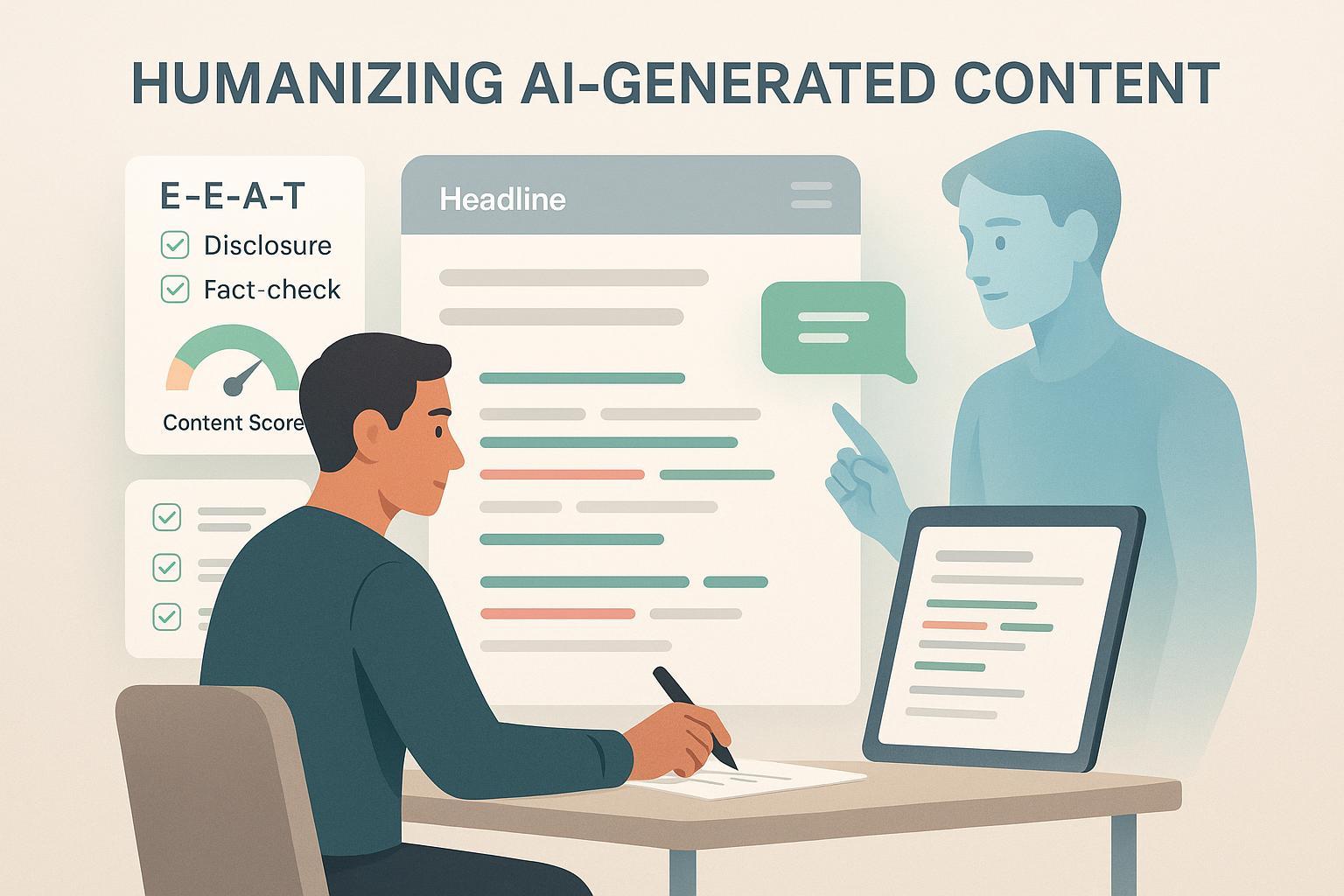
If AI helps you draft, your audience still expects the final piece to feel credible, clear, and human. The fastest path to trust isn’t hiding AI—it’s building transparent, quality-focused workflows that turn a machine-first draft into people-first content. Below is a practical, staged approach you can plug into your editorial process today.
Plan → Draft → Edit → Review → Publish → Govern
Each method below includes what it accomplishes, concrete actions, common pitfalls, and evidence-backed context. The goal: show your expertise and experience, reduce errors, and make your content genuinely useful.
1) Map audience intent before you draft
What it accomplishes: Ensures your content solves real problems for specific readers, not generic AI predictions.
Do this:
- Identify audience segments and their jobs-to-be-done (JTBD). Spell out the task they’re trying to complete and the constraints they face.
- Classify intent (informational, navigational, transactional) and any stakes (YMYL vs. non-YMYL). Calibrate tone and rigor accordingly.
- Write a one-sentence “reader success” goal and use it as your draft’s north star.
Best for: Teams and solo creators who want drafts to feel anchored to real needs.
Pitfalls: Persona stereotypes; overgeneralization; ignoring context in regulated domains.
Evidence: Google’s guidance emphasizes people-first quality and transparency for generative content; see the 2025 fundamentals in Using generative AI for content — Google Search Central.
2) Disclose AI use—specifically and simply
What it accomplishes: Builds credibility by clarifying how AI contributed and how humans ensured accuracy.
Do this:
- Say what AI did (e.g., “first-draft outline,” “summarized public documents”), why you used it, and who reviewed it.
- Prefer per-article disclosures for significant AI involvement; link to a site-level AI policy for consistency.
- Keep disclosures short, specific, and adjacent to the byline or editor’s note.
Example language: “We used an AI assistant to generate a first-draft outline. A human editor fact-checked, added examples from our experience, and verified sources to meet our accuracy and ethics standards.”
Pitfalls: Vague labels (“AI-assisted”) without details; no mention of human oversight; disclosure fatigue.
Evidence: Trusting News found in 2024–2025 that specificity reduces trust loss versus vague notices; see New research: be specific when disclosing AI use (Trusting News, 2024) and the 2025 study on how AI disclosures can help and hurt trust. Templates are available in Trusting News’ sample language.
3) Add E-E-A-T checkpoints to every piece
What it accomplishes: Demonstrates Experience, Expertise, Authoritativeness, and Trustworthiness—signals readers (and evaluators) look for.
Do this:
- Add a byline with real credentials; show relevant experience and links to your About/Contact pages.
- Cite authoritative, dated sources; name the publisher and surface key metadata near the claim.
- Add firsthand examples, case notes, or quotes from subject-matter experts.
Context: Google’s stance rewards original, high-quality content that demonstrates E-E-A-T regardless of production method; see Google Search’s guidance about AI-generated content (2023). Evaluator summaries note the lowest ratings apply when content is mostly AI with little added value; see Google SQRG 2025 summary (Originality.ai).
Tools and resources: Platforms like QuickCreator support E-E-A-T reviews and content quality checks. Disclosure: QuickCreator is our product.
Internal helpers:
- AI E-E-A-T Checker — Assess your draft against common E-E-A-T signals.
- Content Quality Score docs — Understand and standardize quality criteria during edits.
Pitfalls: Thin bios, generic claims, and weak citations. Don’t rely on AI alone to “sound authoritative”—show lived experience.
4) Make AI the first draft—then run a human editorial workflow
What it accomplishes: Reduces errors, adds depth, and aligns content with brand standards.
Do this:
- Define roles: author, editor, fact-checker, and subject-matter reviewer.
- Require a fact-check pass before publication; annotate claims with sources and dates.
- Prohibit fully automated publishing; require human approval gates.
Evidence: Google warns against mass-produced, low-value pages and emphasizes meeting Search Essentials; see Using generative AI for content (Google Search Central, 2025). NN/g urges treating genAI output as a first draft and designing for verification; see AI Hallucinations: What Designers Need to Know (NN/g, 2025).
Internal helper: For implementation ideas, see Generative AI content workflows (QuickCreator, 2025).
Pitfalls: Overreliance on AI; skipping reviews under deadline pressure; generic rehashes that add little value.
5) Verify facts against primary sources
What it accomplishes: Prevents plausible falsehoods and stale statistics from eroding trust.
Do this:
- For every statistic or claim, link to the canonical page (original study, official documentation) and include the year in text.
- Avoid secondary summaries when possible; if used, still trace to the primary source.
- Add update dates and correction notes where relevant.
Evidence: NN/g documents how chatbots can discourage error checking and why teams must design workflows to counter that tendency; see AI Chatbots Discourage Error Checking (NN/g, 2025).
Pitfalls: Blindly trusting AI citations; unlabeled charts; outdated or geography-agnostic stats.
6) Insert real human experience and examples
What it accomplishes: Distinguishes your content from generic summaries and demonstrates lived expertise.
Do this:
- Add a mini-case: what you tried, what failed, and what changed.
- Include direct quotes or insights from SMEs; attribute clearly.
- Use screen captures, timelines, or short data tables to show work.
Evidence: Google’s evaluative stance focuses on originality and added value regardless of how content is produced; see Google Search’s guidance about AI-generated content (2023).
Pitfalls: Fabricated anecdotes or unverifiable “experience” claims; filler stories that don’t help the reader.
7) Humanize tone, voice, and style
What it accomplishes: Moves your writing from robotic and buzzword-heavy to clear and conversational.
Do this:
- Vary sentence length; trim clichés; favor precise verbs over vague adjectives.
- Use micro-stories or scenario snippets to illustrate points.
- Tailor terminology to audience knowledge level; avoid jargon sprawl.
Quick comparison:
| Robotic phrasing | Humanized phrasing |
|---|---|
| “Leverage cutting-edge synergies to optimize outcomes.” | “Use one shared checklist so marketing and CX stay aligned.” |
| “It is important to utilize data-driven paradigms.” | “Run a weekly report and remove any pages that nobody reads.” |
Evidence: NN/g’s 2025 guidance encourages outcome-oriented writing and critical evaluation of genAI drafts; see The UX Reckoning: Prepare for 2025 and Beyond (NN/g). For marketing workflows, see Content Marketing Institute’s 2025 guidance on integrating AI responsibly.
Internal helper: See Humanize AI Text: a practical guide (QuickCreator) for deeper techniques.
Pitfalls: Over-casual tone in technical or regulated contexts; buzzwords that signal vagueness.
8) Structure for scannability and trust
What it accomplishes: Makes it easy for readers to evaluate and use your content.
Do this:
- Use descriptive headings, bullets, tables, and checklists.
- Add before/after passages showing how you edited AI text.
- Include a short FAQ block addressing common reader questions.
Evidence: Google’s 2025 fundamentals encourage clarity, accuracy, and transparency, including sharing details about how content was created; see Using generative AI for content (Google Search Central, 2025).
Pitfalls: Wall-of-text sections and burying key information.
9) Prioritize originality and value density
What it accomplishes: Moves beyond thin, scaled summaries into genuinely useful, unique content.
Do this:
- Remove filler; cut paragraphs that only restate common knowledge.
- Add a unique angle, dataset, or comparison that aids decision-making.
- Consolidate duplicative pages; redirect low-value content.
Evidence: Google warns against scaled content abuse and rewards original, high-quality work; see Spam policies overview — Google Search Essentials and the March 2024 update introducing new abuse policies.
Pitfalls: Publishing many shallow pages; chasing volume over substance.
10) Use data and visuals with transparent labeling
What it accomplishes: Strengthens claims and improves accessibility.
Do this:
- Label charts clearly; include data sources and collection dates.
- Add alt text and, where applicable, brief methodology notes.
- Keep visuals simple; avoid decorative complexity that obscures meaning.
Evidence: Google’s structured data policies emphasize accuracy and appropriate usage; see Structured Data policies — General guidelines (Google).
Pitfalls: Unlabeled axes; mixing geographies; cherry-picked or unverifiable data.
11) Establish brand governance and editorial standards
What it accomplishes: Ensures consistency and ethical guardrails at scale.
Do this:
- Write down style rules, citation standards, disclosure triggers, and review gates.
- Specify unacceptable uses (e.g., fake testimonials, deceptive images).
- Train authors and editors; audit compliance quarterly.
Evidence: The Content Marketing Institute’s 2025 guidance prioritizes governance and training alongside AI integration; see CMI’s workflow and ethics recommendations.
Pitfalls: Unenforced policies; unclear accountability; “policy theater.”
12) Publish with transparency signals
What it accomplishes: Shows readers who wrote, edited, and updated the piece.
Do this:
- Display bylines with credentials, an editor’s note when applicable, and an updated-on timestamp.
- Add conflict-of-interest disclosures and link to your AI-use policy.
- Keep a visible corrections process and log.
Evidence: Evaluator guidance highlights trust cues and penalizes low-value AI-only content; see SQRG 2025 summary (Originality.ai). For disclosure practices, revisit Trusting News’ 2025 study.
Pitfalls: Hidden updates; no corrections policy; ambiguous authorship.
13) Govern and maintain: audit, update, and prune
What it accomplishes: Keeps your library accurate, compliant, and valuable.
Do this:
- Run quarterly content audits; update facts and remove thin pages.
- Monitor for spam risks (scaled content abuse, site reputation abuse, expired domain abuse).
- Track performance and reader feedback; schedule refreshes.
Evidence: See the 2024 announcement on new spam policies and site reputation abuse policy update (2024); Google’s fundamentals reiterate accuracy and quality obligations.
Pitfalls: Set-and-forget publishing; ignoring policy changes.
FAQs: quick answers your audience is searching for
-
Will AI content hurt SEO?
- Not inherently. Google’s systems reward original, high-quality content demonstrating E-E-A-T regardless of how it’s produced. Focus on people-first value and avoid scaled, low-value pages; see Google Search’s guidance about AI-generated content (2023) and 2025 fundamentals on generative AI.
-
Should I disclose AI use?
- When AI meaningfully shaped the content, yes—be specific about what AI did and who reviewed it. Specific disclosures tend to preserve trust better than vague labels; see Trusting News’ 2024 guidance.
-
How do I prevent hallucinations?
- Treat AI output as a first draft; implement human fact-checks against primary sources and require editor approval. NN/g outlines why teams must design for verification; see AI Hallucinations (2025).
Next steps
- Pick two pages this week and run them through your disclosure and E-E-A-T checkpoints.
- Add a one-page editorial policy covering AI use, citations, and review gates.
- Schedule a quarterly content audit to update facts and prune low-value pages.
By making AI a starting point—not the finish line—you’ll produce content that reads like it’s written by a pro, backed by real experience, and worthy of your audience’s trust.
