Best Multi-Touch Attribution Tools in the United States (2025): HubSpot vs Dreamdata vs Attribution vs Windsor.ai vs Funnel vs Branch vs SharpSpring

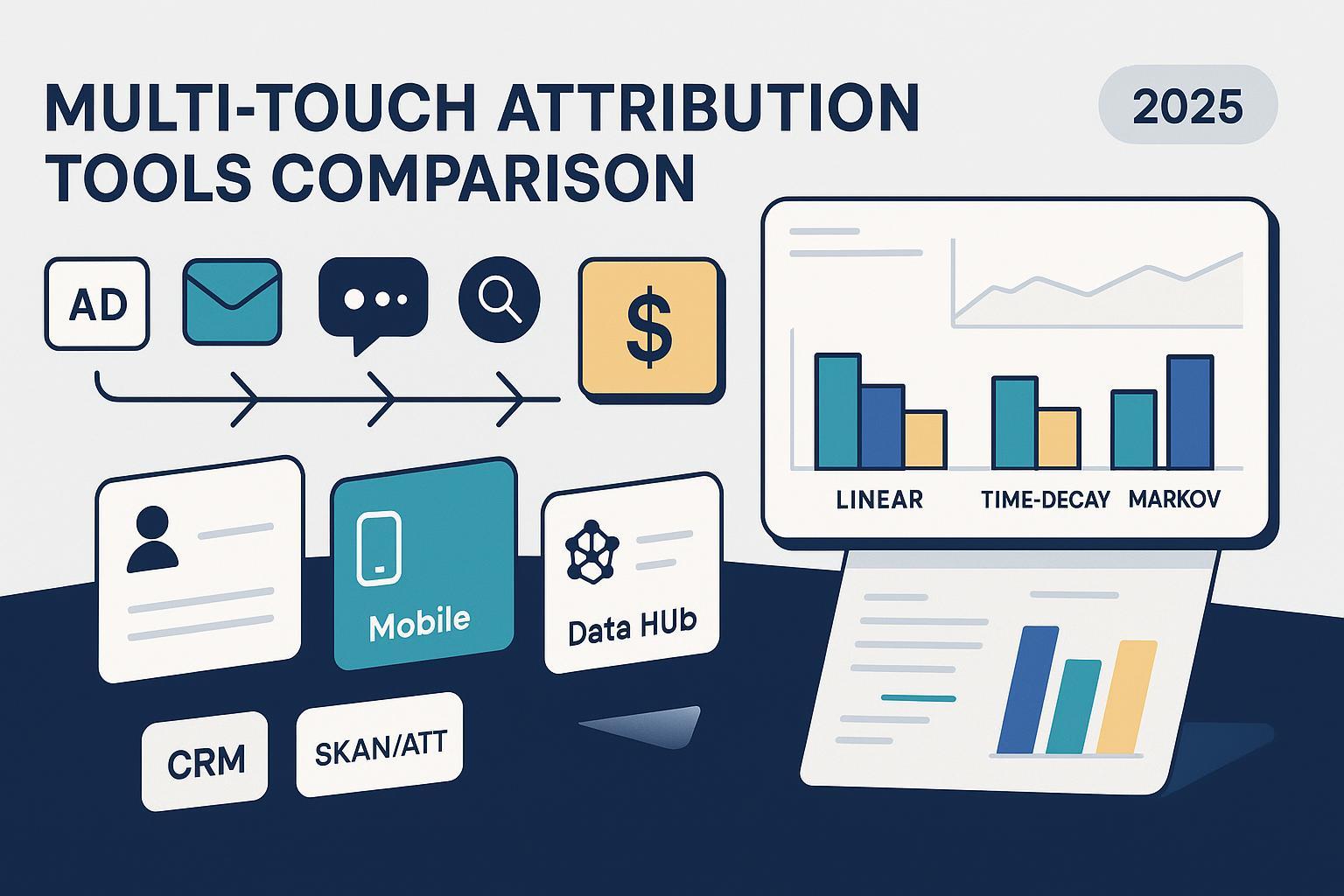
Multi-touch attribution (MTA) matters more than ever in 2025. Between third‑party cookie deprecation and mobile privacy shifts like Apple’s ATT and SKAN, marketers need tools that stitch together first‑party signals across web, app, ads, and CRM—then credit revenue fairly across touchpoints. This guide compares seven widely adopted tools in the U.S. market—Attribution (AttributionApp.com), Branch, Dreamdata, Funnel (Measurement), HubSpot Marketing Hub, SharpSpring (Constant Contact Marketing Automation+), and Windsor.ai—so you can match capabilities to your stack and goals.
Methodology and ordering: We ordered vendors alphabetically to avoid bias and relied primarily on vendor documentation and official resources. Pricing and feature notes are as of Oct 5, 2025. Where a claim isn’t fully documented in primary sources, we call it out transparently and recommend confirming with the vendor.
How to choose quickly
- Data capture and identity: Do you need first‑party, server‑side, or web‑to‑app coverage? Any offline touchpoints to ingest?
- Modeling depth: Are rule‑based models (linear, time decay, position‑based) enough, or do you require data‑driven options (e.g., Markov, Shapley) for complex journeys?
- B2B pipeline alignment: Do you need account‑level attribution tied to opportunities, deal stages, and revenue in CRM?
- Mobile/app needs: Do you rely on iOS/Android acquisition or web‑to‑app flows, and need SKAN/ATT alignment?
- Integrations and data ops: Which CRMs, ad platforms, and BI/warehouses must be connected? How frequently do you need data refreshed?
- Reporting and usability: Who will consume the insights—analysts, executives, or channel managers—and what granularity and visuals do they expect?
- Pricing/logistics: Seats, MTUs/MAUs, connector limits, onboarding services, and contract length can impact total cost.
Snapshot comparison (high-level)
| Tool (alpha) | Modeling depth | B2B pipeline fit | Mobile/web-to-app | Connectors & exports | Privacy posture highlights | Reporting style | Pricing/logistics (as of Oct 5, 2025) | Key limitations |
|---|---|---|---|---|---|---|---|---|
| Attribution (AttributionApp.com) | Rule-based + data-driven (vendor‑stated Markov/Shapley) | Strong with CRM integrations | Web/app via integrations | Multiple ad/CRM connectors; details vary by plan | Depends on implementation; confirm | Flexible model comparisons | Usage-based/by quote; MTU tiers by implementation | Technical docs for models are mainly marketing pages; confirm specifics |
| Branch | Mobile-first multi-touch; SAN-aware | Limited pipeline features natively | Excellent web-to-app and app measurement | Broad mobile ad network support; SDK-first | ATT/SKAN guidance and pipelines | App-centric dashboards + SKAN views | Usage-based/by quote | User-level granularity constrained under ATT/SKAN |
| Dreamdata | Rule-based + data-driven (Markov) | Excellent account-based & revenue tie‑out | Web focus; app via integrations | Native CRM/ad integrations; exports to confirm | B2B data governance; confirm certifications | Journey visualization & pipeline lens | Free tier + paid by quote | Warehouse export and Shapley support not fully verified in docs |
| Funnel (Measurement) | MTA + MMM + incrementality (suite positioning) | Indirect (feeds CRM/BI) | Web/app via connectors | 500+ connectors (plan‑dependent); warehouse/BI destinations | Privacy via data governance; confirm certifications | Blended MTA/MMM views + data hub | Flexpoints + tiered pricing | Complexity and pricing predictability can vary |
| HubSpot Marketing Hub | Robust rule-based; revenue attribution in Enterprise | Strong if you run HubSpot CRM | Web focus; app via partners | Native ad and CRM integrations; BI exports vary | Mature DPA/security posture | Out-of-box attribution & journey analytics | Tiered by contacts/edition | Advanced models by tier not fully enumerated in one official list |
| SharpSpring (Constant Contact MA+) | Multi-touch in automation suite | Good for SMB/agency workflows | Web focus | CRM + marketing integrations; details vary | Confirm with vendor | Lifecycle and funnel reports | By quote; commonly cited contact tiers | Official model list and current pricing less transparent |
| Windsor.ai | Rule-based models; detailed list unverified | Works via data connectors to CRM/BI | Web focus; app via connectors | 300+ connectors; multiple destinations | Confirm with vendor | Attribution analytics + exports | Tiered plans | Specific model documentation not centralized; verify before purchase |
Note: Model support and privacy certifications vary by tier and configuration—verify details directly with vendors.
Vendor-by-vendor analysis (alphabetical)
Attribution (AttributionApp.com)
What it is: A flexible attribution platform known for supporting multiple MTA models and deep integrations with ad platforms and CRMs.
Where it shines
- Modeling flexibility: Vendor documentation describes support for first‑touch, last‑touch, linear, time‑decay, position‑based and data‑driven models including Markov chains and Shapley values. See the vendor’s description of its advanced multi‑touch capabilities in the Attribution advanced attribution overview.
- Integration breadth: Connectors for major ad platforms and CRM tools; HubSpot marketplace listing corroborates an integration path (confirm required plan).
- Customization: Good fit for teams that need model comparisons across segments, campaigns, or funnel stages.
Trade-offs and limitations
- Technical depth: Much of the public model documentation lives on marketing pages rather than developer docs; evaluate proof points and model explainability in a trial.
- Pricing clarity: Plans are often by quote and can be MTU-based; forecast usage carefully.
Best for
- Teams that require algorithmic model options (e.g., Markov/Shapley) and want to compare results alongside standard rule-based models.
Pricing/logistics
- Typically usage-based or by quote; plan structures can vary by integration (as of Oct 5, 2025). Validate MTU tiers and services before contracting.
Branch
What it is: A mobile measurement and deep-linking platform (MMP) built for app-centric and web‑to‑app growth, with multi-touch visibility across multiple ad network touchpoints.
Where it shines
- App and web‑to‑app measurement: Branch details how multi-touch attribution illuminates multiple assisting touchpoints contributing to installs and conversions in its Multi‑Touch Attribution article (Help Center, 2025).
- Privacy alignment: Extensive support and guidance for ATT prompts and SKAdNetwork pipelines, including setup documentation and SKAN-specific features, outlined in Branch’s SKAN guides (2025). See Branch’s documentation on enabling SKAdNetwork.
- Deep linking: SDKs for iOS/Android/web support deferred and contextual deep linking.
Trade-offs and limitations
- B2B pipeline fit: Limited native opportunity/deal-stage attribution compared with CRM-centric tools; you may need to blend Branch with your CRM/BI for revenue tie‑out.
- Privacy constraints: Under ATT/SKAN, user‑level granularity and cross‑app ID resolution are constrained by platform policies.
Best for
- Mobile-first and app-led teams that need robust web‑to‑app flows, SAN coverage, and SKAN-compliant measurement.
Pricing/logistics
- Usage-based/by quote (as of Oct 5, 2025). Expect SDK implementation and cross‑team coordination with mobile engineering.
Dreamdata
What it is: A B2B revenue attribution and pipeline analytics platform that models multi-stakeholder account journeys from first touch to closed-won.
Where it shines
- Data-driven attribution: Dreamdata’s documentation confirms its data-driven attribution is based on a Markov model, enabling algorithmic credit assignment across journeys. See Dreamdata’s note that its DDA is “based on a Markov model” in the Dreamdata data-driven attribution docs (2025).
- B2B journey mapping: Visualize account-level journeys and drill into touchpoints; run multiple models against the same journey for perspective.
- CRM alignment: Strong HubSpot/Salesforce alignment for deal-stage and revenue tie‑out; supports common B2B use cases (ABM, SDR touches, events).
Trade-offs and limitations
- Documentation gaps: Public docs don’t confirm Shapley support; treat it as unverified. Warehouse export details and SLAs should be confirmed with sales.
Best for
- Mid-market and enterprise B2B teams with long sales cycles who need account-based revenue attribution.
Pricing/logistics
- Free tier available; paid plans by quote (as of Oct 5, 2025). Implementation typically involves CRM and ad platform integrations.
Funnel (Measurement)
What it is: A measurement suite combining digital attribution, MMM, and incrementality testing built on a robust marketing data hub.
Where it shines
- Triangulated measurement: The Measurement product is positioned to bundle multi-touch attribution (digital attribution) with MMM and incrementality, letting teams triangulate channel value. Funnel describes this combined approach on its Measurement product page (2025).
- Connectors and destinations: Large connector catalog and governed data operations make it a strong fit for omnichannel teams pushing data into warehouses and BI.
- Data ops foundation: Flexpoints and tiering let you scale volume and add destinations as needs grow.
Trade-offs and limitations
- Complexity and cost predictability: Flexpoints require planning; teams should forecast volumes (rows, sources, refresh) to avoid surprises.
- Indirect B2B pipeline lens: Revenue tie‑out often happens in your CRM/BI rather than natively in the tool.
Best for
- Omnichannel teams centralizing data in a warehouse/BI who want MTA alongside MMM and incrementality for a balanced measurement strategy.
Pricing/logistics
- Tiered plans with Flexpoints usage model (as of Oct 5, 2025). Confirm connector access by tier and any Measurement add‑on pricing with sales.
HubSpot Marketing Hub
What it is: An integrated marketing and CRM platform with native attribution reports for contacts, deals, and revenue—especially capable in Professional and Enterprise tiers.
Where it shines
- Native CRM alignment: HubSpot’s Knowledge Base explains attribution across contacts, deals, and revenue within the platform, which is powerful if you already run HubSpot CRM. See HubSpot’s overview in the Understand attribution reporting article (Knowledge Base, 2025).
- Enterprise analytics: Advanced multi-touch revenue attribution and customer journey analytics are available at higher tiers, with Professional covering core contact attribution and custom reporting.
- Privacy and security posture: Mature legal and compliance framework, including a Data Processing Agreement suitable for GDPR/CCPA programs; see the HubSpot DPA (2025).
Trade-offs and limitations
- Model specifics by tier: HubSpot doesn’t publish a single, definitive page enumerating every attribution model per tier; if you need a specific model (e.g., W‑shaped vs full‑path), verify availability before committing.
- Cost escalators: Pricing scales with contacts and feature tiers; onboarding for advanced features may be non‑trivial.
Best for
- Teams already invested in HubSpot CRM seeking out‑of‑the‑box attribution and journey analytics without stitching multiple tools.
Pricing/logistics
- Tiered by edition and contacts; onboarding often required (as of Oct 5, 2025). Check current packaging and limits prior to purchase.
SharpSpring (Constant Contact Marketing Automation+)
What it is: An integrated marketing automation and lightweight CRM platform with multi-touch attribution features geared toward SMBs and agencies.
Where it shines
- All‑in‑one efficiency: Email, automation, CRM, and reporting in one place, reducing integration overhead for smaller teams.
- Agency workflows: Multi‑client management and pricing models have historically appealed to agencies.
Trade-offs and limitations
- Transparency: Public, official documentation listing specific attribution models is limited; verify model catalog and reporting depth with sales.
- Pricing clarity: Frequently cited contact‑tier pricing appears across third‑party reviews, but official, up‑to‑date pricing should be confirmed directly.
Best for
- SMBs and agencies that want integrated marketing automation with baseline multi-touch reporting without building a large data stack.
Pricing/logistics
- By quote; often contact‑tiered (as of Oct 5, 2025). Confirm current plan inclusions and limits.
Windsor.ai
What it is: A marketing data integration platform that also provides attribution analytics; known for a large connector library and flexible destinations.
Where it shines
- Connector breadth: Multiple destinations and a large source catalog make it appealing for teams centralizing data and layering their own BI.
- Pricing transparency: Public plan structure provides a sense of limits on sources, destinations, and refresh. See Windsor.ai’s pricing information (2025).
- Practical exports: Works well as the connective tissue between ad platforms, analytics, and your data warehouse/BI tools.
Trade-offs and limitations
- Model specifics: An official, centralized list of supported attribution models (e.g., Markov, Shapley) is not clearly documented on core pages reviewed; confirm details with the vendor.
- In-tool reporting depth: Some teams may rely on external BI for advanced visualization and cohorting.
Best for
- Data‑savvy teams that want an affordable connector + attribution layer feeding their warehouse and BI stack.
Pricing/logistics
- Tiered plans with varying limits (as of Oct 5, 2025). Validate source/destination caps and refresh SLAs.
Recommendations by scenario
-
B2B SaaS with long sales cycles and multiple stakeholders
- Top fits: Dreamdata for account-based revenue attribution; HubSpot Enterprise if your GTM runs on HubSpot CRM; consider Attribution for teams that specifically need algorithmic models and custom comparisons.
- What to validate: CRM field mapping, offline events (sales calls, events), lead-to-revenue tie‑out at account level, model explainability for stakeholders.
-
Omnichannel web marketers centralizing data in BI
- Top fits: Funnel (Measurement) for MTA + MMM + incrementality with a strong data hub; Windsor.ai for cost‑effective connectors and attribution feeding your warehouse.
- What to validate: Connector coverage and quotas, refresh frequency, governance (naming conventions, consent flags), and BI destination support.
-
Mobile-first/app-led growth
- Top fits: Branch for web‑to‑app and SAN measurement with robust SKAN pipelines; blend with a CRM‑centric tool if you need revenue tie‑out.
- What to validate: ATT prompt handling, SKAN configuration, deferred deep linking quality, and cross‑platform identity stitching.
-
SMBs wanting integrated marketing + attribution
- Top fits: HubSpot Professional for native contact attribution in a mature suite; SharpSpring for automation + CRM with multi-touch basics.
- What to validate: Feature gating by tier, onboarding needs, and contact‑based pricing growth over 12–24 months.
Practical next steps (vendor‑agnostic)
- Inventory your signals: List every touchpoint you need to track (ads, website, chat, email, events, app, partner referrals) and whether it’s client‑ or server‑side.
- Decide on model scope: Start with a simple rule-based model for reporting continuity, then pilot a data‑driven model on a subset to compare outcomes.
- Map CRM and revenue fields: Ensure lead, contact, opportunity, and product data are clean and consistently keyed for attribution.
- Plan privacy alignment: Document consent flows, ATT prompts (if applicable), and SKAN configurations. Establish a process for honoring user choices across systems.
- Stress‑test exports: Validate warehouse/BI exports, scheduled freshness, and row volumes before committing to contracts tied to usage.
Evidence and verification
- HubSpot’s native attribution coverage is outlined in the Understand attribution reporting article (Knowledge Base, 2025); the platform’s privacy stance is reflected in the HubSpot DPA (2025).
- Dreamdata confirms that its data‑driven attribution “is based on a Markov model” in the Dreamdata data-driven attribution docs (2025).
- Attribution (AttributionApp.com) publicly describes advanced multi‑touch support including Markov and Shapley in the Attribution advanced attribution overview (2025).
- Funnel positions its Measurement product as combining MTA, MMM, and incrementality on the Measurement product page (2025).
- Branch explains its multi‑touch approach for app installs and conversions in the Multi‑Touch Attribution article and provides SKAN setup guidance via enable SKAdNetwork (Help Center, 2025).
- Windsor.ai publishes public plan details and limits on its pricing information page (2025).
Final note: Pricing, packaging, and integrations evolve quickly. Use this guide as a validated starting point and confirm specifics with each vendor before you buy.
