How to Evaluate and Choose Useful Keywords for SEO

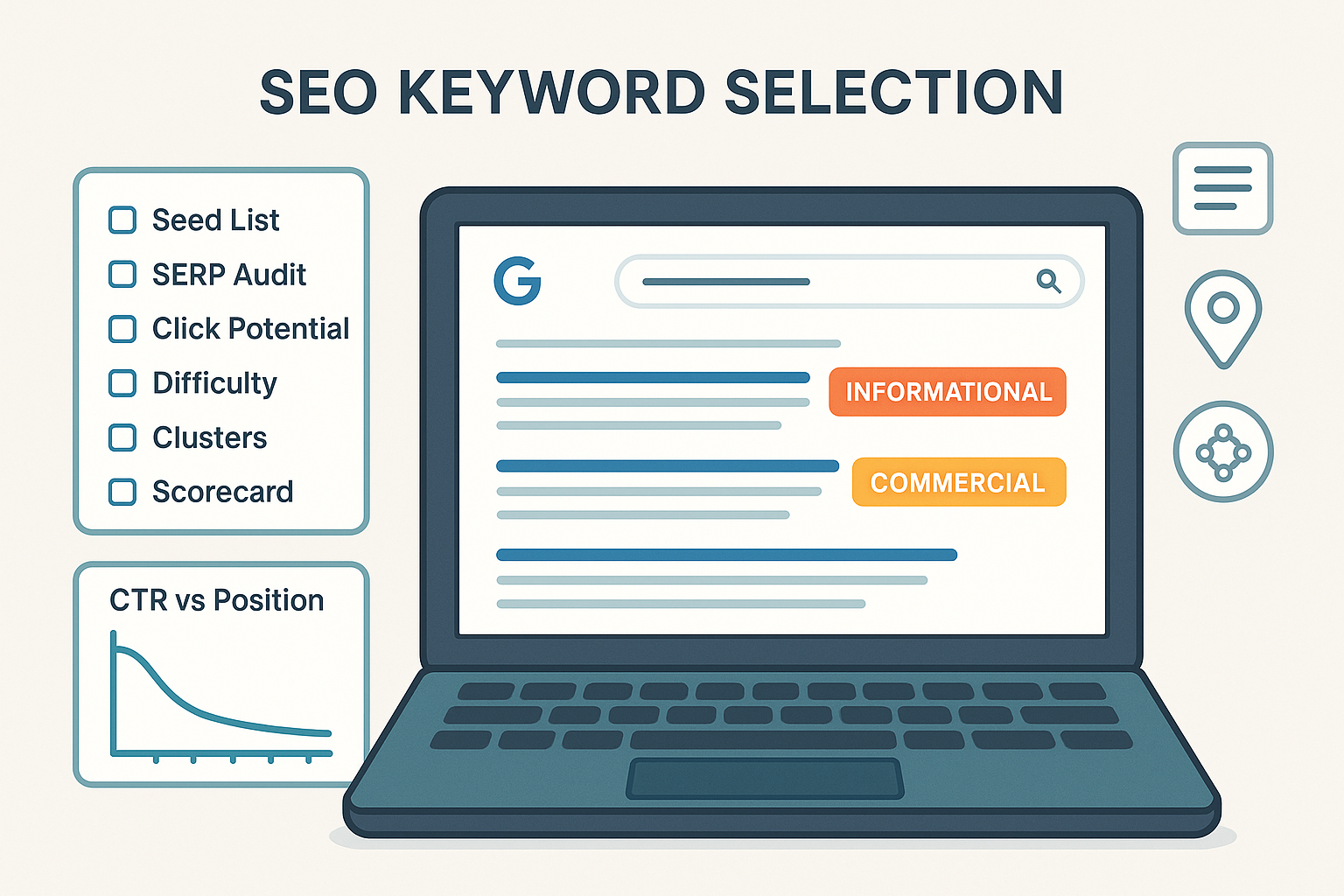
Picking the right keywords is about more than search volume. In this hands-on guide, you’ll build a focused list of keywords, evaluate each one’s intent, click potential, and difficulty, cluster them into a plan, and verify your choices after publishing. Expect a practical, repeatable workflow you can complete without expensive tools.
- Time commitment: 3–6 hours for a first pass across 30–50 terms, plus periodic reviews
- Difficulty: Beginner to Intermediate
- What you’ll need: A browser, Google, Google Search Console access, one keyword tool (optional), and a spreadsheet
Why this works: You’ll align your topics with real user intent, prefer clicks over raw volume, and prioritize terms you can realistically win—exactly what Google emphasizes in its people-first guidance in the SEO Starter Guide (Google, updated 2025).
Step 1: Define your goals and constraints
Clarify what success looks like before touching a tool.
Do this:
- Identify your audience and their stage in the funnel (awareness, consideration, decision).
- List business outcomes for this content (email signups, trial starts, leads, sales).
- Set constraints: current site authority, resources, timeline.
Why it matters: Your keyword short list should connect to measurable value, not just traffic.
Checkpoint (5 minutes): Write one sentence per goal. If a keyword doesn’t serve one of these goals, it’s out.
Pro tip: If you’re brand new to SEO, skim the basics of what keywords vs. topics mean to avoid over-focusing on single phrases.
Step 2: Build a seed list (30–60 minutes)
Collect 30–50 candidate terms from multiple sources so you’re not biased by one tool.
Do this:
- Competitor pages: Search your core topic and list keywords from top pages’ titles/H1s and headings.
- Your site search and Search Console: Pull queries you already show impressions for.
- Customer inputs: Support tickets, sales calls, community threads, and FAQs.
- Tools (optional): Use any keyword tool to expand long-tail variants.
Why it matters: A wide, intent-diverse seed prevents tunnel vision.
Checkpoint: Tag each term with a rough intent (Informational, Commercial, Transactional, Navigational). If you struggle, you’ll fix it in Step 3.
Step 3: Evaluate search intent via a quick SERP audit (45–90 minutes)
Intent determines the content format that can win.
Do this for each candidate:
- Google the keyword in an incognito window.
- Skim the top 3–5 results. Note dominant page types: guides, listicles, comparisons, product pages, local packs, videos.
- Identify the intent the SERP clearly favors (informational vs. commercial, etc.). If the top results are “best X” lists with affiliate angles, that’s commercial investigation; if they’re how-to guides, that’s informational.
- Note SERP features: featured snippet, People Also Ask, local pack, shopping, videos, knowledge panels, or AI Overviews.
Why it matters: Matching the format and angle the SERP rewards drastically increases your odds. For deeper context on intent patterns and how to optimize for them, see Backlinko’s concise Search Intent hub (Backlinko, 2025 update).
Verification: Your planned content format should mirror what ranks. If the SERP is dominated by product pages and your idea is a general guide, either pick a more commercial term or shift your format.
Internal deep-dive: For a friendly walkthrough on identifying and acting on intent, read The Power of User Intent in SEO.
Step 4: Estimate click potential, not just volume (30–60 minutes)
Two keywords with the same volume can have very different “click potential” depending on SERP features.
Do this:
- Use CTR-by-position ranges as a directional baseline. For example, in 2025 datasets, Position 1 often earns around 35–40% CTR, with steep drop-offs thereafter; see the Google CTRs by ranking position (First Page Sage, 2025) for a broad benchmark.
- Adjust for SERP features that suppress clicks. AI Overviews, featured snippets, knowledge panels, local packs, and shopping carousels can significantly reduce available organic clicks. Advanced Web Ranking’s ongoing reports show variability by SERP makeup; check a recent update like the 2025 Q2 CTR analysis (Advanced Web Ranking) to calibrate expectations.
- Rough estimate: Click potential = Estimated volume × Expected CTR for your likely position × Adjustment factor for SERP features (e.g., 0.6 if heavy zero-click elements are present).
Why it matters: You’re prioritizing traffic you can actually capture, not theoretical demand.
Verification: After publishing, compare your page’s CTR at a given average position in Google Search Console to your estimate. If it’s materially lower, revise your title/meta and snippet alignment or target a more specific variant.
Step 5: Assess difficulty and competitor strength (60–120 minutes for 30–50 terms)
Quantify how hard it will be to rank before you commit.
Do this:
- Manual scan: For each top-ranking page, note brand strength, topical depth, content freshness, and number/quality of referring domains (use any backlink checker with a free tier).
- Tool KD (optional): Use a single platform’s “Keyword Difficulty” to compare terms within that tool. Don’t compare KD scores across different tools; formulas differ. For a plain-English overview of common keyword metrics and KD caveats, read the Semrush keyword metrics explainer (Semrush).
- Authority gap: If the SERP is dominated by high-authority domains and your site is small, favor longer-tail variants or plan to build supporting cluster pages first.
Why it matters: You want a portfolio of “near-term wins” and a few “stretch” targets, not a list of unwinnable head terms.
Verification: If your content is high quality and you still sit beyond page 2 after 8–12 weeks, the authority gap may be too wide—pivot to easier variants and build topical authority.
Step 6: Cluster keywords and map to pages (60–90 minutes)
Prevent cannibalization and build topical authority with a simple pillar–cluster plan.
Do this:
- Group terms by shared intent and overlapping SERP results.
- Assign one primary keyword to a pillar page (broad overview), then map related long-tails to cluster pages (narrow subtopics). Interlink pillar ↔ clusters.
- Avoid creating two pages for the same intent; merge or differentiate angles if overlap occurs.
Why it matters: A structured hub-and-spoke makes it easier for users (and search engines) to navigate your expertise. For a strategic overview, see Moz’s topic clusters guide (Moz).
On-page prep: When you’re ready to draft, refresh your titles, descriptions, and headings based on Google’s guidance on influencing title links (Google, 2025) and meta descriptions. If you need a practical refresher on page elements, use this concise guide to understanding and implementing TDK for SEO and the broader tutorial on how to write SEO‑optimized articles.
Step 7: Prioritize with a simple scorecard (45–60 minutes)
Pick winners objectively by scoring each candidate 1–5 on these factors:
- Intent match: How closely can your planned format match the dominant SERP intent?
- Business value: How directly can this term lead to your desired outcome (lead, signup, sale)?
- Click potential: Based on Step 4’s estimate.
- Difficulty: Based on Step 5’s evaluation.
- Topical fit: Does it reinforce a pillar/cluster you’re building?
Add the scores and sort. Keep a balanced backlog: 60–70% “near-term wins,” 20–30% “medium,” 10–20% “stretch.”
Verification: Sanity-check your top 10 against the SERP again. If two terms produce nearly identical SERPs, choose one as primary and use the other as secondary in the same page.
Practical example: turning a seed into a short list (tool-assisted)
Suppose your seed is “email welcome series.” You run a SERP audit and see primarily how-to guides with some “best practices” listicles—clear informational intent with light commercial investigation.
Here’s where a lightweight assist can speed things up: QuickCreator can be used to turn a seed term into related topic suggestions with intent cues and suggested subheadings that mirror the dominant SERP format. Disclosure: QuickCreator is our product.
You could then pick a primary like “how to write an email welcome series,” attach secondary variants such as “welcome email best practices” and “welcome email examples,” and map them into a pillar (overview/how-to) with cluster posts (examples, templates). If you prefer a guided writing flow, the optional AI Blog Builder for SEO Quick Win can generate an outline aligned to your chosen intent and cluster plan.
Post‑publish: verify and iterate in Google Search Console
Do this:
- Performance report: Track clicks, impressions, average CTR, and average position for your target queries and mapped pages. Since late 2024, Google added a 24‑hour “Recent data” view to speed feedback loops; see the Recent data announcement (Google, Dec 2024).
- Compare CTR vs expectation: If CTR is low for your average position, test sharper titles and more descriptive meta descriptions. Ensure your opening section quickly satisfies the query so Google selects relevant snippets.
- Watch position trends: If impressions rise but position stagnates, enhance topical depth, add missing sections, and strengthen internal links from related cluster pages.
- Log changes: Keep a simple change log (date, action, result) to connect edits to outcomes.
Common pitfalls and how to fix them
- Zero‑click heavy SERP: If AI Overviews, snippets, and panels crowd the page, pivot to adjacent long‑tails with modifiers like “for beginners,” “templates,” “pricing,” “vs,” or “near me,” or expand into a pillar + clusters to catch a broader set of queries.
- High difficulty, low authority: Target micro‑intent variants first (e.g., “email welcome series for SaaS trials”). Publish 6–12 cluster pages to build authority before chasing head terms.
- Rankings stall at page 2+: Compare your draft to the top 3–5 pages. Add missing entities, refresh data, improve examples, and cite authoritative sources. Strengthen internal links to the target page.
- SERP volatility: Recheck the SERP weekly for 3–4 weeks before making drastic changes. Improve resilience with clearer structure, scannable sections, and occasional visual summaries.
- Over‑reliance on volume: Never pick a keyword on volume alone. Estimate click potential and business value first.
Quick checklists you can copy
Seed list (15–30 minutes):
- 8–12 terms from competitors’ ranking pages
- 8–12 from your Search Console queries
- 8–12 from customer Q&A and tools
SERP intent audit (per term, ~3 minutes):
- Dominant page type and angle recorded
- SERP features noted (snippet, PAA, local, shopping, video)
- Content format decision made (guide, list, comparison, product)
Click potential estimate (batch, 30 minutes):
- Expected position tier identified
- CTR range chosen and adjusted for SERP features
- Rough click potential calculated
Difficulty and authority gap (batch, 45–60 minutes):
- Top domains’ strength and content depth noted
- Referring domains reviewed (directionally)
- “Near‑term” vs “stretch” tagged
Clustering and mapping (30–45 minutes):
- Primary keyword chosen per page
- Secondary variants assigned
- Internal links planned (pillar ↔ clusters)
On‑page polish before publish (15–30 minutes):
- Titles and headings aligned with intent per Google’s title link guidance
- Meta descriptions summarizing value per Google’s snippet guidance (see SEO Starter Guide link above)
- Optional refresher: TDK basics and article structure via the internal guides linked in Step 6
References and further reading (selective)
- People‑first SEO basics in the SEO Starter Guide (Google, 2025)
- Understanding intent types in the Search Intent hub (Backlinko, 2025)
- CTR planning with the Google CTRs by ranking position (First Page Sage, 2025) and a recent 2025 Q2 CTR analysis (Advanced Web Ranking)
- KD and metric caveats in the keyword metrics explainer (Semrush)
- Topic hub strategy via Moz’s topic clusters overview (Moz)
Wrap‑up
If you follow this workflow—intent-first SERP audits, click potential over raw volume, realistic difficulty checks, and cluster mapping—you’ll choose keywords you can actually win and turn them into traffic that converts. Keep iterating in Search Console, and your list will get smarter every month.
