Google SEO vs Baidu SEO: What’s the Biggest Difference in 2025?

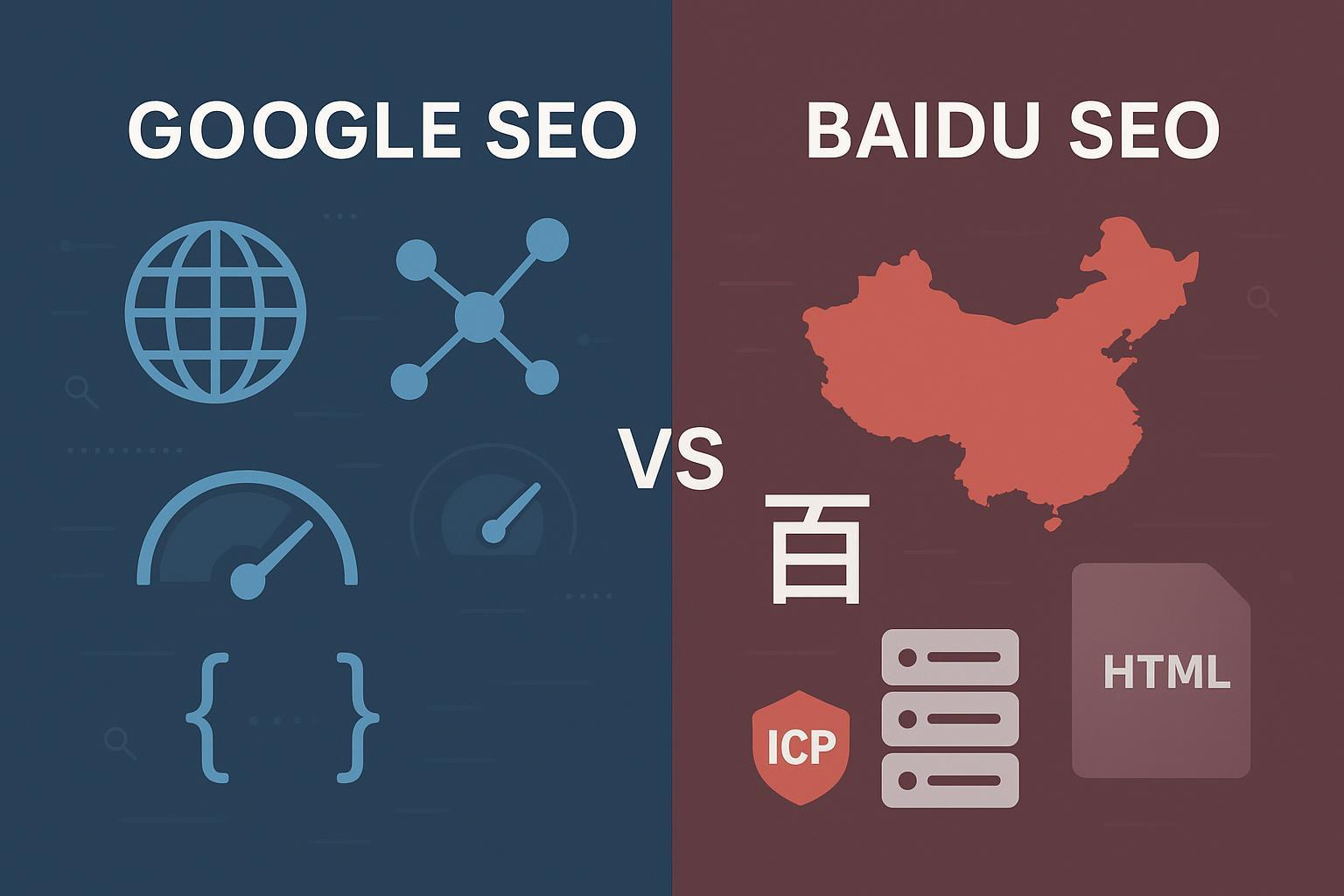
If you’re optimizing for both Google and Baidu in 2025, the single biggest practical difference is this: Baidu expects deep China-specific localization and compliance (Simplified Chinese content, mainland hosting performance, and ICP licensing), paired with an HTML-first, low‑JavaScript architecture. Google, meanwhile, rewards globally oriented, semantically optimized, JS‑friendly sites with structured data and Core Web Vitals excellence. The rest of this guide breaks down what that means in execution—neutral, evidence‑backed, and scenario‑focused.
Market scope and compliance: global vs. China‑centric
- Google remains the dominant global search engine in 2025, with roughly 89–90% share across devices, according to the latest aggregated datasets reported by Statista in 2025: see the global search engine market share 2025 (Statista).
- Baidu leads in mainland China (roughly 50–56% in 2025), and its ecosystem is built for Chinese users, language norms, and regulations.
For Baidu, mainland hosting and ICP licensing are not “nice‑to‑have”—they are foundational. The Ministry of Industry and Information Technology (MIIT) governs ICP filings and licenses; official cloud providers outline the process and requirements. For a plain‑language overview, see Alibaba Cloud’s ICP filing overview (official) (updated guidance referenced in 2024–2025). If you host inside China, file ICP (Bei’an for general sites; commercial license for e‑commerce/value‑added services), and follow PSB filing rules; this materially improves speed, stability, and typically your Baidu visibility.
By contrast, Google does not impose a single‑country licensing prerequisite. Your focus is on helpful content quality, E‑E‑A‑T signals, semantic intent coverage, mobile performance, and structured data.
Crawling, rendering, and indexing: JS‑capable vs. HTML‑first
- Googlebot’s pipeline is crawl → render (with headless Chromium) → index. In Google’s official guidance, JavaScript content is indexable when properly exposed; heavy client‑side rendering can slow things a bit, but is supported. See Google’s JavaScript SEO basics (Search Central) and the December 2024 crawling update referenced in Crawling December resources.
- Baidu Spider is widely documented to be less reliable with client‑side JS. The practical recommendation from seasoned China‑focused SEOs is to favor server‑rendered (SSR) or static HTML (SSG), minimize JS for core content, and ensure fast initial HTML delivery. Consolidated guidance appears in respected practitioner resources such as SEOSherpa’s Baidu SEO guide (2024/2025) and China performance/SEO specialists (e.g., Chinafy’s platform and docs).
Implication for architecture:
- If your site relies on CSR/SPAs for primary content, Google can typically render/index it; Baidu may not. For Baidu, treat SSR/SSG and progressive enhancement as baseline.
Sitemaps and URL submission: robust vs. manual‑leaning workflows
- Google provides robust sitemap support (including sitemap index files) and detailed status reporting in Search Console; see Google’s official Sitemaps documentation.
- Baidu supports XML sitemap and manual URL submissions via the Baidu Search Resource (Ziyuan) platform after site verification. However, whether Baidu fully supports sitemap index (sitemapindex) files remains uncertain in English‑language documentation: multiple Chinese webmaster guides suggest non‑support and recommend splitting sitemaps, while some third‑party posts imply support. Actionable takeaway: verify directly in Ziyuan’s submission interface and follow platform feedback; if in doubt, split large sitemaps into separate files and submit individually. A representative practitioner viewpoint appears in resources like Chinafy’s Baidu Webmaster Tools guide.
Ranking signals and content policies: semantic vs. exactness
- Google prioritizes E‑E‑A‑T, helpful content, Core Web Vitals, mobile‑first indexing, and structured data. These are articulated across official documentation and recurring guidance from Google Search Central.
- Baidu tends to reward exact‑match keyword clarity in titles and meta, Simplified Chinese content written for Chinese users, mainland speed, and local (.cn/.com.cn) backlinks. Seasoned China SEO guides consistently highlight these factors—see the detailed playbooks in SEOSherpa’s Baidu SEO guide (2024/2025).
Practical takeaway:
- Lean into semantic coverage and structured data for Google; avoid robotic exact‑match stuffing.
- Be literal and clear with keywords for Baidu, write in native Simplified Chinese, keep HTML clean and fast, and earn links from reputable Chinese domains.
Webmaster tools: GSC vs. Baidu Ziyuan
| Capability | Google Search Console | Baidu Webmaster Tools (Ziyuan) |
|---|---|---|
| Verification | DNS/HTML/file/token methods | Site verification in Chinese UI |
| URL Inspection | Detailed crawl/render/index status | Basic indexing status; manual URL submission |
| Performance Reporting | Clicks, impressions, CTR, queries, pages; export & API | Keyword/traffic insights via Baidu Tongji; less granular |
| Coverage & Crawl Stats | Rich coverage, crawl stats, indexation diagnostics | Crawl diagnostics; fewer granular statuses |
| Sitemaps | Full support incl. sitemap index | XML sitemap submission; index support status is unclear |
| Manual Actions & Security | Manual actions, spam reports, security issues | Quality checks; anti‑spam policies; documentation primarily in Chinese |
- In practice, GSC is more developer‑friendly, with strong APIs and detailed diagnostics. Ziyuan is improving but still leans on manual processes and Chinese‑language documentation.
SERP layout and ads ecosystems
- Baidu SERPs in many categories are ad‑heavy and include Baidu‑owned modules (e.g., Baijiahao, Zhidao), compressing above‑the‑fold organic real estate. While recent English‑language quantitative CTR studies are sparse, industry analyses continue to show these patterns; see the China SERP feature study summarized by Advanced Web Ranking’s China analysis (2024).
- Google separates ads and organic more clearly but increasingly features rich results (Knowledge Panels, Featured Snippets, and AI Overviews), which reduce traditional blue‑link visibility.
What to change in your stack and workflow
If you primarily target Google:
- Use semantic topic clustering, high‑quality editorial standards, and structured data.
- Monitor Core Web Vitals and mobile‑first best practices; see Mobile‑first indexing best practices (Google).
- Ensure JS is renderable and not blocked; follow Google’s JavaScript SEO basics.
- Complement with a content quality workflow; for practical tooling ideas, explore 13 Top SEO Content Quality Analysis Tools (2025).
If you primarily target Baidu (China):
- Architect for SSR/SSG, minimize JS for core content, and deliver fast initial HTML.
- Host in mainland China or use a compliant China CDN to improve speed and crawlability; pursue ICP filing/licensing. For step‑by‑step context, see Alibaba Cloud’s ICP filing overview.
- Write in Simplified Chinese, optimize titles/meta with clear, exact intent, and build links from reputable Chinese domains.
- Split and submit sitemaps directly in Ziyuan; monitor crawl diagnostics and indexing.
- For China‑specific tooling context and ecosystem overview, you can review Best generative engine optimization tools in China (2025).
Scenario guidance: choosing your path
- Global brand, China expansion imminent
- Legal/compliance first: establish or partner with a local entity; complete ICP/PSB filings.
- Re‑platform to SSR/SSG or prerender for Baidu; simplify JS.
- Host inside China (or at minimum, a compliant China CDN); test speed in major cities.
- Build local content and authority: Simplified Chinese copy, local backlinks, and Baidu Tongji analytics.
- SaaS or media site with heavy JS stack
- For Google, invest in performance budgets and hydration strategies; monitor render delays.
- For Baidu, introduce SSR/SSG or prerender for core routes; expose content statically.
- E‑commerce with multi‑market catalogs
- Segment catalogs and templates per market; avoid one‑size‑fits‑all.
- Use localized keyword research and metadata for Baidu; semantic topical coverage and structured data for Google.
Data and ecosystem context to keep in mind
- Google’s global scale and ongoing changes (e.g., AI Overviews) affect CTR and user paths; for macro context on search behavior, see Google search statistics and trends (2025 overview).
- Baidu’s ecosystem and governance mean compliance is a prerequisite, not an afterthought. Where English documentation is thin (e.g., sitemap index support, official JS guidance), follow platform behavior and expert consensus, and validate directly within Ziyuan.
Also consider: workflow help across markets (disclosure)
Disclosure: QuickCreator is our product. If you need to scale multilingual content workflows and maintain SEO consistency across Google and Baidu, QuickCreator offers AI‑assisted writing, multilingual generation, and integrated optimization guidance. Use it as an operational layer—plan compliance and technical stack separately.
For deeper guidance on building multilingual content processes, you can explore AI blog writing workflows and a fundamentals explainer on keywords vs. topics.
Bottom line
- The biggest difference in 2025: Baidu demands China‑specific localization and compliance plus an HTML‑first delivery model; Google favors semantic, JS‑capable, schema‑rich optimization.
- Choose architecture and workflows based on where your audience lives. For China, secure ICP, host inside the mainland, simplify JS, and write in native Simplified Chinese with exact intent. For global Google, invest in semantic coverage, Core Web Vitals, and robust structured data.
- Validate assumptions directly in each platform’s tools (GSC vs. Ziyuan), and iterate based on measured crawl/index behavior and market feedback.
