Google Merchant Center Approval for China-based Sellers Targeting the U.S. (2025): FAQ

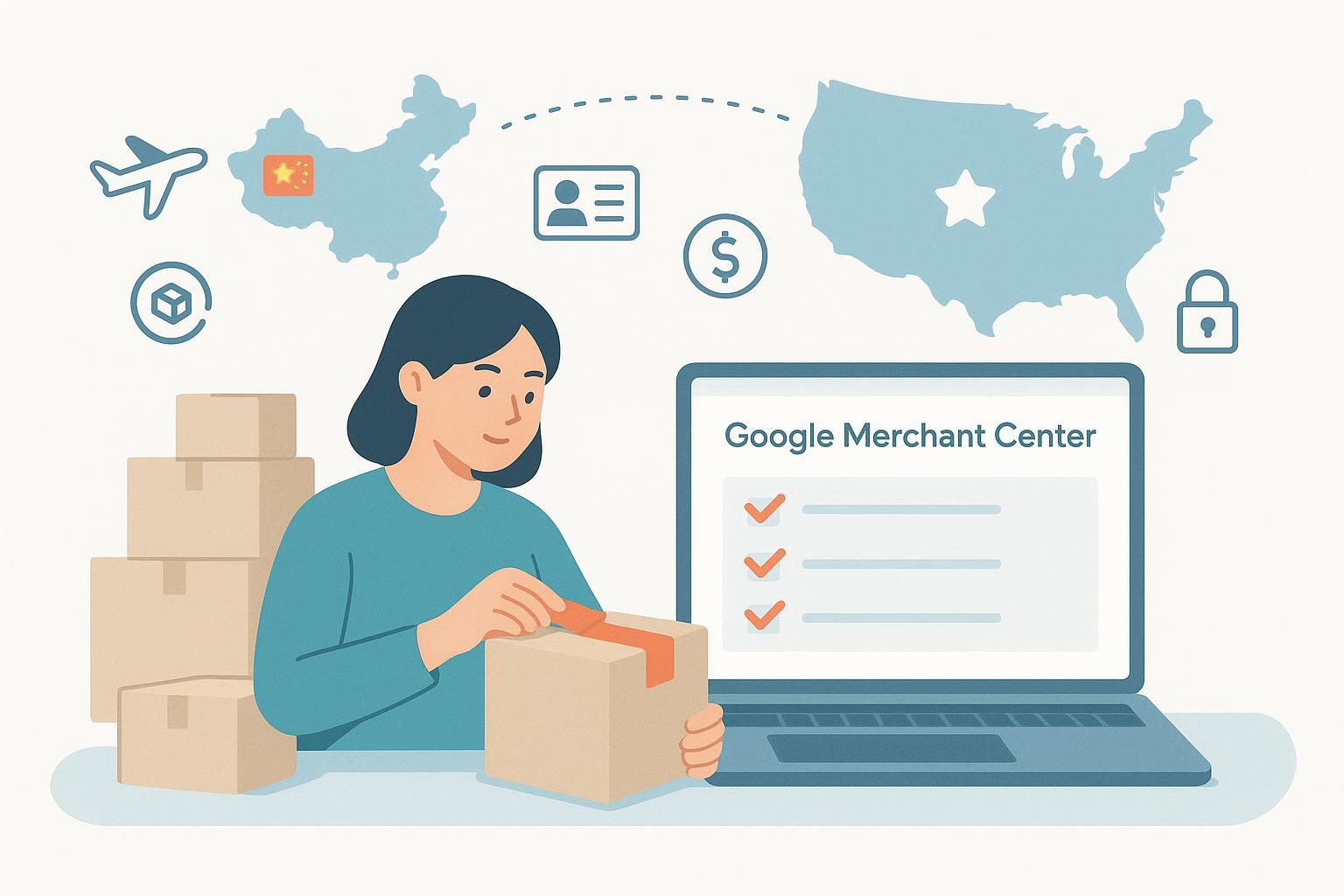
1) Can a China-based company get approved to sell to U.S. shoppers in Google Merchant Center?
Yes—being incorporated in China is not a disqualifier. Approval depends on meeting Merchant Center requirements for your website, product data, and policies.
Why it matters: Google’s systems care about compliance and shopper trust, not your registration country. You can target the U.S. by configuring your feed and account correctly, as described by Google Developers (2025) in the guide on targeting multiple countries.
Quick checklist:
- Your site is in English for U.S. shoppers and prices are in USD throughout the purchase flow
- Essential policies are visible: shipping, returns/refunds, terms, privacy
- Accurate product data that matches the landing page
- Realistic shipping times and costs for U.S. delivery
- Valid business and identity verification when requested
2) What actually determines our approval likelihood?
It’s conditional. The biggest drivers are trust and consistency: policy-compliant site, accurate product data, and transparent shipping/returns.
Why it matters: Most disapprovals stem from trust issues. Google’s Shopping ads policy on Misrepresentation (Google Merchant Center Help, 2025) emphasizes accurate business identity, truthful claims, and consistency between your feed and website.
Pass/fail signals to prioritize:
- Business identity and contacts: consistent legal name, physical address, and at least one reliable support channel
- Clear policies: returns/refunds (window, who pays return shipping), shipping methods/costs, privacy, and terms
- Accurate pricing/availability: no bait-and-switch, hidden fees, or mismatches between feed and landing page
- Secure checkout (HTTPS) and recognized payment methods
3) We got “Website or online store needs improvement.” What does that mean—and how do we fix it?
It’s a quality/trust catch-all. Google found your store lacks some essentials or has UX problems that could hurt shoppers.
How to diagnose and fix:
- Add or improve required pages: shipping, returns/refunds, privacy policy, terms
- Display clear contact info: email or form (and ideally phone or physical address)
- Ensure a secure, working checkout on HTTPS; no broken links or placeholder content
- Make product pages complete: accurate titles, detailed descriptions, images, price, availability, and variant clarity
- Keep all prices, currencies, and availability in sync across feed and site
Tip: Treat the site like a U.S. buyer would—can they see costs, delivery times, and the return process before purchasing?
4) What is “Misrepresentation” and how do we avoid it?
Misrepresentation covers deceptive or confusing practices (e.g., inconsistent business info, unrealistic claims, or hidden costs). Avoid it by being precise and transparent.
Practical steps:
- Keep your company name, address, and contacts consistent across your site, Merchant Center, and any linked accounts
- Match feed data to landing pages for price, currency, and availability
- Don’t overpromise delivery or product capabilities; disclose material limitations
- Show the full price early (no surprise fees at checkout)
Reference: See Google’s Shopping ads policy on Misrepresentation (Google Merchant Center Help, 2025) linked above in Q2.
5) What U.S.-specific website elements should we prepare (language, currency, legal pages)?
Provide a U.S.-native experience: English copy, USD pricing from product page to checkout, and standard legal pages.
What to include:
- Language and localization: clear American English; U.S. sizes/units where relevant
- Currency: prices in USD consistently; Google’s price attribute (Google Merchant Center Help, 2025) requires currency alignment with the target country and landing page
- Legal pages in the footer: shipping, returns/refunds, terms, privacy
- Contact details: a reachable channel (email/form and preferably phone or address)
6) How should we set shipping and realistic delivery windows for the U.S.?
Configure shipping services in Merchant Center and publish realistic timelines and costs on-site.
Actions:
- In Merchant Center, set up U.S. shipping services and rates using Google’s instructions on shipping settings (Google Merchant Center Help, 2025)
- Show practical delivery estimates; Google notes delivery time is handling plus transit—see estimated delivery time (Google Merchant Center Help, 2025)
- Mirror the same costs and delivery windows on your website and at checkout
- Avoid promising “2–3 days” if fulfillment actually takes longer from overseas
7) Do we need a U.S. return address to get approved?
Not necessarily. What matters is a feasible, clearly disclosed returns process for U.S. customers.
Best practices:
- Publish a returns/refunds policy with the return window, who pays return shipping, timelines for refunds, and where/how returns are processed
- If returns go to China or a third country, state expected timelines and costs clearly
- Offer at least one responsive support channel for return authorization and status updates
8) Which product data requirements most affect approval (for U.S. targeting)?
Accuracy and alignment. Your feed must match your site and U.S. targeting settings.
Focus on:
- Currency and price: USD in the feed and on landing pages; see the price rules noted in Q5
- Availability: keep in sync (in stock/out of stock) to avoid mismatches
- Attributes: provide required identifiers and correct GTIN/brand where applicable
- Variants: ensure size/color information and URLs map to the exact variant shown
9) What identity or business verification should a non-U.S. entity expect?
Expect website verification/claiming and possible identity checks for your ads account or payments profile.
What you may be asked for:
- Government ID and business registration as part of Advertiser identity verification (Google Ads API, 2025)
- Website domain verification and claiming for your store’s URL—see Google Developers (2025) on verifying and claiming your URL
- If requested, provide consistent business documents that match the legal name and address on your site and account
10) How long does initial review or a re-review take?
There’s no guaranteed timeline. Many accounts and product feeds are reviewed within a few days, but complex cases or appeals can take longer.
Tips:
- Submit for review only after you’ve corrected every issue and double-checked your site and feed
- Avoid repeated review requests without fixes—this can slow things down
- Keep a change log (what you changed, where, and when) to reference in any future appeal
11) We were disapproved or suspended—what’s the most effective way to appeal?
Fix root causes first, then submit a concise, evidence-backed appeal.
Step-by-step:
- Diagnose against Misrepresentation and site quality expectations (see Q2–Q4)
- Update policies (shipping, returns) and contact info; correct price/currency/availability mismatches
- Document fixes with screenshots and direct URLs (e.g., updated returns page, corrected product pages)
- In your appeal, state the issue in one sentence, list concrete fixes, and link to evidence; keep the tone factual and specific
12) Are there special rules for restricted products or dropshipping?
Yes—some categories have extra requirements, and dropshipping is fine if you’re transparent.
Guidance:
- Check category-specific Shopping policies for restricted or regulated items (e.g., medical devices, supplements); provide any required safety info or documentation
- For dropshipping, make sure your site shows accurate stock status, realistic delivery estimates, and a workable returns process—even if a supplier ships on your behalf
- Keep your business identity and responsibility clear to shoppers; you’re the seller of record
Final notes for China-to-U.S. applicants
- Incorporation location isn’t the barrier—transparency and consistency are
- Treat every page and data point as evidence of trust: identities, prices, availability, shipping, returns
- When in doubt, align your site and feed with Google’s official guidance cited in this FAQ and set expectations realistically for U.S. buyers
