How to Build a Google Ads PPC Plan in the United States with a $40,000 Monthly Budget (2025)

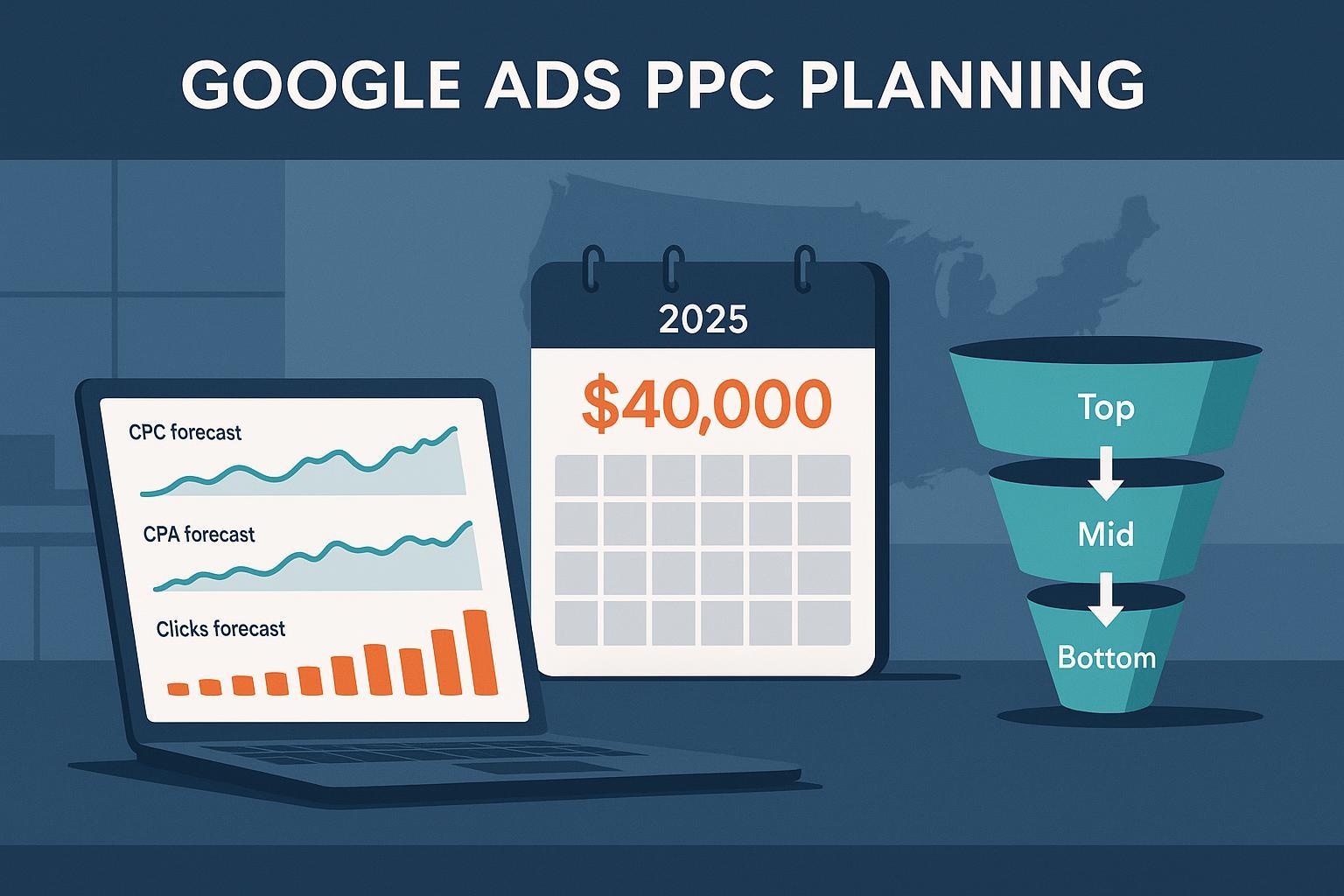
If you manage around $40,000 per month in Google Ads, the difference between a “good” plan and a “great” plan often comes down to two things: how you allocate the budget across the funnel and how you forecast—and then react to—CPC and conversion rate volatility. Below is the workflow I use in 2025 to stand up a reliable plan, pressure‑test the numbers, and give myself clear operating rules when conditions change.
Step 1: Ground your plan in current (2025) benchmarks
Benchmarks aren’t targets, but they anchor reasonable assumptions when you lack recent first‑party data. In 2025 US Search, many accounts see an overall CPC near the mid‑$5 range and typical conversion rates in the high‑single digits. Industry dispersion remains large, so always adjust to your vertical.
- For cross‑industry CPC, CVR, and CPL reference points, see the 2025 table from WordStream’s 2025 Google Ads Benchmarks (published 2025). Their dataset highlights significant differences by vertical (e.g., legal vs. auto service).
- For corroborating US averages (including CPC around the mid‑$5s in 2025), consult LocaliQ’s 2025 Search Advertising Benchmarks.
Practical use:
- Start with your last 90 days of actuals. If your data is thin or stale, initialize with WordStream/LocaliQ and replace with your own numbers as soon as your new structure accrues statistically meaningful data.
- Create separate benchmark lines for brand vs. non‑brand, and for lead gen vs. e‑com (CPL/CPA and CVR differ materially).
Step 2: Allocate the $40,000 by funnel and campaign type
At this spend level, over‑segmentation is a real risk. Keep structure lean, fund learning adequately, and concentrate dollars where marginal CPA/ROAS performance is strongest.
A proven starting split for direct‑response goals:
- Bottom‑funnel (Brand Search, high‑intent Non‑Brand, Performance Max, Shopping): 50–65%
- Mid‑funnel (Remarketing, high‑fit audiences, mid‑intent Search): 20–30%
- Top‑funnel (YouTube, Discovery/Display awareness): 10–20%
Example allocation for $40,000/month:
| Funnel/Type | Campaigns | % of Budget | Monthly $ |
|---|---|---|---|
| Bottom | Brand Search; High‑intent Non‑Brand; Performance Max; Shopping | 60% | $24,000 |
| Mid | Remarketing; Mid‑intent Search; PMax nurture segments | 25% | $10,000 |
| Top | YouTube; Discovery/Display | 15% | $6,000 |
Where this works well:
- Direct‑response objectives with clear CPA/ROAS targets
- Adequate branded demand and strong product‑market fit (so bottom‑funnel can scale efficiently)
Trade‑offs and adjustments:
- If your brand volume is small, shift ~5–10% from bottom to mid/top to seed audiences and demand.
- For e‑commerce with large catalogs, allocate more to Performance Max/Shopping; for lead gen with complex qualification, fortify mid‑funnel remarketing and OCT (offline conversion tracking).
- Consider shared budgets across closely related campaigns cautiously; they can improve pacing but may mask cannibalization. For a practitioner’s perspective on when and how to use them, see TwoSpouts’ shared budgets guide.
Step 3: Forecast clicks, conversions, and CPA using simple, auditable math
Use transparent formulas so stakeholders can follow your logic and so you can re‑forecast quickly when inputs shift.
Core formulas:
- Clicks = Budget ÷ CPC
- Conversions = Clicks × CVR
- CPA (or CPL) = Budget ÷ Conversions
Base case (2025 average assumptions; replace with your vertical’s numbers):
- Budget = $40,000
- CPC ≈ $5.26 (US 2025 average reference from LocaliQ)
- CVR ≈ 7.5% (US 2025 average ballpark per WordStream/LocaliQ)
Calculations:
- Clicks ≈ 40,000 ÷ 5.26 ≈ 7,605
- Conversions ≈ 7,605 × 0.075 ≈ 570
- CPA ≈ 40,000 ÷ 570 ≈ $70
Notes:
- Many industry datasets label acquisition as CPL (cost per lead). If you’re lead gen, “CPA” here is functionally CPL unless you pass sales stage/value via OCT. WordStream’s 2025 overview mentions overall CPL in the ~$70 range; that aligns with this base case’s implied CPA.
Sensitivity scenarios (build these into your spreadsheet):
- If CPC rises +10% to $5.79: Clicks ≈ 6,907; Conversions ≈ 6,907 × 7.5% ≈ 518; CPA ≈ $77
- If CPC falls −10% to $4.73: Clicks ≈ 8,457; Conversions ≈ 8,457 × 7.5% ≈ 634; CPA ≈ $63
- If CVR improves +1 percentage point to 8.5%: Conversions ≈ 7,605 × 8.5% ≈ 646; CPA ≈ $62
- If CVR drops −1 percentage point to 6.5%: Conversions ≈ 7,605 × 6.5% ≈ 494; CPA ≈ $81
Implementation tips:
- Forecast at the channel/campaign cluster level (e.g., Brand, Non‑Brand, PMax, YouTube). Then roll up to account level. This makes re‑forecasting manageable when one cluster deviates.
Step 4: Translate allocation into a practical campaign structure
Lean, intent‑aligned structures tend to outperform sprawl at this budget.
Bottom‑funnel (≈$24,000):
- Brand Search: Exact/Phrase on core brand + key products. Tight negatives to avoid support queries.
- High‑intent Non‑Brand Search: Focused themes with tested ad groups; Broad match can work with strong Smart Bidding and negatives.
- Performance Max: Use high‑quality creative, product feeds (if e‑com), audience signals (first‑party lists, high‑value segments). Exclude brand if you need clean non‑brand measurement.
- Shopping (if e‑commerce): Clean feed taxonomy, profit‑based priorities, and negative term hygiene.
Mid‑funnel (≈$10,000):
- Remarketing: Site visitors segmented by recency, depth, and product/category. Consider PMax nurture asset groups.
- Mid‑intent Search: Problem/solution queries, competitor comparisons, and category terms with tighter CPA guardrails.
Top‑funnel (≈$6,000):
- YouTube: Skippable in‑stream with strong hooks; segment by in‑market and custom intent. Use view‑through windows for learning but optimize to conversions where possible.
- Discovery/Display: Emphasize high‑fit audiences; cap frequency.
Bidding strategy selection (by data sufficiency):
- New/low‑data campaigns: Maximize Conversions (or Maximize Conversion Value for e‑com) to collect signal.
- Stable volume (≥15–30 conversions/30 days per campaign/portfolio): move to Target CPA or Target ROAS for tighter control. See Google’s primer: Automated bidding (Smart Bidding) overview.
Attribution and measurement essentials:
- Use GA4 key events aligned with Google Ads conversions; default to data‑driven attribution (DDA) for multi‑touch credit.
- Enable Enhanced Conversions to improve match rates in a privacy‑constrained environment; for lead gen specifics, see Google’s Enhanced Conversions for leads.
- If you’re lead gen, implement Offline Conversion Tracking (OCT) to feed actual sales stages or revenue back into bidding.
Step 5: Define pacing, guardrails, and your operating cadence
Two mechanics to remember about budgets in Google Ads:
- On high‑opportunity days, Google may spend up to 2× your average daily budget, but you won’t be charged more than your monthly charging limit (average daily budget × 30.4). See Google Ads Help: About overdelivery and daily budgets.
- For a plain‑English recap of how monthly limits work in practice, see Search Engine Land’s explainer on monthly charging limits (2024; still accurate in 2025).
Operating cadence at ~$40k/month:
- Daily: Verify spend pacing, delivery status, CPC spikes/drops, and tag health. Scan search terms and placements for obvious waste.
- Weekly: Reallocate budget across clusters based on CPA/ROAS relative to target. Refresh negatives and audiences. Review asset coverage in PMax/YouTube.
- Monthly: Deep‑dive conversion quality, run at least one landing page/CRO test, evaluate bid strategy status (ready to shift to tCPA/tROAS?).
- Quarterly: Seasonal and scenario planning, including “CPC +15%” and “CVR −1pp” impacts, and cross‑channel mix reviews.
Pre‑committed guardrails (write them down):
- Scale rule: Increase budgets by 10–20% on clusters beating target CPA/ROAS by ≥20% for ≥14 days with stable volume.
- Pause/repair rule: If a cluster is >25% worse than target for 7 days and trending, pause tests, broaden queries/audiences, or shift to a more permissive bid strategy until stability returns.
- Shared budgets: Review weekly for cannibalization; if one campaign chronically starves others, split the budget.
Step 6: A worked example of $40,000/month with forecasts
Let’s translate the allocation into click and conversion forecasts using the base assumptions. Replace with your vertical’s CPC/CVR as soon as you can.
Assumptions:
- CPC = $5.26 overall blended (will differ by cluster)
- CVR = 7.5% overall blended (bottom‑funnel typically higher; top‑funnel lower)
Illustrative distribution of efficiency:
- Bottom‑funnel: CPC $5.50; CVR 10.0%
- Mid‑funnel: CPC $5.00; CVR 6.0%
- Top‑funnel: CPC $4.50; CVR 2.0%
Forecast table:
| Cluster | Budget | CPC | Est. Clicks | CVR | Est. Conversions | Est. CPA |
|---|---|---|---|---|---|---|
| Bottom | $24,000 | $5.50 | 4,364 | 10.0% | 436 | $55 |
| Mid | $10,000 | $5.00 | 2,000 | 6.0% | 120 | $83 |
| Top | $6,000 | $4.50 | 1,333 | 2.0% | 27 | $222 |
| Total | $40,000 | — | 7,697 | — | 583 | $69 |
How to use this:
- The mix yields an overall CPA near $69, consistent with 2025 broad CPL signals. But you’d hold the top‑funnel accountable to a view‑assisted or multi‑touch KPI (e.g., cost per engaged view, or assisted pipeline) while mid/bottom carry the efficiency target.
- If bottom‑funnel saturates (diminishing returns), shift 5% of budget from bottom into mid to expand audience pools without letting CPA run away.
Scenario checks:
- If CPC increases +10% for non‑brand and PMax (bottom‑funnel), recalc only that cluster; expect ~9% fewer clicks and proportionally fewer conversions—plan to offset with creative/LP tests.
- If CVR lifts +1pp in mid‑funnel after a CRO test, your blended CPA can drop several dollars—justify a reallocation to that cluster.
Step 7: Real‑world case insight and what to borrow
Public $40k+/mo disclosures with full metric detail are rare, but iterative optimization patterns are common. For example, a US medical clinic using Performance Max in late 2024 saw a competitive spike in March 2025 and recovered by May via improved audience signals, creatives, and negative keywords—conversions rose from single digits to dozens with controlled spend growth. Read the narrative in Sandyriev’s medical clinic case study.
What to apply at $40k scale:
- Treat PMax as a system: audience signals, creative variety, feed health (if e‑com), and brand exclusions where necessary.
- When auctions heat up, respond with creative/LP quality and audience refinement before simply escalating budgets.
Step 8: Common pitfalls (and fixes) at this budget level
- Over‑segmentation and budget dilution
- Symptom: Dozens of ad groups/campaigns with <$50/day each, stuck in learning.
- Fix: Consolidate by intent; give each campaign enough daily budget to gather statistically useful data.
- Tracking gaps and misattribution
- Symptom: Sudden CPA swings, inconsistent conversion counts across GA4 and Ads.
- Fix: Audit tags, ensure GA4 key events match Ads conversions, enable Enhanced Conversions, and pass offline outcomes back where possible.
- Cannibalization (Brand vs. Non‑Brand, PMax vs. Shopping)
- Symptom: Branded queries inflating non‑brand results; Shopping/PMax overlap.
- Fix: Use negatives/exclusions and clear campaign priorities; monitor search terms; consider brand‑excluded PMax to measure prospecting.
- Rigid bids that ignore data sufficiency
- Symptom: tCPA/tROAS applied too early; throttled volume and unstable CPA.
- Fix: Start with Max Conversions/Value; only move to tCPA/tROAS after 15–30 conversions in 30 days per entity.
- Ignoring budget mechanics
- Symptom: Perceived “overspend” day‑to‑day and reactionary cuts.
- Fix: Plan around monthly charging limits and expected overdelivery; pace to the month, not the day. See the Google and Search Engine Land resources cited above.
Step 9: When and how to adapt this plan
- E‑commerce with large catalogs: Increase PMax/Shopping share; target ROAS becomes the north star once you have reliable revenue tags.
- High‑consideration B2B: Expect lower CVR and higher CPL; invest more in mid‑funnel remarketing/nurture and OCT to avoid optimizing to unqualified form fills.
- Heavy seasonality: Build pre‑season audience pools at top/mid; budget‑front‑load in peak weeks; pre‑bake “CPC +20%” models.
- Limited brand demand: Reduce brand allocation; invest in non‑brand discovery and YouTube to build intent; ensure creative and LPs are education‑forward.
Step 10: Assets you should prepare before launch
- A living spreadsheet with: inputs (CPC, CVR, CTR), allocation by cluster, forecast math, and quick scenario toggles (+/−10% CPC, +/−1pp CVR).
- A change log and weekly reallocation plan, so decisions aren’t ad hoc.
- A measurement checklist: GA4 events, Google Ads conversion imports, Enhanced Conversions, and (if lead gen) OCT.
- A simple playbook for bid strategy transitions (e.g., Max Conversions → tCPA after stability and volume thresholds are met).
For additional budgeting context and examples of structuring daily/monthly budgets, see SearchAtlas’s Google Ads budget guide.
Appendix: Example daily budgets and monthly charging awareness
If you set $40,000/month, your average daily budget at the account level is ~$1,316 (40,000 ÷ 30.4). With overdelivery allowed, some days may spend up to ~2× that on strong‑opportunity days, but charges will reconcile to the monthly cap as defined by Google. That’s why pacing to the month and using alerting (scripts or platform rules) matters more than micromanaging single‑day fluctuations.
What to do next
- Plug your own CPC and CVR into the sample table and re‑forecast by cluster.
- Launch with the suggested split, but commit to weekly reallocations based on relative CPA/ROAS.
- Prioritize measurement quality (Enhanced Conversions and, for lead gen, OCT) so Smart Bidding can optimize to real outcomes.
With a disciplined allocation, transparent forecasts, and clear operating rules, $40,000/month is ample to hit aggressive performance goals while building durable mid‑ and top‑funnel momentum.
