How to Increase a Website’s Authority (2025)

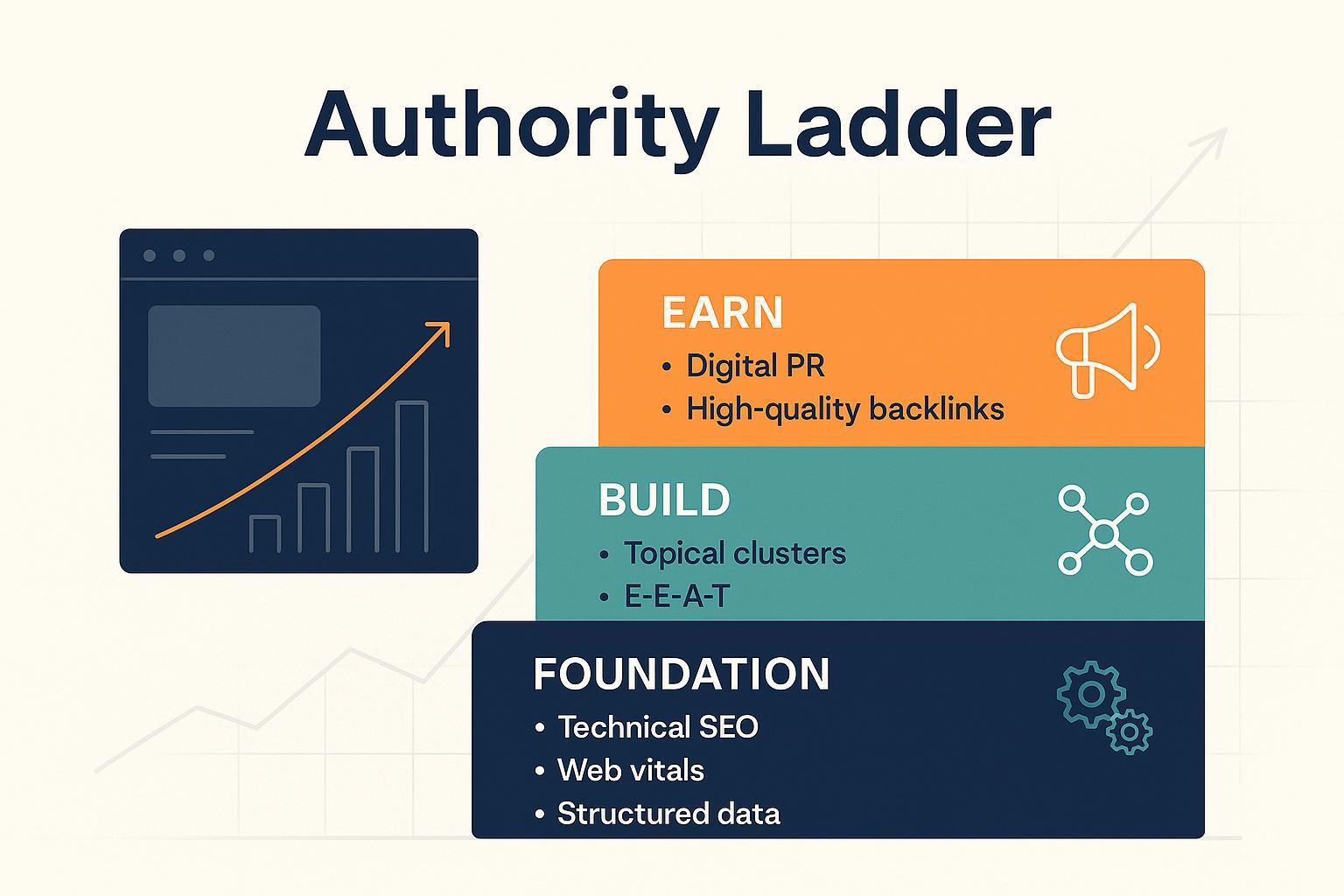
Authority is shorthand for how search engines and users assess your site’s credibility, topical depth, and usefulness. In 2025, that translates into consistent evidence of experience, expertise, and trust—plus a clean technical foundation and a healthy, editorial backlink profile. One essential clarification up front: popular metrics like DA/DR/AS are useful for benchmarking, but they’re not ranking factors. Moz states clearly in its 2025 overview that Domain Authority is a predictive score, not used by Google; treat it as a compass, not the destination.
Below is a practice-first framework I’ve used to raise site authority while staying aligned with Google’s systems and policies. Think of it as an Authority Ladder: Foundation → Build → Earn.
Foundation: Get the technical and structural basics right
Strong authority rarely survives weak infrastructure. I prioritize the following in the first month, then revisit quarterly.
-
Site architecture that reinforces topics
- Keep high-value pages within three clicks from the homepage; cluster related content under clear hubs. Avoid deep, brittle paths that bury context.
- Use descriptive, human anchors for internal links; link new articles back into existing hubs to prevent orphan pages.
-
Core Web Vitals and page experience
- Target LCP ≤ 2.5s, INP ≤ 200ms, and CLS ≤ 0.1 at the 75th percentile. Google replaced FID with INP on March 12, 2024—optimizing interaction latency is now critical. For precise thresholds and optimization guidance, the 2024–2025 Core Web Vitals overview on web.dev and the INP deep-dive article on web.dev are the definitive references.
-
Crawlability and indexation hygiene
- Clean up redirect chains, duplicate content, and inconsistent canonicals. Keep XML sitemaps current and robots.txt intentional. Monitor index coverage and server responses when rolling out structural changes.
-
Structured data for eligibility (not a magic bullet)
- Implement supported schema types relevant to your content (Article, Organization, Product, etc.) and validate with Google’s tools. The 2025 Search Developers introduction to structured data explains how markup improves eligibility for features but does not guarantee display.
-
Internal linking basics
- Place contextual links high on the page where they matter to readers. Interlink spokes within a hub and from spokes back to the pillar. The 2025 internal linking guide by Search Engine Land offers practical patterns worth adopting.
Practical checkpoint (quarterly): crawl the site, re-test Core Web Vitals, validate structured data, and audit internal links to fix orphaned or underlinked assets.
Build: Demonstrate topical authority and trustworthy expertise
Authority isn’t just volume of content; it’s coherent coverage and credible voices.
-
Create topic clusters that fully cover intent
- Pick 3–5 pillars tied to your audience’s core problems. For each pillar, map 8–15 spokes that address specific intents (how-to, comparisons, troubleshooting, definitions, advanced tactics). Shopify’s 2025 explainer on topical depth captures the approach well; see Shopify’s topical authority guidance (2025).
- Publish the pillar first, then roll out spokes weekly. Ensure every spoke links up to the pillar and sideways to closely related spokes.
-
Embed E-E-A-T in the content and metadata
- Attribute articles to real authors with relevant credentials; add author bios and organization details; cite primary data sources; show your experience (screenshots, processes, sample calculations).
- The 2025 Quality Rater Guidelines PDF clarifies evaluators’ focus on experience, expertise, authoritativeness, and trust. While not a direct ranking factor, these signals align with how helpful content is assessed.
-
Refresh and expand strategically
- Set a 90-day refresh cadence for top performers; add new questions, update data, strengthen examples, and re-check internal links.
- Add 2–4 new spokes per month in active clusters to maintain breadth and depth. Use Search Console query growth and coverage reports to prioritize.
-
Improve content quality with structured reviews
- Standardize briefs, outline uniqueness, insist on primary data or firsthand process documentation, and enforce peer review of claims.
- If your team needs a practical audit helper, this overview of SEO content quality analysis tools (2025) outlines how to assess E-E-A-T signals and helpfulness at scale.
A neutral, practical example using QuickCreator
When teams struggle to operationalize clusters and internal links, I’ve used an AI editor to speed up drafts without sacrificing review rigor. One workflow:
- Define a pillar (“B2B SEO strategy”) and 10 spokes (“topic clusters,” “internal linking,” “technical audits,” etc.).
- Generate first-pass outlines and drafts, then enrich them with your own screenshots, process steps, and data points.
- Publish the pillar; interlink all spokes to it, plus cross-link closely related spokes.
- Run a link audit to fix orphan pages and add descriptive anchors in the first 30% of each article.
For teams wanting a single tool for this drafting and linking cadence, QuickCreator can help manage block-based editing, multilingual SEO briefs, and internal link placement within a simple UI. Disclosure: QuickCreator is our product. Keep editorial control and fact-checking in-house—authority is earned through real expertise and careful verification, not automation.
- For detailed tactics on link structure and avoiding homogenized content patterns, see this internal linking tutorial used by content teams to harden hub-and-spoke structures.
Earn: Acquire editorial links safely and consistently
High-quality backlinks validate your site’s authority, but the how matters more than the count.
-
Publish linkable assets
- Original research, visual data summaries, technical teardown posts, or comprehensive guides. Pitch journalists and relevant newsletters with concise angles and assets.
-
Curate and pitch resource inclusion
- Build niche resource pages on your site and ask for inclusion on curated lists where your resource genuinely fills a gap.
-
Contribute expert perspectives
- Write for reputable industry publications; avoid mass guest posting on thin or irrelevant sites. Prioritize thought leadership over link quantity.
-
Community and events
- Webinars, workshops, and sponsorships can earn editorial mentions and links when the content is substantive and unique.
-
Risk management and compliance
- Follow Google’s 2025 spam policies, especially around link schemes, site reputation abuse, and scaled content. See the official Google Search spam policies (2025) for rel="sponsored"/rel="ugc" usage and prohibited behaviors.
-
Disavow with care
- Use disavow only if you have substantial, unremovable unnatural links and risk or have received a manual action. For most sites, better link hygiene and removal requests suffice.
The Authority Ladder: a 12-week roadmap
This is the cadence I’ve found realistic for small teams.
Weeks 1–2: Foundation
- Crawl the site; fix critical indexation issues and redirect chains.
- Implement or validate structured data for core page types; test in production.
- Optimize Core Web Vitals focusing on images, caching, code splitting, and interaction latency.
- Define 3–5 pillars and map 8–15 spokes per pillar.
Weeks 3–6: Build
- Publish pillar pages and 6–10 spoke articles; interlink hub ↔ spokes and spoke ↔ spoke.
- Add author bios, organization details, and citations to primary sources.
- Begin outreach planning for a linkable asset (research or visual report).
Weeks 7–10: Earn
- Launch the linkable asset and pitch 30–50 targeted contacts (press, industry blogs, newsletters).
- Request inclusion on 10–20 relevant resource pages.
- Contribute 2 expert articles to reputable publications tied to your niche.
Weeks 11–12: Consolidate and refresh
- Audit internal linking and orphan pages; add links high in the content.
- Refresh the top 5 performing posts with updated data, examples, and cross-links.
- Review Search Console query coverage and expand spokes where demand is growing.
Measurement: What to track (and what to ignore)
Track
- Search Console query growth across clusters, impressions, and CTR shifts.
- Crawl health: error rates, index coverage, canonical consistency.
- Core Web Vitals at the 75th percentile and trend over time.
- Editorial links from relevant domains; anchor relevance; new referring domains.
Treat as benchmarks, not goals
- DA/DR/AS trends for competitive context. Use them to spot momentum, not as KPIs.
What NOT to focus on in 2025
-
DA manipulation and vanity link chasing
- Buying low-quality links, submitting to spammy directories, or bulk guest posting on thin sites risks penalties and rarely builds real authority.
-
Excessive automation of thin content
- Scaled AI content without firsthand experience, verification, or value-add is flagged by modern systems and violates the spirit of helpful content.
-
Over-investing in deprecated or low-visibility rich results
- Mark up content correctly, but don’t depend on FAQPage/HowTo visibility for your strategy; eligibility and display have changed in recent updates. Use schema to clarify meaning and eligibility, not to “force” rankings.
Advanced guards and maintenance
- Server log reviews during major site changes to confirm crawl behavior.
- Quarterly structured data validations and spot checks on rich result eligibility.
- Author and source governance: enforce bios, citations to primary data, and revision histories.
- Internal link expansion: as clusters grow, add cross-links between spokes to surface related expertise.
- On-page audit cadence: lightweight checks help catch regressions. Many teams use curated tools via AI SEO Chrome extensions (2025) to streamline reviews.
Why this works (and where it doesn’t)
This ladder works because it aligns with how modern search systems evaluate usefulness and trust: fast, stable pages; coherent topical coverage; demonstrated expertise; and third-party validation through editorial links. It’s not a silver bullet—ultra-competitive YMYL niches or markets dominated by entrenched brands will require longer timelines, deeper expert collaboration, and often stronger digital PR to break through. In those cases, compress the Foundation work into month one, expand the Build phase across multiple quarters, and run ongoing, high-quality campaigns for Earn.
Sources worth bookmarking
- For link structure patterns and practical examples, use the 2025 internal linking guide by Search Engine Land.
- For structured data principles and eligibility, the 2025 Search Developers introduction remains canonical.
- For Core Web Vitals thresholds, consult the 2024–2025 web.dev Core Web Vitals overview and the INP deep dive.
- For E-E-A-T context in evaluations, refer to the 2025 Quality Rater Guidelines PDF.
- For safe link practices and prohibited behaviors, keep the 2025 Google Search spam policies handy.
Implement the ladder, measure honestly, and iterate. Authority accrues through consistent, verifiable quality—not shortcuts.
