How Often Should a New Site Publish? A Practical Cadence That Drives SEO Without Burning You Out

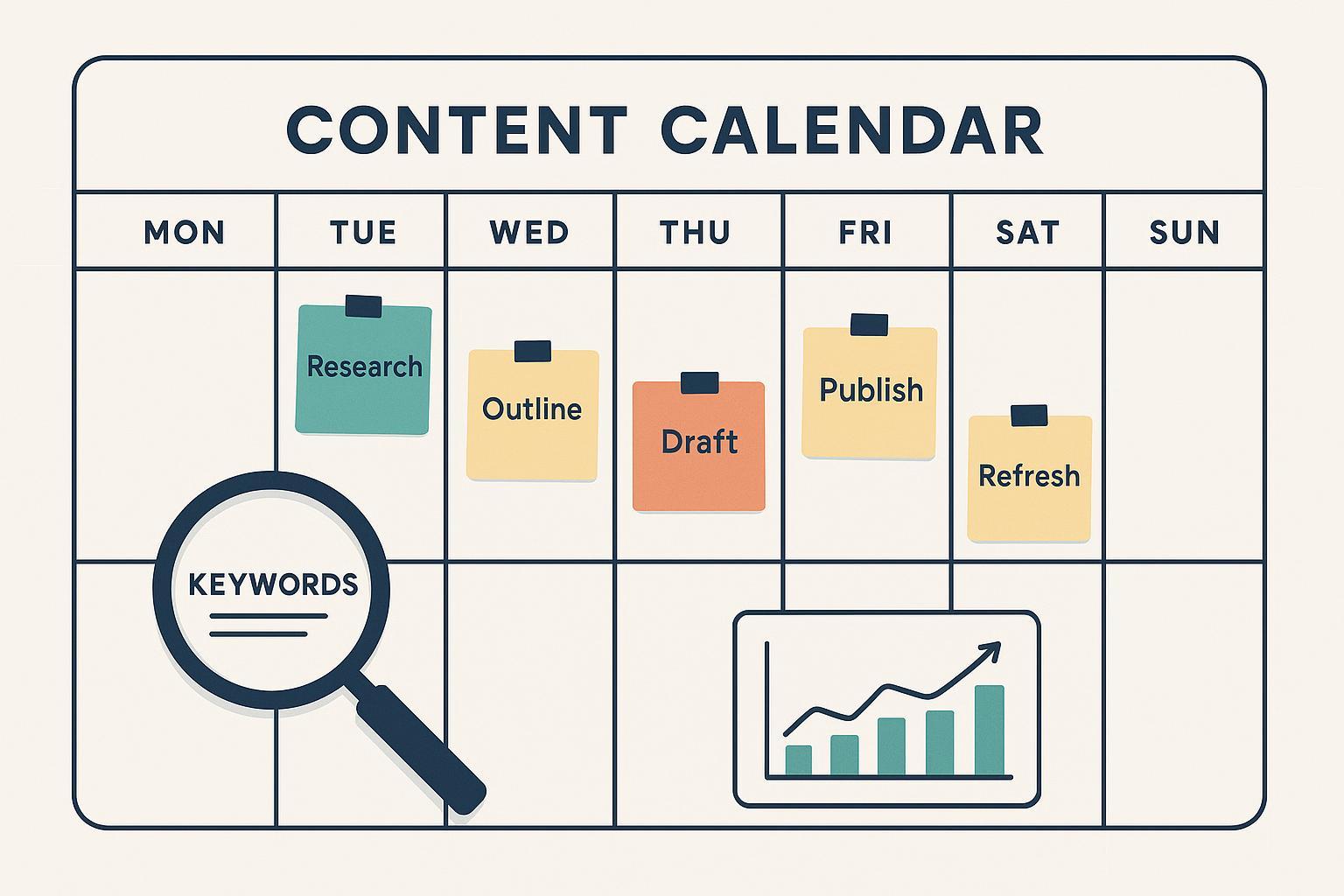
If you want a simple number, here it is: start with 1–2 high-quality posts per week and scale to 2–4 only when you can sustain quality, optimization, and updates. That’s the short answer. The long answer—and what actually gets results—is matching your publishing cadence to your resources, niche, and the workflow that keeps quality high.
Below is the field-tested framework I use for new sites. It’s built on recent guidance from Google and industry data, paired with what consistently works in practice.
A quick decision framework: pick your starting cadence in 60 seconds
Score yourself on each criterion below. If you score 4–5 in most rows, choose the higher cadence for your phase; if you’re at 1–3, start lower.
- Research capacity (hours/week):
- 1–3 hours = 1 post/week
- 4–6 hours = 1–2 posts/week
- 7–10 hours = 2–3 posts/week
- Writing/editing capacity (hours/week):
- 2–4 hours = 1 post/week
- 5–8 hours = 1–2 posts/week
- 9–12 hours = 2–3 posts/week
- SEO proficiency (self‑rated):
- Beginner = 1–2/week max
- Intermediate = 2–3/week possible
- Advanced = 3–4/week possible
- Niche competitiveness:
- Low = lower cadence can still win
- Medium = 1–2/week start, scale with quality
- High = consider 2–4/week if you can maintain standards
- Content quality threshold (be honest):
- If every piece is truly helpful, original, and intent‑focused → you can scale
- If quality slips under pressure → cap at 1–2/week and add updates
Tip: If you can’t allocate recurring time for updates and internal linking, don’t exceed 2/week. Publishing velocity without maintenance leads to content decay and diminishing returns.
What the latest evidence actually shows (without hype)
- Google’s 2024 core updates reinforced that the priority is helpful, original content—not sheer volume. As Google put it in March 2024, the aim was to show “less content that feels like it was made to attract clicks” and more that users find useful; see the announcement in the Google March 2024 Search update and the technical details in the Search Central core update and spam policies (2024). The August 2024 core update continued this emphasis on helpfulness and quality; see the August 2024 core update post.
- Publishing frequency correlates with better outcomes in industry surveys, but process quality matters just as much. Orbit Media’s ongoing survey (2024/2025 editions) shows that bloggers who publish weekly or more often and follow mature processes (editorial planning, collaboration, long‑form, visuals) more often report “strong results.” See the primary summary at Orbit Media’s Blogging Statistics. Treat this as directional correlation, not a causal guarantee.
- Blogging remains a reliable traffic and lead channel in 2025. HubSpot’s 2025 report highlights that a large majority of marketers attribute measurable results to blogging and plan to keep investing; see the HubSpot 2025 State of Blogging overview page for context.
- Crawl budget isn’t your constraint when you’re new. For small/new sites, Google notes that crawl budget management is primarily a large-site issue; your priority is site health, clear sitemaps, and strong internal linking. See Search Central’s crawl budget guidance.
- Updating content is a growth lever. Content decay is real—older posts lose rankings as intent and competition evolve. Clearscope explains how and why this happens in their overview of what content decay is and how to fix it. As a practical rule of thumb, Semrush recommends revisiting key posts every 3–6 months to maintain relevance; see Semrush on when to update blog content.
Bottom line: publishing more often increases your learning velocity and SERP coverage, but quality and maintenance are the multipliers. There is no ranking bonus for volume alone.
Recommended cadence by growth phase
These ranges assume you’re publishing intent‑focused, well‑optimized posts of meaningful depth (usually 1,200–2,000+ words for mid‑funnel topics; shorter for specific how‑tos) with clear internal links.
-
Launch (0–3 months)
- 1–2 posts/week to build initial topical clusters and internal link pathways.
- If you have a team and a nailed workflow, scale to 2–4/week, but only with rigorous QC.
- Focus on low‑competition queries and “jobs to be done” content to earn first impressions and clicks.
-
Growth (3–9 months)
- Sustain 2–4 posts/week only if quality remains consistent; many teams do better at 1–2/week plus 1 refresh/week.
- Add quarterly audits to identify winners to expand and decaying posts to fix.
-
Maintenance and scaling (9+ months)
- Balance new content (1–2/week) with updates (1–2 refreshes/week).
- Deepen topical authority with supporting articles, expert interviews, and original data.
Trade‑offs in practice:
- Higher cadence accelerates coverage but increases editorial load and risk of duplication/quality dips.
- Lower cadence can still win competitively if each page is uniquely helpful and you actively refresh high‑value posts.
A sustainable weekly workflow that scales your cadence
I’ve found the teams that sustain output year‑round rely on a simple, repeatable loop rather than heroics.
- Plan 4–8 weeks ahead
- Batch topic ideation around clusters, map keyword intents, and assign owners. If you’re new to planning, this walkthrough will help: Effective Planning of Blog Content.
- Outline with search intent in mind
- Draft outlines that mirror real user tasks and questions; pre‑plan internal links.
- Draft and fact‑check
- Write to solve the task completely. Add original examples, screenshots, and numbers where possible.
- Optimize pre‑publish
- Apply a consistent on‑page checklist: titles, meta, headers, schema where relevant, internal links, images with alt text. If you need a compact primer, see Mastering Blog SEO: A Beginner’s Guide.
- Publish, interlink, and request indexing
- Publish on a predictable day/time; add links to/from cluster pages; submit updated sitemaps if needed.
- Review and refresh
- Track impressions, CTR, and positions. Schedule refreshes every 3–6 months for priority posts. This tactical how‑to can help tighten your on‑page process: Writing SEO‑Friendly Blog Posts in 2025.
A practical tool example for sustaining 1–4 posts/week
Used judiciously, AI‑assisted workflows help teams maintain cadence without sacrificing quality. For example, a small team might use QuickCreator to turn SERP/topic recommendations into structured outlines, draft initial versions, apply automatic on‑page SEO checks, and push finished posts to WordPress in one click—then use built‑in analytics to flag refresh opportunities.
Disclosure: The example above uses our own product for illustration.
The key is oversight: keep a human editor responsible for intent alignment, originality, and final QA. AI can accelerate, but it shouldn’t decide what to publish.
Modern SEO considerations that affect your cadence
- E‑E‑A‑T signals: Incorporate first‑hand experience, cite original data, and get expert review where appropriate. Author bios and transparent sourcing build trust.
- Internal linking and crawlability: Keep important pages within ~3 clicks of the homepage. Fix broken links, minimize redirect chains, and ensure mobile/desktop link parity. For context on where crawl budget actually matters, see Google’s crawl budget documentation (most new sites don’t need to manage it explicitly).
- Freshness and content decay: Set a refresh cadence (3–6 months for key posts). If a post’s rankings or CTR slide, expand content to meet the evolved intent, update stats and examples, and reinforce internal links. Clearscope’s explanation of content decay is a useful primer.
- Alignment with recent Google updates: The thrust of the March and August 2024 updates is clear: helpfulness and originality. If increasing volume threatens either, scale back. See Google’s March 2024 Search update and the August 2024 core update for framing.
Two realistic starting scenarios (and expected timelines)
Timelines vary by niche and competition, but here’s what I typically see for new sites that stick to the plan.
-
Solo creator, new site
- Cadence: 1–2 posts/week for 12 weeks, then maintain 1/week plus 1 refresh/month.
- Expected signals: indexing and impressions within ~30–45 days; first top‑20 rankings by months 2–3; meaningful traffic gains months 3–6 as cluster depth grows.
- Watchouts: don’t chase volume at the expense of depth; keep outlines tight and add real examples.
-
Small business with a lean team
- Cadence: 3 posts/week for 6 months, plus biweekly refreshes to top posts.
- Expected signals: quicker coverage across the cluster, higher crawl demand, and measurable lead/assisted conversions by months 5–6 if technical hygiene is solid.
- Watchouts: editorial bottlenecks and duplicate intent; maintain a “one intent, one URL” rule.
Note: These are directional timelines; execution quality and niche difficulty dominate the outcome.
Common pitfalls when increasing publishing volume
- Publishing thin variants that target the same intent (keyword cannibalization)
- Over‑relying on AI drafts without human originality or verification
- Skipping internal links and schema opportunities
- Ignoring updates for posts that are slipping on CTR or position
- Letting calendars drift—missing 2–3 weeks often sets you back a full month
When these recommendations don’t fit (and what to do instead)
- News and trending topics: Cadence can spike daily; build lighter, rapid‑publish workflows and prioritize speed plus accuracy.
- Ultra‑niche sites: Lower volume can still dominate; put energy into depth, references, and expert validation.
- Local‑only service businesses: A smaller set of evergreen service pages and occasional posts/updates may outperform a high‑volume blog. Focus on FAQs, case studies, and local authority signals.
Metrics and review rhythm to keep your cadence honest
Track weekly:
- New posts published and updated
- Indexing status, impressions, average position (Search Console)
- CTR on priority pages, and internal link additions
Review every 30 days:
- Identify posts with rising impressions but flat CTR (improve titles/meta and snippet coverage)
- Spot decaying posts (slipping positions) and schedule refreshes
- Check topic coverage within clusters; plan supporting posts
Quarterly:
- Full content audit—merge thin pages, consolidate overlapping intents, expand winners
- Re‑score your capacity and adjust cadence up or down
Sample two‑week calendar you can reuse
Week A
- Mon: Research + outline Post 1 (Cluster A)
- Tue: Draft Post 1; outline Post 2 (Cluster A)
- Wed: Edit/optimize Post 1; internal links; publish
- Thu: Draft Post 2
- Fri: Edit/optimize Post 2; publish; log candidates for refresh
Week B
- Mon: Refresh a high‑value post; add updated stats and links
- Tue: Research + outline Post 3 (Cluster B)
- Wed: Draft Post 3
- Thu: Edit/optimize Post 3; publish
- Fri: Technical hygiene (fix links, check Core Web Vitals), plan next week
Keep this cadence for 8 weeks, then evaluate your bandwidth and results.
Quick answers to the most common questions
- Is frequency a ranking factor? Not directly. Quality and usefulness are, per Google’s 2024 updates. More content only helps if it’s good content.
- How long until I see results? Expect early signals in ~30–45 days and meaningful growth in 3–6 months in many niches, with variance by competition and execution.
- Should I pause new posts to update old ones? Yes—if a page is decaying or close to a key threshold (e.g., positions 11–20), a refresh can outperform a new post this week.
- What’s the best day/time to publish? Pick a predictable schedule your team can hit. Consistency beats chasing the mythical “perfect” time.
Next steps
- Choose your starting cadence (1–2/week for most new sites), map one topical cluster, and schedule 8 weeks today.
- Implement the workflow above and add a simple refresh rhythm (3–6 months for priority posts).
- If you need help scaling without adding headcount, consider trying QuickCreator for outlines, SEO checks, and one‑click publishing while keeping a human‑in‑the‑loop editor.
References for further reading
- Google’s framing of helpful, original content: March 2024 Search update and August 2024 core update
- Correlations between process, frequency, and outcomes: Orbit Media’s Blogging Statistics
- Blogging ROI context: HubSpot 2025 State of Blogging
- Crawl budget basics for when you eventually scale: Search Central’s guidance
- Why and how to prevent content decay: Clearscope on content decay and Semrush on update cadence
