How long should a blog post or article be? How does word count impact SEO?

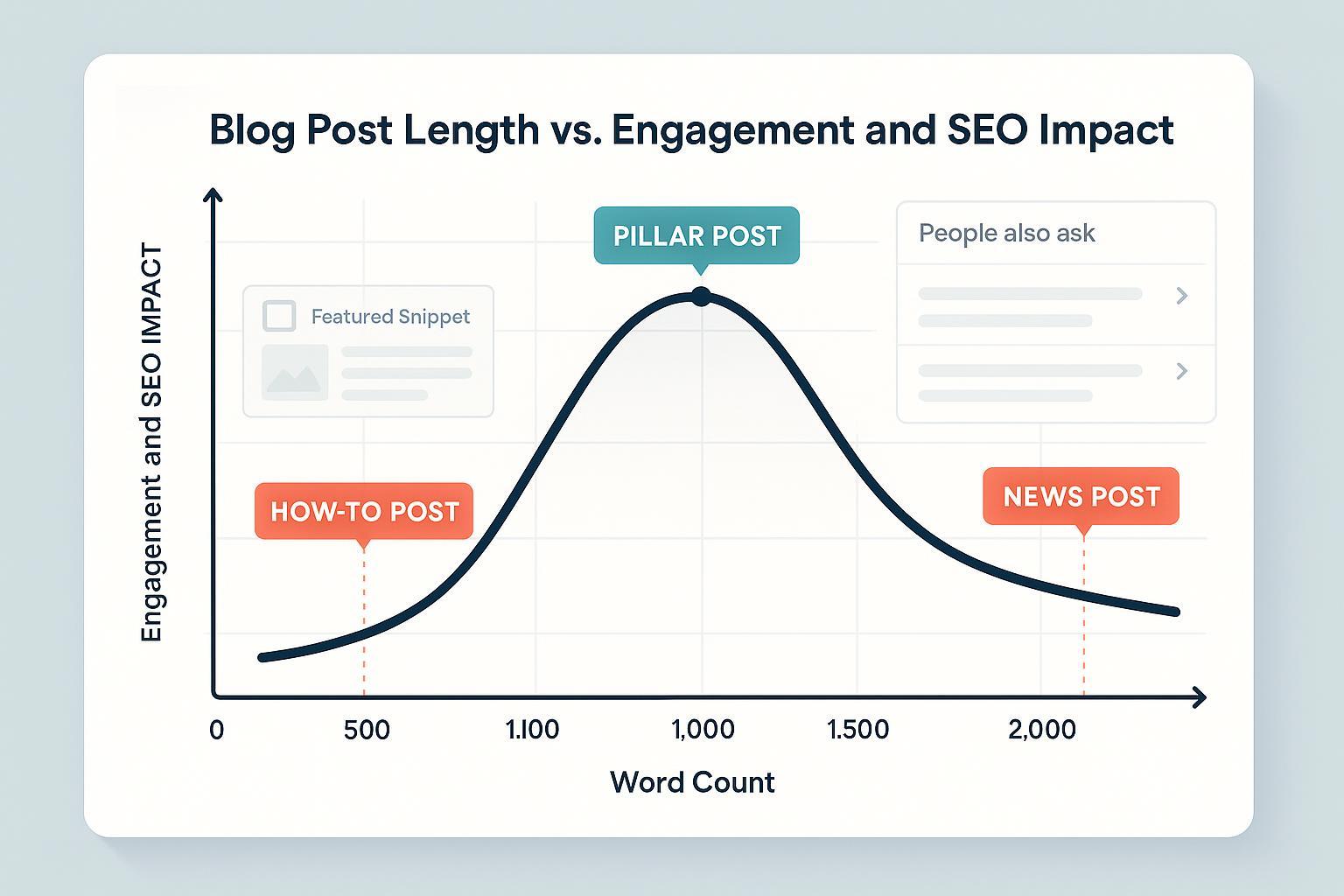
If you’re looking for a magic number, you won’t find it. Word count is not a ranking factor. What moves the needle is how completely you satisfy the searcher’s intent with helpful, trustworthy content. In practice, that means choosing a length that matches topic complexity and the competitive SERP, then validating with post-publication metrics.
What Google actually says about word count
Google’s guidance prioritizes helpful, people-first content and technical soundness—not length. The SEO Starter Guide (Google, ongoing) emphasizes relevance, crawlability, and clear structure; word count is never listed as a ranking signal. Likewise, the Search Quality Evaluator Guidelines (Google, 2024 PDF) focus on Page Quality and Needs Met via E‑E‑A‑T, not numeric thresholds.
Core updates in 2024 reinforced this stance: improve usefulness and overall quality, not volume. See Google’s August 2024 core update post for the emphasis on helpful content rather than arbitrary length.
Benchmarks: useful ranges by content type (context, not rules)
Industry data can help you set expectations, but treat it as a starting point, not a prescription.
- In Orbit Media’s long-running survey, average blog post length sat around 1,400+ words in 2024–2025; longer, more in‑depth posts correlate with stronger results when they genuinely add value (sample ~1,000+ bloggers). See Orbit Media’s 2025 blogging statistics.
- Backlinko’s study of 11.8M search results found the average first-page result contains ~1,447 words and that backlinks correlate strongly with higher rankings; length alone does not determine position. See Backlinko’s 11.8M Google results analysis.
- Practitioner guidance often recommends ~2,100–2,400 words for comprehensive blog posts when the topic merits depth. See HubSpot’s blog SEO guidance for context.
Working ranges by content type
| Content Type | Typical Range | When to go shorter | When to go longer |
|---|---|---|---|
| How‑to/tutorial | 1,500–2,500 | Simple, single‑task steps | Multi‑step, complex workflow with visuals |
| Pillar/ultimate guide | 2,500–3,500+ | Narrow, well‑defined scope | Topic hub covering subtopics, internal links |
| News/press update | 300–600 | Brief announcement | Add background, quotes, context if warranted |
| Local service page | 700–1,200 | Single service, clear intent | Multiple services, FAQs, trust signals, processes |
| Product review/round‑up | 800–1,800 | Single product, few differentiators | Detailed comparisons, testing methodology |
These ranges summarize common practice across niches; always benchmark your live SERP before deciding.
A practitioner workflow to set the right length
Use this repeatable process to pick a word count that aligns with intent, competition, and your resources.
- Define search intent and topic scope
- Classify intent (informational, transactional, navigational). List the subquestions your audience expects the page to answer.
- Benchmark the SERP
- Analyze the top 8–10 results for your primary keyword: approximate word counts, H2/H3 patterns, media usage, FAQs/PAA coverage, and presence of featured snippets. Aim to match or slightly exceed the average only when your topic genuinely requires more depth.
- Assess topic complexity and reader expectations
- If the topic involves multi‑step instructions, nuanced comparisons, or domain expertise, lean toward 2,000–3,000+ words. For simple updates or single‑answer queries, concise often wins.
- Identify coverage gaps and unique value
- Note what competitors miss: original data, case examples, visuals, expert quotes, or clearer explanations. Plan to fill those gaps.
- Draft for scannability
- Use descriptive H2/H3s, short paragraphs, bullets, tables, and visuals. Longer pieces must be easier to scan than shorter ones.
- Optimize and publish
- Nail fundamentals: title/meta, structured headers, relevant schema, internal links to clusters/pillars, alt text, and fast loading.
- Monitor and iterate
- Track engagement and search metrics weekly for 6–8 weeks; refresh if intent or SERP shifts.
Example: using an AI assistant to calibrate length
On a practical level, platforms can help you translate the steps above into time savings. QuickCreator can pull current SERP patterns, suggest a target length based on live competitors, and generate an outline that covers common People Also Ask questions. Its integrated analytics then surface engagement time, scroll depth, and keyword performance so you can iterate without guesswork.
Disclosure: QuickCreator is our product.
How to validate if your chosen length helps SEO
You’re validating usefulness, not just size. Measure whether the content keeps readers engaged and satisfies queries.
-
Engagement depth (GA4)
- Track average engagement time and set up a scroll‑depth event to see whether readers reach core sections. GA4’s capability to define custom metrics is documented in Google’s GA4 custom metrics guide.
-
Search performance (Search Console)
- Monitor impressions, average position, and CTR for your primary queries through Search Console Insights/About. Watch how metrics move after refreshes.
-
Technical UX: Core Web Vitals
- Longer pages must still be fast and stable. Keep LCP under ~2.5s, INP around ~200ms, and CLS under 0.1 per Google’s Core Web Vitals documentation.
-
Off‑page signals
- Track growth in quality referring domains. Backlinko’s 11.8M‑result study showed top pages earn materially more backlinks; length is not the driver—the value is. Reference the Backlinko study above for context.
Timeframes and refresh cadence
- Initial evaluation window: 6–8 weeks post‑publish.
- Refresh triggers: intent changes, new SERP features, declining engagement time, or competitor upgrades.
- Refresh tactics: update data/quotes, add missing subsections, improve visuals, tighten fluff, adjust internal linking.
Scenarios and how to choose the right length
-
How‑to/tutorials
- Start near 1,800–2,200 words if the steps are moderately complex. If a small subset of readers needs deeper context, consider a separate advanced post and cross‑link.
-
Pillar/ultimate guides
- Build comprehensive hubs at 3,000+ words if the topic anchors a cluster. Use jump links, table of contents, and strong internal linking. Length supports breadth here, but only if each section answers an expected question.
-
News and press updates
- Keep it tight—300–600 words—unless the story requires context or stakeholder quotes. Speed and clarity beat verbosity.
-
Local service pages
- Aim for 700–1,200 words, emphasizing detailed service descriptions, process transparency, FAQs, trust elements (reviews, certifications), and local signals (NAP consistency). The right length is the one that removes buyer uncertainty.
-
Product reviews and roundups
- For single‑product reviews, 800–1,200 words often suffices. For roundups or comparative testing, 1,500–2,500 works if you include criteria, test results, and clear pros/cons.
Common pitfalls (and how to avoid them)
-
Padding for length
- Symptom: sections that repeat or meander. Fix: cut aggressively; merge duplicative points; replace filler with data, examples, or visuals.
-
Mismatch with intent
- Symptom: informational content on transactional queries (or vice versa). Fix: re‑segment keyword set; add or remove commercial elements accordingly.
-
Ignoring SERP features
- Symptom: missing snippet‑friendly answers or PAA coverage. Fix: add succinct Q&A blocks and definition paragraphs.
-
Thin E‑E‑A‑T signals
- Symptom: anonymous author, no sources, generic claims. Fix: add author bio, cite primary sources, include practitioner experience.
Implementation checklist you can use on your next article
- Define the main intent and list the subquestions your audience expects.
- Benchmark the top 8–10 results: average length, headings, snippets/PAA, media, gaps.
- Decide on a target range that reflects complexity and competition.
- Outline with scannable H2/H3s; plan visuals, tables, and short paragraphs.
- Add unique value: data points, examples, quotes, or original visuals.
- Optimize on‑page elements: title, meta, schema, internal links, alt text.
- Publish and track: engagement time, scroll depth, impressions, position, CTR, backlinks.
- Refresh based on 6–8 week results and SERP changes.
A note on correlation vs causation
Studies often show longer posts correlate with higher rankings and more links, but they don’t prove that length alone causes better performance. As Google’s documentation and core updates emphasize, optimize for helpfulness and trust; use length as a by‑product of complete coverage.
Further reading
- Strengthen fundamentals with our SEO Unlocked: A Comprehensive Guide.
- Learn how AI can accelerate outlines and drafts in AI Writing Documentation.
- Fine‑tune audience comfort with Understanding Readability Levels.
References cited in text:
- Google SEO Starter Guide
- Google Search Quality Evaluator Guidelines (2024 PDF)
- Google August 2024 Core Update post
- Orbit Media 2025 Blogging Statistics
- Backlinko 11.8M Google Search Results study
- HubSpot Blog SEO guidance
- GA4 Custom Metrics guide
- Google Core Web Vitals docs
- Search Console Insights/About
