Best Performing Google Ads Headlines for B2B SaaS (United States, 2025)

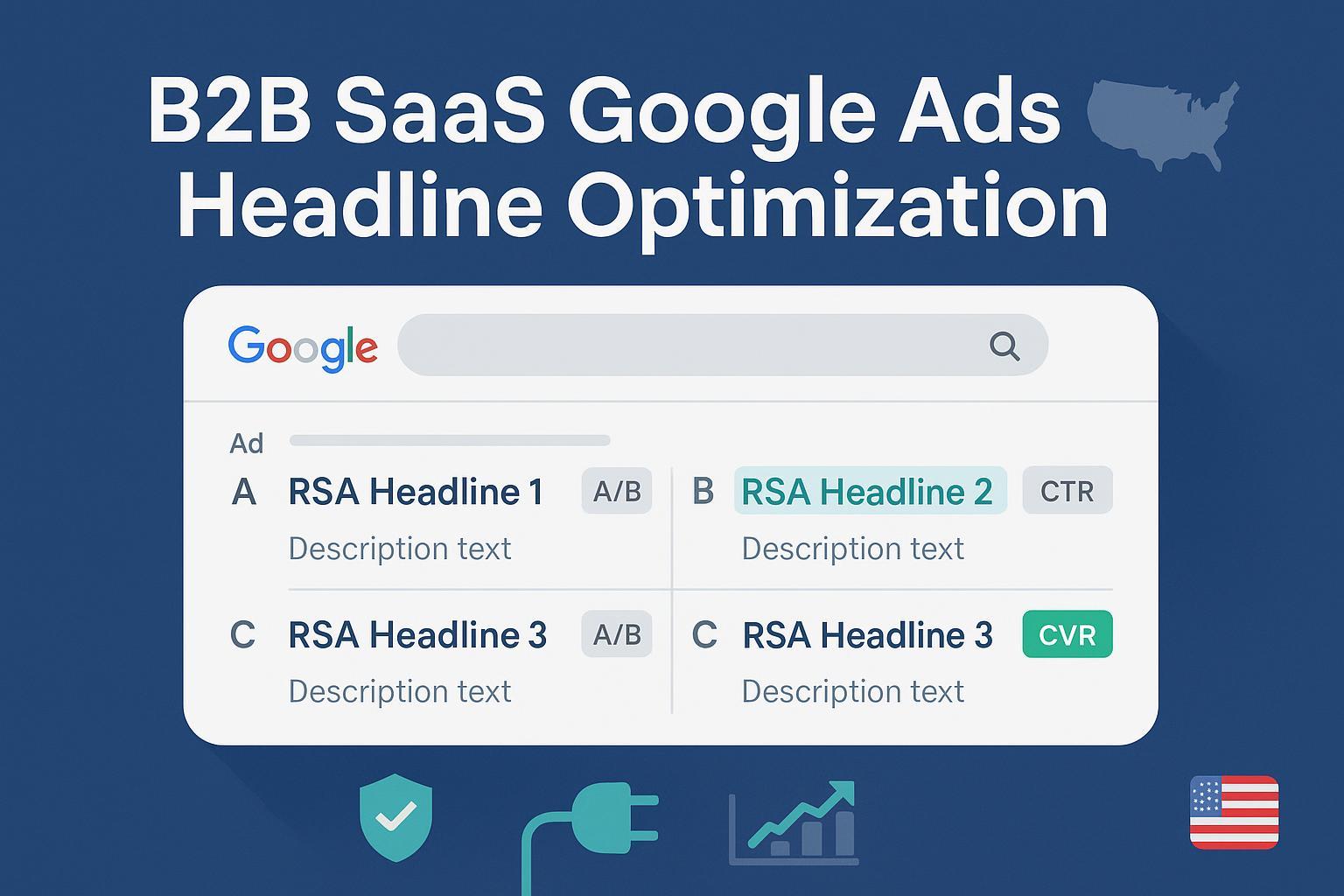
If you manage paid search for a US B2B SaaS, you’ve felt it: CPCs are rising while CTR is sliding. In 2025, non‑branded B2B search CTR hovers near ~4% and CPCs have climbed above ~$5 in many cohorts, making headline craft and testing the most controllable lever you have. Add Google’s AI Overviews reshaping SERPs and RSA serving becoming more flexible, and the “best performing headline” today is the one that is specific, proof‑rich, policy‑clean, and tested against real intent.
What “best performing” means in 2025 for B2B SaaS
In practice, a top‑performing headline doesn’t just chase CTR. It pulls the right click and sets up conversion. Prioritize:
- CTR (click‑through rate) for attention and relevance
- CVR (conversion rate) for sign‑ups, demo requests, or qualified leads
- CPL/CPA for economic efficiency
- Downstream SaaS KPIs: SQL rate, pipeline value, CAC, and payback period
Set expectations with current US data points. For example, Dreamdata’s US B2B non‑branded search cohorts in 2025 show CTR near 4% with CPC rising to $5.34; broader US Google Ads reports cite all‑industry search CPCs around the mid‑$6 range, with typical conversion rates in the low single‑digits. See the Dreamdata 2025 B2B search benchmark and WordStream’s 2025 Google Ads benchmarks for context.
- According to the Dreamdata 2025 B2B Google Search benchmark, CTR is ~4% and CPC ~$5.34 for non‑branded B2B search in the US.
- Broader US averages referenced by WordStream’s Google Ads Benchmarks 2025 place general Search CPCs around the mid‑$6 range and conversion rates often in the 3–5% band.
The RSA realities you must design for
Responsive Search Ads (RSAs) remain the default. Your headlines have to work under these constraints:
- Provide up to 15 headlines (30 characters each) and 4 descriptions (90 characters each). Google may serve as few as a single headline and one description on some impressions, especially on mobile.
- Pinning is possible but reduces flexibility and can lower ad strength. Use it sparingly for truly critical messages (e.g., brand, offer) and ensure every asset reads coherently in any order.
- Serving has become more flexible through 2024–2025, with Google prioritizing combinations predicted to perform better.
For specification details and practical implications, see the Search Engine Land overview of RSAs (2024), the SEMrush RSA guide (2025), and reporting on increased flexibility from Search Engine Journal (2025).
Headline principles that consistently win for B2B SaaS right now
These patterns are field‑tested across US SaaS accounts and align with current RSA behavior, SERP shifts, and policy realities:
- Variety without duplication: Ship 10–15 distinct headlines per RSA. Avoid near‑duplicates so the system can explore real differences. See guidance summarized in the Search Engine Land RSA overview (2024).
- Specific value propositions: Speak to outcomes buyers feel—ROI, efficiency, uptime, compliance, integration readiness. WordStream’s value proposition guidance emphasizes clarity over buzzwords; start with concrete benefits per persona.
- Quantified proof: Numbers beat adjectives. Use timeframes, percentages, counts: “Deploy in 7 Days,” “Cut Ticket Backlog 42%,” “Trusted by 5,000+ Teams.” HawkSEM and other PPC sources consistently highlight quantified benefit language for RSAs.
- Social proof, if policy‑compliant: Ratings, awards, customer counts, recognizable categories. Ensure claims are verifiable on your landing page.
- DKI with care: Dynamic Keyword Insertion can lift relevance, but set strong defaults (e.g., “{Keyword:ITSM Platform}”) and avoid awkward phrasing. Combine DKI with a solid non‑DKI headline mix.
- Pin sparingly: Pin only essentials (brand, key offer). Overpinning may reduce exploration and ad strength.
- Persona targeting: CIOs care about security/compliance; Ops about efficiency; Finance about TCO and payback; IT about integration, APIs, uptime.
- Offer friction reducers: “Free Trial,” “No Credit Card,” “No Setup Fees,” “SOC 2 Type II.” All claims must be true and supported on the landing page.
For deeper reading on value props and headline craft, see WordStream’s value proposition examples (updated 2024) and CoSchedule’s guidance on effective ad headlines (2024).
Templates and 30‑character examples mapped to funnel stages and SaaS verticals
Keep headlines ≤30 chars. Favor natural language and proof. Adapt category/brand keywords to your ad group intent.
TOFU (Awareness)
- Problem framing
- Stop Shadow IT Risk
- End Manual Ticketing
- Category + benefit
- ITSM Platform for Scale
- RevOps Data, Unified
- Data point + value
- Cut Backlog 42%
- Deploy in 7 Days
- Thought leadership
- 2025 IT Ops Benchmarks
- CFO RevOps Playbook
MOFU (Consideration)
- Offer + outcome
- Free Trial—Automate L1
- Free Trial—Faster AP
- Social proof
- Trusted by 5,000+
- Used by Fortune 500
- Integration
- Works with ServiceNow
- Native HubSpot Sync
- Compliance
- SOC 2, HIPAA Ready
- PCI‑DSS Compliant
BOFU (Decision)
- CTA + value
- Book Demo—Lower TCO
- See ROI in 90 Days
- Pricing/guarantee
- No Setup Fees
- No CC Required
- Competitive edge
- Switch from Zendesk
- Alternative to Xero
- Urgency/timeframe
- Deploy in 7 Days
- Go Live in 48 Hrs
Competitor conquesting (policy‑safe)
- Alternative to [Brand]
- Migrate Fast from [Brand]
Ensure your landing page substantiates any competitor references and that you comply with Google Ads misrepresentation and trademark policies.
Security/Compliance SaaS
- SOC 2 Type II—Fast
- Meet HIPAA Today
FinTech SaaS
- PCI‑DSS Compliant
- Cut ACH Fees 20%
HR/Payroll SaaS
- Onboard in 3 Days
- Stop Payroll Errors
Data/Analytics SaaS
- Unified Customer Data
- Dashboards in Hours
IT/DevOps SaaS
- 99.99% Uptime
- Terraform‑Ready
Tip: Build headline families by theme (Security, Efficiency, Integration, Proof, Offer) so asset‑level reporting can reveal which themes convert best.
Implementation: A pragmatic workflow for headline generation, testing, and measurement
-
Clarify intent and personas per ad group
- Map queries to funnel stage and buyer persona. Separate “tool category” intent (e.g., “best ITSM platform”) from “problem” intent (e.g., “reduce ticket backlog”).
-
Generate 12–15 headlines per RSA using themes
- Create 2–3 headlines per theme: Security/Compliance, Efficiency/Automation, Integration, Proof/Numbers, Offer/CTA.
- Keep each headline standalone and ≤30 characters.
-
Pin sparingly and ensure coherence with fewer assets
- If you must pin, pin brand or key offer to position 1. Validate every combination reads clearly even if Google shows only one headline.
-
Use campaign‑level assets where helpful
- Apply up to three headlines and two descriptions at the campaign level to standardize offers or proof across tightly related ad groups. This reduces operational friction.
-
Launch experiments for 2–4 weeks
- Use Google Ads Experiments to compare asset sets or pinning strategies. Aim for several thousand impressions and, where possible, 100+ conversions per variant to reach directional confidence.
-
Instrument asset‑level reporting and export
- Enable headline performance columns so you can analyze clicks and conversions by headline. Export to Sheets or BI via Supermetrics and tag themes to spot what wins. In mid‑2025, trade media coverage highlights improved asset‑level visibility; see Search Engine Land’s July 2025 reporting on RSA headline data.
-
Judge success by theme, not just by ad
- Roll up metrics by headline theme across ad groups. Compare CTR, CVR, and CPL by theme for intent cohorts (e.g., Security queries vs. Pricing queries).
-
Iterate with discipline
- Change one variable at a time—e.g., swap two Efficiency headlines while holding pinning constant. Archive underperformers; replace with new variations within the same theme family.
-
Tooling to speed the cycle
- Google Ads Editor for bulk headline ops.
- Optmyzr or Adalysis for creative testing and significance checks.
- Supermetrics to pipe asset performance into dashboards.
-
Align headlines with landing page proof
- Every quantified claim must be supported by visible, verifiable proof on the destination page. This reduces disapprovals and builds trust.
Troubleshooting and trade‑offs
- Overpinning hurts exploration and often lowers ad strength. If assets look incoherent without pins, rewrite for standalone clarity.
- DKI can lift relevance but watch for awkward grammar and policy conflicts. Use robust defaults and review search terms weekly.
- CTR up, CPL flat or worse? You may be attracting lower‑quality clicks. Add qualifying language (persona‑specific, compliance requirements, pricing signals) and refine negatives.
- Mobile truncation: Write for 20–24 characters as a safe core with the final 6–10 characters adding proof or a qualifier.
- AI Overviews SERPs: Expect more conversational queries and variable layouts. Natural‑language headlines that restate the benefit (“Cut Support Wait Times”) and reinforce brand can maintain visibility. Google has documented US rollouts in 2024 and increased usage through 2025; see announcements from Google’s 2024 AI Search rollout and the 2025 usage update.
- Testing too many variables at once confounds learning. Group headlines by theme and rotate themes methodically.
Readiness checklist to ship a new RSA set today
- 12–15 unique, standalone headlines ≤30 chars
- Themes covered: Security, Efficiency, Integration, Proof, Offer
- 2–4 descriptions aligned with the same themes
- Pins limited to brand/critical offer; every combination reads clearly
- DKI only where helpful, with strong defaults
- Experiment set up for 2–4 weeks with clear success metrics
- Asset‑level reporting enabled and export pipeline ready
- Landing page proof aligned to each claim
- Policy review complete (claims, competitor references, trademarks)
Conclusion
In 2025’s US B2B SaaS landscape, “best performing” Google Ads headlines are built on specificity, proof, and disciplined testing—then tuned to how RSAs actually serve in evolving SERPs. Treat headline creation as an ongoing operating system: theme families, lean pinning, asset‑level measurement, and continuous iteration tied to downstream SaaS KPIs. With CPCs up and attention fragmented by AI‑shaped results pages, the teams that win are those whose headlines speak to the buyer’s exact outcome in fewer than 30 characters—and can prove it.
References for deeper reading embedded above include Search Engine Land’s RSA overviews and mid‑2025 asset‑level reporting, SEMrush’s RSA guide, Search Engine Journal’s flexibility update, WordStream’s 2025 benchmarks, Dreamdata’s 2025 B2B search benchmark, Google’s AI Overviews rollout and usage updates, and CoSchedule’s headline craft guidance.
