Best Tools to Generate Highly Relevant Images in 2025: DALL·E 3 vs Midjourney vs Adobe Firefly vs Stable Diffusion (SDXL) vs Canva Magic Media
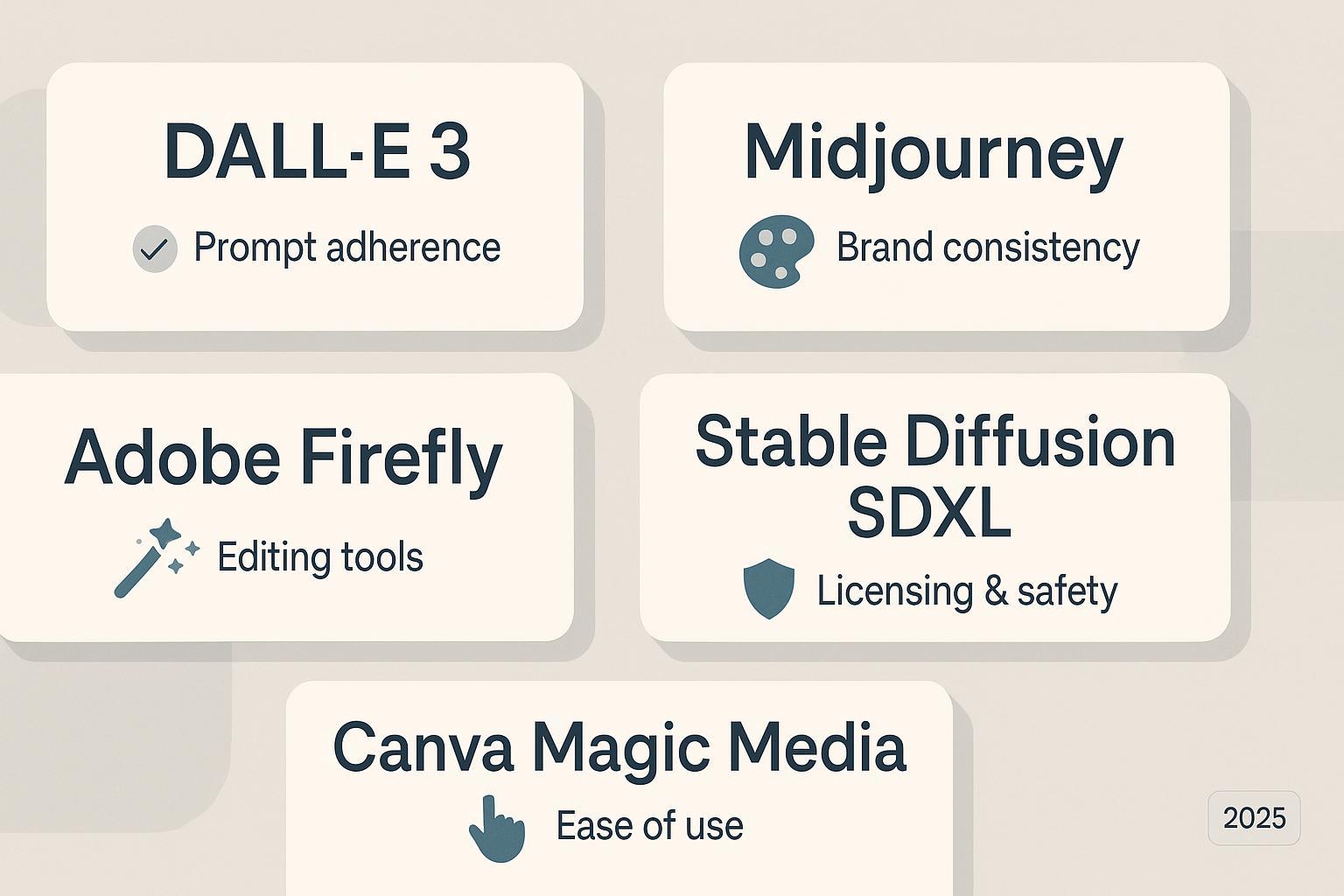
If your team’s goal is “highly relevant images,” you’re really balancing four things: how well a tool follows nuanced prompts (including text-in-image), how consistently it matches your brand style, how fast you can iterate and edit, and whether the licensing is safe for commercial use. In 2025, five options dominate most marketing and content workflows: OpenAI DALL·E 3 (via ChatGPT and the gpt-image-1 API), Midjourney V6/Niji 6, Adobe Firefly Image 3, the Stable Diffusion SDXL ecosystem, and Canva Magic Media. Below, we compare them with practical scenarios, evidence, and caveats.
Note on timeliness: capabilities and pricing change quickly in 2025. We reference official docs with dates where relevant and recommend verifying plan details at the moment you purchase.
Quick decision rules
- Need conversational prompting with strong prompt adherence and legible text-in-image? Choose DALL·E 3 / gpt-image-1 via ChatGPT.
- Need enterprise-grade commercial safety, provenance, and deep Photoshop editing? Choose Adobe Firefly Image 3 (plus Creative Cloud).
- Need top-tier photorealism and artistic style control with rapid iteration? Choose Midjourney V6 (Niji 6 for anime styles).
- Need maximum granular control, reproducibility, and custom brand alignment (poses/layout/style)? Choose Stable Diffusion SDXL with ControlNet/LoRA.
- Need non-designer-friendly branding at scale with templates and Brand Kits? Choose Canva Magic Media.
Tip: Regardless of tool, crafting precise prompts pays off. For a concise primer that marketers can apply immediately, see these AI image generator tips for stunning visuals.
At-a-glance comparison (2025)
| Tool | Prompt adherence & text-in-image | Brand consistency controls | Editing & iteration strength | Licensing/commercial use | Ease of use | Integrations & workflow fit |
|---|---|---|---|---|---|---|
| DALL·E 3 / gpt-image-1 | Strong adherence; conversational refinement; improved text rendering | Basic style via prompt; less deterministic than ControlNet/LoRA | Inpainting/outpainting and variations via API/UI; iterative chat edits | User owns output per the OpenAI Services Agreement (2025) | Very easy in ChatGPT; API for devs | Fits fast blogging and prototyping; simple pipeline hooks |
| Midjourney V6/Niji 6 | Excellent visual quality; long-prompt coherence improved | Style Reference (--sref), --style raw for consistency | Remix, inpainting, zoom/pan; rapid iteration | Commercial use for paid plans; companies >$1M need Pro/Mega per the Midjourney Terms of Service (2025) | Moderate (Discord workflow) | Great for campaign visuals and series styling |
| Adobe Firefly Image 3 | Strong understanding; often conservative but reliable | Generative Match & Structure Reference; Content Credentials | Photoshop Generative Fill/Expand; pro-grade compositing | Enterprise output indemnity and guardrails detailed in Adobe Generative AI Product Terms (2025) | Moderate if non-designer; easy for Adobe users | Ideal for brand-safe enterprise pipelines |
| Stable Diffusion SDXL | High controllability via ControlNet/LoRA; deterministic seeding | Custom LoRA/DreamBooth for brand alignment | A1111 & ComfyUI enable granular in/outpainting and batch flows | Commercial use under Community License; >$1M may need Enterprise per the Stability AI Community License (2025) | Steepest learning curve | Best for technical teams needing reproducible control |
| Canva Magic Media | Good adherence for marketing visuals; simple text use | Brand Kit, templates, style matching | Quick variants and edits; less granular control | Users own outputs; allowances vary by plan per Canva AI Product Terms (2025) | Easiest for non-designers | Perfect for fast, on-brand social/blog graphics |
Deep dive: strengths, constraints, and who each tool is for
OpenAI DALL·E 3 / gpt-image-1 (ChatGPT + API)
What stands out:
- Prompt adherence and in-image text are strong, and the conversational loop in ChatGPT is ideal for marketers iterating quickly. OpenAI introduced the 2025 Image Generation API (gpt-image-1) with generation, editing, and variations endpoints—see the OpenAI image generation API announcement (2025).
- Ownership: As of 2025, OpenAI’s contract states customers own output, enabling commercial use; see the OpenAI Services Agreement (2025).
Where it’s best:
- Blog headers with legible text overlays, infographic-like images with callouts, and fast iterations inside ChatGPT.
Constraints:
- Less deterministic layout and pose control than SDXL pipelines with ControlNet/LoRA. Pricing and quotas can vary by plan; verify the ChatGPT pricing page (2025).
Who should choose it:
- Marketers and content teams who value speed, strong prompt adherence, and minimal setup.
Midjourney V6 (and Niji 6 for anime)
What stands out:
- Leading photorealism and artistic quality, with improved long-prompt coherence and better text-in-image than older versions. Iteration tools—remix, inpainting, zoom/pan—make exploration fast. Commercial guidance is explicit: companies with >$1M revenue need Pro or Mega for commercial use per the Midjourney Terms of Service (2025) and the companion “Using Images & Videos Commercially” page.
Where it’s best:
- Campaign visuals, stylized product hero images, and brand series using parameters like --sref (Style Reference) and --style raw.
Constraints:
- Discord-first workflow has a learning curve. GPU hour tiers and pricing are managed in-app; verify before scaling.
Who should choose it:
- Agencies and creators prioritizing visual impact and style with rapid iteration.
Adobe Firefly Image 3 (with Creative Cloud)
What stands out:
- Commercial safety and provenance via Content Credentials and enterprise indemnity. The legal guardrails and indemnification scope are outlined in the Adobe Generative AI Product Specific Terms (2025).
- Brand consistency tools: Generative Match for style alignment and Structure Reference for layout coherence. Tight integration with Photoshop’s Generative Fill/Expand enables production-grade edits.
Where it’s best:
- Enterprise content pipelines that demand risk-managed outputs and seamless handoff to Creative Cloud tools.
Constraints:
- Generative credits and feature eligibility vary by plan; check Adobe’s Generative Credits FAQ and plan pages before heavy use.
Who should choose it:
- Design-forward teams and enterprises needing commercially safe, transparent outputs and deep editing capabilities.
Stable Diffusion SDXL ecosystem (ControlNet/LoRA/ComfyUI/A1111)
What stands out:
- Maximum control: SDXL paired with ControlNet for pose/edge/depth and LoRA/DreamBooth for brand/subject alignment delivers deterministic outputs, especially important for complex layouts or recurring brand elements. The licensing posture for commercial use depends on revenue and model terms; see the Stability AI Community License (2025).
- Workflow flexibility: Local setups (AUTOMATIC1111 WebUI) and modular node-graphs (ComfyUI) support batch processing and reproducible pipelines.
Where it’s best:
- Technical teams and studios that need precise composition, reproducible shots, and custom brand styles.
Constraints:
- Setup complexity, asset licensing diligence (including third-party LoRAs), and compute requirements for fine-tuning.
Who should choose it:
- Power users and teams with technical resources who want ultimate control and repeatability.
Canva Magic Media
What stands out:
- Simplicity: Text-to-image inside a familiar editor, with Brand Kit integration, templates, and instant variants—ideal for non-designers. Ownership and usage allowances are documented in the Canva AI Product Terms (2025), and plan pricing is shown on the Canva pricing page (2025).
Where it’s best:
- Fast social and blog graphics that must stay on-brand without heavy technical controls.
Constraints:
- Image quality and granular controls trail specialized tools; quotas apply on Free and lower-tier plans.
Who should choose it:
- SMB marketers and teams who value speed, templates, and collaboration more than deep technical control.
How to choose (practical rules)
- If your prompt includes detailed text that must be legible (e.g., “Header with 8-word headline + subheading”), start with DALL·E 3 or Firefly, then polish typography in Canva or Photoshop.
- If you need exact poses, camera angles, or brand-specific motifs across a series, SDXL with ControlNet and a custom LoRA will provide the most consistency. Midjourney’s --sref can be a lighter-weight path if you don’t need full determinism.
- For enterprise risk management and provenance, Firefly with Content Credentials and eligible indemnity is the safe bet.
- For high-impact campaign visuals with speed, Midjourney’s iteration tools are hard to beat.
- For non-designer teams producing many on-brand graphics weekly, Canva Magic Media plus Brand Kit and templates is pragmatic.
For deeper brand alignment and narrative cohesion in blogs, these two guides can help: visual storytelling for blogs and enhancing blogs with AI-generated images.
Local SEO tip: If you publish location-based posts (e.g., storefront announcements), geotagging your images can improve visibility for local queries. Here’s a practical walkthrough on geotagging images for local SEO.
Real-world workflows (examples)
- Blog header with text-in-image
- Draft in DALL·E 3 via ChatGPT (“Generate a 16:9 header with the line ‘Winter gear that actually keeps you warm’ on a clean background”). If text alignment isn’t perfect, edit in the ChatGPT canvas or switch to Firefly for structure reference. Finalize typography in Canva or Photoshop and export optimized for web.
- On-brand series for a campaign
- In Firefly, use Generative Match with a brand style sample to align outputs. Alternatively, in Midjourney, reference a style with --sref and keep --style raw for less stylization. For maximum consistency, train a lightweight LoRA in SDXL on your brand’s iconography.
- Local SEO image for a store launch
- Capture the storefront, use SDXL + ControlNet to maintain scene geometry while enhancing lighting and signage, or use Midjourney inpainting for quick fixes. Then geotag and compress before publishing.
Pricing and licensing notes (as of 2025)
- DALL·E 3 / ChatGPT: Individual access frequently listed at $20/month; API is usage-based. Verify the latest rates on OpenAI’s pages (pricing changes are common in 2025).
- Midjourney: Tiered subscriptions with GPU hour allocations; commercial rule for companies >$1M revenue is documented in their ToS.
- Adobe Firefly: Included in Creative Cloud plans; generative credits and eligibility vary—review plan details and credit tables.
- Stable Diffusion SDXL: Local use can be free (compute costs apply); hosted APIs are credit-based; licensing depends on revenue and model terms.
- Canva Magic Media: Free, Pro, Teams, Business, and Enterprise tiers; check allowances and any enterprise indemnity specifics on the official pricing and help pages.
Bottom line: match the tool to the job
- For accuracy to nuanced prompts and legible text, DALL·E 3 / gpt-image-1 is a strong first stop.
- For enterprise-safe creative with deep editing and provenance, Adobe Firefly is the safest all-around.
- For stylistic excellence and photorealism with quick iteration, Midjourney leads.
- For deterministic control and brand-specific pipelines, SDXL with ControlNet/LoRA is unmatched.
- For speed and on-brand templated marketing visuals, Canva Magic Media keeps teams moving.
Also consider workflow hubs that make publishing easier. The platform QuickCreator helps teams embed, optimize, and publish images alongside multilingual blog content without technical overhead. Disclosure: QuickCreator is our product.
Sources and official references
- Ownership of outputs and API capabilities: see the OpenAI Services Agreement (2025) and the OpenAI image generation API announcement (2025).
- Midjourney commercial rules: documented in the Midjourney Terms of Service (2025) and the “Using Images & Videos Commercially” help materials.
- Adobe Firefly indemnity and guardrails: described in the Adobe Generative AI Product Specific Terms (2025).
- SDXL licensing overview: the Stability AI Community License (2025) explains commercial allowances.
- Canva ownership and plan allowances: detailed in the Canva AI Product Terms (2025) and pricing on the Canva pricing page (2025).
