The Complete Beauty & Personal Care Devices SEO Strategy (2025): How to Rank in 90 Days

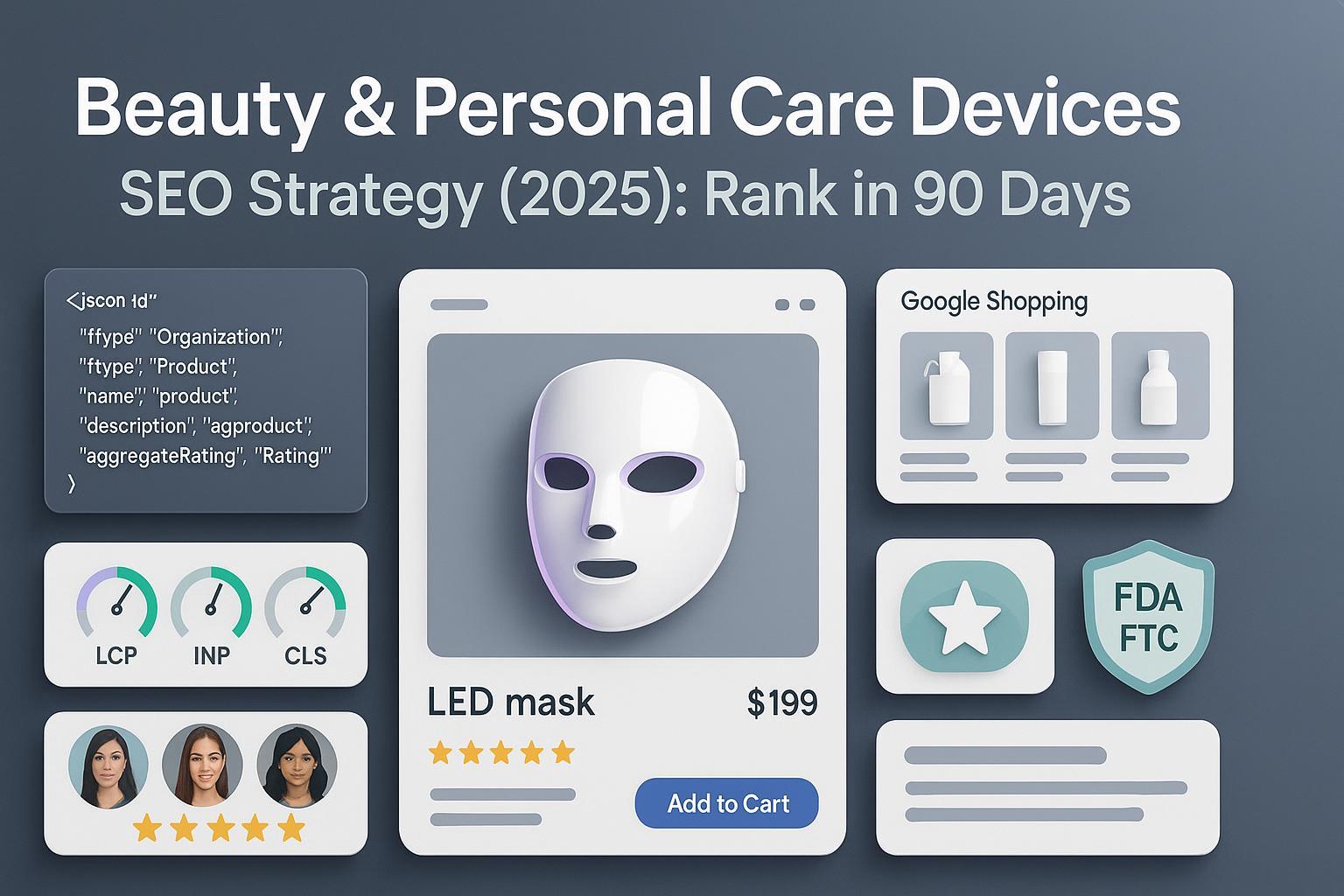
If you sell beauty and personal care devices—IPL hair removal tools, LED masks, microcurrent toners, cleansing brushes—2025 SEO is less about hacks and more about trust, proof, and precision. In my experience, the brands that win fastest pair first‑hand product evidence with variant‑savvy structured data, fast PDPs, and squeaky‑clean compliance.
This guide is your 90‑day, step‑by‑step playbook. We’ll ship the foundations in weeks, stand up review excellence, wire your Merchant Center for coverage, and publish the kind of experience‑backed content that Google actually rewards in YMYL categories.
What “good” looks like in 90 days:
- 90%+ of mobile URLs passing Core Web Vitals; schema error rate under 2%.
- Product pages that show real testing evidence and expert review.
- Variant‑aware Product schema with Review/AggregateRating, and HowTo where appropriate.
- Merchant Center coverage with zero critical disapprovals on priority SKUs.
- Top‑20 rankings on 30–50% of your priority terms; +30–50% impressions in GSC across device clusters.
Note on sources and compliance: Throughout, I cite authoritative documentation using inline, descriptive anchors so your team can implement confidently.
Part 1: The 2025 Landscape for Beauty & Personal Care Devices SEO
Beauty devices live in YMYL territory. Google’s systems weigh trust and E‑E‑A‑T more heavily when health or safety could be affected. Google reiterates in 2025 that, among the E‑E‑A‑T elements, “trust is most important” for helpful, reliable, people‑first content, especially in YMYL contexts, per the 2025 iteration of Google’s guidance in the page Creating helpful, reliable, people‑first content: see the note about trust being most important in the Google documentation (Google Search Central, Creating helpful, reliable content).
Three realities shape your plan:
- Reviews system rewards first‑hand, insightful analysis—not reworded manufacturer blurbs. See Google’s overview of what the reviews system evaluates (Google Search Central, Reviews system).
- Spam policy enforcement (e.g., site reputation abuse) escalated since 2024. If you host third‑party content primarily to manipulate rankings, expect demotions. Google clarified this with dedicated policy pages and blog updates in 2024–2025 (Google Search Central blog, March 2024 core update & spam policies; Google’s site reputation abuse policy clarification).
- Structured data and Merchant listings keep evolving: 2025 documentation emphasizes proper Product variants modeling, detailed offers, and eligibility for Shopping and product snippets (Google Product variants structured data; Product structured data; Merchant listing structured data).
What this means for you: publish evidence‑rich product/editorial reviews, align every claim with substantiation, implement variant‑aware schema and bulletproof feeds, and harden your trust signals across the site.
Part 2: Foundation First (Weeks 1–2) — Technical Audit, E‑E‑A‑T Surfaces, Trust
Your first two weeks set crawlability, performance, and credibility.
Technical and page experience benchmarks
- Target Core Web Vitals at the 75th percentile: LCP ≤ 2.5s, INP < 200ms, CLS < 0.1, as defined in Google’s 2025 vitals documentation (Core Web Vitals overview; Page experience guidance).
- Use PageSpeed Insights (CrUX field data), Search Console CWV, and Chrome DevTools performance profiler to find main‑thread JS bottlenecks and layout shifts (PSI docs; Chrome DevTools).
Launch checklist (Week 1–2)
- Crawl & index: Audit with GSC Indexing report; fix robots.txt/sitemaps; eliminate soft‑404s and canonicalization issues; ensure hreflang if multilingual.
- Speed on PDP/PLP: Serve WebP/AVIF product images, resize and preconnect critical origins; lazy‑load below‑the‑fold media; inline critical CSS; defer non‑essential JS. Reserve media/ads space to prevent CLS (Page experience guidance).
- Structured data baseline: Validate Product, Offer, and BreadcrumbList JSON‑LD. Add Review/AggregateRating if you have authentic reviews. Monitor with Search Console enhancement reports; adhere to structured data policies (Intro to structured data and policies; Structured data policies).
- E‑E‑A‑T surface: Add or strengthen About, Medical Review, Editorial Policy, and Customer Service pages. Display author bios with credentials (e.g., dermatologist review where relevant), link to professional profiles, and list your testing methodology.
- Trust signals: Prominent warranty/returns, shipping, and contact info. These also align with Merchant Center misrepresentation standards (Merchant Center return policy transparency).
What “good” looks like
- GSC shows <1% coverage errors; CWV “good” status for ≥90% of mobile URLs; structured data enhancement reports show <2% error rate.
Part 3: Product Review Excellence (Weeks 2–5) — First‑Hand, Compliant Reviews
In 2025, editorial reviews that demonstrate personal use and offer unique insights are the differentiator. Google’s reviews documentation stresses original research and evidence from knowledgeable people (Google Reviews system).
Anatomy of a high‑performing device review page
- Declare methodology: device version, test duration, skin/hair type context, usage frequency, environment.
- First‑hand evidence: original photos/video of unboxing, usage, interface, tips; side‑by‑side comparisons with prior models; performance measurements when applicable.
- Pros/cons, who it’s for/not for; alternatives and comparisons.
- Safety and contraindications: e.g., Fitzpatrick skin types for IPL, acne/rosacea considerations for LED wavelengths. Link to credible references when discussing safety/efficacy.
- Clear verdict with scores and use‑case recommendations.
- Reviewer identity and credentials; review date; update history.
Compliant claims and disclosures
- Map every efficacy/safety claim to substantiation. For devices with medical intents, ensure language aligns with FDA status: “FDA‑cleared” (510(k)) if true; avoid implying “FDA‑approved” unless PMA‑level approval is granted. The FDA explains the difference between clearance and approval, and warns against “FDA‑certified/registered” marketing phrasing that misleads consumers (FDA, clearance vs approval explainer).
- Endorsements & reviews must disclose material connections per the FTC’s updated Endorsement Guides (June 2023) and the 2024 final rule banning fake reviews/testimonials; atypical results require clear disclosure (FTC, Endorsement Guides update 2023; FTC final rule banning fake reviews 2024).
Template: review page outline
- H1: Product name + category + year (e.g., “Best At‑Home IPL Hair Removal Devices (2025) — Hands‑On Review”)
- Summary box: key specs, price range, who it’s for, quick verdict
- Testing protocol: skin/hair type, frequency, duration, metrics
- Performance sections: comfort, speed, efficacy, maintenance
- Safety & contraindications: with citations
- Comparisons & alternatives: table and narrative
- Photos/video gallery: original media
- Pros/cons & scores; final verdict; FAQs
- Author bio with credentials; medical review badge if applicable
Structured data for review pages
- Add Review with itemReviewed pointing to Product. Include author, datePublished, reviewBody, reviewRating, images when relevant. Follow policies for valid author naming and avoid promotional content in schema fields (Review snippet guidance).
Moderation & UGC
- Implement a review acquisition program that requests reviews post‑purchase, encourages media uploads, and flags disclosures for incentivized reviews. Ensure moderation avoids suppression of negatives; the FTC’s Consumer Reviews & Testimonials Rule requires integrity in handling reviews (FTC Q&A on the rule).
Part 4: Structured Data & Merchant Center (Weeks 3–6) — Variants, Feeds, Rich Results
Variant‑aware Product schema
- Use ProductGroup for the parent and Product for each variant; link variants to the parent with isVariantOf; define variesBy (e.g., color, size, attachments) and hasVariant at the group. Offers (price, availability), sku, gtin, and images must be variant‑specific. See Google’s 2025 docs on variants (Product variants structured data).
- Add AggregateRating to the Product level when you have sufficient reviews; include reviewCount and ratingValue. Ensure compliance with structured data policies.
HowTo and FAQ eligibility
- HowTo can still earn rich results when properly marked up and visible, while FAQ is restricted primarily to authoritative organizations (health/government). Use HowTo for “How to use an IPL device safely” where the steps are explicit and include images when useful. Always adhere to structured data policies (FAQPage eligibility note; Structured data policies).
Merchant Center setup and hygiene
- Feeds: Use item_group_id to group variants; provide variant‑defining attributes (color, size, material, etc.) consistently. Keep price and availability accurate; enable Automatic Item Updates where appropriate. See Google’s product data spec overview and glossary (Merchant Center glossary/spec index).
- Policies: Publish clear return/refund policies and shipping information on site and mirror them in Merchant Center; inconsistencies can trigger misrepresentation suspensions (Merchant Center return policy transparency).
- Announcements: Watch 2025 announcements such as changes to tax or feed attributes to avoid disapprovals (Merchant Center announcements hub).
Diagnostics workflow
- Weekly: Check Merchant Center Diagnostics for item disapprovals, policy issues, and feed warnings; fix within 72 hours for priority SKUs.
- Search Console: Monitor Product and Merchant listing enhancements; fix markup issues promptly.
Part 5: Content Hub Strategy (Weeks 4–8) — Mixed Intent That Converts
Build topic clusters that connect your PDPs with safety, usage, and comparison content. SERPs for device queries are mixed: editorial reviews, retailer PDPs, videos, image packs, Shopping modules, and People Also Ask. Pages that win show first‑hand evidence and strong E‑E‑A‑T with structured data to match (Google Reviews system).
Core hub pillars
- Conditions & outcomes: “Does red light help acne?” with citations and safety notes; avoid unsubstantiated medical claims. Link to your LED mask PDPs and comparison pages.
- Device types: Deep guides per category (IPL, LED, microcurrent, cleansing brushes): how they work, who benefits, safety, maintenance.
- Comparisons: “IPL vs laser at home,” “LED mask vs handheld,” “Device A vs Device B” with performance tables and compatibility notes.
- How‑to safety: Stepwise guides with contraindications and post‑care. Mark up with HowTo when eligible.
Internal linking
- Use hub pages to route to PDPs, comparison pages, and reviews; include breadcrumb navigation and contextual links. Leverage related questions/FAQs on editorial pages (visible on page even if FAQ rich results are limited).
Publishing cadence (Weeks 4–8)
- 4–6 expert‑backed reviews/guides (prioritize top SKUs/categories)
- 2–3 comparisons (brand vs brand; category vs category)
- 2–3 how‑to safety pieces with clear steps and media
Part 6: Review & UGC Engine (Weeks 4–9) — Acquire, Moderate, Showcase
Acquisition program
- Post‑purchase emails/SMS at 10–14 days; second nudge at 30–35 days for efficacy‑dependent devices.
- Incentives with disclosure: small credits or loyalty points; auto‑insert “This review was incentivized” badge/disclaimer to meet FTC expectations (FTC endorsements overview).
- Capture media: prompt for photos/videos and specific usage contexts; allow skin/hair type tagging for filtering.
Moderation policy
- Don’t suppress negatives. The 2024 FTC rule prohibits deceptive review practices; maintain an auditable moderation log (FTC Q&A on the rule).
- Flag health/safety claims for expert review; ensure medical disclaimers if users claim atypical results.
On‑page presentation
- Show distribution of ratings, most helpful reviews, and filters (skin type, hair color, concern). Surface media‑rich reviews prominently. Add “verified purchase” badges where technically supported.
Syndication
- Where permitted, syndicate reviews to authorized marketplaces; ensure schema reflects AggregateRating accurately and does not inflate ratings.
Part 7: Off‑Page Signals (Weeks 5–10) — Digital PR, Expert Quotes, Medical Advisors
Quality editorial coverage and expert validation bolster authority in YMYL. Aim for expert‑led content and credible mentions rather than raw link volume.
Tactics
- Expert network: Commission dermatologist/esthetician quotes or reviews for your highest‑stakes pages. Surface their credentials and review notes in‑line and in structured author markup.
- Digital PR stories: Data‑backed releases such as “At‑home hair removal safety survey (n=1,000)” or “LED wavelengths and acne—what shoppers get wrong.” Pitch to beauty publications and health tech press.
- Product seeding with disclosure: Follow FTC endorsement guidelines for any gifted products; insist on clear disclosures by creators/influencers (FTC Endorsement Guides update 2023).
Measurement
- Track referring domains quality, unlinked brand mentions, and expert citation pickups. Prioritize placements that also drive qualified traffic.
Part 8: Analytics & Iteration (Weeks 6–12) — See What’s Working, Double Down
Dashboards
- Search Console: Performance by device clusters (IPL, LED, microcurrent), rich result coverage, enhancement errors.
- Merchant Center: Diagnostics, click share for Shopping, price competitiveness.
- CWV: Field data trends by template (PDP, PLP, blog), INP outliers.
Experiments
- Title/meta and intro refinements on review pages to surface first‑hand proof above the fold.
- Media swaps: lighter hero images vs. autoplay videos—measure INP/CLS impact.
- Internal link boosts from hubs to lagging PDPs.
Realistic expectations
- Even with strong execution, competitive YMYL niches take time. Industry analyses show it often takes months to see material ranking impact from links and other signals; many top‑ranking pages are older than two years. While individual numbers vary, analyses like Ahrefs’ time‑to‑rank and link impact studies indicate movement typically unfolds over months, not weeks (Ahrefs, SEO statistics/time to rank analyses; Ahrefs, SEO guarantee analysis).
Part 9: The Compliance Playbook — Build Trust By Design (Ongoing)
Claim taxonomy
- Cosmetic vs medical: If your copy implies treating diseases/conditions or altering body structure/function, you’re in device/medical territory. Align marketing with device classification and approvals.
- FDA status language: Use “FDA‑cleared” for Class II devices with 510(k); do not claim “FDA‑approved” unless PMA‑approved. Avoid “FDA certified/registered” as a consumer‑facing claim. The FDA provides plain‑language explanations for consumers and marketers on these distinctions (FDA, clearance vs approval explainer).
Endorsements, testimonials, and UGC
- Disclose material connections conspicuously; atypical results must be labeled as such. See the FTC’s updated Endorsement Guides and FAQs, and the 2024 rule on fake reviews/testimonials (FTC Endorsement Guides update 2023; FTC Consumer Reviews & Testimonials Rule Q&A).
Before/after imagery standards
- Consistent lighting, angle, background; no editing that changes outcomes; indicate timeframe; disclose typical results; obtain consent. When outcomes are atypical, state what typical users can expect.
Policy pages and transparency
- Prominent, plain‑English policies: returns, refunds, shipping, privacy, warranty, and customer service contact info. These documents support both SEO trust and Merchant Center’s misrepresentation checks (Merchant Center return policy transparency).
Part 10: The 90‑Day Roadmap — Week‑by‑Week Plan, Checkpoints, and KPIs
Weeks 1–2: Lay the foundation
- Technical audit; fix indexation issues; implement CWV improvements on PDP/PLP; baseline Product/Breadcrumb schema; publish/refresh About, Editorial Policy, Medical Review pages.
- KPIs: ≥70% mobile URLs “good” CWV; <5% structured data errors; Index coverage errors <2% of valid pages.
Weeks 2–5: Review excellence sprint
- Publish 2–3 hands‑on reviews (top SKUs) and 1 comparison; integrate Review schema; add original photos/video; incorporate safety sections with citations; add expert review for high‑risk topics.
- KPIs: 3–5 editorial assets live; review pages pass Rich Results Test; first new keywords enter top 30.
Weeks 3–6: Structured data + Merchant Center hardening
- Implement ProductGroup/isVariantOf for top 10 SKUs; add AggregateRating where eligible; audit and fix Merchant Center disapprovals; sync policies (returns/shipping) with site.
- KPIs: Schema validation error rate <2%; 0 critical disapprovals on priority SKUs; eligible product/merchant listing enhancements appear in GSC.
Weeks 4–8: Content hubs and internal links
- Publish 2 how‑to safety guides and 1–2 category deep dives; expand comparison content; weave hub → PDP links. Consider HowTo markup where eligible.
- KPIs: +20–30% GSC impressions on category clusters; People Also Ask appearances; early rich results on eligible pages.
Weeks 4–9: Review & UGC engine
- Launch post‑purchase review flows with disclosure; enable media uploads; add filters (skin/hair type). Start syndication where permitted.
- KPIs: +50–100 verified reviews across top SKUs; ≥20% media attachment rate; visible increase in on‑site conversion from PDPs with rich reviews.
Weeks 5–10: Off‑page authority
- Secure 2–5 expert quotes/reviews; pitch 1–2 data stories for digital PR; seed products with clear disclosures.
- KPIs: 5–10 high‑quality referring domains; 2–3 expert citations; branded search and unlinked mentions rising.
Weeks 6–12: Analytics & iteration
- Optimize titles/intros; adjust internal links; test media load strategies; refine schema; keep feeds/audits tight.
- KPIs by Day 90: ≥90% mobile CWV pass; top‑20 presence for 30–50% priority keywords; +30–50% impressions for target clusters; CTR +1–2 pp on pages gaining rich results; zero policy violations.
Appendices — Copy‑Ready Snippets and Checklists
Review schema (JSON‑LD) pattern
{
  "@context": "https://schema.org",
  "@type": "Review",
  "author": {
    "@type": "Person",
    "name": "Jane Doe"
  },
  "datePublished": "2025-06-12",
  "itemReviewed": {
    "@type": "Product",
    "name": "At-Home IPL Hair Removal Device X",
    "sku": "IPLX-001",
    "image": [
      "https://example.com/images/iplx-front.jpg"
    ]
  },
  "reviewRating": {
    "@type": "Rating",
    "ratingValue": "4",
    "bestRating": "5"
  },
  "reviewBody": "After 10 weeks of testing on Fitzpatrick II–III skin with dark hair, I saw ~60% reduction on calves. Comfort is good at mid-level intensity; speed is average. Cooling tip helps minimize discomfort."
}
Product variants (ProductGroup + Product) skeleton
{
  "@context": "https://schema.org",
  "@type": "ProductGroup",
  "name": "LED Light Therapy Mask Y",
  "productGroupID": "LEDY-ALL",
  "variesBy": ["color", "attachments"],
  "hasVariant": [
    {
      "@type": "Product",
      "name": "LED Mask Y – Full Spectrum",
      "sku": "LEDY-FULL",
      "isVariantOf": {"@id": "#LEDY-ALL"},
      "image": ["https://example.com/images/ledy-full.jpg"],
      "offers": {
        "@type": "Offer",
        "priceCurrency": "USD",
        "price": "349.00",
        "availability": "https://schema.org/InStock"
      }
    },
    {
      "@type": "Product",
      "name": "LED Mask Y – Acne (Blue/Red)",
      "sku": "LEDY-ACNE",
      "isVariantOf": {"@id": "#LEDY-ALL"},
      "image": ["https://example.com/images/ledy-acne.jpg"],
      "offers": {
        "@type": "Offer",
        "priceCurrency": "USD",
        "price": "299.00",
        "availability": "https://schema.org/InStock"
      }
    }
  ]
}
HowTo skeleton (for a safety guide)
{
  "@context": "https://schema.org",
  "@type": "HowTo",
  "name": "How to use an at-home IPL device safely",
  "totalTime": "PT25M",
  "step": [
    {"@type": "HowToStep", "text": "Patch test on a small area 24 hours before first full use."},
    {"@type": "HowToStep", "text": "Shave the area; avoid tanning/self-tanners for 2 weeks prior."},
    {"@type": "HowToStep", "text": "Select intensity based on skin tone guide; start low."},
    {"@type": "HowToStep", "text": "Wear protective eyewear if recommended; avoid tattoos and moles."},
    {"@type": "HowToStep", "text": "Glide device without overlapping flashes; cool the skin after."}
  ]
}
Technical CWV checklist
- Compress and resize hero/product images; prefer WebP/AVIF; preconnect to CDNs.
- Defer non‑critical JS; split bundles; minimize main‑thread work; use web workers where appropriate.
- Inline critical CSS; prefetch key routes; lazy‑load below the fold.
- Reserve aspect‑ratio boxes for media; use font‑display: swap.
- Validate with PSI and fix INP outliers.
Compliance checklist
- Claims mapped to substantiation; medical vs cosmetic taxonomy complete.
- FDA status language audited; no “FDA‑approved” unless PMA.
- Endorsement disclosures in place; incentivized reviews labeled; moderation policy published.
- Before/after standards documented; consent and typical results disclaimers added.
- Return/refund/shipping policies consistent with Merchant Center settings.
Reporting & KPIs dashboard (baseline → Day 90)
- CWV pass rate (mobile, by template)
- Structured data errors/warnings
- GSC impressions/clicks for device clusters
- Rich results coverage (Product, Merchant, HowTo)
- Merchant Center disapprovals and click share
- Reviews count, media rate, average rating (and distribution)
- Top‑20 keyword coverage across priority terms
What “Winning” Looks Like After 90 Days
You’ve shipped a trustworthy site that loads quickly, explains safety clearly, shows real use, and speaks the language of both shoppers and search engines. Your product and review pages are eligible for rich results; Shopping coverage is clean; expert validation backs your claims. Rankings are moving into the top 20 on a meaningful slice of your targets, and impressions are lifting across device categories. From here, you’ll scale the cadence—more first‑hand reviews, more comparisons, more expert collaborations—while keeping compliance as your moat.
Further reading and implementation references
- Helpful content/E‑E‑A‑T and trust emphasis (2025): Google, Creating helpful, reliable content
- Reviews system: Google, Reviews system documentation
- Structured data (Product, variants, Review, HowTo): Google, Product variants; Google, Review snippet; Google, HowTo policies
- Merchant Center: Google, Announcements/spec updates; Google, Return policy requirements
- FDA/FTC compliance: FDA, clearance vs approval explainer; FTC, Endorsement Guides update 2023; FTC, Consumer Reviews & Testimonials Rule Q&A
- Industry expectations: Ahrefs, SEO timelines and statistics
If you follow this roadmap with discipline, you won’t just rank—you’ll become the most trusted destination for at‑home beauty devices in your niche.
