B2B SEO vs B2C SEO: Key Differences in 2025

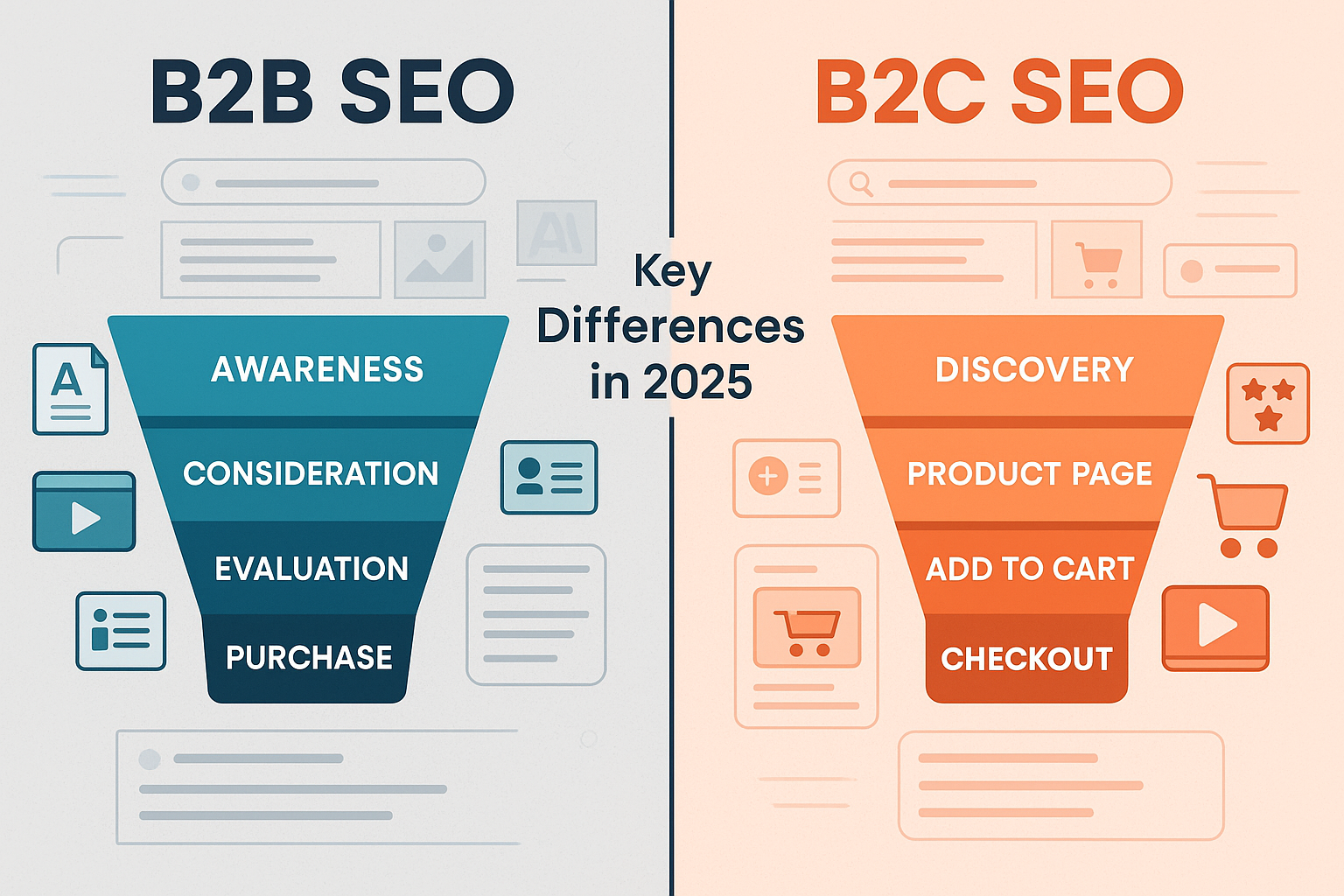
B2B and B2C SEO aren’t just variations on the same playbook—they serve different buying behaviors, decision cycles, and SERP realities. In 2025, those differences are amplified by AI Overviews, richer SERP elements, and stronger expectations for proof and UX. This guide breaks down what actually changes between B2B and B2C SEO, where they overlap, and how to choose (and adapt) based on your business model, price point, and buying complexity.
If you’d like a fast primer to ground your team before diving in, grab a few foundational reads from our curated list of free SEO eBooks (QuickCreator resource).
What really differs: audience behavior and intent
- B2B intent is typically research-driven and problem-solution oriented. Queries often involve industry jargon and evaluation terms (e.g., “SOC 2 compliance checklist,” “enterprise IAM vendors”). Multiple stakeholders need to be convinced, so content must be credible and comprehensive. Recent syntheses in 2024–2025 underline this pattern; see the overview by Contentoo in the B2B vs B2C SEO differences (2024, updated 2025).
- B2C intent leans more toward immediate needs and comparison/transactional searches (“best running shoes 2025,” “iPhone 15 case reviews”), with a bigger role for visuals, social proof, and price. Salesforce’s ongoing guide to B2B vs B2C ecommerce differences (2024–2025) captures the shorter, individual decision dynamics common in consumer retail.
Implication: Map intent to content depth and next-step clarity. B2B readers expect verification and layered proof; B2C shoppers expect frictionless discovery and checkout support.
Sales cycle and stakeholders
- B2B: Buying is long and committee-driven. Forrester reported in 2024 that an average of 13 people are involved in B2B decisions, with most purchases spanning multiple departments, according to the Forrester “State of Business Buying, 2024” press note. Additional industry tracking in 2025 highlighted double-digit month cycles for complex deals.
- B2C: Decisions are fast and individual, especially for low- to mid-ticket products. Salesforce’s 2024–2025 guidance (linked above) contrasts the simpler B2C flow with the elongated B2B path.
Implication: Your SEO must align with the velocity and verification demands of the purchase. In B2B, plan for multi-touch nurture and content that arms champions internally. In B2C, prioritize speed, clarity, and conversion UX.
Keyword strategy: volume vs specificity
- B2B: Lower-volume but higher-intent phrases, often long-tail and technical. Topic clusters around specific problems, roles, and industries outperform generic head terms.
- B2C: Higher-volume, competitive head and mid-tail terms. Category and product keywords, modifiers like “best,” “cheap,” “review,” and local intent matter.
Implication: For B2B, winning the right 100 visits can beat the wrong 10,000. For B2C, scalable category architecture and product discoverability are foundational.
Content formats that convert
- B2B: In-depth educational assets—long-form guides, case studies, comparison pages, implementation checklists, product-led tutorials, webinars. These support evaluation, consensus-building, and procurement.
- B2C: Visual and transactional assets—high-quality product pages, comparison lists, reviews/UGC, short videos, lifestyle stories, and FAQs that reduce purchase friction.
Practical tip: Whatever your model, boost content reliability and selection for SERP features with strong structure and quality controls. A current roundup of tooling like the 13 top SEO content quality analysis tools (2025, QuickCreator) can help standardize your review workflows.
SERP features and where to compete in 2025
- B2B: Featured snippets and People Also Ask are prime surfaces for how-to and definition queries; knowledge panels and publisher authority matter. The 2025 CTR study by FirstPageSage shows how SERP elements influence click behavior across positions—see their Google CTRs by position and element (2025).
- B2C: Shopping and product carousels, local packs, image/video packs, and review-rich results dominate high-intent queries. Product and Review structured data are table stakes.
Implication: Engineer for the surfaces that matter to your intent. Use schema and structured content to be eligible for resilient features across both models (snippets, PAA; Shopping and reviews for consumer queries). Google’s official structured data introduction (Search Central) remains the canonical reference.
Conversion paths and KPIs
- B2B: Demo requests, trials, and gated assets feed nurture sequences and revenue attribution. Pipelines measure MQL→SQL conversion, trial→paid, and MRR.
- B2C: The site is the store. Add-to-cart, checkout conversion rate, average order value (AOV), repeat purchase rate, and CLV lead. Typical ecommerce conversion rates cluster around the low single digits; Shopify’s 2024–2025 benchmark article notes ~2.5–3% as a common range with top performers higher—see Shopify’s ecommerce conversion rate benchmarks (2024–2025).
Implication: Define success upstream. In B2B, “rankings” without pipeline value are misleading. In B2C, SEO decisions must align with CRO.
AI Overviews and zero‑click: what changed in 2025—and how to adapt
- Rollout: Google expanded AI Overviews in May 2024; see Google’s announcement in Generative AI in Search (2024).
- Impact ranges: Independent syntheses in 2025 report notable CTR reductions when AI Overviews appear. Search Engine Journal’s September 2025 briefing summarizes ranges around 34–46% CTR declines, varying by query and layout—see the impact of AI Overviews summary (SEJ, 2025). Ongoing tracking from seoClarity indicates rising incidence across mobile/desktop keywords in 2025; see their AI Overviews impact research (seoClarity, 2025).
- Differential impact: B2B informational queries may be summarized more often, but professional buyers still click to verify sources and access details; B2C comparison queries can be satisfied in-SERP more frequently.
Adaptation playbook (applies to both; emphasize per model):
- Be a cited source: Publish original data, methods, and clearly segmented sections; implement schema to aid selection.
- Target resilient features: Featured snippets, PAA, and multimedia packs; for B2C, double down on product/review schema and short-form video.
- Diversify channels: In B2B, lean into LinkedIn, webinars, and email; in B2C, capitalize on social, creator collaborations, and UGC.
Compact side‑by‑side comparison (2025)
| Dimension | B2B SEO | B2C SEO |
|---|---|---|
| Buyer intent | Research/problem-solution; multiple stakeholders | Transactional/comparison; individual |
| Sales cycle | Long, multi-touch; internal consensus | Short, direct; impulse or quick compare |
| Keywords | Low-volume, high-specificity; jargon | High-volume; category/product + modifiers |
| Content | Long-form, case studies, webinars, implementation guides | Product pages, reviews/UGC, short video, comparisons |
| SERP focus | Snippets, PAA, knowledge panels | Shopping, local, image/video, reviews |
| Conversion | Demo/trial, gated assets → nurture | Add to cart → checkout |
| KPIs | MQL→SQL, trial→paid, pipeline, MRR | Conversion rate, AOV, CLV, revenue |
Scenario mini‑checklists you can put to work today
If you’re a B2B SaaS growth marketer (lead‑gen SEO)
- Define ICPs and buying committee roles; map questions by stage.
- Build topic clusters around pains, integrations, and comparisons.
- Produce authority assets: implementation guides, case studies, ROI calculators, competitor alternatives pages.
- Offer trials/demos with clear next steps; align nurturing with content.
- Instrument pipeline metrics (MQL→SQL, trial→paid) and multi-touch attribution.
- Optimize for snippets/PAA; add FAQ and HowTo schema where appropriate.
For motivation and cadence, this short read can help you keep publishing consistently: consistency quotes that support B2B blogging rhythm (QuickCreator).
If you run a DTC ecommerce brand (organic sales focus)
- Fortify technical SEO: crawlability, speed, mobile UX, faceted navigation hygiene.
- Elevate product/category pages: unique copy, specs, comparison blocks, high-quality images/video.
- Implement Product/Review schema; collect and display UGC.
- Tight CRO loops: A/B test key templates, reduce checkout friction, enable guest checkout.
- Expand multimedia: short video, creator reviews, and image packs for visual SERPs.
- Track conversion rate, AOV, and cohort retention alongside SEO traffic.
If you’re an agency strategist (mixed B2B/B2C portfolio)
- Segment client goals, KPI frameworks, and funnels by model; avoid mixing playbooks.
- Build reusable briefs and templates for each scenario (B2B long-form hub > spoke; B2C category > product > FAQ/review).
- Align reporting to business outcomes (pipeline vs revenue) and to SERP feature targeting.
- Create GEO (Generative Engine Optimization) guidelines for your team.
When executing long-form resources, these practical tips can streamline your process: how to create a comprehensive guide (QuickCreator).
B2B ecommerce SEO vs B2C ecommerce SEO
- B2B ecommerce challenges include complex catalogs, account-based pricing, and gated experiences. Keep category hubs crawlable, canonicalize or noindex low-value facets, and avoid hiding essential specs behind login. Shopify’s enterprise guidance on B2B ecommerce best practices (2025) covers crawlability and merchandising considerations.
- B2C ecommerce emphasizes speed, product schema, rich media, and local/visual SERP surfaces. Maintain image/video optimization and review hygiene.
International SEO: different stakes for B2B vs B2C
- Hreflang and localization: Use Google’s canonical instructions for bidirectional annotations and correct language–region codes—see the hreflang implementation guide (Search Central).
- B2B: Localize industry jargon, references, and case studies; often organize by country due to regulatory nuances.
- B2C: Lean into local language/culture, shipping/returns, and local inventory signals where applicable.
How to choose your emphasis in 2025
Use these three questions to decide where to lean:
- What’s your price point and risk? Higher ACVs and perceived risk push you toward B2B-style authority building and nurture.
- Who decides? More stakeholders and procurement steps mean B2B content depth and attribution rigor.
- How do you convert? If checkout is the finish line, prioritize B2C playbooks for product discoverability and CRO.
Remember, hybrids exist. A company selling both enterprise software and lower-priced add-ons may need dual tracks: one B2B, one B2C—with separate KPIs, templates, and editorial calendars.
Also consider (tooling)
Disclosure: QuickCreator is our product. If you need a practical way to operationalize both playbooks—AI writing with SERP-aware optimization, block-based editing, multilingual generation, analytics, and one-click WordPress publishing—consider using QuickCreator to reduce production overhead while maintaining quality.
Sources cited (select, time‑stamped)
- Google: Generative AI in Search (AI Overviews rollout, 2024)
- Search Engine Journal: Impact of AI Overviews (CTR ranges, 2025)
- seoClarity Research: AI Overviews impact tracking (2025)
- Forrester: State of Business Buying (committee size, 2024)
- Salesforce: B2B vs B2C ecommerce differences (2024–2025)
- FirstPageSage: Google CTRs by position and element (2025)
- Shopify: Ecommerce conversion rate benchmarks (2024–2025)
P.S. If you want to enhance on-page workflows without another tool sprawl, you can also explore complementary utilities like the best AI SEO Chrome extensions (2025, QuickCreator). Keep link usage focused so teams aren’t overwhelmed.
