How to Improve AI Search Visibility for Healthcare Services in the United States (2025)

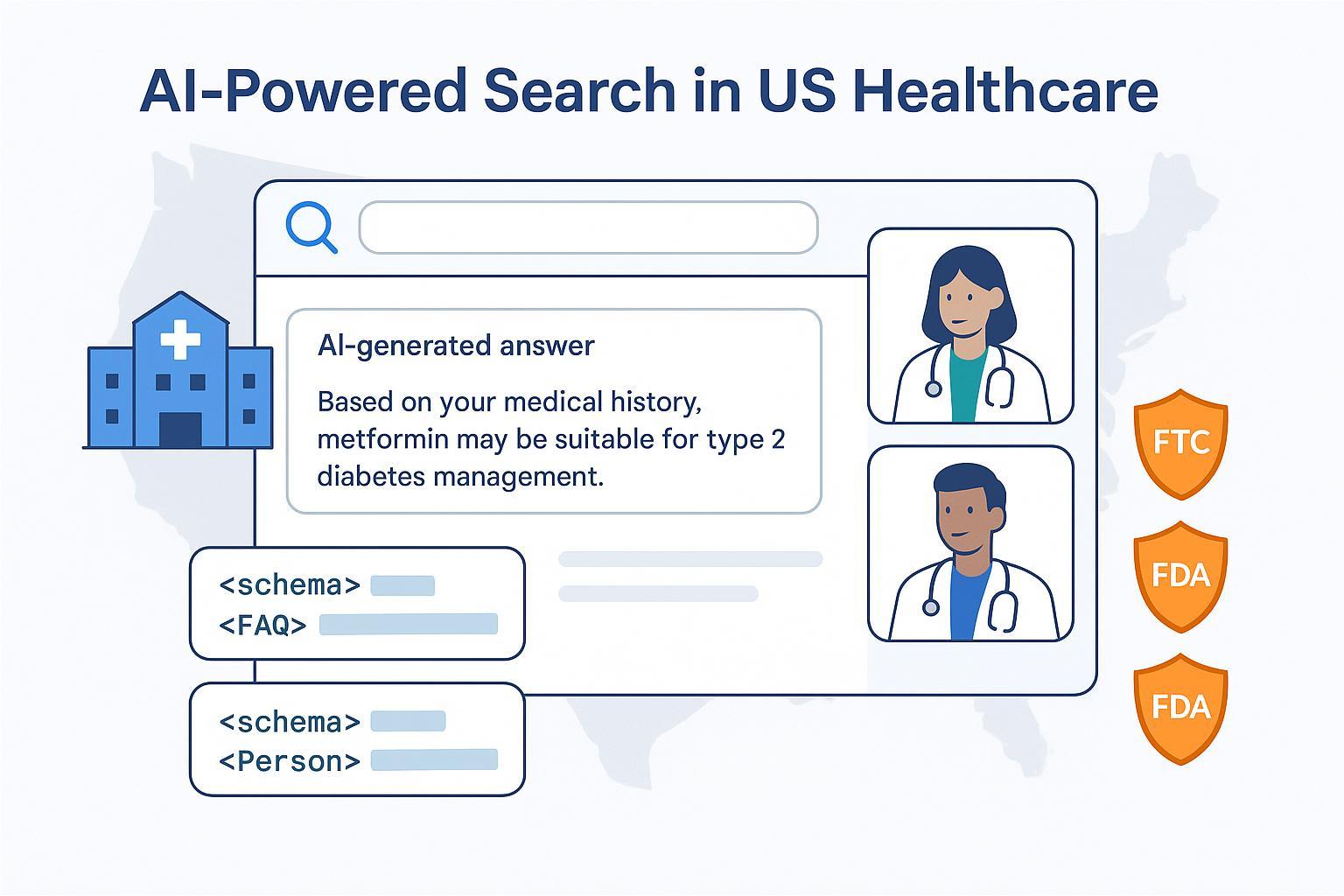
If you manage digital marketing for a US healthcare organization, you’ve likely felt the shift: AI Overviews and answer engines now sit between your content and the patient. Based on hands-on work with hospitals, specialty clinics, and multi-location practices, here’s a practical, compliance-aware playbook to sustain and grow visibility when AI does the summarizing.
What changed in 2024–2025—and why it matters for healthcare
- AI answers increasingly summarize health questions, then link to a handful of sources. Google clarifies there’s no special “AI Overviews SEO”—inclusion follows Search Essentials and content quality; you can’t opt in programmatically, and standard robots/noindex are the only effective exclusions, as described in Google’s guidance on AI features and your website (2025).
- Google’s 2025 recommendations stress original, helpful coverage and authority signals to perform well in AI search experiences. See Google’s developer blog on the top ways to succeed in AI search (2025).
- Expect more impressions but fewer clicks for informational queries. Industry data in 2025 shows material CTR declines where AI results appear; BrightEdge’s one‑year review reported more search usage alongside lower click‑through after AI Overviews, summarized on the BrightEdge AI Overviews page (2025). Your strategy must embrace zero‑click realities and measure outcomes beyond blue links.
What follows are the practices that consistently move the needle without compromising HIPAA/FTC/FDA requirements.
Pillar 1: E-E-A-T you can operationalize for YMYL health content
What works in practice is less about slogans and more about consistent process.
-
Show credentials everywhere it matters
- Author line on every clinical page: name, degrees, specialty, and role.
- “Medically reviewed by” with a clinician’s full credentials and date.
- Link each name to a bio page and the clinician’s credentialing bodies (medical board, associations).
-
Make sourcing easy for answer engines
- Cite primary sources (guidelines, peer‑reviewed references) inline and explain why you chose them.
- Avoid sweeping claims; use careful qualifiers and state evidence strength.
-
Increase update cadence on sensitive topics
- Add “Last medically reviewed” with the month/year, and maintain a rolling 6–12 month review cycle for high‑risk topics.
-
Transparency and scope
- Prominently disclose scope and limitations of information (education, not a substitute for care) and provide clear escalation paths to care.
Practical boundary: Quality raters evaluate health content with elevated standards. If your topic is high‑risk (diagnosis, treatment), ensure expert review and clear sourcing as articulated in the publicly available Search Quality Rater Guidelines PDF (latest public edition).
Disclosure language template you can adapt
Educational content only. Reviewed by [Clinician Name, Credentials] on [Month, Year]. This page summarizes current guidance and may not reflect every patient scenario. For personal medical advice, contact a licensed clinician or call emergency services if you’re experiencing urgent symptoms.
Pillar 2: Structured data that reliably helps now
In healthcare, structured data is less about flashy rich results and more about sending unmistakable semantic signals that AI systems can trust. Focus on JSON‑LD, align markup with visible content, and follow Google’s intro to structured data (accessed 2025).
Recommended schema building blocks
- Organization/Local: Organization, LocalBusiness, Hospital, MedicalClinic
- People: Person, Physician (for licensed providers), Author
- Content: Article/BlogPosting, FAQPage (only when the page shows real Q&A), BreadcrumbList
- Health extension (semantic enrichment, not a guaranteed rich result): MedicalWebPage, MedicalCondition, MedicalProcedure, MedicalSpecialty
Copy-paste JSON-LD starters (customize values to match on-page content)
Organization/Hospital
{
  "@context": "https://schema.org",
  "@type": "Hospital",
  "name": "Example General Hospital",
  "url": "https://www.examplehospital.org/",
  "logo": "https://www.examplehospital.org/static/logo.svg",
  "sameAs": [
    "https://www.linkedin.com/company/examplehospital"
  ],
  "address": {
    "@type": "PostalAddress",
    "streetAddress": "123 Health Ave",
    "addressLocality": "Boston",
    "addressRegion": "MA",
    "postalCode": "02114",
    "addressCountry": "US"
  },
  "telephone": "+1-617-555-0100",
  "medicalSpecialty": "Cardiovascular"
}
Physician bio
{
  "@context": "https://schema.org",
  "@type": "Physician",
  "name": "Dr. Jordan Lee, MD",
  "medicalSpecialty": "Endocrinology",
  "affiliation": {
    "@type": "MedicalOrganization",
    "name": "Example Endocrine Clinic"
  },
  "url": "https://www.exampleclinic.com/providers/jordan-lee-md",
  "sameAs": [
    "https://license.medboard.state.us/xyz",
    "https://www.abim.org/verify/abc"
  ]
}
FAQPage (only for true Q&A on the page)
{
  "@context": "https://schema.org",
  "@type": "FAQPage",
  "mainEntity": [
    {
      "@type": "Question",
      "name": "Do you accept new patients?",
      "acceptedAnswer": {
        "@type": "Answer",
        "text": "Yes. Request an appointment online or call our scheduling line at +1-617-555-0100."
      }
    },
    {
      "@type": "Question",
      "name": "Do you offer telehealth visits?",
      "acceptedAnswer": {
        "@type": "Answer",
        "text": "Yes. Telehealth is available for select visit types. See our telehealth page for eligibility and instructions."
      }
    }
  ]
}
Practical guardrails
- Mark up only what’s visible. Don’t inject FAQPage for hidden accordions that aren’t actually FAQs.
- Use Physician only for licensed clinicians; use Person for non‑clinical authors/editors.
- Health‑Lifesci types improve semantic clarity but don’t guarantee special SERP features.
- Validate with the Rich Results Test and re‑check after content edits.
Pillar 3: Local SEO for multi-location practices and individual clinicians
AI answers often cite the best-structured local sources. Get your Google Business Profile (GBP) hygiene perfect, then layer clinic and practitioner pages with consistent NAP data.
GBP playbook (multi-location)
- Separate profiles: One for the practice/hospital location, and individual profiles for eligible practitioners. Consistent naming, primary category, unique phone numbers, and URLs per profile.
- Attributes that matter: Accepting new patients, wheelchair accessible, languages, women‑led, appointment availability.
- Appointments: Add online appointment links directly in GBP via Google’s guidance on managing your Business Profile (2025).
- Photos and services: Upload exterior/interior photos and list core services; keep them consistent with your site service pages.
- Reviews: Ask ethically, respond professionally, never gate or incentivize by sentiment.
On‑site local landing pages
- One page per location and per practitioner, each with unique content: hours, parking, transit, insurances, specialties, nearby landmarks.
- Embed maps thoughtfully; include crawlable NAP and appointment options.
- Link each clinician page to the location page and vice versa; mirror this in schema.
Pillar 4: Optimize for AI Overviews, Bing Copilot, and answer engines
What consistently increases inclusion and citations in AI answers:
-
Make your page the easiest to quote
- Plain‑language definitions near the top; short, evidence‑linked summaries; then deeper sections.
- Distill complex processes into step lists and small tables—AI systems surface scannable structure.
-
Put claims in context
- Use restrained language; attribute to guidelines or systematic reviews where feasible.
- Consider ClaimReview only if you’re assessing a public claim with evidence; otherwise, avoid misusing it.
-
Keep freshness observable
- Display review dates and update notes; avoid undated clinical advice pages.
-
Technical hygiene
- Fast, mobile‑first pages; clear headings; canonical tags; clean internal linking.
Important constraints to remember
- There’s no AI Overviews-specific markup and no magic tag to “opt in.” Google reiterates this in its page on AI features and your website (2025).
- Optimize for traditional ranking and trust signals first; AI experiences draw heavily from those.
Pillar 5: Compliance workflows that won’t slow growth
Your marketing can be both compliant and effective if you bake legal/clinical checks into the workflow.
HIPAA and tracking technologies
- Align analytics and ad pixels with the HHS Office for Civil Rights guidance on online tracking (last updated March 2024). It clarifies when data may be PHI/IIHI, when BAAs are required with vendors, and safeguard expectations. See the HHS OCR resource on HIPAA and online tracking technologies (2024 update).
- Practical guardrails we apply:
- Avoid collecting user-entered symptom data on marketing pages without explicit need and protection.
- Use IP anonymization and limit parameter logging; segregate portal vs. marketing analytics.
- Execute BAAs with vendors that might receive PHI; document data flows.
FTC: endorsements, reviews, and AI disclosures
- The FTC’s Consumer Reviews and Testimonials Rule (effective Oct 21, 2024) bans fake reviews, undisclosed insider reviews, and certain incentivized practices. Healthcare marketers must ensure any AI‑assisted summaries or review widgets don’t fabricate sentiment or mislead. Review the FTC’s Q&A on the Consumer Reviews and Testimonials Rule (2024).
- When using AI to draft patient education, disclose internal use where it affects consumer understanding, and always have qualified clinicians review before publication.
FDA: drugs/devices promotional constraints
- If you market prescription products or devices, promotional content must be truthful, non‑misleading, and present fair balance of risk/benefit, including online and social placements. The FDA’s OPDP outlines expectations in the OPDP Frequently Asked Questions.
Compliance checklist to integrate into your CMS workflow
- Pre‑publish clinical review by a licensed clinician for YMYL topics (logged with date/credentials).
- Policy check for HIPAA tracking tech on pages with forms, find‑a‑doctor, and condition content.
- FTC review of testimonials and star ratings; require disclosure and moderation rules.
- FDA review (if applicable) for fair balance and mandatory statements.
- Accessibility check (WCAG 2.2 AA) for forms, color contrast, focus states, and error handling.
Pillar 6: Measure the right things in an AI-first SERP
Traditional CTR and rank still matter, but they’re insufficient when AI captures attention. A practical measurement stack:
-
Segment keyword sets
- Group queries into informational, navigational, and local intent. Track a sample set that visibly triggers AI answers via manual SERP audits.
-
Track inclusion and citation lift
- Create a monthly sampling routine: for 50–100 priority queries, capture whether an AI Overview appears and whether your brand is among the cited sources.
-
- GBP actions (calls, directions, appointment clicks), online booking starts/completions, and patient portal conversions often move even if page CTR dips.
-
Expect ranges, not absolutes
- Across our projects, informational pages frequently see impression growth with CTR pressure in AI-heavy SERPs. This aligns with 2025 industry findings summarized by the BrightEdge AI Overviews page (2025). Your mileage will vary by specialty and market.
Sample before/after table you can adapt
| Metric | Baseline (Q1) | After 90 days (Q2) |
|---|---|---|
| % priority queries with AI Overview present (sampled) | 18% | 31% |
| % of sampled AI Overviews citing your site | 6% | 14% |
| Organic CTR on informational pages | 3.8% | 3.0% |
| GBP appointment clicks (all locations) | 1,120 | 1,390 |
Note: Use as a template; replace with your own tracking numbers.
Pillar 7: Accessibility and patient portals
Answer engines favor clear, accessible information; patients benefit too. Prioritize WCAG 2.2 AA conformance, which adds criteria like focus visibility, target size minimums, and accessible authentication. See the W3C’s WCAG 2.2 specification (Oct 2023) for the latest success criteria.
Quick wins
- Ensure forms have labels, inline error messages, and keyboard operability.
- Increase tap targets and ensure visible focus styles.
- Provide accessible alternatives for CAPTCHA and dragging interactions.
- Make patient portal login flows usable with assistive tech and without cognitive burdens.
30/60/90‑day execution plan
Days 1–30: Stabilize foundations
- Implement author, reviewer, and “last reviewed” patterns across clinical pages.
- Publish or update physician bios with credentials and Physician schema.
- Launch or clean up GBP for all locations and primary practitioners; add appointment links and key attributes.
- Deploy Organization/Hospital schema sitewide; add FAQPage only on true Q&A pages.
- Establish a compliance checklist and route: clinical review, HIPAA tracking guardrails, FTC testimonial checks.
Days 31–60: Build AI‑friendly content structure
- Rewrite top 20 condition/service pages with clear definitions, short summaries, and scannable lists.
- Add citations to primary sources in intros; include update notes.
- Create unique local landing pages per location and practitioner; interlink logically.
- Start monthly AI Overview sampling for 50–100 priority queries; track citations.
Days 61–90: Optimize and scale
- Expand structured data: MedicalWebPage on key education pages; ensure alignment with visible content.
- Improve page speed and mobile UX; fix internal linking and breadcrumb consistency.
- Launch a review governance program compliant with FTC rules; publish response guidelines.
- Produce one comprehensive guide per specialty that consolidates expertise—these tend to be cited by AI systems when well sourced.
Common pitfalls (and how to avoid them)
- Overusing FAQPage markup on non‑FAQ content. Only mark up questions that appear on the page.
- Publishing AI‑drafted clinical content without licensed review. Always implement clinician review and disclosure.
- Tracking tech sprawl. Limit pixels on sensitive pages; document data flows; obtain BAAs as needed per the HHS OCR online tracking guidance.
- Ignoring local basics. Inconsistent NAP, missing appointment links, and incomplete GBP categories cost you citations and clicks. Use Google’s Business Profile management guidance as your checklist.
- Misapplying promotional rules. If drugs/devices are in scope, validate content against the FDA’s OPDP FAQs before launch.
Quick reference: Source policies and docs to keep handy
- Google’s page on AI features and your website (2025) and developer blog on how to succeed in AI search (2025)
- Google’s intro to structured data
- HHS OCR’s resource on HIPAA and online tracking technologies
- FTC’s Consumer Reviews and Testimonials Rule Q&A
- FDA’s OPDP FAQs
- W3C’s WCAG 2.2 specification
With these workflows, schema templates, and compliance guardrails, your healthcare organization can stay visible in AI‑first search while protecting patients and your brand.
