Best AI Models and Tools for Writing Page Copy and Articles (2025)

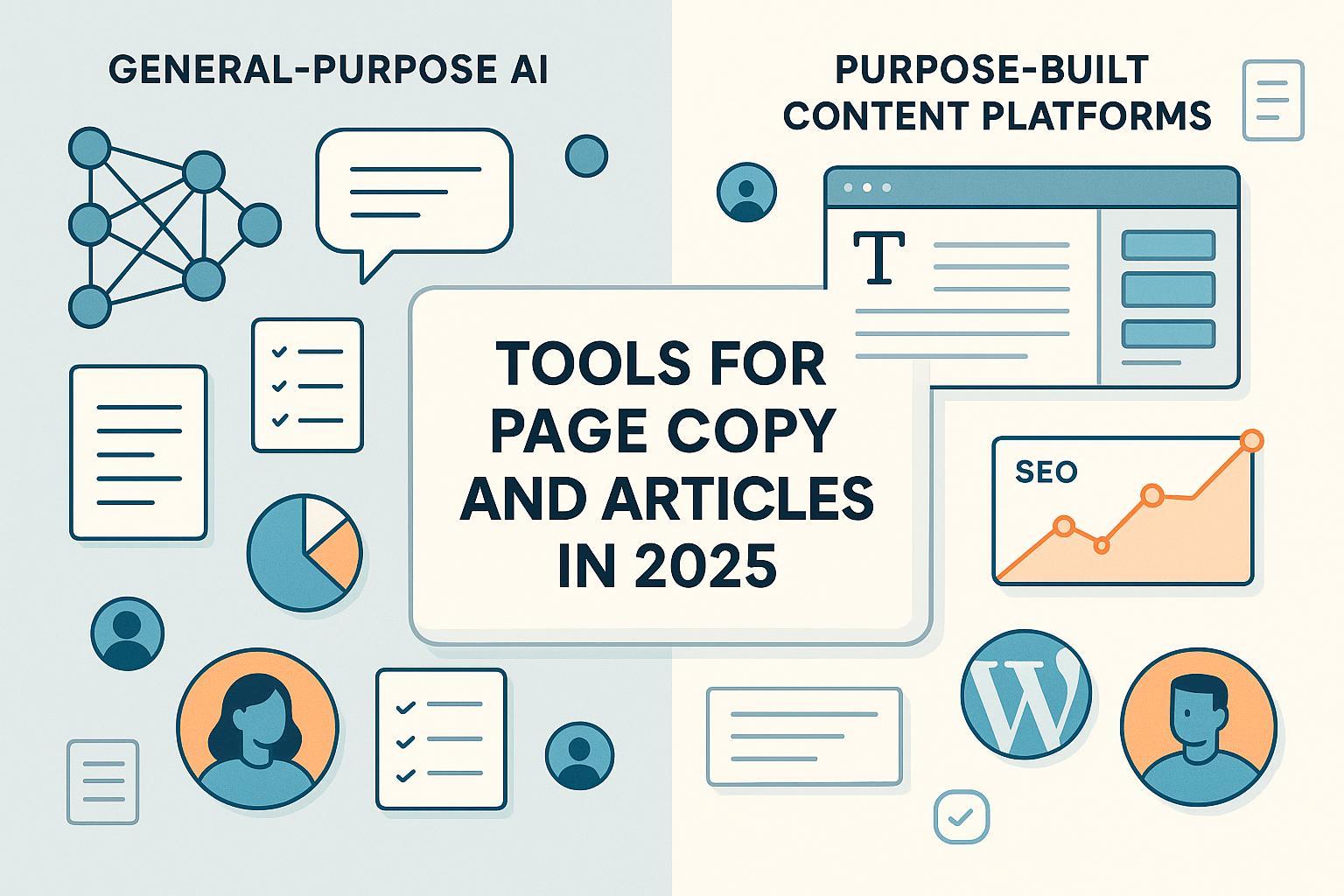
If you’re deciding between raw large language models (LLMs) and purpose-built AI copy platforms for landing pages and blog articles, 2025 offers excellent choices—and real trade‑offs. This review compares leading general models (OpenAI, Anthropic, Google) with popular marketing platforms (Jasper, Copy.ai, Writesonic, QuickCreator) across writing quality, long‑form coherence, SEO tooling, brand voice governance, collaboration, integrations, workflow automation, cost, data controls, speed, and multilingual support. All facts below are “as of Nov 2025,” and you should verify current limits/pricing before purchase.
Who this is for
- SMB owners and solo marketers who need fast, SEO‑friendly pages and blogs without technical overhead
- Marketing managers and content teams prioritizing brand voice, approvals, analytics, and CMS integrations
- Agencies running multi‑client workflows with governance, bulk production, and cross‑CMS publishing
- SEO leads and strategists who need SERP‑aware drafting, on‑page optimization, internal linking, and content refresh pipelines
Two ways to work in 2025
- General‑purpose LLMs (OpenAI, Anthropic, Google): extremely flexible for bespoke prompts and research synthesis; you assemble your own SEO and publishing stack.
- Vertical AI content platforms (Jasper, Copy.ai, Writesonic, QuickCreator): opinionated workflows with templates, brand voice, SEO helpers, collaboration, and publishing/hosting built‑in or integrated.
Quick scan: core differences that matter
| Dimension | General LLMs (OpenAI, Anthropic, Google) | AI Content Platforms (Jasper, Copy.ai, Writesonic, QuickCreator) |
|---|---|---|
| Long‑form coherence & context | Strong to excellent; very large context windows on some models | Long‑form editors help with structure; context size abstracted |
| SEO tooling | Bring your own SERP tools and on‑page optimizers | Built‑in SERP/keyword tools, optimization checkers, internal linking varies by platform |
| Brand voice governance | Prompt engineering or custom memory/KB | Style guides, brand voice, knowledge bases, approvals |
| Collaboration & governance | Strong in enterprise LLM suites; limited in consumer apps | Roles/permissions, comments, approvals, multi‑client support |
| Publishing/hosting | Manual copy‑paste or custom APIs | WordPress/CMS integrations; some include free hosting |
| Workflow automation/agents | Possible via API/zap/agents; DIY | Native workflows/agents tailored to marketing |
| Cost model | Seats (apps) or tokens (API); can be efficient for power users | Tiered plans by seats/usage; value from integrated features |
| Data controls/compliance | Enterprise plans emphasize privacy & admin | Varies by vendor; check trust/privacy pages |
What’s new or notable in late 2025
- Context windows are massive: Google reports up to 2M tokens for Gemini 1.5 Pro and up to 1M for Flash in the API, enabling direct ingestion of large PDFs and research sets, per the official Gemini API models page (Google, 2025). Pricing for Flash is clearly listed on the Gemini API pricing page (Google, 2025).
- OpenAI’s Business and Enterprise plans add admin/security features, connectors, and larger context windows in the app; plan structure and pricing are detailed on the ChatGPT business pricing page (OpenAI, 2025). Consumer Plus limits are not numerically specified in official docs—treat them as “expanded but limited.”
- Anthropic’s Claude lineup has evolved; Claude 3.5 Sonnet is retired. The current Sonnet family includes Claude Sonnet 4.5 with 200K context, per the Claude Sonnet page (Anthropic, 2025) and the Anthropic pricing page (2025).
Per‑product capsules (alphabetical within categories)
General‑purpose LLMs
Anthropic — Claude Sonnet 4.5
- Best for: Long‑form reasoning and careful drafting within a large (200K) context; safety‑conscious teams.
- Pros: Strong reasoning and writing quality; 200K context; available via Anthropic app and cloud partners.
- Constraints: SEO and publishing steps are external; pricing is per‑token and can add up for very long outputs; prior model retirements can confuse versioning.
- Pricing/limits (as of Nov 2025): See official pages for current token rates and context; avoid relying on retired 3.5 Sonnet numbers. Reference the Anthropic pricing page (2025).
- Integrations/Notes: API; availability via Amazon Bedrock and Google Vertex AI varies by region.
- Evidence: Model family and context are documented on the Claude Sonnet page (Anthropic, 2025).
Google — Gemini 1.5 Pro / 1.5 Flash
- Best for: Ingesting large research (Pro up to 2M tokens) and speed/cost‑sensitive drafting (Flash up to 1M tokens).
- Pros: Massive context windows; strong multimodal; clear Flash token pricing; native Workspace integrations.
- Constraints: Pro pricing details are less explicit publicly; SEO/publishing require external tools; Flash trades some depth for speed.
- Pricing/limits (as of Nov 2025): Token‑based; Flash input/output rates listed on the Gemini API pricing page (Google, 2025); model context on the models page (Google, 2025).
- Integrations/Notes: API, Google Cloud Vertex AI, Gems in Gemini apps.
- Evidence: Context windows and pricing are in Google’s 2025 developer docs linked above.
OpenAI — ChatGPT (Plus, Business, Enterprise)
- Best for: Flexible drafting, analysis, and custom prompts with enterprise governance options.
- Pros: Strong reasoning; advanced data analysis and connectors; enterprise admin/security; expanded context in Business/Enterprise modes.
- Constraints: Consumer Plus numeric limits are not officially published; SEO and publishing require separate tools; plan complexity for teams.
- Pricing/limits (as of Nov 2025): Plus $20/month; Business $25/seat/mo (annual) or $30/seat/mo (monthly); Enterprise custom—see the ChatGPT business pricing page (OpenAI, 2025). App‑level context windows vary by plan and model family per official help resources.
- Integrations/Notes: Connectors (e.g., Slack, Google Drive, SharePoint), projects/tasks, SSO/SCIM on Business/Enterprise.
- Evidence: Plan structure and features described on OpenAI’s 2025 business pricing page linked above.
AI content platforms
Copy.ai
- Best for: Speed‑first GTM content with workflows/agents and brand voice for teams.
- Pros: Agent Studio and unified workflows; Infobase/brand voice; broad integrations; tiered plans from Chat to Enterprise.
- Constraints: Native SEO depth is lighter than some competitors; workflow credits can add planning overhead.
- Pricing/limits (as of Nov 2025): Tiered plans and inclusions listed on the Copy.ai pricing page (2025); feature set overview on Copy.ai features (2025).
- Integrations/Notes: CRM, analytics, and productivity suite integrations.
- Evidence: Agents/workflows highlighted on the Content Agent Studio page (Copy.ai, 2025).
Jasper
- Best for: Brand‑governed marketing content and team collaboration with a long‑form Canvas editor.
- Pros: Canvas collaborative workspace; Brand Voice/Jasper IQ for style and knowledge; 90+ apps/templates; emerging multi‑agent workflows.
- Constraints: Some integrations/features tied to higher tiers; certain pricing details can be gated; deep SEO often relies on partner tools.
- Pricing/limits (as of Nov 2025): Plans differentiate audiences (e.g., Creator, Pro, Business); confirm current pricing on the site. See Jasper Canvas help (2025) and Jasper apps overview (2025).
- Integrations/Notes: Surfer SEO, Grammarly, Zapier, and more; real‑time collaboration and comments in Canvas.
- Evidence: Canvas and Brand Voice/Jasper IQ are described across Jasper help and product pages cited above.
QuickCreator
- Best for: SEO‑led blogging with SERP‑aware drafting, automatic on‑page optimization, and integrated publishing/hosting.
- Pros: AI blog/article writing with real‑time SERP signals; block‑based editor; free blog hosting; one‑click WordPress publishing; multilingual; analytics; team collaboration.
- Constraints: Primarily blog‑first focus; highly custom web components may require external site builders; verify current pricing on the website.
- Pricing/limits (as of Nov 2025): Check official site for current tiers and inclusions.
- Integrations/Notes: Embeds multimedia via third‑party APIs; WordPress publishing; SEO analytics and recommendations.
- Evidence: Product overview and educational resources are available on the site; for example, see the AI Blog Writer overview.
On first mention: QuickCreator. Disclosure: QuickCreator is our product.
Writesonic
- Best for: SEO‑forward teams that want audits, internal linking, topic clusters, and WordPress publishing in one place.
- Pros: SEO audits, internal linking, clustering; long‑form editor (AI Article Writer); WordPress publishing; Chatsonic for general chat.
- Constraints: Features spread across multiple plans; some pricing details surface in docs/blogs rather than a single canonical page.
- Pricing/limits (as of Nov 2025): Current tiers and inclusions are on the Writesonic pricing page (2025); feature summaries on Writesonic features (2025).
- Integrations/Notes: WordPress and other CMS exports; brand voice and team collaboration.
- Evidence: Writesonic’s official features and pricing pages linked above.
How they differ in real workflows
- Research‑heavy articles with lots of source material: Gemini 1.5 Pro’s 2M tokens or Claude Sonnet 4.5’s 200K make it practical to ingest long PDFs and multi‑source notes directly. You’ll still need separate SEO tools for SERP analysis, on‑page checks, and internal linking.
- Brand‑consistent campaigns across a team: Jasper’s Brand Voice/Jasper IQ and Canvas, plus agentic workflows, help keep tone consistent while moving fast. Copy.ai’s Agent Studio offers speed‑first, programmable workflows for GTM assets.
- SEO‑led blogging with built‑in publishing: Writesonic and QuickCreator focus on SEO features and WordPress/hosting workflows, letting you go from keyword intent to optimized draft to published post without leaving the platform.
If you’re new to SEO‑aware drafting, these primers can help: a concise explainer on what keywords and topics mean in SEO and a practical overview of TDK (title, description, keywords) fundamentals. To reduce generic AI tone, see this guide to overcoming content homogenization. For quality scoring and prioritization, many teams benefit from an SEO content quality analysis workflow (2025).
Costs and limits: what to expect
- LLM apps vs API: LLM apps (ChatGPT Plus/Business, Gemini Advanced) are predictable per‑seat; API usage can be cheaper for power users but requires engineering. OpenAI’s app plan structure (Plus, Business, Enterprise) is detailed on the ChatGPT business pricing page (OpenAI, 2025). Google lists model contexts and Flash pricing in its 2025 developer docs linked above.
- Platforms: Jasper, Copy.ai, and Writesonic organize plans by seats/use; SEO and multi‑brand features often sit in higher tiers. Verify details on each vendor’s current pricing page.
Data controls and compliance
- Enterprise LLM suites emphasize privacy and admin controls (e.g., SSO/SCIM, auditability). OpenAI details Business/Enterprise controls and privacy posture on its business pages; Google Cloud and Anthropic document their enterprise practices in official resources. For platforms, review each vendor’s trust/privacy pages and, if you’re in regulated industries, request detailed security documentation.
Scenario‑based recommendations (no single “winner”)
- Long, research‑heavy articles with many sources: Google Gemini 1.5 Pro or Anthropic Claude Sonnet 4.5. If you prefer OpenAI’s ecosystem, ChatGPT Business/Enterprise plus external SEO/publishing tools works well.
- Team campaigns that must stay on‑brand with approvals: Jasper for deep brand governance and collaboration; Copy.ai if speed‑first workflows/agents are your priority.
- SEO‑led blogging with integrated publishing/hosting: QuickCreator or Writesonic.
- Prompt‑savvy solo creators who like manual stacks: ChatGPT Plus/Business or Gemini apps, then add your own SEO optimizer and CMS publishing.
- Budget or speed for short social copy: Gemini 1.5 Flash or lower‑tier platform plans (Copy.ai Chat, Writesonic Individual).
How to choose in under 60 seconds
-
Are you primarily writing SEO‑led blogs with WordPress or hosted publishing? Choose QuickCreator or Writesonic.
-
Do you need strict brand voice governance and team approvals? Choose Jasper; consider Copy.ai if automated workflows/agents matter more than deep SEO.
-
Will you ingest large research (100s of pages) into drafts? Choose Gemini 1.5 Pro (2M context) or Claude Sonnet 4.5 (200K).
-
Are you a prompt‑savvy solo creator who prefers flexible stacks? Choose OpenAI ChatGPT Plus/Business or Gemini apps, then add a separate SEO optimizer and your CMS.
If your marketing strategy uses sprints, this primer on implementing SEO sprints can help you structure tool usage across planning → drafting → optimization → publishing → refresh.
Methodology and verification notes
- Evidence comes from official documentation and pricing pages as of November 2025. For example, Google’s 2M/1M context figures are described in the developer docs linked above (2025), OpenAI’s plan structure and pricing appear on the 2025 business pricing page, and Anthropic’s current model lineup and pricing are documented on official pages (2025). When public consumer limits are not specified (e.g., ChatGPT Plus numeric caps), we avoid asserting numbers.
- Tools evolve quickly. Always verify current plan inclusions, security posture, and integration availability before purchase.
Appendix: Helpful internal resources for beginners
- Understand SERP‑aware drafting and quality checks: SEO content quality analysis tools (2025)
- Learn the AI Blog Writer workflow: AI Blog Writer overview
- Keyword/topic fundamentals: What are keywords and topics
- Meta basics for on‑page SEO: TDK guide
- Avoid generic AI tone: Overcome content homogenization
- Plan your work: Implementing SEO sprints
