AI content detectors: how they work and what actually matters for SEO

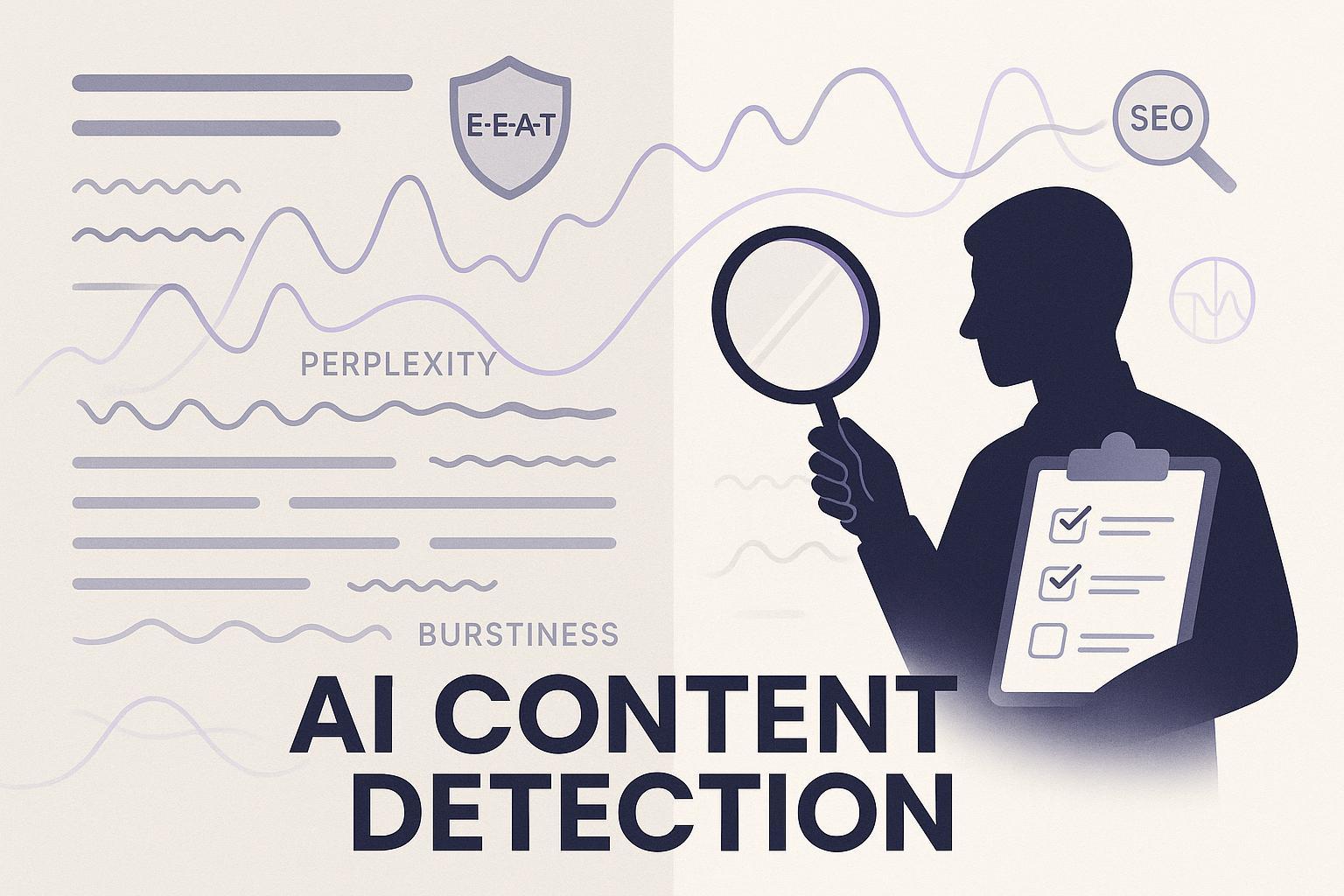
AI content detectors are everywhere right now. Many SEO teams worry that “failing” a detector will tank rankings, while “passing” guarantees safety. Here’s the short truth: detectors estimate, they don’t prove—and Google ranks for usefulness and policy compliance, not for detector scores.
This explainer breaks down how detectors work in plain English, where they’re genuinely useful (and where they’re not), and what marketers and SEO managers should prioritize to ship trustworthy, high‑performing content.
What is an AI content detector?
An AI content detector is software that analyzes a piece of text and estimates the likelihood it was produced by a generative model (like a large language model) rather than a human. Most tools return a probability or label (e.g., “likely AI”), not definitive proof. Think of it like a weather forecast: it provides a probability based on patterns—not a courtroom‑grade verdict. Results are especially shaky on short passages, heavily edited drafts, or translated text.
How detectors generally work (without the math)
Detectors look for statistical and stylistic patterns that are more common in model‑generated text.
Perplexity (predictability). In simple terms, this measures how easy it is to predict the next word. Model outputs often read as smooth and unsurprising, which means lower unpredictability. Educator resources describe perplexity as a way to gauge “randomness” in text; lower randomness can be a signal of AI‑like output.
Burstiness (variation). Humans naturally mix short and long sentences and vary rhythm. Model text can be more uniform. Combining perplexity and burstiness gives a rough “texture” profile of the writing.
Stylometry (style fingerprints). Tools may compare word choices, syntax, and cadence to patterns typical of model output—or to a known human author’s baseline (if available).
Supervised classifiers. Many detectors are trained on large sets of labeled examples (human vs. AI). The model learns features that separate the classes and returns a score on new inputs.
Important: these signals are probabilistic. Edits, paraphrases, translation, or deliberate obfuscation can blur or flip the signals. Independent testing has shown that detectors can be evaded or confused, and that their accuracy varies widely across text types and languages.
Why false positives and false negatives happen
Short text is unreliable: too little signal to classify.
Domain and style bias: technical manuals, boilerplate, or highly polished prose can look “AI‑like.”
Post‑editing and paraphrasing: small human edits or paraphrase tools can change the signals without changing meaning.
Evasion tactics: writers can intentionally alter phrasing to dodge detection.
A 2023 independent evaluation of multiple detectors reported substantial misses and inconsistencies, especially once AI text was paraphrased or translated, concluding that current detectors are neither consistently accurate nor reliable; treat outputs as one signal, not evidence. See the findings summarized in Deborah Weber‑Wulff et al., “Testing of Detection Tools for AI‑Generated Text” (2023). Separately, OpenAI discontinued its own AI‑text classifier in 2023 due to low accuracy, noting poor true‑positive rates and nontrivial false positives; see OpenAI’s “New AI classifier for indicating AI‑written text” (updated 2023).
A quick anecdote from the field
A mid‑market B2B SaaS client insisted on “passing” a commercial detector before publishing. An expert‑written post—with original screenshots and customer quotes—scored “likely AI” on one detector but “likely human” on another. Our senior editor reviewed notes, interview transcripts, and source citations and confirmed originality. We shipped as‑is. Within weeks, the article earned featured snippets and conversions. Lesson: detector outputs can conflict; editorial evidence and user value should drive decisions.
Detectors and Google rankings: myth vs. reality
Google does not rank content based on third‑party AI detector scores. Google’s public guidance emphasizes that appropriate use of AI is allowed; what matters is whether content is helpful, original, and compliant with Search Essentials and spam policies. See the policy statement in Google Search’s guidance about AI‑generated content (2023) and the practical recommendations in “Using generative AI content on your site” (updated 2025).
What will get you in trouble is behavior like “scaled content abuse”: mass‑producing pages primarily to manipulate rankings, regardless of whether a human or a model typed the words. Google clarified this in the March 2024 update and maintains it in its current policies; see “Spam Policies for Google Web Search” (updated 2025).
In short: passing a detector ≠ ranking boost; failing a detector ≠ penalty. Focus on usefulness and compliance.
Where AI detectors are actually used today
Academic integrity workflows. Universities and assessment bodies may use detectors as one signal to start a conversation, not as sole evidence. Multiple institutions have cautioned against over‑reliance due to false positives/negatives and bias risk.
Enterprise compliance and editorial policy. Some organizations require disclosure of AI assistance or run screening checks to maintain standards. That’s a policy choice, separate from Google rankings.
Publishing guidelines. Many scholarly and media publishers ask authors to disclose AI use and maintain human accountability for accuracy and integrity. These are editorial norms rather than SEO ranking systems.
Practical SEO playbook: how to create detector‑agnostic, high‑performing content
Treat detector scores as optional QA inputs only when stakeholders demand them. The path to rankings is still quality, experience signals, and policy compliance. Here’s a pragmatic checklist:
Nail search intent and usefulness
Start with a clear user problem. Outline what the page must answer that top results miss.
Add original value: first‑hand examples, proprietary data, screenshots, or quotes from SMEs.
Make E‑E‑A‑T visible
Attribute content to a real author with credentials. Include short bios and experience relevant to the topic.
Cite primary, authoritative sources; link precisely at the claim level.
Add first‑hand evidence: photos, clips, data tables, or mini case notes when appropriate.
If you want a quick diagnostic of experience and authoritativeness signals, see QuickCreator’s AI E‑E‑A‑T Checker.
Strengthen editorial quality
Use a human editor to restructure, clarify, and fact‑check. Push past generic phrasing; add concrete details, comparisons, and counterpoints.
Avoid scaled thin content. If a template is necessary, ensure each page has unique insights and utility.
Build site‑level trust
Cluster related articles to grow topical authority; use internal links to connect genuinely related pages.
Keep pages updated. Add change logs where useful.
Measure what actually matters
Track rankings, clicks/CTR, engagement, and conversions—not detector scores. Iterate based on these signals.
Operationalize quality checks with a content quality score plus human editorial review; see content score overview and the Content Quality Score documentation.
If a client requires a detector check
Explain that outputs are probabilistic and inconsistent across tools. Log which tool, version, date, and score you used.
Treat results as a prompt for deeper review: verify sources, add first‑hand evidence, and keep revision notes.
Do not gate publication solely on a detector label—seek editorial corroboration.
For a step‑by‑step hybrid human+AI workflow blueprint that teams can adopt, see best practices for content workflows with humans + AI.
Brief look ahead: watermarking and provenance
Detectors infer after the fact. A different approach is to embed or preserve origin signals at creation time.
Watermarking. Google DeepMind’s SynthID, for example, embeds imperceptible watermarks in AI outputs to aid identification, with stated limitations and a need for ecosystem adoption.
Content provenance. The C2PA standard (Content Credentials) attaches cryptographically signed metadata about an asset’s origin and edit history. Adoption is growing across creative tools.
These technologies support transparency and trust. They are not, by themselves, SEO ranking boosters. For search, the north star remains helpfulness, originality, and adherence to spam policies.
Bottom line
AI content detectors estimate likelihood; they do not prove authorship.
Google’s rankings hinge on content usefulness, experience/expertise signals, and spam policy compliance—not detector scores.
Use detectors, if required, as one QA input among many. Prioritize human editorial review, first‑hand value, precise sourcing, and continuous measurement.
Next steps
If you want a repeatable way to ship helpful, accurate, detector‑agnostic content, explore how QuickCreator can help operationalize E‑E‑A‑T signals and on‑page SEO in your workflow. Disclosure: QuickCreator is our product.
References for policy and evidence mentioned above include Google’s guidance on AI content (2023), the “Using generative AI content” documentation (updated 2025), the Spam Policies page (updated 2025), and independent evaluations of detector accuracy (Weber‑Wulff et al., 2023; OpenAI classifier note, 2023).
