Affiliate KPIs: Definitions, Formulas, and a Monthly Report Template (United States)

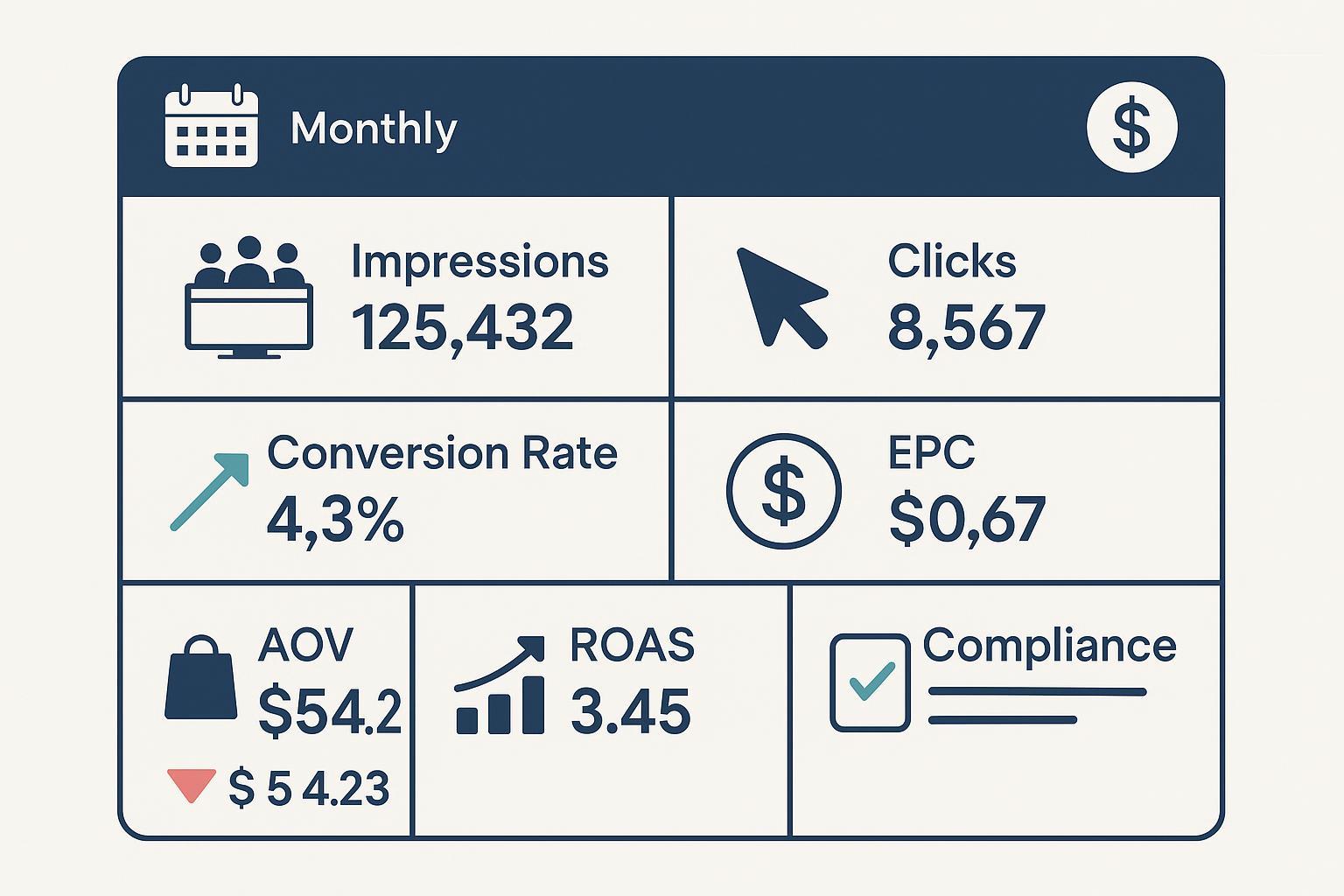
Affiliate KPIs are the quantitative metrics you use to measure how well your affiliate (partner) program is performing—across traffic quality, conversion efficiency, economics, and compliance. In a U.S. context, that means reporting in USD, aligning timestamps to a U.S. time zone, and documenting Federal Trade Commission (FTC) disclosure practices alongside performance.
You might wonder why “KPIs” matter when many platforms already show dashboards. The value of KPIs is not the numbers themselves, but the clarity they create: clear definitions, consistent formulas, and transparent assumptions. This article gives you precise, U.S.-ready definitions, explains how metrics relate, highlights FTC obligations, and provides a copy-ready monthly report template.
What counts as an “Affiliate KPI” (and what doesn’t)
Affiliate KPIs are operational measures of program performance, not legal guarantees or universal standards. Calculations vary by network or platform. Your report should always state your exact formulas and any platform-specific conventions (for example, whether EPC is reported per click or per 100 clicks). Where a metric depends on policy—such as your attribution window—document that policy upfront.
Core KPIs with plain-language formulas
Note: Percentages are typically shown as a percent; currency is USD for U.S. programs. If your platform defines a metric differently, specify your convention in the report.
- Click-through rate (CTR): clicks ÷ impressions.
- Conversion rate (CR): conversions ÷ clicks.
- Earnings per click (EPC): total affiliate earnings ÷ clicks. Some networks present EPC per 100 clicks; if you follow that convention, state it clearly, as described by the ShareASale explanation of EPC per 100 clicks (2022).
- Average order value (AOV): revenue ÷ orders.
- Cost per acquisition/sale (CPA/CPS): affiliate program costs attributable to conversions ÷ conversions. Clarify whether “costs” include commissions only or also bonuses, technology/network fees, and in-house labor.
- Return on ad spend (ROAS): revenue ÷ total program spend. Include commissions, bonuses/bounties, and platform fees for accuracy.
- Approval rate: approved transactions ÷ tracked transactions. Specify your program’s reconciliation and “locking” timelines because pending actions can still be reversed.
- Time-to-conversion (latency): average or median time from click to conversion.
- Refund/chargeback/reversal rate: reversed conversions ÷ approved conversions.
- Active affiliate rate: affiliates with at least one click or conversion ÷ total affiliates.
- New vs. returning customer mix: share of first-time customers vs. repeat buyers attributed to affiliates.
- Effective commission rate: total commissions ÷ net sales (after cancellations/returns).
- Attribution window/cookie duration: the time period a click can earn credit (e.g., 30 days) and the crediting rule (last click vs. multi-touch). State these rules in your template header.
Practical example (EPC and ROAS)
- If you paid $15,000 in commissions and fees to generate 60,000 clicks, EPC = $15,000 ÷ 60,000 = $0.25 per click. If your platform reports per 100 clicks, that would display as $25.00 EPC per 100.
- If total revenue from affiliates was $120,000 and total program spend (commissions + fees) was $24,000, ROAS = 120,000 ÷ 24,000 = 5.0 (i.e., $5 revenue for every $1 spent).
How these KPIs relate to each other
- EPC is largely a function of CR, AOV, and your commission structure. If CR or AOV rises (with the same commission rate), EPC typically increases.
- CPA/CPS and ROAS move in opposite directions: lowering CPA (by improving conversion or reducing costs) generally improves ROAS.
- Approval rate affects your “real” economics. A program that books strong gross sales but later voids a high share will report disappointing net revenue and strained affiliate relationships.
- Attribution rules (window length, last-click vs. data-driven) can materially shift perceived performance across channels. Document your rule set and keep it consistent in month-to-month comparisons.
U.S. compliance essentials (FTC)
As of October 2025, the FTC requires clear, conspicuous, and unavoidable disclosures when there’s a material connection (like commissions from affiliate links). Disclosures should be placed where consumers will notice them, near the endorsement or link, and in plain language. Advertisers are expected to inform partners of these duties, monitor for compliance, and take corrective action when issues arise. See the FTC’s practical guidance in the FTC business guidance on endorsements, influencers, and reviews (updated 2025) and the regulatory text summarized in the Federal Register notice for the Endorsement Guides (2023).
Compliance isn’t just legal hygiene—it is a performance factor. Noncompliant posts can be taken down or corrected, affecting traffic, conversion, and partner trust. Your monthly report should document training, monitoring, and remediation.
The Monthly Affiliate Report Template (United States)
Copy and adapt the structure below. Keep all numbers in USD and align timestamps to a U.S. time zone (e.g., ET or PT). At the top, declare your attribution window and crediting rule.
- Cover block
- Reporting month: [e.g., September 2025]
- Program owner: [Name, Title]
- Data sources: [Network/Platform names]
- Time zone: [e.g., Eastern Time]
- Attribution: [e.g., 30-day last-click; cross-device enabled]
- Currency: USD
- Executive summary (1–2 paragraphs)
- Highlights: Revenue, commissions, CR, ROAS
- What changed MoM/YoY and why (promotions, seasonality, partner mix)
- Key actions taken (e.g., commission tier updates, new creatives)
- Program KPIs summary (include MoM and YoY)
- Traffic: Impressions, clicks, CTR
- Conversions: Conversions, CR, time-to-conversion
- Revenue: Gross sales, net sales, AOV
- Economics: Commissions, effective commission rate, EPC [state “per click” or “per 100 clicks”], CPA/CPS, ROAS
- Quality: Approval rate, refund/chargeback rate
- Affiliate performance breakdown
- Top 10 by net sales: [Affiliate, clicks, conversions, net sales, AOV, approval rate, EPC, CPA/CPS, ROAS]
- Top 10 by EPC: [Affiliate, traffic volume, EPC, approval rate]
- Notes: Partner strategies observed (content vs. deal, placements, seasonality)
- Revenue and conversions by affiliate type: content, loyalty/cashback, coupon/deal, influencer, subnetwork
- Visuals: Pie or bar charts for share of revenue and conversion
- Quality & compliance
- Approval rate trend and void reasons: returns, cancellations, fraud, policy violations
- Fraud/quality screening notes
- FTC disclosure monitoring summary: trainings delivered, audits performed, corrective actions (include examples/screenshots where possible)
- Attribution & policy notes
- Cookie duration and click lookback window
- Last-click vs. multi-touch rules; cross-device tracking availability
- Restrictions: trademark bidding, coupon governance, paid search policies
- Actions & recommendations
- Commission tier adjustments (by partner type or performance)
- Recruitment targets and outreach status
- Creative updates (new banners, text links, product feeds)
- Landing page and checkout experiments
- Compliance follow-ups and documentation tasks
- Appendices
- Data dictionary: Every KPI with the exact formula used
- Export snapshots: Network/platform exports (with dates)
- Campaigns/promotions list: What ran, when, outcome metrics
Mini data dictionary (include in your appendix)
- CTR = clicks ÷ impressions
- CR = conversions ÷ clicks
- EPC = total affiliate earnings ÷ clicks (state if “per 100 clicks”)
- AOV = revenue ÷ orders
- CPA/CPS = program costs attributable to conversions ÷ conversions
- ROAS = revenue ÷ total program spend
- Approval rate = approved ÷ tracked
- Refund/chargeback rate = reversed ÷ approved
- Effective commission rate = commissions ÷ net sales
Common pitfalls and how to avoid them
- EPC confusion: Some platforms display EPC per 100 clicks. Label your convention on every report and reconcile when comparing sources, as highlighted by the ShareASale explanation of EPC per 100 clicks (2022).
- Approval vs. locking: Performance often looks different before actions are “locked.” Define your locking timeline and communicate when data is final. For a reference on action lifecycles, see Impact.com’s overview of action locking and payments (2023).
- Attribution discrepancies: Affiliate platforms commonly credit last click in-channel, while analytics suites like GA4 may use data-driven attribution. Expect differences and document your comparison method, as discussed by Rakuten Advertising’s GA4–affiliate comparison (2023).
- Cost completeness: If you exclude bonuses or network fees from “spend,” your CPA and ROAS will look better than reality. Decide whether to include these costs and stick to that convention.
- Time zone drift: Mixing ET/PT or comparing platform exports in different time zones leads to false swings. Fix a primary time zone and require it for all exports.
Implementation checklist
- Define and publish formulas and conventions (EPC unit, attribution window, lock dates) in every report.
- Align data extracts to one U.S. time zone; set currency to USD.
- Segment by affiliate type to find mix effects (e.g., content vs. coupon).
- Track quality metrics (approval, reversals) alongside top-line growth.
- Document FTC compliance: partner training, audits, and corrective actions with dates.
- Reconcile attribution differences when comparing affiliate platform data to GA4 or other analytics.
With clear definitions, consistent assumptions, and a repeatable U.S.-specific template, your monthly affiliate reporting will shift from “numbers on a page” to decisions that grow revenue responsibly and compliantly.
