On-Page SEO for Outdoor Sports & Camping Gear Product & Category Pages (2025): Titles, H1s, and Internal Links

·September 4, 2025
·10 min read
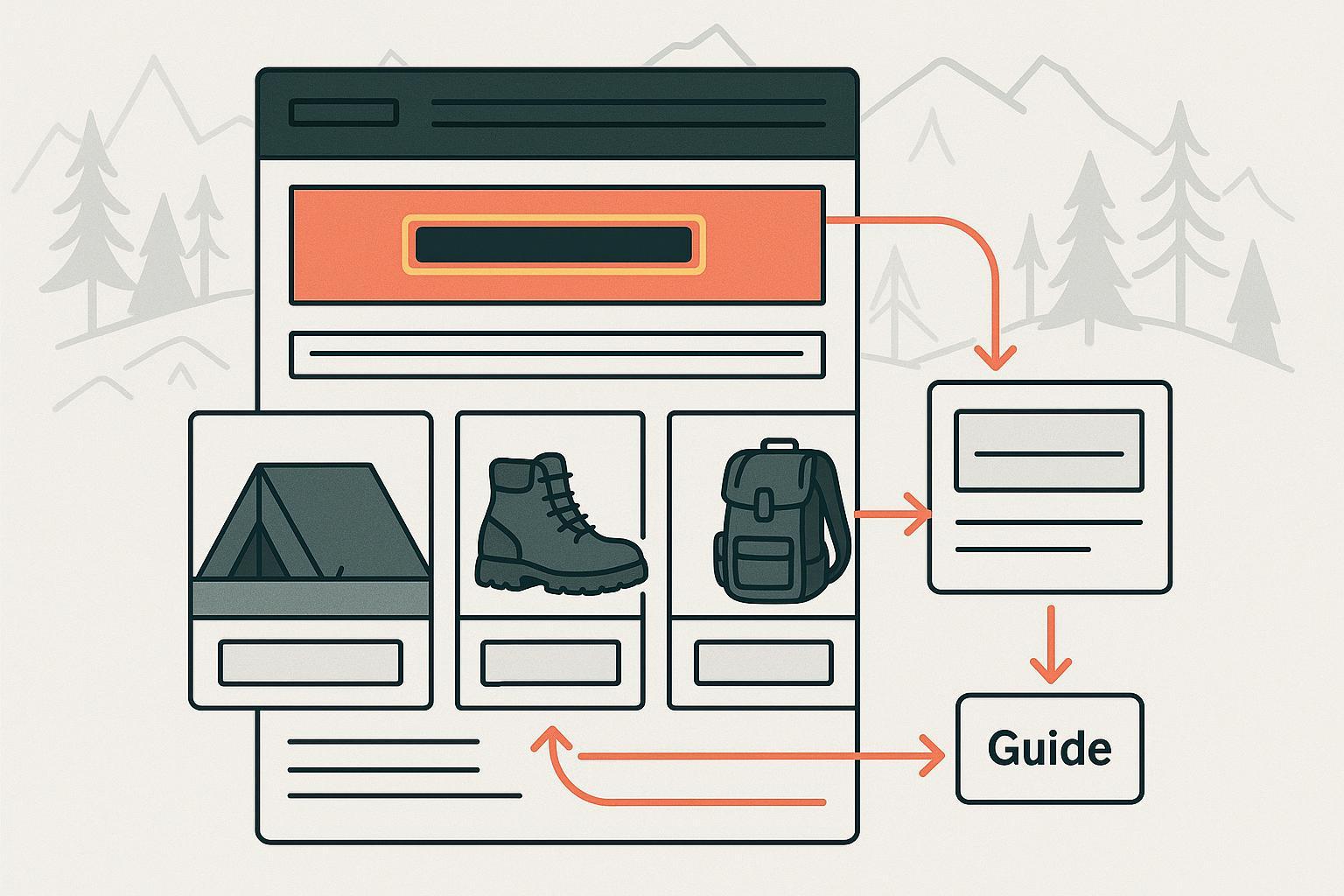
I’ve spent the last few years deep in outdoor ecommerce (tents, packs, boots, skis). The biggest gains haven’t come from fancy hacks—they’ve come from ruthlessly nailing three fundamentals on product and category pages: Titles, H1s, and internal links. In 2025, these basics matter even more because Google now sources title links from multiple places on your page (including og:title) and keeps adjusting how it displays elements like breadcrumbs.
What follows is a practitioner guide with templates, checklists, and pitfalls that I’ve repeatedly used to lift organic CTR, rankings, and revenue in outdoor/camping niches.
Key 2025 notes you should factor in:
- Google may generate your SERP title from the HTML
, the main on-page heading, or even Open Graph tags; keep them consistent and concise, per Google’s guidance in the <a href="https://developers.google.com/search/docs/appearance/title-link" rel="nofollow">Title links documentation (updated 2024)</a> and the <a href="https://developers.google.com/search/updates" rel="nofollow">documentation change log noting og:title as a source (Aug 23, 2024)</a>.</li> <li>Breadcrumbs are still worth implementing, but Google announced a mobile display simplification in 2025; see the <a href="https://developers.google.com/search/blog/2025/01/simplifying-breadcrumbs" rel="nofollow">Google Search Central note “Simplifying breadcrumbs” (2025-01-23)</a> and the <a href="https://developers.google.com/search/docs/appearance/structured-data/breadcrumb" rel="nofollow">Breadcrumb structured data documentation</a>.</li> </ul> <p>Quick-win audit (10–15 minutes)</p> <ul> <li>Titles: Are any product/category titles duplicated or boilerplate-heavy? Are the 10 highest-margin pages clean and unique per Google’s <a href="https://developers.google.com/search/docs/appearance/title-link" rel="nofollow">Title links guidance</a>?</li> <li>H1s: Does every page have exactly one clear H1 that matches the page’s purpose? (See Google’s <a href="https://developers.google.com/style/headings" rel="nofollow">developer style guide on headings</a>.)</li> <li>Internal links: Are your top seasonal categories and hero products linked from at least one relevant hub and one editorial asset with descriptive anchors? Confirm links are crawlable <a href> per Google’s <a href="https://developers.google.com/search/docs/crawling-indexing/links-crawlable" rel="nofollow">link best practices</a>.</li> </ul> <p>Section A — Titles that win clicks without rewrites In outdoor ecommerce, titles do two jobs: capture the exact buyer intent (activity + product + attribute) and avoid getting rewritten. Here’s how I structure them.</p> <p>A1) Product page titles</p> <ul> <li>Template: [Brand/Series] + Core Product + Key Attribute(s) + Audience/Use Case (optional)</li> <li>Examples: <ul> <li>“Salomon X Ultra 4 GTX Men’s Waterproof Hiking Shoes | 2025 Colors”</li> <li>“NEMO Dagger OSMO 2P Backpacking Tent — Ultralight, 3-Season”</li> <li>“Osprey Atmos AG 65 Backpack — Men’s, 65L, Ventilated”</li> </ul> </li> <li>Guardrails: <ul> <li>Keep title and H1 semantically aligned to reduce unhelpful rewrites per Google’s <a href="https://developers.google.com/search/docs/appearance/title-link" rel="nofollow">Title links documentation</a>.</li> <li>Watch length and boilerplate. Studies have shown Google often rewrites long or repetitive titles; Zyppy’s large dataset reported a ~61.6% rewrite rate in 2022, especially for length extremes and boilerplate-heavy patterns; see the <a href="https://zyppy.com/seo/title-tags/google-title-rewrite-study/" rel="nofollow">Zyppy title rewrite study (2022)</a>. Ahrefs’ 2024 refresh also documents widespread mismatches; see <a href="https://ahrefs.com/blog/title-tag-seo/" rel="nofollow">Ahrefs’ title tag SEO guide (2024 update)</a>.</li> <li>For variants (colors, sizes), avoid fragmenting titles across multiple URLs unless variants truly need unique pages. Use a primary, self-canonical product page and variant selectors; see Google’s guidance on <a href="https://developers.google.com/search/docs/crawling-indexing/consolidate-duplicate-urls" rel="nofollow">consolidating duplicate URLs with canonicalization</a> and the 2024 note on <a href="https://developers.google.com/search/blog/2024/02/product-variants" rel="nofollow">Product variants / ProductGroup structured data</a>.</li> </ul> </li> </ul> <p>A2) Category page titles (collections)</p> <ul> <li>Template: Activity + Product Type + Key Attribute(s) | Optional Brand/Season</li> <li>Examples: <ul> <li>“Ultralight Backpacking Tents | 1–2 Person & 3–4 Season Options”</li> <li>“Women’s Waterproof Hiking Boots | Vibram Soles, Wide Sizes”</li> <li>“Backpacking Stoves | Canister, Liquid Fuel & Ultralight Alcohol”</li> </ul> </li> <li>Practical rules: <ul> <li>Use the highest-intent keyword early (“Ultralight Backpacking Tents”), then modifiers that help shoppers (“1–2 Person,” “3–4 Season”).</li> <li>Seasonal modifiers can improve CTR during peaks (e.g., “Summer 2025 Camping Tents”), but don’t drop the core category keyword.</li> <li>Keep the H1 close to the title; if you add promo text in the title, keep the H1 steady (e.g., H1: “Ultralight Backpacking Tents”).</li> </ul> </li> </ul> <p>A3) Rewrite avoidance checklist</p> <ul> <li>Unique per page; no boilerplate across dozens of pages.</li> <li>Concise and descriptive; avoid stuffing or bracketed promo clusters that invite rewrites (supported by the <a href="https://zyppy.com/seo/title-tags/google-title-rewrite-study/" rel="nofollow">Zyppy rewrite analysis</a>).</li> <li>Align the trio: <title>, H1, and the main on-page visual title. If you use og:title, keep it consistent (Google notes og:title as a source in the <a href="https://developers.google.com/search/updates" rel="nofollow">Title links documentation updates (2024)</a>).</li> <li>Don’t bury the primary intent: “Men’s Waterproof Hiking Boots” beats “Shop Great Deals on Men’s Footwear | Hiking Boots, Running Shoes, Sandals.”</li> </ul> <p>Section B — H1 hierarchy that serves both shoppers and search Google and accessibility best practices agree: one clear H1 per page, then a logical descending structure. In practice, that also boosts scannability and reduces duplicate content issues.</p> <p>B1) Product pages: One H1, then structured H2–H3s</p> <ul> <li>H1: Exact product name (don’t decorate).</li> <li>H2 ideas: “Key Features,” “Specs & Materials,” “Fit & Sizing,” “Care & Repair,” “FAQs,” “Warranty & Returns.”</li> <li>H3 examples under Specs: “Weight & Packed Size,” “Materials (e.g., GORE-TEX, Dyneema),” “Temperature Rating,” “Capacity & Dimensions.”</li> <li>Why: Descriptive headings are a usability and SEO win per Google’s <a href="https://developers.google.com/style/headings" rel="nofollow">style guide on headings</a> and the refreshed <a href="https://developers.google.com/search/docs/fundamentals/seo-starter-guide" rel="nofollow">SEO Starter Guide (2024)</a>.</li> </ul> <p>B2) Category pages: H1 clarity + short intro copy + internal link blocks</p> <ul> <li>H1: Name the category with the highest-intent phrasing (“Men’s Waterproof Hiking Boots”).</li> <li>Add 60–120 words of intro copy summarizing selection scope, key attributes, and fit guidance. Then include structured H2 sub-sections such as “Popular Subcategories,” “Top Brands,” and “Buying Guides.”</li> <li>This matches ecommerce UX findings that intermediary category pages with scannable scopes and subcategory choices improve navigation; see Baymard’s observations on ecommerce taxonomy and filters in their public articles, such as <a href="https://baymard.com/blog/ecommerce-navigation-best-practice" rel="nofollow">ecommerce navigation best practices</a> and <a href="https://baymard.com/blog/current-state-product-list-and-filtering" rel="nofollow">product list and filtering insights</a>.</li> </ul> <p>B3) Duplication traps to avoid</p> <ul> <li>Don’t repeat the same H1 across sibling collections (e.g., “Hiking Boots” for men’s and women’s). Add the differentiator to the H1.</li> <li>Don’t stack multiple level-1 headings; keep one H1 only. Google and accessibility guidance agree on one primary page heading; see Google’s <a href="https://developers.google.com/style/headings" rel="nofollow">headings style guide</a>.</li> </ul> <p>Section C — Internal links: how outdoor stores pass authority where it converts If you only have time for one strategic improvement, fix internal links. In controlled and observational tests, dialing up relevant, crawlable links from hubs to subcategories/products reliably moves the needle.</p> <p>Evidence worth noting</p> <ul> <li>seoClarity reports ecommerce cases where increasing internal links from top-level pages to deeper categories and products lifted organic traffic ≈24% to level 2–3 categories and ≈23% for top products; see the <a href="https://www.seoclarity.net/blog/internal-linking-case-study" rel="nofollow">seoClarity internal linking case study</a>.</li> <li>SearchPilot’s controlled experiments often show 5–15%+ uplifts when internal linking is tested methodically (results vary by site); see <a href="https://www.searchpilot.com/resources/case-studies/impact-of-internal-linking-seo" rel="nofollow">SearchPilot internal linking experiments and methodology</a>.</li> <li>Google underscores the fundamentals: use crawlable <a href> links, ensure every important page is linked from at least one other page, and use descriptive anchors; see <a href="https://developers.google.com/search/docs/crawling-indexing/links-crawlable" rel="nofollow">Google’s link best practices</a>.</li> </ul> <p>C1) Architecture map for outdoor/camping</p> <ul> <li>Hubs (top): “Camping Gear,” “Hiking Gear,” “Ski & Snow,” “Climbing,” “Trail Running.”</li> <li>Subcategory hubs (mid): “Ultralight Backpacking Tents,” “3-Season Sleeping Bags,” “Bear Canisters,” “Water Filters & Purifiers,” “Women’s Hiking Boots,” “Trekking Poles,” “Camp Stoves.”</li> <li>Product pages (bottom): Link across to complementary gear.</li> <li>Editorial hubs: “How to Choose a 3-Season Tent,” “Ultralight Backpacking Checklist,” “Hiking Boot Fit Guide.”</li> </ul> <p>C2) Where to add links (and anchors that help)</p> <ul> <li>Category templates <ul> <li>“Popular Subcategories” H2 with list links: “1–2 Person Tents,” “3–4 Season Tents,” “Ultralight Tents <2 lb,” “Family Camping Tents.”</li> <li>“Top Brands” block: “MSR Backpacking Tents,” “Big Agnes Tents,” “NEMO Equipment Tents.”</li> <li>“Buying Guides” block: “How to Choose a 3-Season Tent,” “Ultralight Tent Materials Explained.”</li> </ul> </li> <li>Product templates <ul> <li>“Pairs well with” module: “Tent Footprint for NEMO Dagger 2P,” “3-Season Down Sleeping Bags,” “Inflatable Sleeping Pads (R-Value 3–4).”</li> <li>In specs or FAQ copy, add contextual links with descriptive anchors: “compatible with standard 110g canister fuel” → link to “Canister Fuel” category.</li> </ul> </li> <li>Editorial templates <ul> <li>From guides to categories/products with exact or partial-match anchors: “ultralight backpacking tents,” “men’s waterproof hiking boots.”</li> </ul> </li> </ul> <p>C3) Crawlability and duplication hygiene</p> <ul> <li>Navigation links are good; contextual links are better when they indicate semantic relationships (e.g., “bear canisters” inside a “Backpacking Food Storage” guide). Keep links as proper <a href> elements to be crawlable, per <a href="https://developers.google.com/search/docs/crawling-indexing/links-crawlable" rel="nofollow">Google’s link best practices</a>.</li> <li>Avoid linking to duplicate variant URLs. When variants must exist as separate URLs, always link to the canonical version as recommended in <a href="https://developers.google.com/search/docs/crawling-indexing/consolidate-duplicate-urls" rel="nofollow">Google’s canonicalization guidance</a>.</li> </ul> <p>C4) Link quantity and placement</p> <ul> <li>From each category hub, ensure at least: <ul> <li>4–8 links to key subcategories</li> <li>3–6 links to best-selling brands or brand collections</li> <li>2–4 links to topically relevant buying guides</li> </ul> </li> <li>From each high-value product page: <ul> <li>3–5 links to complementary categories/products</li> <li>1–2 links back to the parent subcategory and one broader hub</li> </ul> </li> <li>Use judgment: more links are fine if relevant and scannable; avoid dumping massive link lists that harm UX.</li> </ul> <p>Seasonal update playbook (built for outdoor retail) Outdoor demand is seasonal. Your titles, H1s, and internal link prominence should reflect this. I run a quarterly refresh cadence.</p> <p>Step 1 — Forecast intent</p> <ul> <li>Use Google Trends (United States) to plot broad and niche terms like “camping tents,” “ultralight backpacking,” “hiking boots,” and “ski helmets” over the past 24 months. Summertime peaks for camping and hiking are well-documented in Google’s retail season insights; see <a href="https://www.thinkwithgoogle.com/intl/en-apac/consumer-insights/consumer-journey/retail-advertising-strategy-summer/" rel="nofollow">Think with Google’s seasonal retail insights</a>.</li> </ul> <p>Step 2 — Refresh titles and H1s (light touch)</p> <ul> <li>Keep the core keyword; add or swap seasonal modifiers only where they improve clarity or CTR: <ul> <li>“Ultralight Backpacking Tents — Summer 2025 Picks”</li> <li>“Backpacking Stoves | Cold-Weather Ready (Winter 2025)”</li> </ul> </li> <li>Don’t chase fleeting trends in your H1s if it hurts evergreen relevance. The title can carry more of the seasonal promo while the H1 stays stable.</li> </ul> <p>Step 3 — Reprioritize internal links</p> <ul> <li>Promote seasonal subcategories from the homepage, top hubs, and relevant guides (e.g., “Bear Canisters,” “Water Filters” in spring/summer; “Avalanche Beacons,” “Insulated Boots” in late fall).</li> <li>Add temporary “Seasonal Top Picks” link modules in relevant categories and product pages.</li> </ul> <p>Step 4 — Measure and revert</p> <ul> <li>Track CTR and impressions in Google Search Console for the refreshed pages. If CTR drops, revert the modifier and test alternate wording.</li> </ul> <p>Common pitfalls (and how to fix them fast)</p> <ul> <li>Keyword-stuffed titles that invite rewrites: Strip to activity + product + attribute; align with the H1 per <a href="https://developers.google.com/search/docs/appearance/title-link" rel="nofollow">Google’s Title links guidance</a>.</li> <li>Multiple H1s or decorative H1s: Use one H1; demote stylized copy to a div or lower-level heading. See Google’s <a href="https://developers.google.com/style/headings" rel="nofollow">headings style guidance</a>.</li> <li>Orphaned seasonal collections: Launching “Labor Day Camping Sale” without links. Ensure crawlable links from at least one hub and a relevant guide per <a href="https://developers.google.com/search/docs/crawling-indexing/links-crawlable" rel="nofollow">Google’s link practices</a>.</li> <li>Variant cannibalization: Splitting “Green” vs. “Blue” tent pages with near-duplicate titles. Consolidate to a primary page and variants, with canonicals and ProductGroup markup where applicable; see the <a href="https://developers.google.com/search/blog/2024/02/product-variants" rel="nofollow">Product variants/Group guidance (2024)</a>.</li> <li>Breadcrumb reliance on mobile CTR: Since 2025, Google simplified mobile breadcrumb display; don’t depend on it for mobile SERP differentiation. See <a href="https://developers.google.com/search/blog/2025/01/simplifying-breadcrumbs" rel="nofollow">“Simplifying breadcrumbs” (2025)</a>. Still implement breadcrumbs and markup for desktop and UX via the <a href="https://developers.google.com/search/docs/appearance/structured-data/breadcrumb" rel="nofollow">Breadcrumb structured data docs</a>.</li> </ul> <p>Implementation checklists</p> <p>Product page checklist (Titles, H1s, Internal Links)</p> <ul> <li>Title: [Brand/Series] + Product + Key Attribute(s). Under ~60–65 chars when possible; no boilerplate repetition.</li> <li>H1: Exact product name; one per page. H2/H3 structure for Features, Specs, Fit, FAQs.</li> <li>Internal links: <ul> <li>From product to parent subcategory and one broader category hub</li> <li>3–5 contextual “Pairs well with” links to complementary categories/products with descriptive anchors</li> <li>From editorial guides back to this product with exact/partial-match anchors</li> </ul> </li> <li>Canonicalization: Single primary URL; variants handled via selectors and canonical; see Google’s <a href="https://developers.google.com/search/docs/crawling-indexing/consolidate-duplicate-urls" rel="nofollow">duplicate URL consolidation</a>.</li> </ul> <p>Category page checklist (Titles, H1s, Internal Links)</p> <ul> <li>Title: Activity + Product Type + Attribute(s) | Optional season/brand</li> <li>H1: Same concept, slightly cleaner for on-page clarity. One H1 only.</li> <li>Intro copy: 60–120 words outlining scope and buyer tips.</li> <li>Internal link modules: <ul> <li>Subcategories: 4–8 links (e.g., “1–2 Person Tents,” “4-Season Tents”)</li> <li>Brands: 3–6 links to brand collections</li> <li>Guides: 2–4 links (e.g., “How to Choose a 3-Season Tent”)</li> </ul> </li> <li>Breadcrumbs: Implement trail and structured data. Don’t depend on mobile SERP display; see <a href="https://developers.google.com/search/blog/2025/01/simplifying-breadcrumbs" rel="nofollow">Google’s 2025 update</a>.</li> </ul> <p>QA and measurement plan</p> <ul> <li>GSC title/CTR monitoring: For pages you refresh, annotate the date and compare 14/28-day CTR deltas. If CTR stagnates but impressions rise, test a shorter, clearer title that matches the H1 more closely (a tactic supported by Google’s <a href="https://developers.google.com/search/docs/appearance/title-link" rel="nofollow">Title links documentation</a>).</li> <li>Internal link maps: Export your category/product topology and ensure every key page has at least one contextual link from a hub and one from editorial. Use crawl tools to verify <a href> discoverability per <a href="https://developers.google.com/search/docs/crawling-indexing/links-crawlable" rel="nofollow">Google’s link best practices</a>.</li> <li>Split-test internal link modules: Where platform traffic permits, A/B test link blocks to measure impact—SearchPilot’s methodology outlines how to run controlled SEO tests; see their overview of <a href="https://www.searchpilot.com/resources/case-studies/impact-of-internal-linking-seo" rel="nofollow">internal linking experiments</a>.</li> </ul> <p>Notes on platform implementation (Shopify/BigCommerce)</p> <ul> <li>Both platforms encourage unique, descriptive titles/headings and clean internal linking; ensure important collections are discoverable via navigation and contextual blocks. See Shopify’s high-level guidance in <a href="https://www.shopify.com/blog/ecommerce-seo-best-practices" rel="nofollow">Shopify’s ecommerce SEO best practices</a> and BigCommerce’s overview in <a href="https://www.bigcommerce.com/articles/ecommerce/ecommerce-seo/" rel="nofollow">BigCommerce’s ecommerce SEO guide</a>.</li> <li>Pattern your templates to automatically populate subcategory/brand/guide link blocks so editors can’t ship orphaned or thin category pages.</li> </ul> <p>Why this works (and where it doesn’t)</p> <ul> <li>Why it works: You’re aligning your intent signals across the exact elements Google now uses to generate title links while giving users a clear page structure and pathways to act. Evidence suggests internal linking is one of the most reliable on-page levers for discoverability and rank improvements, as shown by the <a href="https://www.seoclarity.net/blog/internal-linking-case-study" rel="nofollow">seoClarity case study</a> and <a href="https://www.searchpilot.com/resources/case-studies/impact-of-internal-linking-seo" rel="nofollow">SearchPilot experiments</a>.</li> <li>Boundaries: If inventory is tiny or the site lacks crawlable editorial content, internal link opportunities shrink. For commodity product names shared across brands (“Trekking Poles”), you’ll need stronger category intro copy and brand/attribute modifiers to differentiate. Also, titles can’t fix thin content—category and product detail quality still matter per the <a href="https://developers.google.com/search/docs/fundamentals/seo-starter-guide" rel="nofollow">SEO Starter Guide (2024 refresh)</a>.</li> </ul> <p>Copy-and-paste templates</p> <ul> <li>Product Title: “{Brand} {Model} {Core Product} — {Key Attribute 1}, {Key Attribute 2}” <ul> <li>Example: “Osprey Atmos AG 65 Backpack — Ventilated Frame, Men’s 65L”</li> </ul> </li> <li>Category Title: “{Activity} {Product Type} | {Key Attribute/Use Case}” <ul> <li>Example: “Backpacking Stoves | Ultralight Canister & Liquid Fuel”</li> </ul> </li> <li>Product H1: “{Brand} {Model} {Core Product}”</li> <li>Category H1: “{Activity} {Product Type}” (no promo; keep clean)</li> <li>Internal Link Anchors (examples): <ul> <li>From tent product: “3-Season Down Sleeping Bags,” “Inflatable Sleeping Pads (R-Value 3–4),” “Tent Footprints.”</li> <li>From boots category: “Women’s Waterproof Hiking Boots,” “Men’s Wide Hiking Boots,” “Boot Care & Waterproofing.”</li> <li>From editorial: “ultralight backpacking tents,” “bear canisters,” “camp water filters.”</li> </ul> </li> </ul> <p>Final reminder for 2025</p> <ul> <li>Keep the <title>, H1, and main on-page title consistent and concise to minimize rewrites (see <a href="https://developers.google.com/search/docs/appearance/title-link" rel="nofollow">Google’s Title links documentation</a>).</li> <li>Maintain one H1 and a descriptive hierarchy (see <a href="https://developers.google.com/style/headings" rel="nofollow">Google’s headings style guide</a>).</li> <li>Keep internal links crawlable and descriptive, and increase link prominence to seasonal and high-margin categories/products ahead of demand peaks per <a href="https://developers.google.com/search/docs/crawling-indexing/links-crawlable" rel="nofollow">Google’s link best practices</a>.</li> <li>Implement breadcrumbs and markup for clarity and desktop SERP, but don’t rely on mobile breadcrumb display per <a href="https://developers.google.com/search/blog/2025/01/simplifying-breadcrumbs" rel="nofollow">Google’s 2025 note</a>.</li> </ul> <p>If you apply only these three levers—and you apply them consistently—you’ll see compounding gains in discoverability and conversion across your outdoor and camping catalog.</p> </div></div></div><div show="true" showcta="true" class="qc-blog-container-right-sidebar"><div style="border-radius: 12px; padding-left: var(--qc-preset--spacing--0); padding-right: var(--qc-preset--spacing--0); padding-top: var(--qc-preset--spacing--60); padding-bottom: var(--qc-preset--spacing--60); background-color: #B4D6FF; height: auto" class="alignwide qc-cover-wrapper has-custom-content-position is-position-center" elementtype="div" useimagebackground="false" imgbg="" imgbgpositionleft="50" imgbgpositiontop="50" overlay="#165DFF" overlayopacity="0.8" contentposition="center" alt="" parallax="false"><div class="qc-cover-wrapper__inner-container"><div style="flex-wrap: wrap; justify-content: center; display: flex;" class="alignwide"><div colmd="10" class="col col-md-10"><p style="text-align: center"><span style="color: var(--qc-color5)" class="qc-h2-tag">Accelerate Your Blog's SEO with QuickCreator AI Blog Writer</span></p><div class="qc-buttons-wrapper "><div class="alignfull qc-buttons-container is-horizontal is-content-justification-center" custommargin="70" justification="center" style="margin-top:var(--qc-preset--spacing--70);margin-bottom:var(--qc-preset--spacing--70);gap:var(--qc-preset--spacing--40)"><div style="background-color: #2E2372; background-color: #2E2372; " link="https://quickcreator.io/ai-blog-writer" opennewtab="false" width="" outline="false" class="qc-button-wrapper "><a class="qc-button-container" href="https://quickcreator.io/ai-blog-writer" target="_self"><strong><span style="color: #ffffff">Get 3 Free Articles </span></strong></a></div></div></div></div></div></div></div></div></div></div><div style="padding-top: var(--qc-preset--spacing--40); padding-bottom: var(--qc-preset--spacing--50); background-color: #ffffff" contentcontainer="container-fluid" class="qc-default-footer-wrapper alignfull"><div class="qc-default-footer-container container-fluid"><div class="qc-default-footer-menu-box"><div class="qc-navbar-brand-wrapper"><a class="qc-navbar-brand" href="https://quickcreator.io" target="_blank"><div class="qc-navbar-brand-logo"><img src="https://statics.mylandingpages.co/static/block-resources/images/common-header/logo-quick-creator.svg" alt="logo" style=""></div><div class="qc-navbar-brand-name qc-h4-tag" style="color:var(--qc-text-color);">Quick Creator</div></a><div style="display:none"></div></div><div class="qc-links-wrapper "><div addbtnposition="right" defaultlinkcolor="var(--qc-text-color)" style="margin-top:var(--qc-preset--spacing--0);margin-bottom:var(--qc-preset--spacing--0);gap:var(--qc-preset--spacing--40)" class="qc-links-container is-horizontal is-content-justification-left"><div link="https://quickcreator.io" opennewtab="false" class="qc-link-wrapper" style=" "><a href="https://quickcreator.io" target="_self"><span class="qc-p2-tag">Home</span></a></div><div link="https://quickcerator.io/aboutus" opennewtab="false" class="qc-link-wrapper" style=" "><a href="https://quickcerator.io/aboutus" target="_self"><span class="qc-p2-tag">About us</span></a></div></div></div><div logosonly="true" iconcolor="var(--qc-text-color)" iconbackgroundcolor="" size="normal" orientation="horizontal" justification="left" opennewtab="true" customgap="40" custommargin="0" class="qc-icons-view-wrapper "><div style="margin-top:var(--qc-preset--spacing--0);margin-bottom:var(--qc-preset--spacing--0);gap:var(--qc-preset--spacing--40)" class="qc-icons-container is-horizontal is-content-justification-left"><div class="qc-icon __icon-size-normal" style="background: rgba(0,0,0,0)"><a class="qc-icon__link" href="https://www.facebook.com/groups/quickcreatorofficial" style="color:var(--qc-text-color)" target="_blank"><span class="socicon-facebook" style="color:var(--qc-text-color)"></span></a></div><div class="qc-icon __icon-size-normal" style="background: rgba(0,0,0,0)"><a class="qc-icon__link" href="https://youtube.com/@quickcreator10" style="color:var(--qc-text-color)" target="_blank"><span class="socicon-youtube" style="color:var(--qc-text-color)"></span></a></div><div class="qc-icon __icon-size-normal" style="background: rgba(0,0,0,0)"><a class="qc-icon__link" href="https://twitter.com/quick_creator" style="color:var(--qc-text-color)" target="_blank"><span class="socicon-twitter" style="color:var(--qc-text-color)"></span></a></div></div></div></div><div style="margin-top: var(--qc-preset--spacing--20); margin-bottom: var(--qc-preset--spacing--20)" dividerstyle="solid" size="large" color="#EBEBEB" class="qc-divider-wrapper"><div class="qc-divider" style="border-top-style:solid;width:100%;border-top-color:#EBEBEB"></div></div><p><span style="color: var(--qc-color13)" class="qc-p3-tag">© Copyright 2024 seo - All Rights Reserved.</span></p></div></div> </div></div> <script type="text/javascript"> !function(){"use strict";!function(e,t){var r=e.amplitude||{_q:[],_iq:{}};if(r.invoked)e.console&&console.error&&console.error("Amplitude snippet has been loaded.");else{var n=function(e,t){e.prototype[t]=function(){return this._q.push({name:t,args:Array.prototype.slice.call(arguments,0)}),this}},s=function(e,t,r){return function(n){e._q.push({name:t,args:Array.prototype.slice.call(r,0),resolve:n})}},o=function(e,t,r){e._q.push({name:t,args:Array.prototype.slice.call(r,0)})},i=function(e,t,r){e[t]=function(){if(r)return{promise:new Promise(s(e,t,Array.prototype.slice.call(arguments)))};o(e,t,Array.prototype.slice.call(arguments))}},a=function(e){for(var t=0;t<y.length;t++)i(e,y[t],!1);for(var r=0;r<g.length;r++)i(e,g[r],!0)};r.invoked=!0;var c=t.createElement("script");c.type="text/javascript",c.integrity="sha384-50E2mqsjqfklfAkrd6NTKCEXwLzmZKduLvbfgO21IZcqaAnt4Sd98IyALQz7obmW",c.crossOrigin="anonymous",c.async=!0,c.src="https://cdn.amplitude.com/libs/analytics-browser-2.3.6-min.js.gz",c.onload=function(){e.amplitude.runQueuedFunctions||console.log("[Amplitude] Error: could not load SDK")};var u=t.getElementsByTagName("script")[0];u.parentNode.insertBefore(c,u);for(var l=function(){return this._q=[],this},p=["add","append","clearAll","prepend","set","setOnce","unset","preInsert","postInsert","remove","getUserProperties"],d=0;d<p.length;d++)n(l,p[d]);r.Identify=l;for(var f=function(){return this._q=[],this},v=["getEventProperties","setProductId","setQuantity","setPrice","setRevenue","setRevenueType","setEventProperties"],m=0;m<v.length;m++)n(f,v[m]);r.Revenue=f;var y=["getDeviceId","setDeviceId","getSessionId","setSessionId","getUserId","setUserId","setOptOut","setTransport","reset","extendSession"],g=["init","add","remove","track","logEvent","identify","groupIdentify","setGroup","revenue","flush"];a(r),r.createInstance=function(e){return r._iq[e]={_q:[]},a(r._iq[e]),r._iq[e]},e.amplitude=r}}(window,document)}(); amplitude.init("f7883d2dda3e7c3a18c4656a50e3aa8e"); </script> </body> </html>