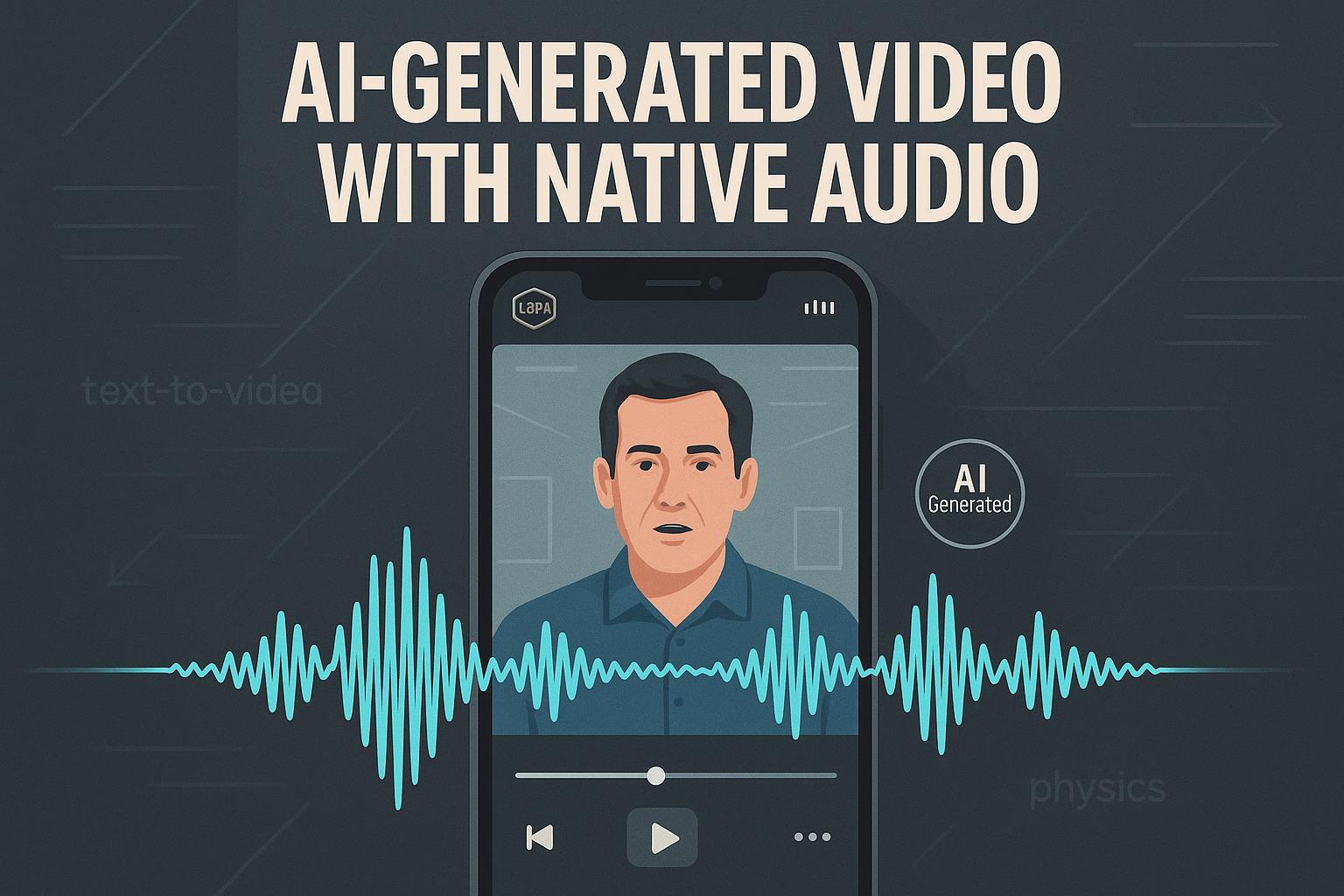
OpenAI’s Sora 2 (2025): AI-generated video with native audio and multimodal control

Updated on Oct 6, 2025
OpenAI’s Sora 2 arrives with native, synchronized audio and stronger physical realism—shifting AI video from “silent clips” to sound-on storytelling. For marketers, agencies, and creators, this changes how scripts, prompts, shotlists, captions, and distribution come together. Access is rolling out via an invite-only iOS app in the U.S. and Canada, with web and API access signaled to follow.
Fast facts you can verify
- Launch timing and access: OpenAI announced Sora 2 and the iOS app on Sep 30, 2025; initial access is invite-only in the U.S. and Canada, with plans to expand. See OpenAI’s 2025 announcement in “Sora 2 is here” and onboarding details in the 2025 OpenAI Help — Getting started with the Sora app.
- Capabilities: Sora 2 generates both video and synchronized audio (dialogue, ambience, SFX) with improved physical accuracy, realism, and controllability compared to prior models, according to the 2025 OpenAI — Sora 2 System Card.
- Provenance and safety: At launch, all Sora outputs carry visible watermarks and embed C2PA metadata for provenance; OpenAI also maintains internal media tracing tools. See the 2025 policy overview in OpenAI — Launching Sora responsibly.
- Early traction: Despite being invite-only, the app surged on the U.S. App Store; install estimates for the first two days reached the six-figure range, per an Oct 3, 2025 analysis by TechCrunch — Sora soars to No. 1 on the U.S. App Store.
Note: Maximum duration, resolution, and aspect ratios for Sora 2 were not officially stated on OpenAI’s pages as of Oct 6, 2025. Treat any numeric specs elsewhere as unconfirmed until OpenAI publishes them.
What’s actually new in Sora 2
Sora 2 brings two leaps that matter in production:
- Native audio generation: Synchronized dialogue and sound effects are created alongside visuals. This reduces post-production friction and makes short-form clips immediately publishable with sound. OpenAI frames this as part of the model’s “video and audio generation” capability in the 2025 Sora 2 System Card.
- Improved realism and control: More accurate physics, sharper realism, stronger steerability, and broader stylistic range. This helps maintain continuity across shots and lowers the risk of uncanny or physically implausible scenes. See the 2025 OpenAI — Sora 2 System Card.
Beyond the model itself, OpenAI shipped a social-style Sora app where creators can share, discover, and iterate. The 2025 OpenAI — Sora 2 is here post outlines a path to broader access, including web login (post invite) and future API availability.
Access and rollout: what we know (and what’s evolving)
- App and region: The iOS app is available to download now; access opens via invites, starting in the U.S. and Canada. You can sign up in-app for notifications. This is documented in the 2025 OpenAI Help — Getting started with the Sora app and the 2025 OpenAI — Sora 2 is here announcement.
- Web and API: After you receive an invite, you’ll be able to access Sora 2 through the web; API access is planned but no dates are provided. See the 2025 OpenAI — Sora 2 is here.
- Evolving details: Timeline for broader regions, Android availability, and precise content limits may change quickly. Keep an “Updated on” note and review OpenAI Help and product pages before publishing firm promises.
Why sound-on AI video matters for marketers and agencies
Most short-form platforms (Reels, Shorts, TikTok equivalents) assume sound-on viewing—even if users sometimes mute. Native audio means you can build end-to-end campaigns without an extra audio production step:
- Script → prompt: Draft your message and brand voice, then translate into a prompt that specifies tone, pacing, and audio cues.
- Shotlist → continuity: Plan a sequence of shots; Sora 2’s control improvements help maintain consistent motion and lighting.
- Captions → accessibility: Add captions and transcripts to improve comprehension, accessibility, and SEO on web embeds.
For blogs and landing pages, pairing video with strong on-page copy amplifies engagement. If you need a quick primer on why video boosts time-on-page and conversions, see our explainer on the power of vlogging for blog success.
Governance and provenance: adopt with brand safety by design
Responsible adoption should be explicit in your workflow. OpenAI states that Sora outputs include visible watermarks and C2PA provenance metadata, with internal tracing tools to identify Sora-made media. Review the 2025 policy guidance in OpenAI — Launching Sora responsibly.
Governance checklist for teams:
- Likeness and voice consent: Obtain written consent before using a person’s likeness or voice. Document approvals and keep audit trails.
- Policy-compliant prompts: Avoid disallowed content; align scripts with platform policies and community guidelines.
- Watermark and C2PA handling: Do not remove watermarks; preserve or expose provenance signals where feasible. Note how these appear on different platforms.
- Age-appropriate protections: Follow onboarding prompts (e.g., birthday entry) and apply distribution controls consistent with your audience.
- Disclosure: Label AI-generated media where required by law, platform policy, or client contracts.
QA checklist before publishing:
- Audio-lip sync: Verify mouth movements match dialogue.
- Brand voice and tone: Ensure narration and sound effects align with brand guidelines.
- Physics and continuity: Watch for implausible motion or lighting shifts across cuts.
- Accessibility: Confirm captions and transcripts are accurate.
From prompt to publish: a practical workflow
A pragmatic pipeline for short-form, sound-on Sora 2 clips:
- Strategy: Define the role of the clip (awareness, consideration, conversion) and the KPI you’ll measure (watch time, saves, CTR).
- Script and prompt: Draft a concise script; turn it into a prompt with scene descriptions, pacing, and audio cues.
- Iteration: Generate multiple takes; track versions and notes.
- QA: Run the governance and QA checklists.
- Packaging: Prepare captions, transcript, thumbnail, and platform-specific metadata.
- Publishing and SEO: Embed on your site with structured data; syndicate across social channels.
Publishing and SEO essentials
- Video schema: Add VideoObject structured data so search engines understand your clip.
- Transcripts and captions: Include a transcript for accessibility and keyword coverage.
- Performance: Optimize page load; host embeds in a way that minimizes CLS and LCP impact.
You can embed Sora videos in a QuickCreator–hosted blog, pair them with captions and on-page copy, and publish to WordPress in one click. Disclosure: QuickCreator is our product.
For technical SEO reminders (schema, performance, and developer-friendly checks), consult our concise guide: Ultimate 2024 SEO cheat sheet.
To streamline the pairing of video with written narrative, CTAs, and captions, many teams use an AI-assisted editor. See our overview of the AI Blog Writer to plan companion posts and campaign variants.
Distribution and measurement: make early pilots count
Treat your first 2–3 weeks as a pilot phase with tight scopes and clear metrics.
-
- Social short-form: Test hooks in the first 1–2 seconds; experiment with audio-led storytelling.
- Email and landing pages: Place the clip near top-of-page; add a transcript and a short summary for skimmers.
- Community platforms: Share iterations and gather qualitative feedback.
-
- Watch time and retention curves
- Saves/shared rate
- CTR to landing pages
- Completion rate with sound-on vs. muted
-
Documentation: Maintain a brief change log of prompts, edits, and performance; note any policy or safety reviews.
What to watch next (evolving items)
- Access expansion: Regions beyond the U.S. and Canada; potential Android availability.
- Specs: Official guidance on duration, resolution, and aspect ratios.
- API: Timelines and pricing for Sora 2 API access.
- Provenance UX: How platforms display watermarks and C2PA metadata; impact on audience trust and ad approvals.
Change log
- Oct 6, 2025: Initial publication with verified capabilities, access logistics, provenance, and workflow guidance. Added governance and QA checklists; included SEO implementation notes and internal links.