How to Build a Scalable AI SEO Engine

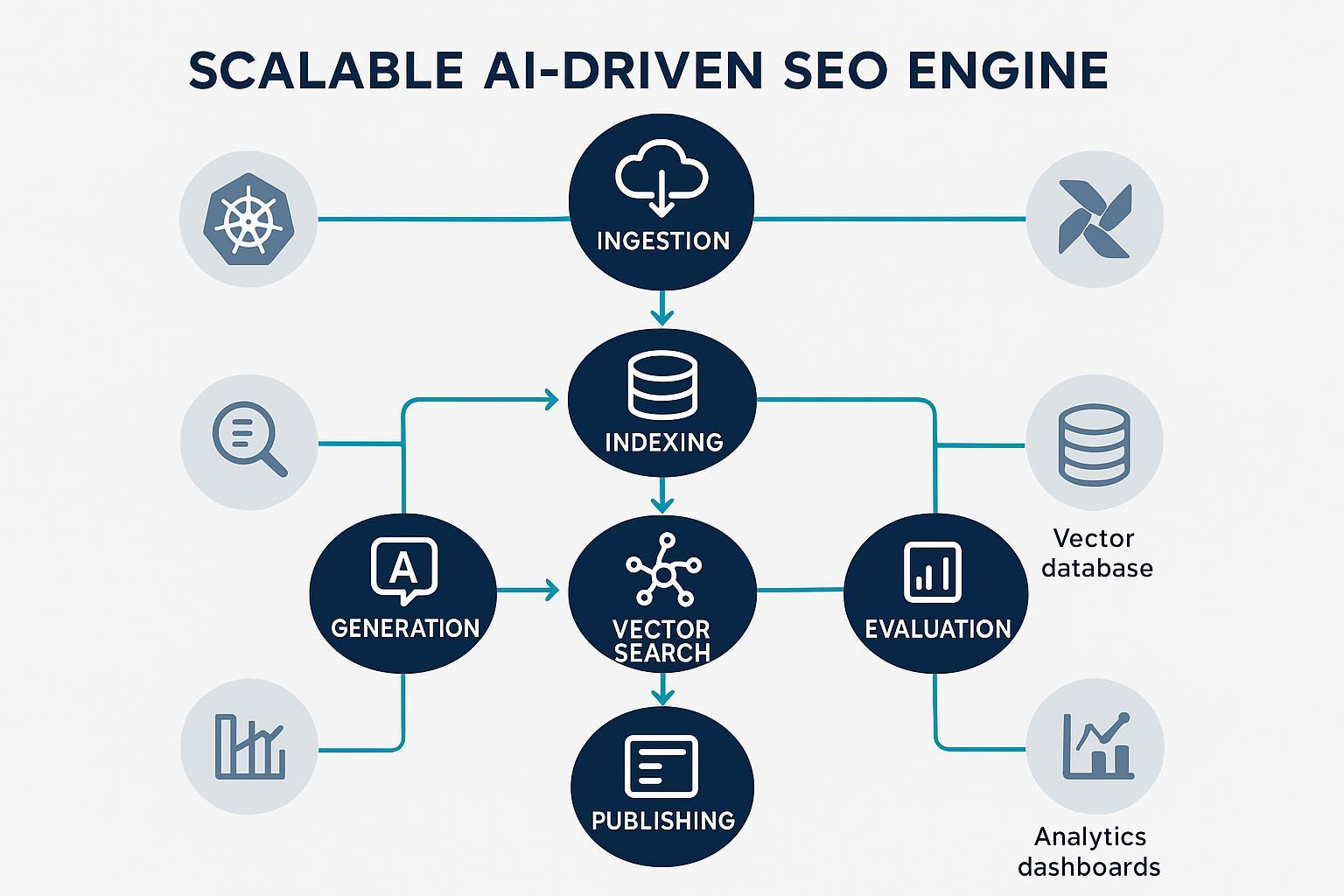
An AI SEO engine should do three things reliably: ground generation in trusted sources, publish technically sound pages at scale, and measure outcomes with ruthless clarity. The fourth, and often overlooked, requirement is compliance—your system must avoid scaled content abuse, preserve editorial standards, and demonstrate E-E-A-T. If you’re building for sustained organic growth, that mix of architecture, governance, and telemetry is non‑negotiable.
The core blueprint: from ingestion to publishing
Think of your engine as a set of modular lanes that run in parallel: ingestion, preprocessing/chunking, embeddings, hybrid retrieval, guardrailed generation, and publishing.
- Ingestion: Connect your CMS, site, APIs, PDFs, and data stores. Use incremental crawling keyed by last-modified timestamps to skip unchanged items. Persist raw documents in object storage with rich metadata.
- Preprocessing and chunking: Split content into token-aware, structure-preserving chunks (respect headings, tables, and code blocks). For large docs, use hierarchical chunking to keep retrieval fast but context-rich.
- Embeddings: Generate semantic vectors and store them in a vector database (Pinecone/Weaviate/FAISS are common). Keep per-chunk metadata for provenance and schema hints.
- Hybrid retrieval and reranking: Combine BM25 with dense vector search to maximize recall, then apply a reranker for precision. For complex topics, entity-aware linking or a lightweight knowledge graph can improve multi-hop queries.
- Guardrailed generation: Concatenate the top‑k chunks with the prompt. Enforce answer faithfulness to retrieved context, cite sources, and reject unsupported claims. Route tough queries to specialized agents.
- Publishing: Automate schema, internal links, canonical tags, hreflang, and XML sitemaps. Push to staging, require editorial approval, then publish. Submit sitemaps and monitor coverage.
For grounding and quality, Retrieval‑Augmented Generation (RAG) is a proven pattern. See the overview in Google Cloud’s “Retrieval‑augmented generation” use case and architecture options in AWS Prescriptive Guidance on RAG for neutral, implementation‑agnostic patterns.
Stack choices that scale without drama
- Orchestration: Apache Airflow for DAG-based ingestion, scoring, and publishing; Prefect for Python-native flows with strong observability.
- Containers and autoscaling: Kubernetes manages deployments and horizontal scaling; the Horizontal Pod Autoscaler (HPA) scales pods on CPU, memory, or custom metrics. The Kubernetes documentation details these patterns clearly.
- Messaging: Kafka for high-throughput event streams; RabbitMQ for flexible queueing and routing. Use messaging to decouple pipeline steps and absorb backpressure.
- CI/CD: Container-first pipelines with canary or blue/green releases. Use IaC (Terraform/Helm) plus automated tests to reduce regressions.
- Observability: OpenTelemetry for vendor-neutral tracing, metrics, and logs. Pair it with Prometheus for time-series collection and Grafana for dashboards. See OpenTelemetry’s documentation for instrumentation guidance.
Programmatic SEO at scale (without thin pages)
Templates are powerful but risky. Each programmatic page must deliver unique value aligned to intent—think localized expertise, structured comparisons, dynamic FAQs, or first‑party metrics rather than generic filler. Bake JSON‑LD schema (FAQPage, HowTo, Product where appropriate) into templates, validate markup, and avoid misleading types.
Internal linking should form hub‑and‑spoke clusters: generated pages link to their topical hub and to related spokes with descriptive anchors. Add self‑referential canonical tags, consolidate parameter variations, and exclude faceted duplicates via robots or noindex. If you operate internationally, include hreflang in templates and keep URL patterns consistent.
Google’s guidance emphasizes crawlable links, strong site organization, and the reduction of duplicates. The SEO Starter Guide and crawlability notes in Links Crawlable are practical references for these basics.
Governance and risk mitigation
Google’s March 2024 update reinforced enforcement against scaled, low‑value content. The spam policy defines scaled content abuse as generating many pages primarily to manipulate rankings rather than help users. Review the policy in Spam Policies for Google Web Search and the update overview in Google’s product blog announcement (March 2024).
Operational guardrails:
- Human‑in‑the‑loop: Require editorial review, fact checking, and authorship attribution before publishing.
- Velocity control: Cap daily releases; batch updates and observe indexation before ramping.
- Transparency: Cite sources, disclose automation use in your editorial policy, and maintain revision logs.
- Safety valves: Use robots/noindex for experimental or low‑value pages and canonicalization to consolidate variants.
Measurement and telemetry you’ll actually use
A scalable engine earns trust through measurement. Pair AI‑specific evaluations with classic SEO telemetry.
- Retrieval and generation: Track precision/recall on benchmark queries, faithfulness to retrieved context, hallucination rate, and citation accuracy. Sample outputs for human review.
- SEO KPIs: Monitor crawlability, indexation, Core Web Vitals, CTR, rankings, and sessions in Search Console/GA4. Analyze server logs to understand bot behavior and crawl budget distribution.
- AI visibility: Monitor citation frequency and share‑of‑voice in AI answer engines with third‑party tools. Treat these metrics as directional.
If you use internal quality scoring, connect it to publishing gates. For example, a content quality score threshold can block releases until issues are resolved. See QuickCreator’s Content Quality Score docs for one way teams operationalize a review threshold.
Practical example: plug in an assistive editor
Disclosure: QuickCreator is our product.
Here’s how a growth team could integrate an assistive editor without compromising governance:
- Drafts: Use an AI‑assisted writer to create first drafts grounded in retrieved context. The AI Blog Writer feature can help produce structured drafts while you enforce your own prompts and citation rules.
- Review: Apply a quality score gate and E‑E‑A‑T checklist. Require human edits for claims, sources, and tone before publishing.
- Publish: Push approved content to WordPress via API from staging. Automate schema and internal links, then submit sitemaps and watch coverage.
This pattern keeps assistance where it belongs—in drafting and on‑page optimization—while human editors own accuracy, voice, and compliance.
Common troubleshooting
- Sudden indexation drop: Check robots.txt, canonicalization, duplicate clusters, and crawl traps (infinite parameters). Verify server response times and rendering.
- RAG hallucinations: Tighten retrieval precision, increase top‑k relevant chunks, and enforce citation validation. Penalize unsupported claims.
- Template thinness: Add first‑party data, entity‑rich sections, and expert annotations. Reduce generic phrasing and consolidate near‑duplicates.
SOP: rolling out your engine safely
- Map intents and entities; design templates with schema and internal linking baked in.
- Stand up ingestion, chunking, embeddings, hybrid retrieval, and observability.
- Run guardrailed generation; enforce editorial review and quality score thresholds before publishing.
- Automate publishing to staging → production; submit sitemaps; monitor Search Console and logs.
- Iterate weekly: audit duplicates, adjust templates, tune retrieval, and manage release velocity.
Quick reference: component options
| Engine component | Primary role | Common option(s) |
|---|---|---|
| Orchestration | Schedule and monitor pipelines | Apache Airflow; Prefect |
| Storage | Persist raw docs/chunks | S3‑compatible object storage |
| Embeddings & search | Semantic retrieval | Pinecone; Weaviate; FAISS |
| Hybrid retrieval | Maximize recall + precision | BM25 + vector search + reranker |
| Generation | Answer/control output | Guardrailed LLM prompts + citation enforcement |
| Publishing | SEO‑ready deployment | CMS/WordPress APIs; schema; sitemaps |
| Observability | Tracing/metrics/logs | OpenTelemetry + Prometheus + Grafana |
| Autoscaling | Handle load spikes | Kubernetes + HPA |
One last thought: speed is seductive, but trust wins. Build for repeatable accuracy and clean operations. When your system consistently produces useful, well‑structured, and accountable content, rankings and AI citations tend to follow. And if you ever wonder whether a template should ship, ask yourself—would a discerning reader find this page genuinely helpful? If not, fix it before it leaves staging.