ChatGPT Ads in 2025: How to Win Without Losing Trust

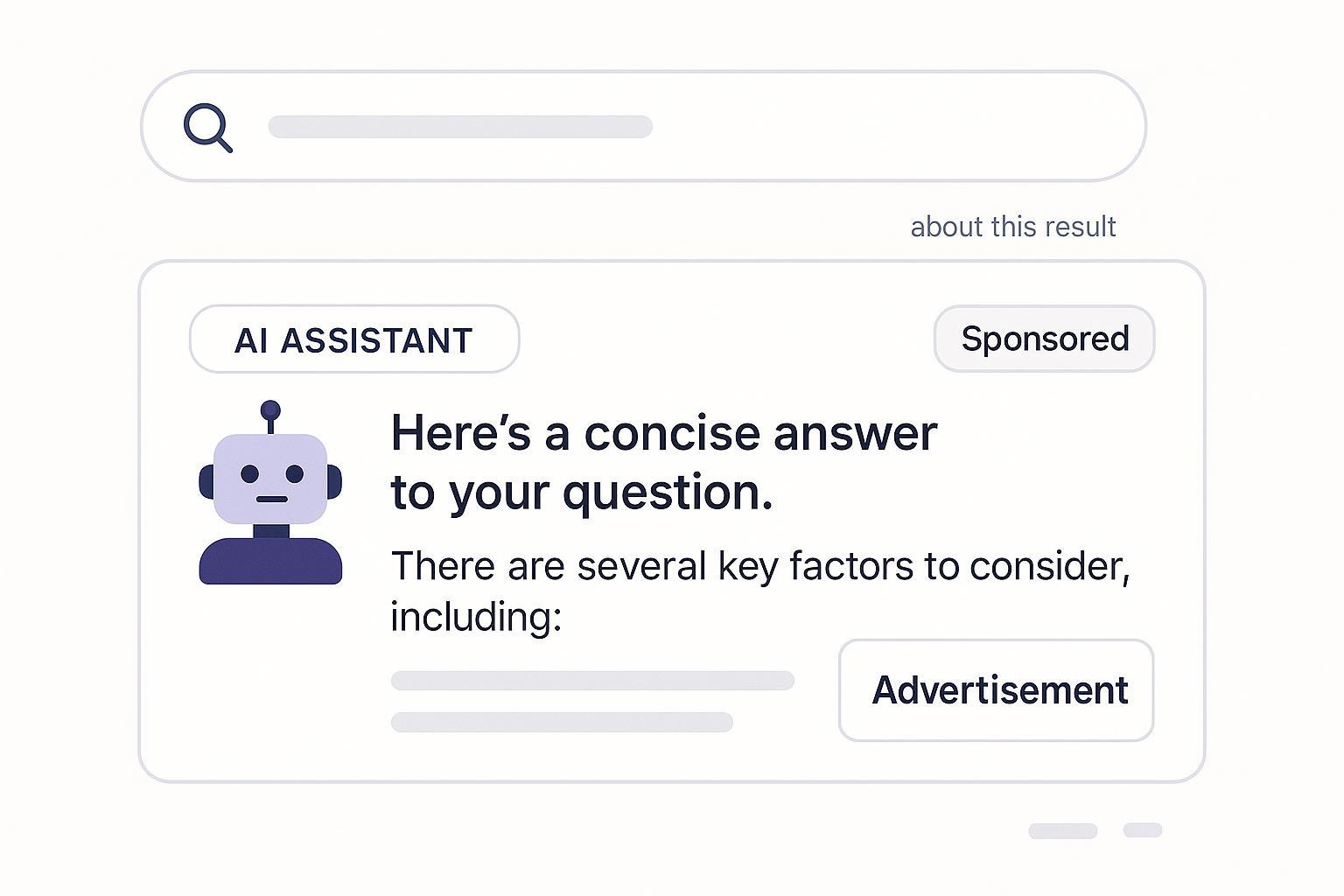
OpenAI is laying the groundwork to turn ChatGPT into an advertising platform. Fresh hiring signals and industry coverage in late September 2025 point to in‑house campaign tooling and attribution for assistant‑style placements. According to Search Engine Land’s Sep 26, 2025 report on OpenAI staffing for an ad platform, the company posted roles to build paid marketing infrastructure and experimentation frameworks—early proof that “answer ads” are coming (Search Engine Land, Sep 26, 2025). In parallel, Adweek’s Sep 28–29, 2025 coverage of OpenAI’s first large‑scale brand campaign for ChatGPT shows momentum to mainstream the assistant and monetize reach (Adweek brand campaign coverage, Sep 28–29, 2025).
Bottom line: “ChatGPT ads” aren’t live inside answers at scale yet, but the staffing, brand push, and audience scale make this the golden window for SMB marketers to prepare. Treat these placements as contextual augmentations to answers—useful when clearly labeled, minimally interruptive, and directly relevant to user intent.
Why this matters now
Assistant results are accelerating a broader zero‑click trajectory. In 2024, SparkToro’s large clickstream study found that 58.5% of US Google searches and 59.7% of EU searches ended without a click to the open web, based on 332 million queries over 21 months—evidence that user needs are increasingly satisfied on‑surface (SparkToro 2024 zero‑click study). As assistants become primary discovery surfaces, brands that produce scannable, verifiable, E‑E‑A‑T‑rich content are more likely to be cited—or linked—by the assistant, creating a new organic channel. Paid placements will sit alongside or within those answers, raising the bar for relevance and trust.
Our POV: contextual answer‑ads are inevitable, but they’ll only work if they are clearly labeled, minimally interruptive, and value‑adding. Marketers who build assistant‑citable content and frictionless landing experiences now will earn citations and convert assistant referrals later—while avoiding the trust backlash of intrusive or opaque ads.
The assistant‑ready playbook for SMBs
1) Format content to be citable by assistants
Put a concise, factual summary near the top (40–80 words) that directly answers the query, then add deeper context below. Mirror conversational queries with FAQ blocks and implement structured data where appropriate.
Concise answer section up top (plain‑language, evidence‑based)
FAQ blocks targeting “how/what/should” questions; keep answers short and verifiable
Use structured data like FAQPage, HowTo, and Article in JSON‑LD to help machines understand the content
Include author bios, edit notes, and update timestamps to reinforce E‑E‑A‑T
Cite primary sources inline with descriptive anchors; avoid link stuffing
Google’s guidance on E‑E‑A‑T emphasizes that trust is the most important element, and its structured data docs provide examples for FAQPage, HowTo, and Article markup. Refer to the official documentation for implementation specifics (Google E‑E‑A‑T guidance; FAQPage structured data).
Internal deep dive: See schema fundamentals and automation in “Schema markup best practices” for practical examples and JSON‑LD snippets (Schema markup best practices).
2) Build landing pages that convert assistant referrals
Assistant‑driven visitors skim and decide fast. Optimize for clarity and low friction.
Mobile‑first performance (fast load, lightweight assets)
Clear above‑the‑fold value proposition and CTA
Short forms (3–5 fields) with optional prefill where feasible
Social proof (logos, quotes, ratings) near CTA
Transparent policy links (privacy, terms) and security signals
For templates that embody these patterns, explore “Assistant‑ready landing pages” with mobile‑first layouts and short‑form modules (Assistant‑ready landing pages).
3) Measurement and KPIs
You’ll need reliable tracking to separate assistant‑driven sessions and evaluate assisted conversions.
UTM conventions: utm_source=chatgpt, utm_medium=ai_assistant (or referral), utm_campaign=chatgpt_fall2025, utm_content=answer_block
Tag likely citation links; remember that copy‑pasted URLs often appear as Direct without UTMs
GA4 setup: create a custom channel group for AI assistants; track assisted conversions in Attribution and Explorations
KPIs: assistant‑driven sessions, assisted conversions, lead quality score, non‑branded query lift, CAC vs. paid search/social benchmarks
4) Budget mix
Keep SEO as your foundation to be cited by assistants, then pilot conversational ads once available.
Maintain or increase SEO investment by ~10–20% focused on assistant‑citable content structure and technical hygiene
Allocate 5–10% of paid budget for early conversational ad tests with strict relevance and frequency caps
Expand only if assisted conversion quality and CAC/ROAS outperform your existing paid search/social benchmarks
5) Governance and brand safety
Trust will make or break answer‑ads. Establish guardrails before you spend.
Labeling: require clear, conspicuous “Sponsored” or “Ad” labels adjacent to placements
Relevance: enforce contextual relevance to the user’s query intent; avoid generic or broad targeting
Exclusions: set category and contextual exclusion lists; protect brand adjacency
Frequency caps: limit exposure per session to avoid fatigue
Audits: review placements weekly during pilots; document negative adjacencies; update exclusions
US regulators and industry bodies have emphasized transparency and truthful labeling for AI‑driven media. For example, the FTC’s 2024 guidance and IAB Tech Lab primers underline clear, conspicuous disclosure standards for advertising and synthetic content, reinforcing the importance of these guardrails.
QuickCreator’s edge: a practical example workflow
QuickCreator helps SMB teams implement the assistant‑ready playbook end‑to‑end—without stitching together multiple tools. Disclosure: QuickCreator is our product.
Here’s a vendor‑neutral workflow you can adapt, using features many platforms aim to provide:
Draft a concise answer block and outline FAQs. Use an AI blog editor to generate a scannable intro and QA pairs that mirror conversational queries. See an “AI Blog Writer workflow” for how to structure these sections and add citations (AI Blog Writer workflow).
Apply structured data automatically. Leverage built‑in schema insertion for FAQPage/Article and validate with Rich Results tests. For broader E‑E‑A‑T confidence, skim “E‑E‑A‑T‑aligned SEO with QuickCreator” to align your author bios, citations, and update stamps (E‑E‑A‑T‑aligned SEO with QuickCreator).
Publish a mobile‑first landing page with short forms and social proof. Use templates tuned for assistant referrals. Pair with SSL and caching to maintain speed and trust signals.
Tag links with standardized UTMs for assistant discovery; create a GA4 channel group for AI referrals. Monitor assisted conversions and lead quality; iterate based on query‑level relevance.
Next steps
Download the one‑page “Assistant‑Ready Content Checklist” and adapt it to your content calendar and landing pages.
Book a demo to implement an “AI Assistant Visibility Pack” and accelerate your rollout with structured content, schema, and measurement baked in.
Mini change‑log (fast‑moving facts)
Updated on 2025‑09‑29
Tracking: awaiting official OpenAI guidance on measurement APIs; use UTMs and GA4 channel groups in the interim.
Ad formats: monitoring for confirmation of answer‑embedded modules vs. adjacent units and exact labeling language.
Eligibility: watching for advertiser categories, brand safety tools, and beta timelines.
References cited in‑text
OpenAI staffing for ad platform (Search Engine Land, Sep 26, 2025)
OpenAI brand campaign coverage (Adweek, Sep 28–29, 2025)
Zero‑click behavior (SparkToro 2024 study)
Google E‑E‑A‑T and FAQPage docs (developer documentation)
Transparency and disclosure norms (FTC 2024; IAB Tech Lab primers)