How to Stay Competitive in the Age of AI Content Creation

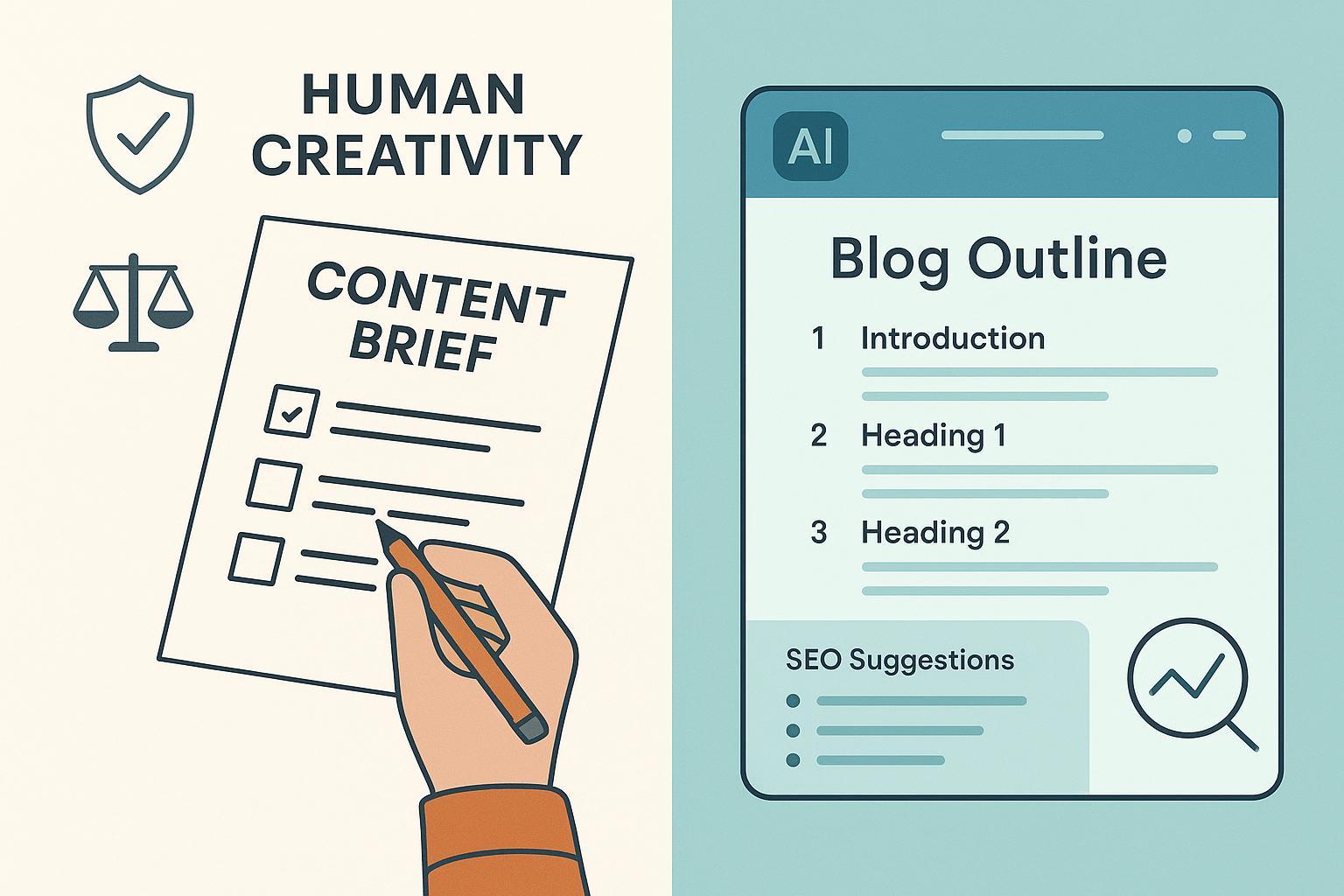
Staying competitive with AI isn’t about publishing more; it’s about shipping distinctive, accurate, and experience-led content at speed—without breaking trust or compliance. Below is the field-tested playbook I use with teams that need results fast and can’t afford rework.
1) The principle: Pair AI speed with human originality
If AI drafts are the engine, your real-world experience is the fuel. Competitive teams operationalize this with a simple three-layer workflow:
- Strategy brief (human-led): Define audience pain, point of view, and differentiators (original data, stories, examples). Capture non-negotiables (claims to verify, brand voice, compliance notes).
- AI-assisted drafting (machine-led): Use AI to expand the brief into a structured outline and draft. Enforce instruction patterns: cite sources, flag uncertainty, and request alternatives.
- Editorial review (human-led): Fact-check, add proprietary examples, tighten voice, and confirm compliance. Publish only when the piece offers unique value—not commodity summaries.
Why it works: Google’s guidance is explicit that using AI is fine if the result is helpful and original, and warns against “scaled content abuse” that creates many low-value pages for ranking purposes. See Google’s 2024–2025 updates on helpful content and spam policies for the operative standard in practice, including the March 2024 core update that targeted low-quality output and reduced it by an estimated 45% in results, per Google’s own communication. For details, review Google’s explanations in the 2024–2025 updates and spam policies: Using generative AI content, the March 2024 update overview, and the scaled content abuse policy.
2) Build a repeatable editorial quality system
Teams that win with AI ship consistently because they don’t “wing it.” They apply a checklist and scorecard on every draft.
Editorial QA checklist (apply before publish):
- Purpose and audience: Is the piece solving a specific user problem better than current SERP leaders?
- Originality and POV: Add unique evidence—your data, interviews, failure lessons, or a novel framework.
- Accuracy and citations: Verify names, numbers, and quotes. Add inline, descriptive citations to primary sources.
- Voice and clarity: Match brand tone; keep sentences economical; front-load value.
- E-E-A-T signals: Demonstrate experience, expertise, author identity, and transparent editorial standards.
- Accessibility: Alt text for images, headings hierarchy, contrast, captions/transcripts where needed.
- Compliance notes: Disclose material connections; consider AI-use disclosure if material for user understanding.
Scoring what matters: Implement a 0–100 content quality score that weights helpfulness, originality, factual accuracy, and readability. For a deeper implementation approach, see the Content Quality Score – QuickCreator Help Center.
3) Keep facts straight and risks low: Factuality, bias, and safety
Hallucinations and hidden bias are the fastest ways to erode trust. Use these guardrails:
- Retrieval-Augmented Generation (RAG): Ground AI answers in your vetted sources. Recent technical surveys and tutorials show RAG measurably reduces unsupported claims when implemented with quality retrieval and monitoring; see a 2024 survey of mitigation techniques and AWS’s 2025 guidance on hallucination detection for RAG systems: Survey of LLM hallucination mitigation (arXiv, 2024) and AWS detecting hallucinations for RAG.
- Human-in-the-loop (HITL): Mandate human review for claims, numbers, and compliance-sensitive passages. Keep a feedback loop to refine prompts and style guidelines over time.
- Prompt patterns that help: Ask the model to cite sources, call out uncertainty, and refuse unverifiable claims. Require a “claims table” during drafting for verification.
- Transparency and deepfake labeling (EU): If you operate in the EU or reach EU users, ensure AI-manipulated media is clearly labeled per the EU AI Act’s transparency obligations that began phasing in through 2025; see the European Parliament’s summary on the Act’s transparency rules: Artificial Intelligence Act – adopted law (2024/2025).
- Reviews/endorsements disclosure (US): The FTC’s final rule banning fake reviews took effect in October 2024 and prohibits AI-generated fake testimonials, with penalties for noncompliance. Review the FTC’s rule and its endorsements guidance to ensure disclosures are clear and conspicuous: FTC final rule banning fake reviews (2024) and FTC endorsements/influencers guidance.
- Accessibility baseline: Treat WCAG 2.1 AA as your minimum. The DOJ’s 2024 rule applies to state/local governments, but it’s a strong standard for marketers to reduce risk and improve UX; pair with W3C’s Accessibility Principles for practical implementation: DOJ ADA web rule fact sheet (2024) and W3C WAI – Accessibility Principles.
4) AI-accelerated SEO that survives core updates
Treat AI as a power tool—never a shortcut to bypass user value.
- Intent-first research: Cluster queries around problems, not keywords. Map competitor coverage gaps and sources to beat.
- Outline with coverage rules: Require the draft to answer the top 3–5 intent questions and include original examples.
- Draft with guardrails: Instruct AI to avoid generic advice, cite primary sources, and flag facts for verification.
- Human enrichment: Add hands-on steps, failures, and proprietary data. Rewrite intros and conclusions for clarity.
- Technical hygiene: Titles, descriptions, headings, schema where appropriate, compressed images with alt text.
- Post-publish QA: Read it like a user. If it feels commodity, rework before you promote.
For staying visible in AI-powered search experiences, Google’s 2025 guidance reiterates non-commodity helpfulness, technical soundness, and authority-building as the path to inclusion in AI Overviews/AI modes. See Google’s 2025 advice for optimizing toward AI search experiences and foundational AI SEO primers from industry editors: Top ways to ensure your content performs in AI Search (Google, 2025) and the Search Engine Land guide to AI SEO (2024–2025).
Further reading: For a scalable QA pattern that pairs agentic automation with claims verification, review Agentic AI Marketing 2025: Speed, Workflow, and QA.
5) Personalization and distribution that actually moves numbers
Use AI to personalize responsibly and atomize content across channels—but measure lift, not volume.
- Atomize with intent: From one flagship piece, generate platform-native variations (email, social, short video scripts) that preserve the core POV and facts.
- Personalize in bounds: Segment by job-to-be-done or industry, not just demographics. Keep disclosures and claims consistent across variants.
- Let data guide optimization: Treat campaigns as experiments. Ship, measure, iterate.
Recent, primary-source ROI examples show the upside when AI supports targeting and creative at scale:
- Microsoft Advertising reported in 2025 that conversational AI experiences delivered 73% higher CTR and a 16% stronger conversion rate on average, with shorter journeys, across advertiser cohorts using Copilot-powered journeys; see the metrics breakdown in Microsoft’s analysis: 73% higher CTRs with conversational AI (Microsoft Advertising, 2025).
- Google Cloud’s 2025 collection of generative AI use cases highlights significant performance lifts in personalized campaigns (e.g., 80% CTR improvement and 31% better cost-per-purchase in a retail case) when teams deploy AI across creative, targeting, and ops: 101 real-world generative AI use cases (Google Cloud, 2025).
Further reading: For a blueprint that links automation with multi-platform personalization, see AI, Hyper-Personalization & Multi-Platform Distribution.
6) Maturity playbooks (right-size your process)
-
Solo creator (2–4 hours per article):
- Brief in 20 minutes; draft with AI in 40; review and enrich in 60; finalize in 20; publish and distribute in 40.
- Non-negotiables: Claims table, two primary-source citations, accessibility checks, and one original example or screenshot.
-
SMB marketing team (half-day sprint):
- Research/brief (60), AI outline and draft (60), SME review (45), editor pass (45), compliance and accessibility (30), publish/distribute (30).
- Non-negotiables: E-E-A-T author box, source-of-truth links, structured data where appropriate, analytics annotations.
-
Agency model (assembly line):
- Strategist crafts briefs; AI and writers co-draft; editors own QA; compliance reviews sensitive claims; PMs enforce SLAs.
- Non-negotiables: Versioned templates, central citation repository, RAG-connected knowledge base, and post-publish performance retros.
7) Practical example: A 20-minute editorial QA + SEO brief workflow
Disclosure: The following example uses QuickCreator, our AI content platform.
- Open QuickCreator and paste a short strategy brief (audience, problem, POV, must-cite sources). Generate an outline that includes a “claims table” and required citations.
- Use the SEO assistant to cluster related intents and recommend coverage gaps to beat. Convert into H2/H3s.
- Generate the draft with instructions to cite primary sources inline, add alt text suggestions, and flag weak sections.
- Run the content quality scoring panel; address low scores in originality or clarity. Re-run a focused rewrite on weak paragraphs.
- Export to your CMS with titles, meta descriptions, and image alt text pre-filled; schedule a human fact-check before publish.
8) Measurement that proves you’re competitive
Track outcomes at three levels and review weekly/monthly:
- Quality and trust: Content quality score, factual error rate, citation mix (primary vs. secondary), accessibility pass rate.
- Reach and engagement: Impressions, CTR, organic share of voice, dwell time, assisted conversions. For AI search, track inclusion and traffic from AI modules where available.
- Efficiency and throughput: Draft-to-publish cycle time, revisions per article, cost per published piece.
Create a monthly retro: Which pieces beat SERP leaders and why? Which ones felt commodity and needed rework? Write it down; systematize the learning.
9) Common pitfalls—and how to avoid them
- Over-automation: If the draft reads like a summary of the SERP, stop and add original insight, data, or examples. Commodity content won’t sustain rankings—per Google’s own policies and updates noted earlier.
- Weak citations: Link to primary sources and include the year near the claim. Don’t stack generic “ultimate guides.”
- Compliance gaps: Add a pre-publish disclosure check for endorsements and AI usage where material. For EU assets with AI media, ensure clear labels under the AI Act’s transparency rules.
- Accessibility as an afterthought: Bake WCAG checks into QA, not post-launch. Use linters and manual testing before you ship.
- No measurement loop: If you’re not segmenting winners vs. underperformers, you’re guessing, not competing.
10) Deployable checklists
Google-aligned SEO guardrails (every article):
- Helpful intent is explicit; avoid mass-produced pages with thin value.
- Distinct POV and examples; at least two primary-source citations with years.
- Technically sound: metadata, headings, internal links, structured data where appropriate.
- Post-publish user read-through; if it feels commodity, revise before promotion.
Factuality and bias controls:
- Claims table with source, date, and verification status.
- RAG grounding to your approved knowledge base for sensitive facts.
- Diverse reviewer pass for bias and inclusive language.
- Endorsements and relationships are clearly disclosed.
- AI-generated media labeled where required (e.g., EU AI Act contexts).
- Records of review (date, reviewer) stored with the asset.
Accessibility essentials (WCAG 2.1 AA baseline):
- Alt text for images; captions/transcripts for A/V.
- Sufficient color contrast; keyboard navigability; visible focus states.
- Clear headings and labels; meaningful link text; error messages that help.
11) Next steps
If you need a practical way to operationalize this playbook—briefs, AI drafts, QA scoring, and SEO checks—try a guided workflow and measure the lift within a week.