Agentic AI in Marketing, Explained in 2025: Why Speed Claims Demand Auditable Evidence

The promise of agentic AI is moving from “copy helpers” to autonomous marketing co‑workers that perceive context, plan, decide, and act across content and campaigns. As vendors race to showcase gains, some metrics circulate without clear provenance—such as LiveRamp’s widely mentioned “46% content creation speed boost,” which, as of October 5, 2025, lacks a primary public source. In this analysis, we unpack what agentic AI actually is, how marketing teams can deploy it responsibly, and how to verify speed and throughput claims before reshaping budgets or SLAs.
What agentic AI is—and isn’t
Agentic AI refers to systems that can act toward goals with minimal human oversight, coordinating tasks like content generation, testing, targeting, budgeting, and journey orchestration under policy guardrails. Salesforce defines agentic AI as technology that enables AI agents to act autonomously without human oversight, articulated in the 2025 Agentforce primer: see the concise overview in the Salesforce Agentforce “What is Agentic AI?”. IBM contrasts agentic AI with generative AI, emphasizing decisioning and action over content production, outlined in IBM Think’s “Agentic AI vs. generative AI” (2025). For marketers, Braze situates agents as behind‑the‑scenes operators that evaluate data, surface insights, and make real‑time decisions within guardrails; see Braze’s “AI Agents in Marketing” (2025).
Why this matters now
Across 2024–2025, large language models gained planning/reasoning, tool‑use, and workflow orchestration capabilities—pushing AI agents from pilots to early production in martech and adtech. McKinsey characterizes this shift as the rise of virtual co‑workers executing complex workflows and creating value beyond simple efficiency; see McKinsey’s “Seizing the agentic AI advantage” (2025). Earlier analysis in 2024 outlines why agents represent the next frontier of generative AI by moving from information to action—refer to McKinsey’s “Why agents are the next frontier of generative AI” (2024). Adoption is accelerating: in McKinsey’s 2025 State of AI, a majority of organizations report AI use in at least one business function, with marketing and sales among the leading areas (cite this report without over‑attributing exact percentages unless cross‑checked against the primary dataset).
How a multi‑agent marketing workflow actually runs
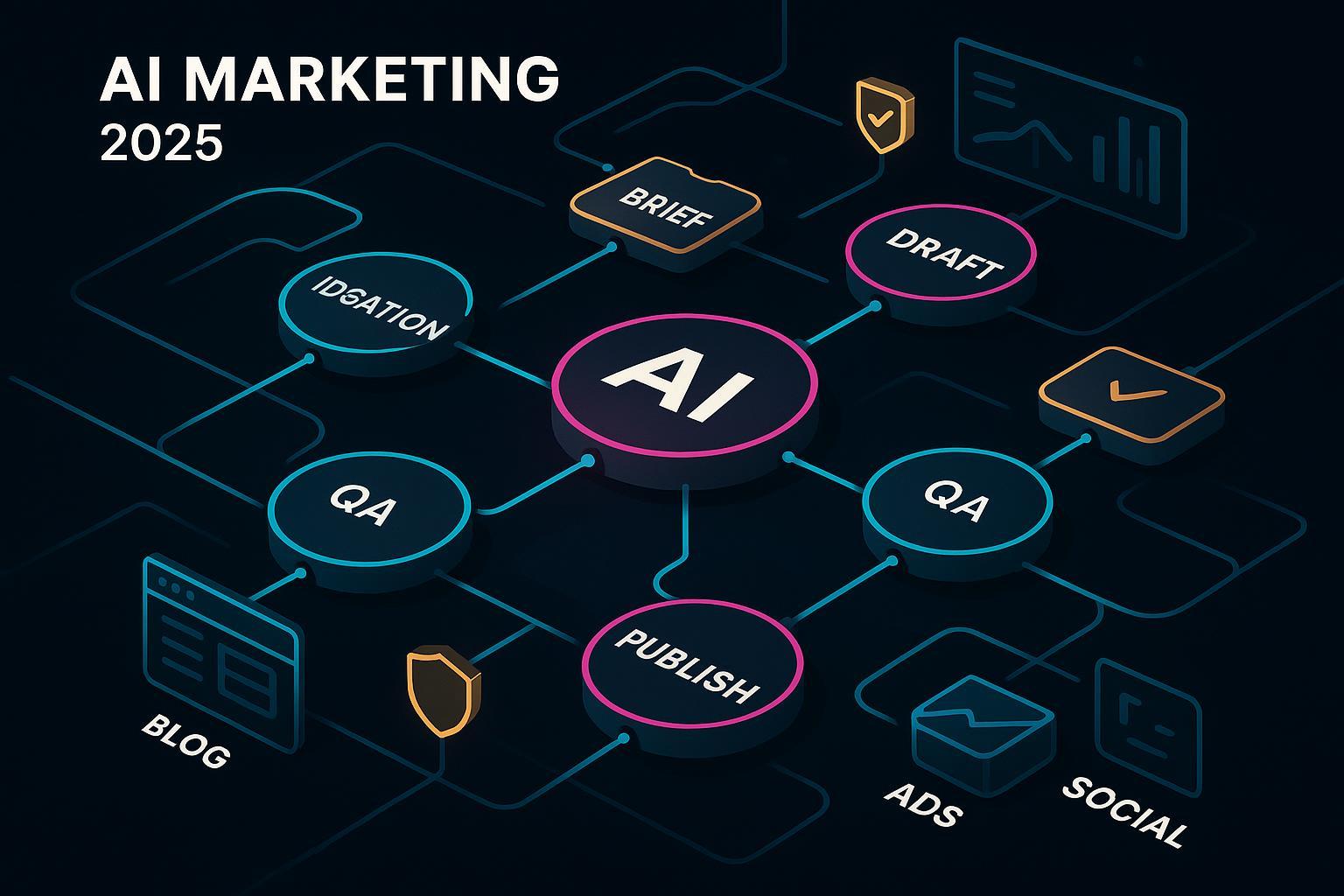
Below is a practical, stepwise workflow that shows how agent chains can transform content operations while keeping humans in the loop for quality and brand safety.
- Ideation: A research agent compiles market and SEO insights; a strategist agent proposes themes; a human reviews.
- Brief: A brief agent structures objectives, audiences, channels, and KPIs.
- Draft: A copy agent produces drafts; an SEO agent adds metadata and suggested internal links; a human editor provides direction.
- QA: A compliance agent scans for PII and risky claims; a brand QA agent checks tone/style; a human approves.
- Publish: A CMS agent schedules/publishes; social/email agents distribute.
- Measure and iterate: An analytics agent tracks KPIs; an experimentation agent launches A/B tests; an optimization agent recommends updates.
In a pilot, a content team can use an AI blogging platform like QuickCreator to generate briefs and first drafts, run an automated SEO check before human QA, and then publish to WordPress via workflow orchestration. Disclosure: QuickCreator is our product.
For practitioners seeking a hands‑on walkthrough of AI content workflows, see this internal resource on step‑by‑step AI content setup and reviews. When automating on‑page elements, this explainer on AI‑generated meta descriptions to improve search performance and our foundation guide SEO explained can help anchor best practices.
Measuring and verifying “speed boosts” the right way
To validate any throughput or speed claims (including unverified figures like “46% faster”), instrument these KPIs and audit steps:
- Throughput: content units per week by type (blogs, emails, ads, product copy) baseline vs. with agents.
- Lead time: median hours from brief to publish, including queueing and approvals.
- Quality gates: editorial defect rate, brand voice adherence, and compliance incidents.
- SEO performance: time‑to‑index, impressions, CTR, and ranking movement for target queries.
- Experiment velocity: A/B tests launched per week; cycle time to statistical significance.
- Cost per unit: blended internal time plus tool costs.
- Governance KPIs: percentage of assets requiring human‑in‑the‑loop approval; rollback rate.
IAB’s 2025 guidance emphasizes outcome‑oriented measurement and rigorous experimentation standards. For marketers aligning agentic workflows with recognized measurement principles, consult the IAB’s “Retail Media Measurement Guidelines” and the 2025 Digital Video Ad Spend & Strategy report (Part One); use these as anchors to design incrementality tests and attribution transparency.
A compact verification table you can adapt
| KPI dimension | What to measure | Baseline vs. agent setup | Audit notes |
|---|---|---|---|
| Throughput | Content units/week by type | Snapshot + 4‑week rolling average | Control for content complexity |
| Lead time | Brief‑to‑publish median hours | Include approvals queue time | Watch for batching effects |
| Quality | Defect rate; brand voice adherence | QA pass rate | Include human spot checks |
| SEO | Index time; impressions; CTR; rank | When comparable queries exist | Avoid confounding seasonality |
| Experimentation | A/B tests/week; time to significance | Powered tests only | Document test design |
| Cost | Blended cost per unit | Tool + labor cost | Include rework/rollback |
| Governance | HITL %; rollback rate | By asset risk category | Keep audit trails |
Governance by design: guardrails without killing speed
Responsible agent deployment requires explicit policy guardrails and operational controls. The NIST AI Risk Management Framework (2024–2025) provides core functions—Govern, Map, Measure, Manage—along with a Generative AI Profile tailored to content and safety risks; see NIST’s AI RMF resources and Generative AI Profile. IBM’s governance guidance for AI agents outlines practical evaluation and oversight of both decision processes and outputs; review IBM’s “Governing AI agents with watsonx.governance” (2025).
A marketing‑ready checklist:
- Define agent roles and least‑privilege permissions.
- Encode brand voice and safety rules as constraints and critic checks.
- Constrain data access and log usage; apply jurisdiction‑aware privacy policies (GDPR/CCPA).
- Set human‑in‑the‑loop thresholds for high‑risk assets (e.g., legal claims, personal data usage).
- Maintain decision/action logs and audit trails.
- Run bias testing across segments and remediate issues.
- Establish rollback and escalation paths for policy violations.
A pragmatic 30–60–90‑day pilot roadmap
- 0–30 days: Define guardrails and SLAs; pick a narrow use case (e.g., repurpose blog posts into emails); instrument metrics; implement human‑in‑the‑loop review.
- 31–60 days: Expand to a multi‑agent chain (brief → draft → SEO → QA); standardize prompts/policies; start controlled publishing.
- 61–90 days: Integrate with CMS/analytics for auto‑publishing and closed‑loop feedback; introduce budget‑aware experimentation and continuous optimization.
FAQs (2025)
- What’s the difference between agentic AI and generative AI? In short, agentic AI focuses on autonomous decisioning and action toward goals, whereas generative AI focuses on producing content; see IBM’s 2025 distinction and Salesforce’s agent definition in the sources above.
- Can agents run without humans? Yes, but marketing teams should maintain human oversight for high‑risk assets and brand safety; NIST’s RMF and enterprise governance practices recommend human‑in‑the‑loop thresholds.
- Where do multi‑agent workflows show up in martech today? Orchestration is emerging across major platforms and cloud services—examples include AWS Bedrock’s multi‑agent collaboration (2024) and vendor playbooks from Braze and Salesforce.
- How should I judge vendor speed claims? Require auditable baselines, comparable content types, controlled publishing windows, and governance‑aware QA metrics. Avoid adopting figures like “46% faster” without a primary source and method.
Mini change‑log
- Updated on 2025‑10‑05: Initial publication. LiveRamp’s “46% content creation speed boost” remains unverified due to lack of primary sourcing. Added definitions from Salesforce, IBM, and Braze; adoption context from McKinsey (2024–2025); governance references to NIST and IBM; measurement anchors via IAB.
If you’re ready to pilot an agentic content workflow safely, consider spinning up a sandbox with interchangeable tools—including QuickCreator—to generate briefs and drafts, apply SEO checks, and publish with human approvals.