Best AI SEO Workflows for Content Teams (2025)

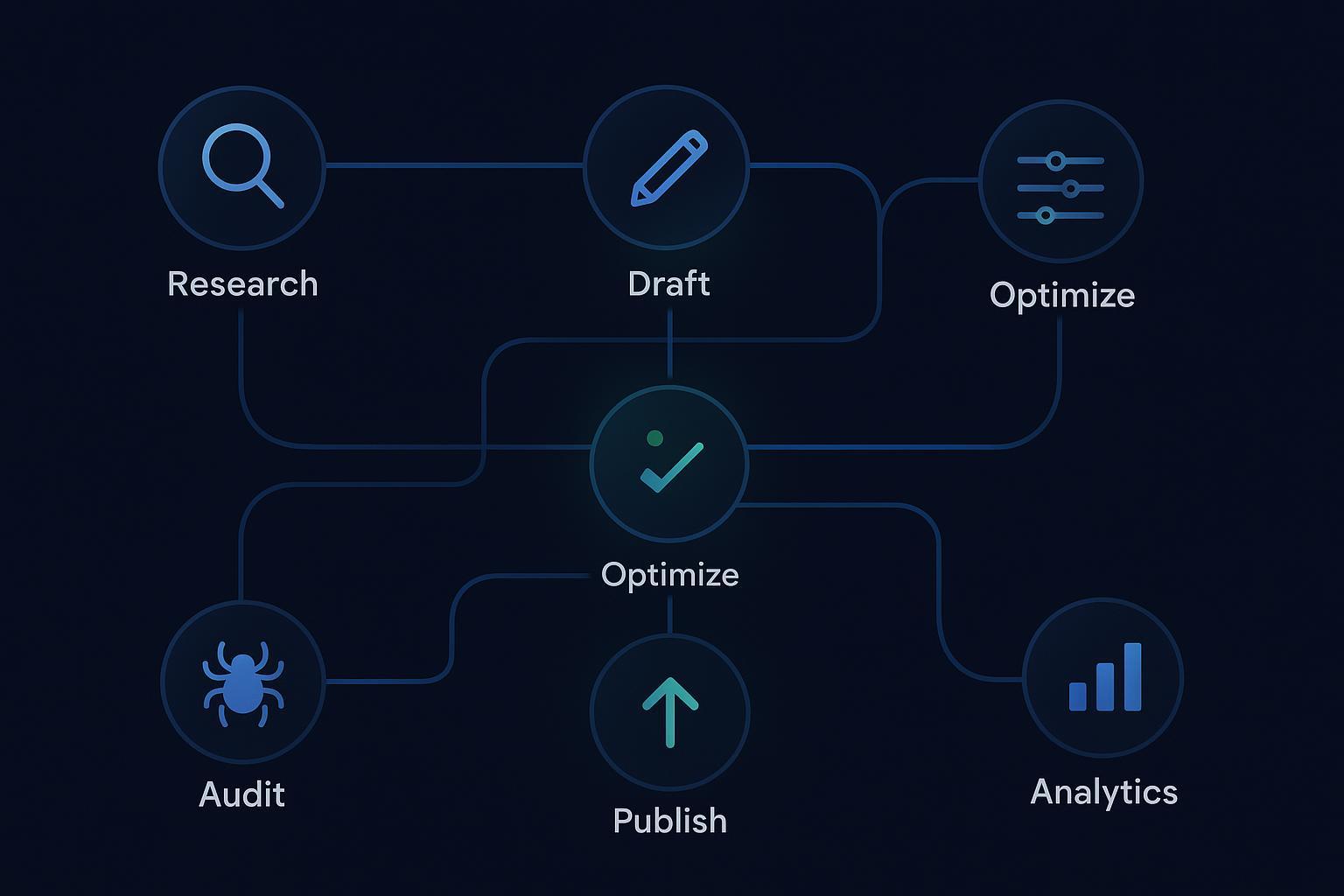
When your pipeline needs to ship faster but quality can’t slip, the answer isn’t “more tools.” It’s a governed workflow that blends automation with human judgment—so every post is accurate, useful, and search-worthy.
The playbook below maps end-to-end AI SEO workflows your team can run today. The foundation: align to Google’s quality signals, show real expertise, and keep transparent governance.
The non-negotiables: quality, governance, and disclosure
- Google’s March 2024 core update shifted focus to multiple core systems that evaluate helpfulness and filter low-quality pages. In short: production method doesn’t matter—quality does. See Google’s explanation in the developer note: the March 2024 update “marks an evolution in how we identify the helpfulness of content” in the official write-up at Google Developers: Our March 2024 core update.
- E-E-A-T still matters. Experience and author transparency build trust and can lift engagement, links, and secondary signals. A practical overview is in Ahrefs’ EEAT guide (reference for implementation, 2024+).
- Governance and transparency aren’t optional. The NIST AI Risk Management Framework (updated with a Generative AI Profile in 2024) recommends clear human oversight, documentation, and deactivation criteria. The EU AI Act will phase in transparency obligations through 2026; see the EU Parliament’s overview of the AI Act. For marketing content, simple disclosures when readers first encounter AI-assisted material and durable audit trails are smart defaults.
The workflow blueprint (A–G)
A) Keyword research and clustering
Use a primary research tool (e.g., Semrush or Ahrefs) to pull seed terms, competitors, and People Also Ask queries. Then ask an LLM to cluster by intent and entity; export clusters into your content calendar.
Human checkpoint: sanity-check intent, difficulty, and business fit. If a cluster doesn’t meaningfully support your product or audience, park it.
Output: pillar/supporting page map, angle hypotheses, FAQ list, and internal link targets.
B) Content brief generation
Turn clusters into briefs with AI assistance, then finalize with editor judgment. Your brief should include:
- Target query cluster and search intent
- Outline with section goals and entity coverage
- Source list and quotable references
- Internal link targets and anchor ideas
- Schema candidates (FAQPage, HowTo, Article)
Human checkpoint: tighten scope, verify sources, and decide the POV that adds something new to the SERP.
C) Drafting (human + AI)
Use an LLM to draft with guardrails: audience, tone, banned claims, and citation prompts. Require evidence-backed statements and embed links to canonical sources. Keep the structure answer-first, then expand with examples, visuals, and step-by-step guidance.
Human checkpoint: fact-check, eliminate fluff, and align voice. Add lived experience (what worked, what didn’t) to satisfy E-E-A-T.
D) On-page optimization and internal linking
Run live optimization in your preferred tool while editing. Use AI to propose internal links by matching embeddings/topical clusters—but approve every link. Map anchors to relevant target pages and avoid repeating the same anchor.
Human checkpoint: ensure links feel natural in context and that meta title/description reflect the promise of the page.
E) Structured data (schema)
Generate JSON-LD only, strictly aligned to visible content. For articles, include author data where appropriate. Validate in the Google Structured Data docs and Rich Results Test, and re-validate after template updates.
Human checkpoint: confirm the schema type matches the page and isn’t bloated with unnecessary properties.
F) Technical SEO audits
Automate weekly crawls (Screaming Frog, Semrush, or Ahrefs) to flag broken links, duplicate titles, soft 404s, canonicalization issues, hreflang errors, and Core Web Vitals regressions. Pipe alerts to Slack/Jira for quick triage.
Human checkpoint: prioritize issues by business impact and address root causes (e.g., CMS template bugs vs. one-off errors).
G) Publishing and post-launch analytics
Publish via your CMS or API, then monitor rankings (GSC), engagement (GA4), and conversions (CRM). Set 30/60/90-day refresh triggers tied to SERP shifts—re-score content, expand sections that underperform, and add fresh internal links.
Human checkpoint: validate changes against user feedback and sales/CS insights, not just rankings.
Example micro-workflow: brief-to-publish inside one platform (QuickCreator)
Disclosure: QuickCreator is our product.
If your team prefers to plan, draft, optimize, approve, and publish in one place, here’s a compact example of how that looks with QuickCreator:
- Create a project and import your keyword clusters. Generate an AI-assisted brief with target intent, outline, entity checklist, and internal link candidates. For a fast primer on end-to-end flow, see How QuickCreator Works.
- Open the AI Blog Writer, seed it with your brief and guardrails (audience, tone, banned claims). Add a short “extra prompt” to enforce titles, structure, or examples via Advanced AI Writing Settings: Extra Prompt.
- Generate a draft, then use the built-in optimization to refine headings, entity coverage, and readability. Insert citations to primary sources as you edit.
- Run internal link suggestions from your site map. Approve only contextual links; adjust anchors to match reader expectations.
- Add JSON-LD schema from the brief recommendations, keeping it minimal and accurate. Validate before publish.
- Route for review: editor fact-check, brand/legal as needed. Track comments and changes directly in the editor.
- Publish to your hosted blog or push to WordPress with one click. If your audience is global, you can extend reach by publishing multilingual content.
- Monitor performance metrics and set refresh reminders; replicate the workflow for the next cluster.
This keeps your team in a single governed system while preserving human review at every critical handoff.
What good looks like: human vs. AI responsibilities
Below is a compact responsibility map you can adapt to your SOP. Think of AI as the accelerator and humans as the steering and brakes.
| Workflow stage | AI responsibilities | Human responsibilities |
|---|---|---|
| Research & clustering | Expand seeds, group by intent/entities | Approve clusters, align to business value |
| Brief creation | Draft outline, entity list, schema candidates | Refine angle, verify sources, finalize scope |
| Drafting | Produce first pass, suggest examples | Fact-check, add experience, sharpen narrative |
| On-page & links | Score coverage, suggest internal links | Approve links, adjust anchors, polish meta |
| Schema | Generate JSON-LD | Validate type/properties, keep minimal |
| Technical QA | Flag crawl/CWV issues | Prioritize fixes, escalate template bugs |
| Publish & analyze | Automate tags, set reminders | Interpret signals, schedule refreshes |
Results to aim for (and what to watch)
Proof points from 2024–2025 suggest the upside is real when you combine content quality with automation:
- A Surfer-led project reported an AI-assisted optimization program lifting organic traffic ~150% and impressions ~200% in three months; methodology, dates, and context are detailed in the vendor’s write-up: Surfer SEO x Lyzr AI case study (2024).
- Hobo’s teams documented audit automation with GSC + Screaming Frog that cut audit time from a day to under an hour, improving onboarding and prioritization; see their Hobo SEO case studies for examples.
Set expectations with metrics you can verify:
- Content quality: coverage score, fact citations present, schema validation pass rate
- Efficiency: time-to-brief, time-to-publish, review cycles
- Impact: rankings for target cluster, organic sessions, assisted conversions
Common pitfalls to avoid: overproducing thin content, letting AI invent sources, bloated schema that doesn’t match visible copy, and internal link spam.
Troubleshooting and guardrails
Use this compact checklist to keep your workflow reliable:
- Deactivate any prompt/model configuration that repeatedly produces factual errors or violates brand/legal guidance.
- Maintain a source policy: prefer primary/canonical sources; cap external links to those that add evidence.
- Keep schema minimal and aligned to visible content; re-validate after template changes.
- Review internal links in context; remove repetitive or irrelevant anchors.
- Log every human approval step (brief, draft, schema, publish) for auditability under emerging AI governance.
Next steps for your team
Start small: pick one cluster, run the A–G workflow, and measure time-to-publish and results after 30/60/90 days. Then standardize your SOP and expand to adjacent clusters. Want a governed, all-in-one path that your editors will actually enjoy using? Give QuickCreator a spin for your next workflow pass and see how the pieces click together.