AI SEO Guide for Content Marketers

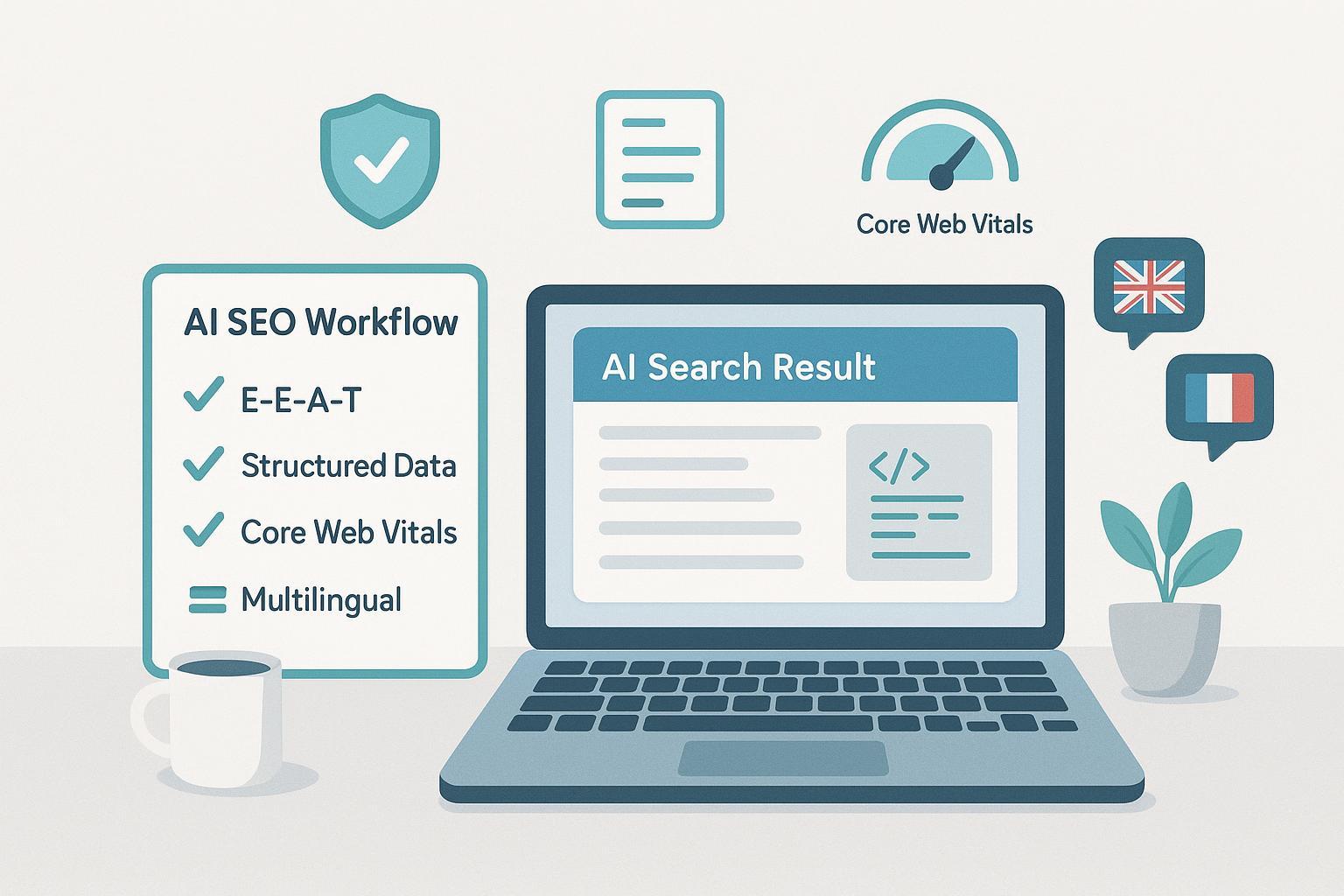
If you’re tasked with driving organic growth in 2024–2025, you’ve probably felt the shift: AI search experiences (like Google’s AI features and answer engines) reward content that’s uniquely helpful, clearly structured, and transparently sourced. This guide translates that reality into a practical playbook you can use today—policy‑aligned, evidence‑aware, and focused on workflows that ship.
1) Policies, E‑E‑A‑T, and What Google Expects in 2024–2025
Google permits AI assistance. What matters is whether your content is helpful, original, and trustworthy. The March 2024 core update and spam policy changes doubled down on reducing unhelpful or mass‑produced pages. Google summarized those changes in the March 2024 core update and spam policies, adding explicit categories like scaled content abuse, site reputation abuse, and expired domain abuse.
What does that mean for content marketers? Put E‑E‑A‑T (Experience, Expertise, Authoritativeness, Trust) into operations, not just rhetoric. Trust is the anchor—pages that signal low trust won’t perform, regardless of other strengths, as reflected in Google’s Search Quality Evaluator Guidelines (latest).
Operationalizing E‑E‑A‑T in day‑to‑day work:
- Tie each article to a credible author with a real bio, credentials, and profile links.
- Inject firsthand experience: screenshots, process details, field notes, and responsibly sourced data.
- Cite authoritative sources in‑line with descriptive anchors (no “click here”), and avoid claims you cannot verify.
- Disclose AI assistance where relevant so readers understand your editorial process.
Google’s 2025 guidance on AI search emphasizes unique content, clear structure, and transparency. See Succeeding in AI search (2025) for the most current framing of how AI features select and present sources.
2) Structuring Content for AI Search and AI Overviews
AI features prefer pages that answer clearly and quickly, then expand with detail. Think of your article like a layered answer: concise at the top, deeper as readers scroll.
Practical structuring patterns that work:
- Mirror the query in your H2/H3 headings and lead with a short, direct answer block (2–4 sentences) before the nuance.
- Use scannable elements where they genuinely help: short lists, step‑by‑step sequences, and compact tables for comparisons.
- Keep entity clarity high: name the concepts, products, organizations, and people explicitly; avoid vague references.
Google confirms that AI features highlight helpful, unique content and display links contextually to encourage exploration. Their overview of AI features and presentation patterns is here: Top ways to perform well in AI features (2025).
3) Structured Data You Should Actually Use (and Validate)
Structured data helps search systems understand your page. Even where classic rich results have changed, schema can still support semantic clarity and eligibility for AI citations.
Focus on JSON‑LD for:
- Article: baseline metadata (headline, author, datePublished, image, publisher, mainEntityOfPage) to reinforce identity and ownership.
- FAQPage: use when you genuinely present Q&A on the page; ensure questions and answers are visible. Note that Google limited FAQ rich result visibility in 2023, but the markup remains useful for clarity. See FAQPage documentation.
- HowTo: helpful for step guides; visibility in classic rich results is limited as of Aug–Sep 2023 changes. Use it for semantic precision when the content is truly instructional. See HowTo documentation.
- Product and Review: for commerce pages, include name, images, offers, and ratings per Google’s patterns. See Product structured data.
Validation and monitoring:
- Test every implementation with the Rich Results Test.
- Cross‑check with the Schema Markup Validator.
- Keep an eye on Search Console Enhancements for structured data feedback.
4) Technical SEO Hygiene That Supports AI Discoverability
AI features don’t bypass fundamentals. If your site is slow, poorly structured, or hard to crawl, you’ll struggle to be cited.
Make sure you have:
- Clean crawlability and indexability: robots.txt allows key paths; low‑value pages use noindex; canonical tags consolidate duplication. Google’s SEO Starter Guide is still your foundation.
- Submitted XML sitemaps and logical information architecture: clear hub‑and‑spoke clusters, descriptive URLs, and no orphaned content.
- Strong Core Web Vitals: target LCP ≤ 2.5s, INP ≤ 200ms, CLS ≤ 0.1 (75th percentile). See Core Web Vitals thresholds and INP details on web.dev.
- Freshness signals: consider IndexNow to prompt rapid re‑crawls where appropriate. Microsoft’s overview: IndexNow drives faster discovery (2025).
5) The AI‑Assisted Workflow (Human‑in‑the‑Loop)
Here’s a reproducible workflow you can adapt to your stack. The goal is speed with quality, not scaled content for its own sake.
-
Research and planning
- Map intent and topic clusters. Capture the questions users actually ask, then decide your angle and differentiation.
- Draft prompts that demand specificity and originality (e.g., “Include schema validation steps and Core Web Vitals thresholds; cite Google docs.”).
- For ideation support, see AI‑powered topic suggestions and the docs for “Extra Prompt” controls: Advanced settings: Extra Prompt.
-
Outline and first draft
- Create a heading structure mirroring user questions. Generate a draft with clear lead answers and deeper sections.
- Add real examples and notes you can verify later.
-
Human editorial pass
- Fact‑check claims, add citations, inject experience (screenshots, process details), and align tone to your brand.
- Add author bio, link to credible profiles, and disclose AI assistance as needed.
-
On‑page optimization
- Clarify entities; weave natural internal links to related hubs; implement JSON‑LD; add accessible multimedia.
- Validate schema and run performance checks.
-
Publish and distribution
- Push to WordPress/CMS; distribute across email and social; consider a short video or carousel summarizing the article’s core steps.
-
Measure and iterate
- Track query‑level performance, citation inclusion in AI features, and engagement. Annotate updates.
Neutral product example (workflow demo): Disclosure: QuickCreator is our product. In practice, a content marketer can use QuickCreator’s AI Blog Writer to generate a draft from a detailed outline and “Extra Prompt,” then pass it through a human editor who adds firsthand notes and citations using the AI Writer with citations. After on‑page optimization and schema validation, they publish to WordPress and monitor performance via integrated analytics. Comparable steps exist in other AI writing platforms; choose the stack that fits your governance and CMS.
6) Measuring Inclusion in AI Features (What’s Feasible Today)
Measurement is evolving. At the moment, Google includes AI clicks within overall Web search totals. Impressions and positions in AI mode may not map perfectly to classic results.
Practical approach:
- Use Search Console and query‑level tracking to watch changes for terms that commonly trigger AI features. Google’s framing of reporting realities appears in Succeeding in AI search (2025).
- Manually check key queries monthly in Google’s AI features and other answer engines (Bing, Perplexity, ChatGPT) to confirm if your page is being cited. Microsoft’s recommendations for answer inclusion are summarized in Optimizing for inclusion in AI search answers (Oct 2025).
- Track KPIs that reflect AI influence: citation frequency, share of voice in answers, attributed traffic, content prominence within the answer block, and engagement metrics (session length, pages per session) for affected queries.
7) Entity‑Centric Optimization
Think like a knowledge graph. The clearer you are about what your page is “about,” and how the entities relate to each other, the easier it is for AI systems to trust and cite you.
Tips that consistently help:
- Use persistent identifiers in schema (@id) and link entities with nested relationships (Organization ↔ Product ↔ Author). Reinforce with sameAs pointing to authoritative profiles.
- Keep naming consistent across your site and external profiles.
- Build internal links around topic/entity clusters; use natural anchors to connect related pages.
- Audit entities quarterly: list your primary and secondary entities, synonyms, and adjacent topics; expand coverage with dedicated, high‑quality pages.
For fundamentals and examples, start with Google’s intro to structured data and Schema.org.
8) Multilingual and Multimodal SEO
International audiences and rich media both matter to AI features.
For multilingual sites:
- Implement hreflang correctly (self‑referencing and bidirectional tags; x‑default where appropriate) and validate in Search Console. See Managing multi‑regional sites.
- Localize language, examples, and metadata—not just translate.
- Use language‑specific URLs and ensure CDNs serve content close to users.
For multimodal:
- Mark up videos and images (VideoObject, ImageObject); add transcripts, captions, and descriptive alt text.
- Keep mobile performance strong; heavy media shouldn’t tank Core Web Vitals.
- Consider cross‑channel reinforcement: a short tutorial video or slideshow can earn visibility beyond classic Web.
9) Governance, Risks, and Troubleshooting
AI assistance speeds creation, but it raises governance questions. A few pragmatic safeguards go a long way.
- Avoid scaled content abuse: don’t mass‑produce thin, near‑duplicate pages. If you’re templating, each page must add unique value.
- Set editorial standards: human review is mandatory; require citations for factual claims; reject drafts that can’t be verified.
- Establish prompt libraries with instructions that force specificity, originality, and transparency.
- Run routine checks: schema validation, internal link audits, Core Web Vitals, indexability, and a monthly review of AI feature visibility on top queries.
- If performance drops: examine crawl issues, remove or improve low‑value content, tighten topical focus, and refresh E‑E‑A‑T signals (author bios, disclosures, citations).
10) Next Steps
If you’re implementing AI SEO this quarter, keep it simple:
- Start with a pilot: pick one topic cluster, publish 3–5 high‑quality pieces using the workflow above, and instrument measurement.
- Operationalize E‑E‑A‑T: author bios, citations, editorial checks, and transparent notes on AI assistance.
- Add schema and validate; shore up technical hygiene and internal links.
- Track AI features monthly, annotate changes, and iterate.
If you want a platform workflow to test end‑to‑end, QuickCreator can be one option with human editorial in the loop and WordPress publishing. For an overview of how it fits, see Best AI blogging platforms comparison, and for diagnostics on the SEO front, this SEOquake installation guide can help with quick audits.
You have the strategy. The rest is execution—answer‑forward pages, real expertise, and consistent validation. Ready to ship?