How AI Will Transform SEO in the Next 5 Years (2025–2030)

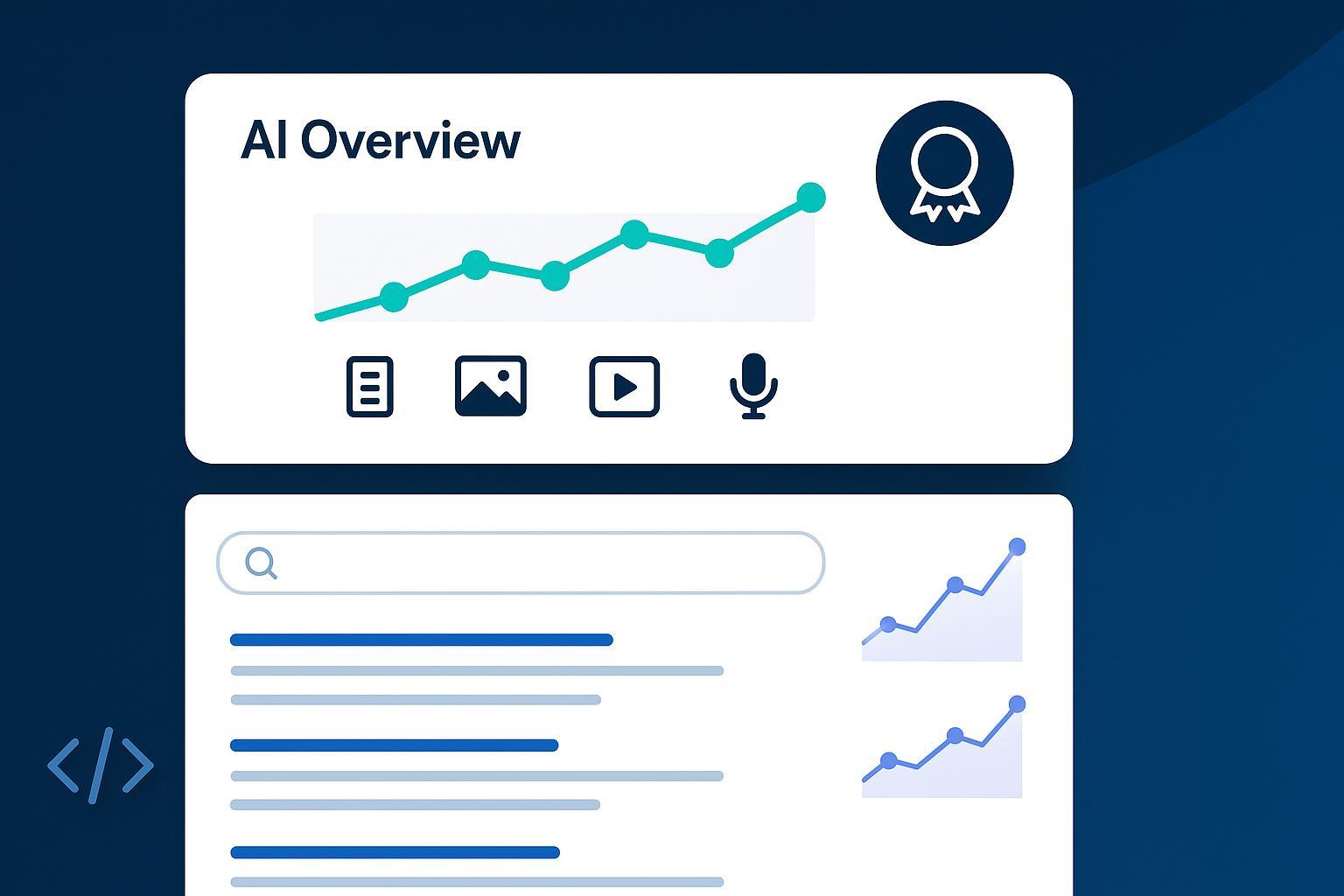
The search results page is no longer just a stack of blue links. In 2025, Google’s AI Mode and AI Overviews started answering more queries directly, citing sources and inviting people to refine with conversational prompts, images, and short videos. That shift rewires how we plan content, measure success, and invest in SEO. Here’s a data-backed view of what changed and a practical playbook to build durable visibility from 2025 to 2030.
From “rankings” to AI visibility
Classic rankings still matter, but they no longer tell the full story. AI Mode (a dedicated AI-first experience) and AI Overviews (summaries inside traditional SERPs) synthesize answers, show follow-up prompts, and include links to the web when helpful. Google frames this as deeper reasoning with clear paths to explore rather than a replacement for websites. You can see how the experience is designed to “go deeper” while offering helpful links in Google’s AI Mode update (May 2025).
Eligibility to be cited is simpler than many assume. There is no special “AI schema.” Instead, a page must be indexable and eligible for a snippet; standard controls apply (noindex, nosnippet, robots). Google reiterates that helpful, reliable, people-first content and correct structured data for your content type improve understanding and selection, without any bespoke AI markup. Review the site-owner perspective in Google Search Central’s “AI features and your website” (2025).
What does this mean for strategy? Treat AI panels as distribution surfaces you can influence. Structure your content so it’s easy to parse, verify, and cite—similar to optimizing for featured snippets, but with multimodal assets and clearer evidence chains.
What the 2025 data actually says
Two realities can be true at once: AI summaries reduce click yield on affected queries, and being cited can still drive meaningful traffic and brand exposure. Pew Research tracked real browsing in the U.S. and reported that users clicked less when an AI summary appeared (8% click-through to traditional results vs. 15% without an AI summary), with only 1% of visits clicking a citation link inside the summary; sessions were abandoned more often when summaries appeared (26% vs. 16%). The study covered 68,879 queries across 900 adults, published July 22, 2025. See the methodology and caveats in Pew Research’s analysis (2025). Google has disputed the magnitude, so consider this evolving.
Seer Interactive’s longitudinal dataset (3,119 informational queries, 42 orgs, 25.1M organic impressions; June 2024–Sept 2025) also shows significantly lower CTRs on queries where AI Overviews appear, alongside overall CTR declines even on non-AIO queries. Correlation isn’t causation, but the directional trend is clear. Read the caveats and numbers in Seer Interactive’s September 2025 update.
Measurement is changing, too. As of mid‑June 2025, AI Mode traffic is included in Google Search Console’s Performance (Web) reports, but there’s no dedicated filter to isolate AI Mode versus classic results. That means you’ll need supplemental tracking to understand AI panel visibility. See coverage in Search Engine Land’s note on AI Mode data in Search Console (June 2025).
So, plan for lower CTR where AI panels appear, and build a measurement approach that tracks citations and presence inside AI answers—not just blue-link position.
The new measurement stack (beyond clicks)
You can’t manage what you can’t measure. Traditional rank and CTR are blunt instruments for AI-first surfaces. Add leading indicators that capture your brand’s “AI visibility.” Think of it this way: traditional KPIs measure how you perform in a list; AI-era KPIs measure how you’re referenced in an answer.
| Aspect | Traditional SEO KPIs | AI-era SEO KPIs |
|---|---|---|
| Primary surface | Blue links (10 results) | AI panels (answers, refinements) + links |
| Lead indicator | Average rank, snippet wins | Citation frequency, panel presence/position |
| Traffic proxy | CTR, clicks | AI panel impressions + citation clicks (where available) |
| Visibility tracking | Rank trackers | SERP/AI snapshots; AI visibility tools |
| Governance | Keyword lists, tags | Query clusters + intent states + conversation paths |
Operationalize quickly with a three-step routine: define a baseline set of high‑value queries and capture weekly SERP/AI panel screenshots; log citation appearances and positions in a simple spreadsheet to chart share of voice over time; and annotate suspected AI feature changes alongside query‑level trends in Search Console. It’s lightweight, but it gives you a directional signal while more formal tooling matures.
How to get selected (and cited): structure, schema, and multimodality
AI systems favor content that’s easy to understand, verify, and quote. That means structured prose, correct schema, and media that clarifies meaning. Use clear H2/H3s, explicit definitions, tightly scoped FAQs, and step-by-step sequences—summaries up top, details below. Bind claims to authoritative sources with descriptive anchors and add the year in prose when the date matters. Apply schema appropriate to the content type (Article, FAQPage, HowTo, VideoObject, Product, LocalBusiness), validated and error-free; there’s no special AI schema, but schema helps interpretation. Cross-check your setup with Google’s AI features and site owner guidance, and prune deprecated or noisy markup in line with “Simplifying Search results” (2025).
Go multimodal by default: include original images with descriptive alt text, short clips with captions and transcripts, and simple diagrams or tables. Google’s I/O 2025 coverage underscores stronger multimodal understanding in Gemini 2.5—use that to your advantage by supplying clean metadata and context; a concise roundup is in Revolgy’s I/O 2025 highlights. Finally, treat E‑E‑A‑T as a workflow, not a label: show who wrote it and why they’re credible, cite sources, include first‑party data where possible, and adopt expert review for sensitive claims. To tighten editorial QA, you can run a pre‑publish checklist with an internal reviewer and tooling such as an AI E‑E‑A‑T checker.
A practical litmus test: if a person skimmed your page for 20 seconds, could they extract the core claim, the steps, and the evidence? If yes, AI systems likely can, too.
Technical SEO that amplifies AI comprehension
The technical foundation still matters—and arguably more—because AI features rely on clean structure and fast, stable rendering. Keep Core Web Vitals healthy (fast LCP, stable CLS, responsive interactivity) to reduce parsing failures and provide a clear DOM for extraction. Use semantic HTML rather than div soup, with clear heading hierarchies and descriptive filenames/alt attributes. Organize related pages to reinforce topic depth and expertise; if you’re formalizing site architecture, this primer on mastering SEO silo structure is a practical starting point. Maintain accurate sitemaps and feeds, refresh overlapping articles to reduce duplication, and confirm you aren’t inadvertently excluding key pages with noindex or nosnippet directives.
Practical example workflow: an AI‑first content brief to publication
Disclosure: QuickCreator is our product.
Here’s a neutral, replicable workflow you can adapt to your stack.
- Define the opportunity: pick a query cluster with demonstrated business value, collect current SERP/AI panel snapshots, and note whether citations appear and which entities are favored.
- Draft an AI‑first brief: outline H2/H3s, core definitions, steps, and FAQs; specify required evidence (studies, official docs) and multimodal assets (one table, two images, one short video); assign schema types (Article + FAQPage + VideoObject where applicable) and a citation checklist.
- Produce and review content: front‑load the answer, add supporting quotes and numbers with links, and use concise alt text and captions; run editorial QA with an E‑E‑A‑T checklist and expert review where needed.
- Implement schema and publish: validate markup, ensure snippet eligibility, ship, and capture initial SERP/AI snapshots.
- Monitor AI visibility: track weekly citation frequency and panel presence for target queries and annotate changes.
If you want a template-driven way to execute steps 2–5 in one place, you can use the AI Blog Writer to generate a structured draft, insert schema‑ready blocks, and keep assets organized while you add citations and run QA.
Risks, caveats, and an update cadence
Metrics in AI search are evolving quickly. The share of queries showing AI panels and the associated CTR deltas will change as features iterate. Mark “evolving” stats in your docs and maintain a quarterly refresh with a short change log. Treat correlation carefully—Seer Interactive notes overall CTR shifts even where AI Overviews don’t appear—so don’t pin every change solely on AI panels. Follow Google’s guidance on generative content quality to avoid scaled, low‑value output; keep human oversight, cite sources, and prioritize originality. And if you serve global audiences, plan for local-language assets, while ensuring alt text, captions, and transcripts meet accessibility standards.
What to do next
- Reframe success around AI visibility by adding citation frequency, panel presence, and AI share of voice to your KPIs.
- Upgrade briefs and templates to structure for reasoning, require evidence, and plan for images, a short video, and a table where it aids clarity.
- Strengthen technicals: validate schema, keep Core Web Vitals healthy, and enforce clean HTML and heading hygiene.
- Stand up measurement: capture weekly SERP/AI panel snapshots, annotate major updates, and review query‑level trends in Search Console.
If you want a faster way to operationalize these steps across a team, QuickCreator can support structured briefs, AI‑assisted drafting, schema‑ready blocks, and collaboration workflows—while keeping you in control of evidence and editorial standards.
References and further reading (selected)
- How AI Mode works and why it links out: Google’s AI Mode update (May 2025)
- Site owner guidance for AI features and eligibility: Google Search Central’s AI features and your website
- User behavior with AI summaries (U.S., July 2025): Pew Research study
- CTR changes on AIO queries with caveats: Seer Interactive’s Sept 2025 update
- AI Mode traffic in Search Console (coverage): Search Engine Land report
- Multimodal capabilities context: Revolgy’s I/O 2025 highlights
- Structured data changes and deprecations: Google’s “Simplifying Search results” (2025)