Why Investing in AI SEO Tools Now Is the Smartest Marketing Move of 2025

Updated on 2025-10-10
2025 is the inflection point
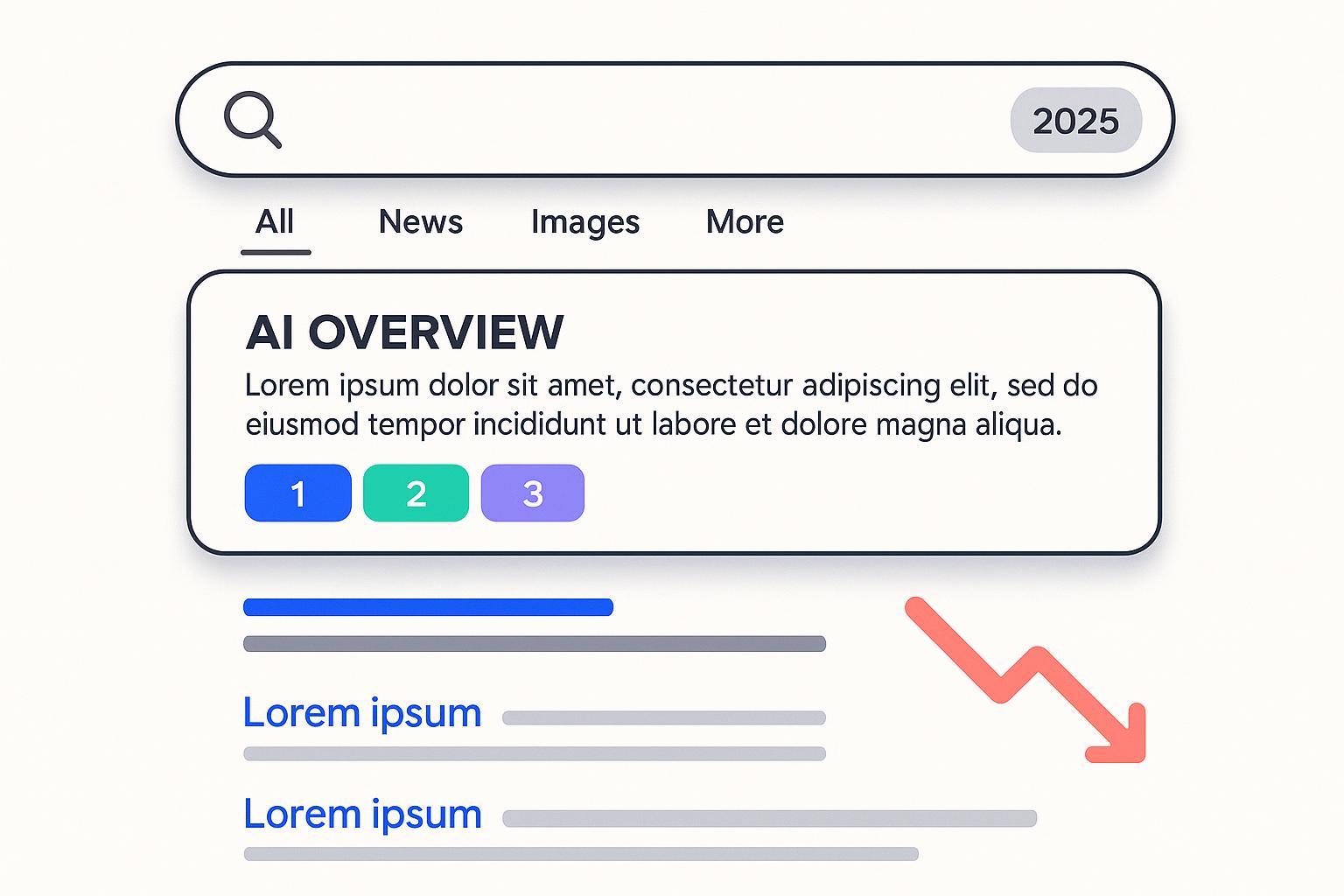
If your organic program still measures success by classic blue‑link CTR alone, you’re flying with one engine. Throughout 2024–2025, Google’s AI Overviews (AIO) began answering more queries up front, while core and spam updates pushed hard against thin or scaled content. The result: reliable traffic patterns from the past decade now wobble, especially on non‑branded informational queries. The opportunity for teams that adapt early is real—faster production cycles, smarter on‑page optimization, and new visibility in AI answer surfaces—provided you pair AI with rigorous governance.
What changed in Search (and why it matters for budgets)
- AI Overviews rolled out widely in mid‑2024 and kept expanding into 2025, reshaping how information is presented and which sources get cited, as outlined in Google’s announcement of the U.S. rollout in May 2024: see the description of “AI Overviews” in the official post, Generative AI in Search (Google, 2024). You can review the details in Google’s May 14, 2024 launch post.
- In parallel, Google updated its spam policies in March 2024 to target scaled content abuse, site reputation abuse, and expired domain abuse—policies that directly affect how you deploy AI in content operations. The definitions are documented in Google Developers’ March 2024 core update and spam policies.
- The update cadence hasn’t let up: multiple 2025 core updates kept quality bars high and volatility real; for example, the June 2025 core update is recorded on the Google Search Status Dashboard entry for June 2025.
- Independent analyses through 2025 show that when an AI Overview is present, traditional organic clicks tend to decline—especially for non‑branded informational queries. One industry study summarized by Search Engine Land in April 2025 found average CTR declines of around 15.5% with AI Overviews present, and up to 37% when they appear alongside featured snippets; non‑branded queries saw about a 20% drop. See the breakdown in Search Engine Land’s April 21, 2025 report on CTR impact.
- Methodologies vary, but the directional signal is consistent: AI answers compress clicks. For example, Ahrefs’ 2025 synthesis discusses both prevalence ranges and notable CTR hits to top results when AIO shows, which reinforces the need to optimize for both traditional rankings and answer surfaces. For details, see Ahrefs’ “Google AI Overviews: All You Need to Know” (2025).
The budget implication: 2025–2026 SEO must prioritize speed, evidence‑rich content, and structure that wins citations in AI answers—without tripping spam policies.
The business case for AI SEO in 2025
Executives aren’t waiting. Enterprise adoption of AI continues to rise, with marketing among the most active functions. In March 2025, McKinsey reported that 78% of organizations use AI in at least one function and 71% use generative AI regularly in at least one function—momentum that supports reallocating spend to AI‑assisted SEO workflows that demonstrably save time and improve quality controls. See the figures in McKinsey’s The State of AI 2025 (PDF).
This isn’t about replacing strategy with automation. It’s about equipping lean teams to:
- Move from brief to draft to publish faster, with human QA at the center.
- Align pages to live SERPs (and AIO patterns) in near‑real time.
- Track new KPIs—AI citation rate, impression‑to‑click delta, and branded search lift—alongside traditional rankings.
The two‑engine SEO model: optimize for rankings and AI answers
Winning in 2025 means designing content for two simultaneous surfaces:
-
Engine 1: Classic organic results
- Build topical authority with hubs and spokes.
- Cover entities comprehensively; enrich with original data, quotes, and visuals.
- Maintain fundamentals: fast pages, clean internal links, descriptive alt text, and relevant schema.
-
Engine 2: AI answer surfaces (AI Overviews and similar)
- Provide a concise, quotable summary early in the page: 2–4 sentences stating the answer, supported by sources.
- Use question subheads (H2/H3) and short step blocks to match common “how/what/why” intents.
- Increase evidence density: cite primary sources, include dates, and clarify geography/scope.
- Keep freshness legit—update meaningfully rather than changing timestamps.
Pro tip: A page that ranks well is still more likely to be cited in AIO. Structuring for Engine 2 shouldn’t cannibalize Engine 1; it should amplify it.
A practical workflow example (mid‑funnel content, tool‑agnostic)
Here’s a lightweight, replicable flow your team can run in a week:
- SERP‑informed brief
- Classify the query (informational vs. commercial), list the user’s jobs‑to‑be‑done, and draft a 3–4 sentence “summary block” intended to be quotable in AI answers.
- Define 3 primary sources you must cite (e.g., an official policy page, a recognized industry study, and a relevant standard).
- Draft with AI assist + human editor
- Generate a structured draft with sections for the summary, steps, FAQs, and schema candidates.
- Have a human editor fact‑check every claim, add original commentary, examples, and visuals, and ensure compliance with spam policies.
- Optimize against live SERPs
- Compare your draft to the top results and any AIO patterns showing—the goal is to fill gaps with depth and clarity, not to mimic.
- Publish, interlink, and monitor
- Add internal links to your topical hub; annotate with dates and authors; then monitor both classic rankings and AIO citations.
Where a platform helps: An AI‑first editor that turns briefs into structured drafts and scores on‑page elements against live SERPs can compress cycle times while keeping humans in control. For teams that prefer an all‑in‑one workflow, QuickCreator supports AI‑assisted drafting, on‑page SEO checks, and one‑click publishing to WordPress, with multilingual generation and analytics.
Disclosure: QuickCreator is our product.
If you need a hands‑on walkthrough, see this step‑by‑step guide to AI‑assisted content workflows, and for drafting with built‑in SEO checks, explore the AI blog writer workflow.
Governance and risk controls (mapped to Google’s policies)
Google’s March 2024 policies explicitly target scaled content abuse, site reputation abuse, and expired domain abuse. Your AI content program should include:
- Human‑in‑the‑loop by default
- Require an accountable editor to approve every page; maintain author pages and bylines.
- Originality and duplication checks
- De‑duplicate internal overlaps; add unique data, quotes, or process insight before publishing.
- Source discipline and dating
- Favor primary sources; include years and scope. Avoid “recency theater” (changing dates without substance)—a 2025 report summarized how multiple AI models exhibited recency bias when presented with newer timestamps on unchanged content; see Search Engine Land’s Oct 9, 2025 recap of the recency‑bias experiment.
- Site reputation and hosting controls
- Don’t host third‑party pages without editorial oversight; avoid parasite pages.
- Update logs and disclosures
- Add “Updated on” notes and a brief change‑log for significant revisions.
For a deeper dive on human‑in‑the‑loop workflows and guardrails, review these best practices for content workflows that win with humans and AI (2025).
Measurement that matches 2025 reality: the AI Impact Dashboard
Beyond rank and CTR, instrument a dashboard that explains what AI surfaces are doing to your funnel:
- AI Overview citation rate
- Of the queries you track, how often does your domain appear in the AI answer citations?
- Impression‑to‑click delta by feature
- Compare pages with and without AIO presence to understand where CTR compression is acute.
- Engagement quality
- Time on page, scroll depth, and save/share events for pages that attract AI‑assisted traffic.
- Assisted conversions
- Attribute conversions influenced by informational pages—even when the first touch came through an AI surface.
- Branded search lift
- Watch for increases in branded queries after shipping authority content in a topic area.
Quantify progress over 4–6 weeks; use deltas to prioritize where AI‑oriented restructuring has the highest payoff.
Your 90‑day pilot plan (budget‑ready)
- Weeks 1–2: Set scope and baselines
- Select 20–40 queries across two topic clusters (mix informational and commercial). Record current rankings, presence/absence of AIO, CTR, and conversion assists.
- Weeks 3–6: Produce 6–10 pages using the two‑engine model
- Each page includes a crisp summary block, evidence‑dense body copy, FAQs, and relevant schema. Editors verify sources and add original commentary.
- Weeks 7–10: Optimize and interlink
- Fill entity gaps, improve internal links to hubs, and refresh metadata and images with descriptive alt text.
- Weeks 11–13: Measure and decide
- Report AI citation rate, impression‑to‑click deltas, engagement depth, and assisted conversions. Decide whether to scale to additional clusters.
Budget framing: License cost for one AI SEO platform + 30–40% of current writing time reallocated from low‑yield manual tasks usually covers the pilot. If the uplift in AI citations and assisted conversions is visible by week 12, expanding the program becomes a straightforward financial decision.
If you want to pilot with the workflow described here, you can start with a small team and scale as you prove results. For a guided setup, revisit the step‑by‑step workflow linked above—or kick off a 90‑day trial with QuickCreator via the guide and templates.
Citations and notes
- AI Overviews launch and scope: Google’s May 14, 2024 announcement
- Spam policy definitions (scaled content, reputation, expired domains): Google Developers, March 2024
- Update cadence reference (example): Google Search Status Dashboard, June 2025 core update
- CTR impact ranges (industry analysis): Search Engine Land, Apr 21, 2025
- AIO prevalence/CTR context: Ahrefs, 2025 overview
- Enterprise AI adoption (budget rationale): McKinsey, The State of AI 2025 (PDF)
- Manipulation risk (recency bias): Search Engine Land, Oct 9, 2025