AI-Powered Predictive Targeting Is Rewriting Omnichannel Marketing in 2025

Updated on October 8, 2025
As cookies wobble and platforms double down on automation, 2025 is the year predictive targeting moves from buzzword to operating system for omnichannel marketing. Google signaled a lasting pivot in April 2025, keeping third‑party cookie choice in Chrome and repositioning Privacy Sandbox APIs (Topics, Protected Audience, Attribution) while planning IP Protection in Q3 2025. See Google’s announcement in the Privacy Sandbox next steps (April 2025), and the API status on Privacy Sandbox overview/status.
Meanwhile, reported changes around Consent Mode v2 tightened the screws on EU traffic. Trade coverage in July 2025 described meaningful impacts when sites lacked Consent Mode v2—limiting remarketing and conversion tracking—so marketers should treat consent signaling as infrastructure. For details, read Search Engine Land’s July 2025 enforcement coverage and pair it with Google’s documented consent signals summarized in CookieYes Consent Mode v2 guide (2025).
Why predictive targeting is different now
Two forces are reshaping strategy:
- Consent-first data collection: With user choice preserved, consent signals (analytics_storage, ad_storage, ad_user_data, ad_personalization) are table stakes for compliant tagging and measurement, as outlined in the CookieYes Consent Mode v2 guide (2025).
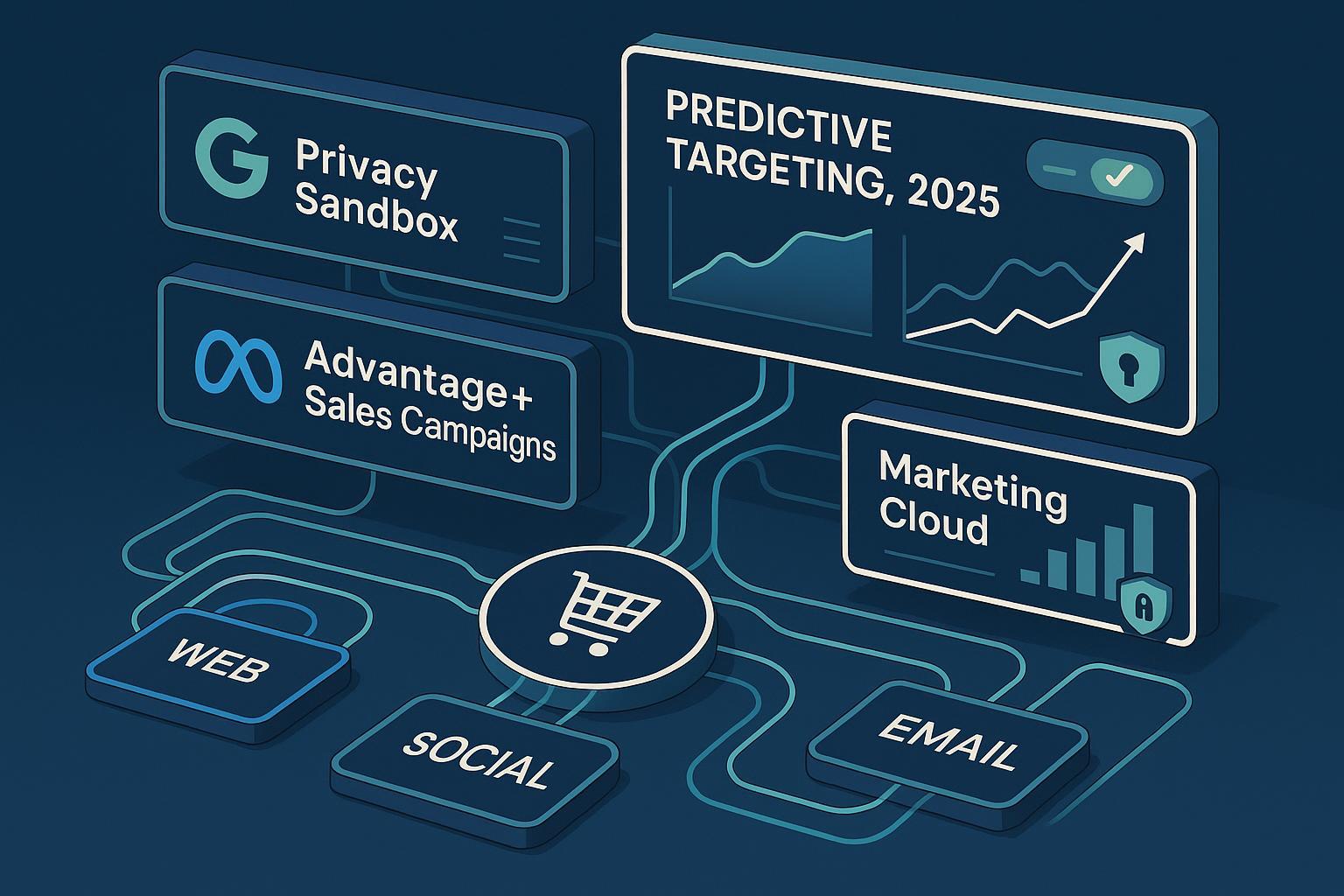
- Platform AI as orchestration, not a black box: Google’s APIs (Topics, Protected Audience, Attribution) are designed to work with constrained identifiers; Meta’s Advantage+ Sales Campaigns (ASC) automate audience discovery and creative allocation; Amazon’s Marketing Cloud (AMC) clean room opens multi‑year, privacy‑safe insights.
The implication: Predictive targeting excels when it’s fed high‑quality, consented first‑party data and governed by lift‑first measurement, frequency caps, and creative testing—not when it’s left entirely to platform defaults.
Measurement is back to basics: MMM + incrementality
Marketers operating with constrained identifiers need frameworks that don’t break when cookies or user identifiers are limited. Media Mix Modeling (MMM) uses aggregated, anonymized data across multiple years to estimate channel contribution and guide budget planning. A practical overview is in the Invoca Media Mix Modeling explainer (2025).
In tandem, design incrementality tests with geo or audience holdouts, proper randomization, and power calculations, then reconcile findings with MMM. Run diff‑in‑diff or regression adjustment, account for lag/adstock, and refresh quarterly to reflect seasonality. When MMM suggests an under‑credited channel, incrementality can validate lift before scaling. Keep both methods privacy‑safe and auditable.
The activation playbook: first‑party data, clean rooms, and server‑side tagging
A resilient omnichannel stack in 2025 looks like this:
- First‑party data foundation: Collect consented identifiers (emails, site/app events) with a robust CMP, clear disclosures, and granular preferences.
- Consent‑aware tagging: Implement Consent Mode v2 and server‑side tagging so conversion signals respect user choices and regional rules.
- Clean room collaboration: Use clean rooms (e.g., Amazon Marketing Cloud) to aggregate, query, and analyze cross‑touch data without exposing raw PII.
- CDP activation + personalization: Segment audiences based on propensity and lifetime value, then trigger messages across paid and owned channels.
- Lift‑first measurement: Bake in holdouts and MMM to validate outcomes across channels.
Operationalizing content across channels is often the bottleneck. Platforms like QuickCreator support omnichannel content production, multilingual variants, and SEO alignment that complement predictive targeting by keeping messaging coherent across paid and owned surfaces. Disclosure: QuickCreator is our product. For a deeper view of content orchestration, see How QuickCreator Supports Omnichannel Support Content.
Channel recipes: Meta ASC + Amazon AMC cross‑learning loop
-
Meta Advantage+ Sales Campaigns (ASC): ASC automates audience expansion and budget allocation, merging prospecting and remarketing with dynamic creative. Practical capabilities and guardrails are outlined in the Birch Advantage+ Sales Campaigns guide (2025).
Workflow: Start with well‑structured product catalog feeds and connected Pixel/Conversions API. Use brand‑safe exclusions, set frequency and creative diversity, and treat the “Opportunity Score” in Ads Manager as directional guidance while validating outcomes via holdouts.
-
Amazon Marketing Cloud (AMC): In 2025, AMC expanded access for Sponsored ads advertisers directly in the Amazon Ads console, and introduced a five‑year lookback enabling deeper LTV and new‑to‑brand analysis. See the Amazon Ads direct access to AMC (Sept 2025) and AMC measurement expansion with five‑year lookback (Jan 2025).
Workflow: Build queries that map sequence effects (e.g., upper‑funnel video exposure → Sponsored Products consideration → Subscribe & Save repeat). Use clean‑room outputs to inform prospecting/remarketing balance and frequency caps in Meta and Google.
To tighten real‑time execution across channels, review Real‑Time AI Campaign Optimization and Audience Segmentation for playbook ideas that are tool‑agnostic.
Compliance callouts: DMA, consent, and tracking protections
The EU’s Digital Markets Act (DMA) entered full‑force enforcement in 2025, expanding gatekeeper obligations and penalties. For context on powers and recent actions, see the European Commission’s DMA portal. In parallel, Google’s tracking protections are evolving—IP Protection is slated to roll out starting Q3 2025—per the Privacy Sandbox protections overview.
Translation for practitioners: keep a living compliance checklist, review CMP logs quarterly, and document tagging/consent flows per region. Tie platform automation to explicit guardrails (frequency, exclusions, creative standards) and audit clean‑room query governance.
Vertical vignettes: practical mini‑scenarios
-
Retail/ecommerce: A multi‑brand retailer uses ASC for catalog‑level discovery with conservative frequency caps. AMC queries reveal that upper‑funnel streaming video yields a 12–18% higher new‑to‑brand rate three weeks post‑exposure; incrementality tests confirm lift, so the team shifts 10% from mid‑funnel display to video. Consent Mode v2 ensures EU conversions are captured compliantly.
-
B2B SaaS: A demand gen team segments first‑party leads by propensity and product interest in a CDP, activates lookalikes via platform AI, and uses MMM for long‑cycle attribution. Clean‑room collaboration aligns content syndication with paid social, while holdout designs confirm that educational webinars produce incremental pipeline over generic gated ebooks.
(These vignettes are illustrative playbooks rather than case claims; validate with your data.)
Next steps: a 30‑day rollout plan
- Week 1: CMP and Consent Mode v2 audit; implement server‑side tagging for priority events; document regional consent flows.
- Week 2: Stand up clean‑room access (AMC or equivalent); define core queries for funnel sequencing and frequency; identify geo or audience holdouts.
- Week 3: Launch ASC with structured creative tests; set frequency caps and exclusions; begin real‑time telemetry monitoring.
- Week 4: Run initial incrementality tests; refresh MMM inputs; present governance‑plus‑lift findings to stakeholders; lock an ongoing refresh cadence.
To align personalization across owned and paid surfaces, explore AI Content Marketing Automation & Personalization at Scale: 2025 for practical content activation ideas.
AI-powered predictive targeting isn’t a switch you flip; it’s an orchestration you design. Anchor it in consented first‑party data, clean‑room collaboration, and lift‑first measurement, then let platform automation work within your guardrails. That’s how omnichannel marketing becomes resilient—and compounding—in 2025.