AI Content Planning for SEO: Complete Framework

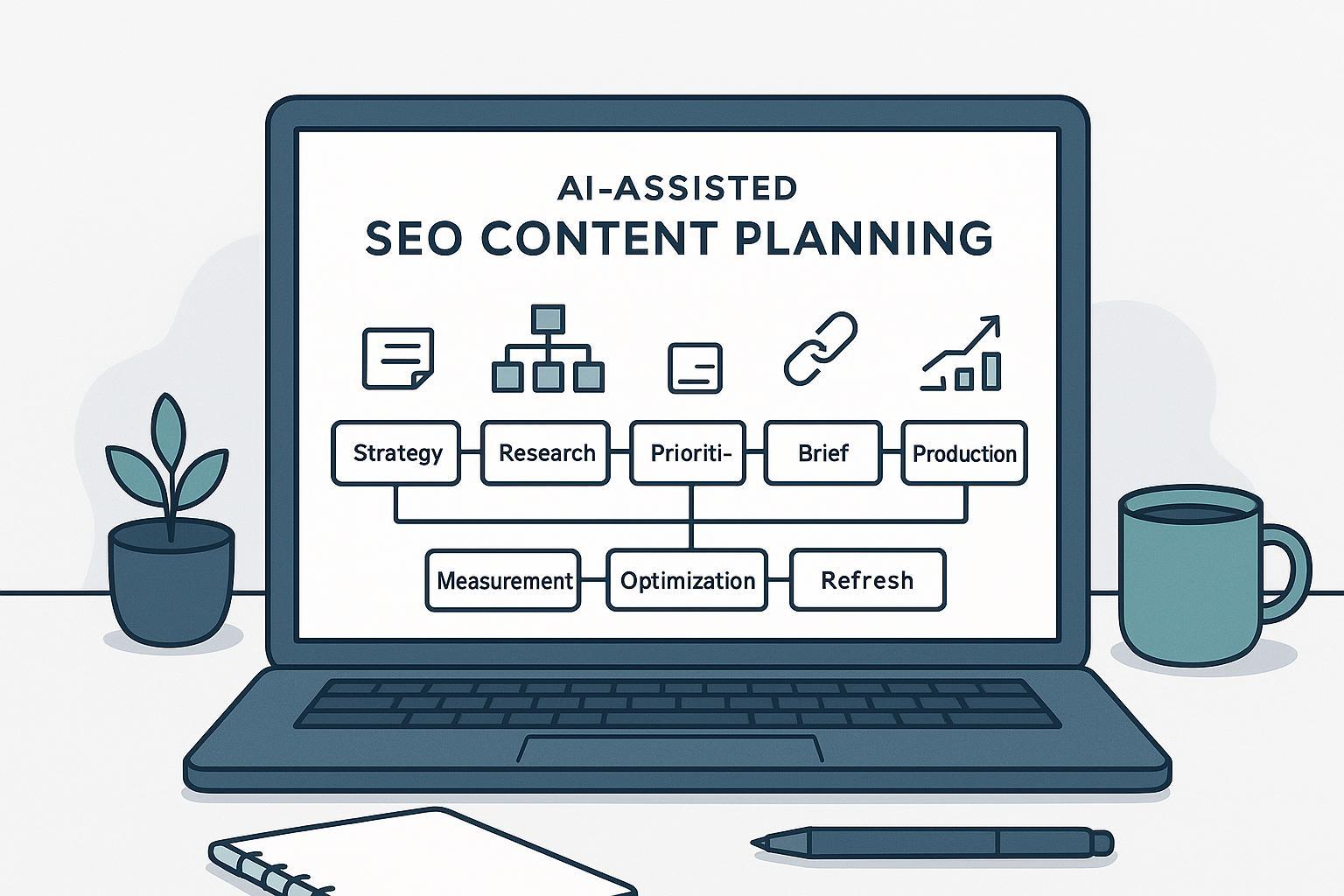
If your content calendar feels busy but unpredictable, this framework turns chaos into a repeatable system. You’ll map business goals to search intent, plan topical authority with entities, create airtight briefs, produce with AI plus human oversight, and measure what truly moves the needle. The playbook is built for SEO leads, editors, agencies, and solo creators who want reliable growth without flirting with spam or shortcuts.
1) Strategy Foundation: Map business goals to search intent
Content planning starts with a simple contract: every article must solve a user problem that also advances a business goal. Tie each topic to your ICP’s pains, the solution you offer, and the search intent you can realistically satisfy.
Define ICPs and high-intent problems. Translate jobs-to-be-done into question-style intents, comparisons, and how-to tasks. Convert business goals to content goals—for example, if demos are the goal, aim for mid-funnel solution comparisons and late-funnel integration guides. Align intent upfront: match each target to a primary intent (informational, navigational, transactional, local). Don’t force a transactional CTA onto a purely informational page; it will ring hollow and likely underperform. Establish success metrics per piece (primary metric such as organic conversions or email sign-ups, plus secondary metrics like scroll depth and engagement time) and document the “why” so reporting later tells a coherent story.
Flag risk and compliance areas. YMYL topics (finance, health, legal) demand heightened accuracy, expert review, and disclosures. In March 2024, Google explained that helpfulness signals were consolidated into core ranking systems and clarified enforcement around scaled content abuse. See Google’s policy overview in the official announcement, “March 2024 core update and spam policies”, and the current Spam Policies for Google Search.
Google’s stance on AI-generated content is straightforward: AI itself isn’t prohibited; usefulness, originality, and people-first value are what matter.
2) Research Layer: SERP reverse-engineering, entities, and information gain
Great content planning reverse-engineers the SERP and the topic’s knowledge graph instead of guessing.
Start with a SERP snapshot. Catalog ranking patterns, common subtopics, content formats, and the angles dominant pages take. Where do they converge? Where do they leave gaps? Then document your information gain opportunities—unique data, first-hand experience, or synthesis you can contribute that isn’t already there.
Map entities to build topical authority. Identify the primary entity (your core topic) and related entities that consistently appear in top results. Cover those relationships across your pillar and cluster pages. For architecture fundamentals and internal-linking rationale, see Mastering SEO Silo Structure for Effective Website Architecture.
About AI Overviews: Google’s official guidance focuses on eligibility—pages must be indexable and eligible for a regular snippet to be considered for AI features. See AI features eligibility in Google Search. Beyond eligibility, industry studies suggest that clear answers, authority signals, and unique contributions may improve citation odds, but the selection pipeline isn’t fully disclosed. Treat such patterns as observational rather than confirmed.
Compliance caveats: Avoid templated pages targeting near-duplicate variations. Google’s “Scaled content abuse” policy explicitly warns against mass-produced, unoriginal pages regardless of whether they come from AI, humans, or both (see Spam Policies link above).
3) Prioritization: 80/20 portfolio using MoSCoW and RICE/ICE
Most teams win by balancing quick wins with flagship assets. Quick wins are updates to pages hovering in positions 6–20 and clusters you can complete fast. Flagship assets are deep pillars and comparison guides that compound authority and revenue.
Use MoSCoW to sort the roadmap (Must/Should/Could/Won’t), then apply RICE or ICE scoring to rank within each bucket. Keep the math simple and transparent so stakeholders can buy in.
Below is a compact scoring blueprint you can copy. Calibrate scales to your data reality (e.g., Reach by search volume or traffic potential; Impact by contribution to conversions/assisted conversions; Confidence by data quality; Effort by person-weeks).
| Initiative | Reach (1–5) | Impact (1–5) | Confidence (1–5) | Effort (weeks) | RICE Score |
|---|---|---|---|---|---|
| Update: “How to choose X” ranking #9 | 4 | 3 | 4 | 1 | 48 |
| New pillar: “X vs Y vs Z” | 5 | 4 | 3 | 4 | 15 |
| Cluster article: “Best tools for X in industry Y” | 3 | 3 | 4 | 1 | 36 |
| Case study with original data | 2 | 5 | 3 | 2 | 15 |
Scheduling tips: Reserve a fixed portion of capacity (e.g., 30–40%) for updates on pages sitting in striking distance (positions 6–20). Batch cluster builds to finish a topic fast; incomplete clusters dilute authority. Slot one flagship per month or quarter, depending on team size, to keep compounding authority.
4) Briefing Blueprint: The standardized brief
A solid brief prevents drift and protects quality when using AI and when handing off to human writers or SMEs. Use a “guardrails, not a script” philosophy.
Core elements to include: target query set and intent; entities and coverage; originality angle and information gain; source list (primary, authoritative sources to consult and cite); SME input plan; internal link targets with descriptive anchors; evidence and citation plan; and UX/accessibility notes (intended reading level, tables/diagrams, alt text needs).
The brief’s job is to constrain the outline, not dictate every heading. Let the writer and editor adapt based on what the SERP and your originality angle demand.
5) Production with AI (Human-in-the-loop): Practical Example/Workflow
Disclosure: QuickCreator is our product.
Here’s a neutral, replicable way to draft with AI while safeguarding accuracy and compliance:
- Prepare your brief and sources. Keep primary sources open (Google documentation, standards bodies, and recognized industry research). When citing policy, link to canonical pages with descriptive anchors, such as Google’s core update announcement and spam policies.
- Draft with an AI assistant, then layer human review. You can use AI Blog Writer to generate a first draft and run built-in SEO checks based on SERP patterns. Keep the human editor in control: verify facts, add first-hand examples, and ensure disclosures are present where needed.
- Cite as you write using anchor text. Link to canonical, authoritative sources, not generic homepages. Limit link density so citations support the narrative rather than overwhelm it.
- Alternatives if you don’t use our tool: a CMS like WordPress plus an SEO plugin, Google Docs/Sheets for briefs and revision logs, and a reputable brief/outlining tool. The principle is the same: AI can accelerate drafting, but humans own accuracy, originality, and compliance.
Fact-checking pass checklist: re-verify statistics and claims against primary sources; add bylines, bios, and context to bolster trust; insert a short methodology note if you include data or experiments.
6) On-Page Optimization and Accessibility
On-page optimization in 2025 is about clarity, structure, and speed.
Headings and scannability. Use a clean H1–H2–H3 hierarchy with descriptive subheads and short paragraphs. This aids readers and helps algorithms parse your content. For fundamentals, see Google’s SEO Starter Guide.
Schema. Implement JSON-LD for Article, FAQPage, HowTo, Breadcrumb, and VideoObject where applicable. Ensure markup matches visible content. For current reference, use Google’s Structured Data introduction and the Search Gallery for eligible types and properties.
Media and performance. Add descriptive alt text, concise captions where helpful, and compress images. Avoid heavy or auto-playing media that degrades mobile performance.
Internal links. Use descriptive anchors to connect clusters to their pillar and to relevant siblings. For architecture strategy and anchor planning, review Mastering SEO Silo Structure for Effective Website Architecture.
Accessibility. Respect color contrast, keyboard navigation, and ARIA labeling where relevant.
7) Distribution and Measurement
Shipping the draft is step one; distribution and instrumentation make it count.
Technical readiness: request indexing where appropriate, submit updated sitemaps, and ensure canonical tags are correct. Double-check robots directives and noindex flags.
Google Search Console: track clicks, impressions, CTR, and average position. Monitor Search appearance for schema issues and Core Web Vitals (LCP, CLS, INP). Annotate notable changes and algorithm updates so trends have context.
GA4: watch organic sessions, conversion rate, and engagement time. Group content to compare pillars vs. clusters.
AI Overviews visibility: there’s no official dashboard for citations; monitor manually for key queries and consider third-party studies. Treat visibility shifts as directional; mechanisms aren’t fully disclosed.
Reporting cadence: weekly spot checks for new/updated pages; monthly dashboards for leaders; quarterly strategic reviews to rebalance the portfolio.
8) Maintenance: Refresh, Prune, Consolidate
Content portfolios decay without upkeep. A lightweight, consistent cadence keeps the whole site healthy.
Refresh. Update pages with decaying traffic or new developments. Add missing entities, update stats and examples, improve internal links, and enhance schema. As discussed by Search Engine Land, thoughtful content refreshing can revive performance; use such perspectives alongside your own data and testing.
Prune. Deindex low-value or redundant pages to improve overall site quality and focus crawl on what matters.
Consolidate. Merge overlapping content into a single owner page. Use canonicals and redirects; retune internal links so authority flows to the owner.
Fix cannibalization. Maintain a keyword-to-URL map. When two URLs compete, decide the owner and refactor or redirect the other.
Set a quarterly audit to catch decay early and keep clusters coherent.
9) Sector-Specific Playbooks
Different teams face different constraints. The framework stays constant; the tooling and cadence flex.
Solo creator: keep a lean stack (CMS, one AI drafting assistant, basic analytics). Timebox weekly: prioritize updates in striking distance and one cluster article per week. Add first-hand screenshots, experiments, or small datasets that only you can provide.
SMB marketing team: use shared brief templates, collaborative editing, structured schema implementation, and a light project management layer. Apply MoSCoW for alignment and reserve capacity for quick wins. Aim for a monthly flagship plus weekly cluster coverage; review SERPs bi-weekly.
Agency operations: standardize briefs, checklists, and an E-E-A-T policy. Maintain client-specific topics/entities maps. Batch cluster builds, rotate refresh cycles, and use RICE/ICE to defend prioritization in stakeholder reviews.
10) Governance and QA
Governance is where quality becomes repeatable. Write down how you work and enforce it.
Editorial QA layers: pre-brief (confirm intent, originality angle, risk flags); draft QA (fact-check against primary sources; add bylines, bios, and transparent sourcing); on-page QA (validate schema, internal links, alt text, heading structure; test mobile readability); post-publish QA (monitor Search Console and GA4; fix schema or internal link gaps quickly).
Score your content. A lightweight scoring rubric keeps standards consistent. For a structured model, see Content Quality Score documentation for an E-E-A-T-aligned approach you can adapt.
Compliance and risk checklist: avoid scaled, templated content that offers no unique value (see Google’s Spam Policies for Web Search); disclose conflicts of interest when your own product is mentioned; cite canonical sources with descriptive anchors and reasonable link density; for YMYL pages, require expert review and maintain versioned change logs.
—
Optional extended reading: If you’re evaluating platforms for AI-assisted writing and SEO workflows, see Best AI Blogging Platforms (Comparison) for an overview to frame your tool selection criteria.
References and primary resources
- March 2024 core update and spam policies (Google Search Central) — Google’s consolidation of helpfulness signals and policy enforcement.
- Spam Policies for Google Search — definitions and examples of scaled content abuse and related violations.
- AI features eligibility in Google Search — basic requirements for appearance in AI features.
- Structured Data: Introduction and Search Gallery — current types and implementation guidance.
- SEO Starter Guide — fundamentals for on-page clarity and usability.
- Refreshing content to drive traffic (Search Engine Land) — industry perspective on revitalizing existing pages.
Notes on evidence and caveats
- AI Overviews citation mechanics beyond eligibility are not fully documented by Google; treat industry analyses as observational.
- Structured data support changes; confirm eligibility in Google’s Search Gallery at implementation time.