How Many Blogs Are Created Per Day (and How Many Blog Posts Are Published Daily) in 2025

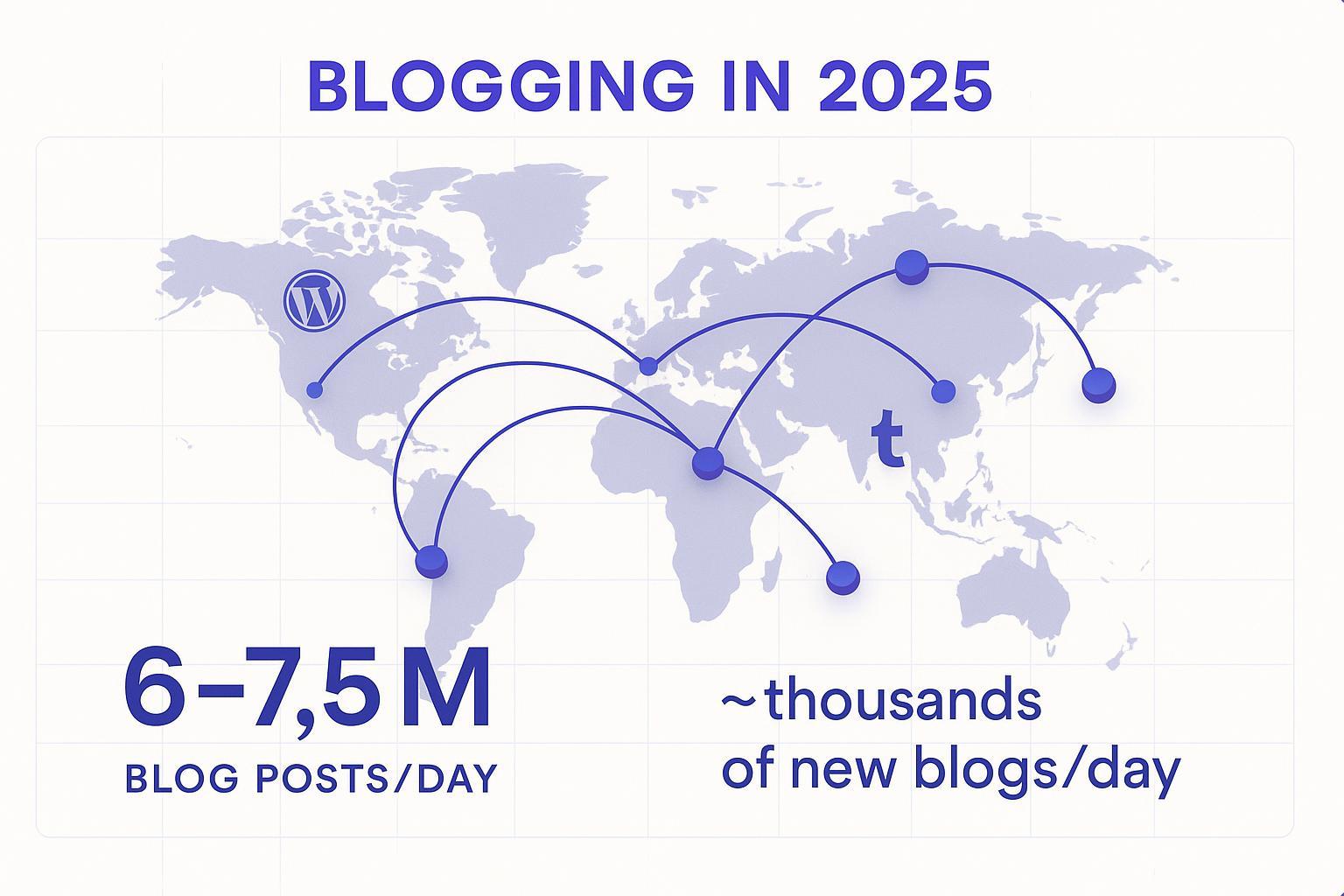
Founders ask two practical questions when budgeting for content: How many new blogs launch each day in 2025, and how many blog posts hit the web daily? The short answer: daily publishing volume is immense, and exact “new blogs/day” is hard to pin down. Below, you’ll get credible ranges, platform context, and plain‑English implications for ROI—plus a transparent methodology section so you can see how the estimates are built.
1) Global daily blog posts (2025): 6–7.5 million
The conservative estimate widely repeated in 2025 roundups is about 6 million posts per day, attributed to WebTribunal and cited by sources like Backlinko’s 2025 blogging statistics.
A higher figure—up to 7.5 million per day—appears in 2025 summaries such as OptinMonster’s “Ultimate List of Blogging Statistics”. Both ranges rely on aggregated counts across platforms and independent sites.
Caveat: Methods behind these global tallies are not fully transparent; treat them as scale indicators rather than audited census numbers.
Implications for founders: Even if you publish one high‑quality post per week, you’re competing with roughly 850,000–1,300,000 posts that same day. Differentiation—topic selection, authority signals, distribution—is more than “nice to have”; it’s survival.
2) WordPress’s footprint: massive share, meaningful slice of daily volume
As of 2025, WordPress powers a huge share of the web (≈43% of all sites) and dominates the CMS market, per W3Techs’ usage comparison (2025). WordPress.com also discusses this leadership in its 2025 market share post.
Many 2025 compilations estimate ~70 million WordPress posts per month, which roughly converts to ~2.3 million/day. This is a secondary proxy—helpful for context, but not an official Automattic tally.
Caveat: WordPress spans WordPress.com plus self‑hosted sites; centralized post counting is inherently tricky.
Implications for founders: Platform share matters for ecosystem reach, but search competition happens at the query level. Your on‑page and entity signals still decide whether you surface against WordPress, Medium, Substack, or custom CMS competitors.
3) Total number of blogs worldwide (2025): 600 million+ (scale indicator)
Many credible 2025 roundups report 600M+ blogs globally. See the scale summary in OptinMonster’s 2025 statistics.
Caveat: “What counts as a blog?” varies—from dedicated sites to blog sections on broader websites. A significant portion is inactive.
Implications for founders: The sheer number of blogs isn’t the main constraint; content quality, topical focus, and authority are. This is where a content quality score aligned with E‑E‑A‑T helps you prioritize improvements over raw volume. For a primer, see Content Quality Score (QuickCreator Help).
4) New blogs created per day (2025): low‑thousands, estimated via domain data
There’s no official global “new blogs/day” measurement. To build a reasonable estimate, use domain registration growth as a proxy.
Verisign’s Domain Name Industry Brief (DNIB) shows total domain registrations at 371.7M in Q2 2025 (up 0.9% quarter‑over‑quarter; +2.6% year‑over‑year). The quarterly increase is roughly 3.3M domains over ~90 days ≈ 36,700/day. See Verisign DNIB Q2 2025. For additional context, review DNIB Q1 2025.
If we conservatively assume ~10% of new domains become active blogs, the estimate lands near ~2,500–3,700 new blogs/day. This excludes blogs created on free platforms (Medium, Blogger, Tumblr subdomains), which could raise the total.
Caveats: This is assumption‑driven. Domain growth includes e‑commerce, SaaS, portfolios, and parked domains. The 10% allocation is a heuristic for directional insight, not a census.
Implications for founders: New competitors appear daily, but most won’t build durable authority. Focusing on topic clusters, internal link architecture, and steady updates can outlast “launch noise.” If you need a refresher on the basics, here’s a beginner’s SEO guide that explains titles, meta, headings, and internal links.
5) Blogger workflow benchmarks (2025): length and time trends
In the 2025 edition of its long‑running annual survey, Orbit Media reports an average blog post length around ~1,300–1,400 words and average writing time near ~3 hours 50 minutes per post. See Orbit Media’s 2025 Blogger Survey for methodology and historical context.
Publishing cadence often falls in the 2–4 posts per month range for many teams, with quality and promotion increasingly prioritized over sheer volume.
Caveat: Averages hide variance by industry and intent (thought leadership vs. product education vs. SEO capture).
Implications for founders: Budget for a full workflow—research, drafting, editing, optimization, and distribution. Skipping optimization is like building a factory but never shipping your products.
6) Platform snapshots beyond WordPress: useful, but sparse on official 2025 counts
Tumblr likely remains massive by blog count, but third‑party tallies vary and official 2025 post/day disclosures are limited.
Medium’s well‑known “built‑in audience” is often summarized around ~100M monthly readers, though official 2025 creator/post counts are not broadly published.
Substack emphasizes creator‑side metrics and reader retention over daily post totals; see its overview of analytics concepts in Substack’s metrics guide.
Caveat: Platform stats frequently rely on secondary synthesis; use them qualitatively.
Implications for founders: Platform choice affects distribution, not just publishing. For B2B search intent, own your domain; use platforms as satellites for reach.
7) Competing in a 6–7.5M posts/day world: practical steps
Narrow your keyword and topic strategy to queries where you can credibly win, then build a cluster with supporting pieces. If you’re new to this, start with what keywords and topics mean (QuickCreator Help).
Invest in on‑page authority signals: expert quotes, original data, and clear structure. Pair that with tidy internal linking and helpful visuals.
Refresh intent‑aligned pages on a cadence. Small improvements to existing, proven URLs often beat net‑new pieces in saturated SERPs.
8) A scalable production toolbox for founders
If your bottleneck is production speed plus SEO hygiene, QuickCreator combines AI drafting, on‑page optimization, and managed publishing in one workflow. Disclosure: QuickCreator is our product.
Best for: small teams that need consistent, SEO‑ready output without juggling multiple tools. Not for: highly bespoke web app builds or sites needing complex custom functionality.
Tip: Use your toolchain to enforce quality bars rather than inflate volume. You can explore the workflow on the AI Blog Writer page.
9) ROI framing: where to spend in 2025
People still read and convert from blogs—especially for B2B research—but the bar for usefulness is higher. Competing against millions of posts daily means allocating budget to depth (research, examples, visuals), not just word count.
Prioritize pages that sit close to revenue (product explainers, comparison pages, “how‑to” guides) and strengthen related discovery content afterwards. Tie performance to qualified traffic and assisted conversions, not raw pageviews.
Methodology & caveats (read this if you care about the numbers)
Global daily post counts come from 2025 roundups synthesizing multiple platforms. We present ~6M/day (conservative) per Backlinko’s citation of WebTribunal and ~7.5M/day (upper bound) per OptinMonster. Methods are not fully disclosed by the origin sources; treat ranges as scale indicators.
WordPress share is based on W3Techs’ measurement of web and CMS usage; platform‑specific monthly post totals are approximations from secondary aggregations.
“New blogs/day” is estimated using Verisign DNIB domain growth (Q1 and Q2 2025), then applying a conservative assumption (~10%) for domains that become active blogs. The proxy excludes subdomain‑driven platforms and assumes uneven adoption by region and industry.
Blogger workflow benchmarks reference Orbit Media’s 2025 survey, which provides a consistent, longitudinal methodology and is widely cited.
Link density: We’ve limited external citations to authoritative pages and kept them to a reasonable number to preserve readability.
If you’re a founder weighing content investment this year: focus on a tight set of topics, publish consistently, and refresh winners. When you’re ready to scale smartly, start a free QuickCreator trial.