From Paper to Digital: The Impact of OCR on Modern Document Management

OCR stands for Optical Character Recognition. It is a useful technology to convert printed papers to digital form, where each word is easily storable, updatable, and editable on a computer, laptop, mobile, or any screen.
Modern document management practices require computerized backups of data. This is only possible with OCR since manual data entry is very tiring and time-consuming.
Cloud backups of the textual information make it very easy to access and share data anywhere, anytime. So, it is, indeed, a step in the future where everything will be available at the click of a button.
This post tends to uncover the complete impact of OCR on modern-day document management practices. We’ll also teach you how to utilize one of the tools with the said technology for your daily tasks.
Influence of OCR on Document Management
Apart from benefits, OCR is very influential and a key element in modern document management for companies and individuals. These will be discussed at length below.
Increased efficiency
OCR photo to text converters save time and effort by quickly digitizing documents. They also utilize Machine Learning algorithms at the back end to accurately extract anything taken as photos or pictures.
As an example, we’ll convert the following image to editable content with the help of the mentioned tool.
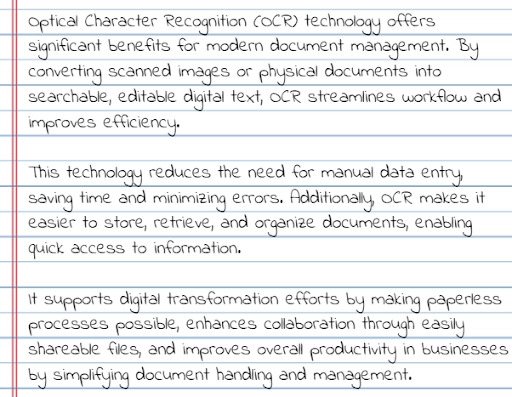
Writing these handwritten notes on a computer would take ages. But the photo to text tool will make this paper into digital form in seconds.
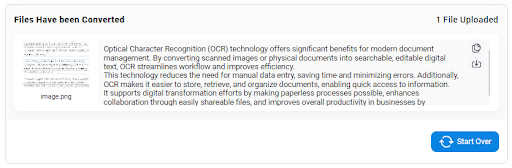
As you can see, the tool has functioned properly, providing us with the handwritten text on our digital screen. Now, you can download the textual information as a .txt file or save the output to your clipboard to keep the workflow up and running.
Space and cost savings
The OCR technology saves space costs as you no longer need to store printed documents in physical rooms. All the information can be digitized; thus, businesses can avoid hefty rental overheads.
Besides all this, you don’t need extra security members to guard the confidential documents in the archive rooms. All the information will be available on the cloud, saving a lot of hassle to protect the trade secrets.
However, one must ensure to place in correct cybersecurity measures to avoid spillage of data online. Best practices are to hire professionals in the field to put up firewalls on the website, use 2-factor authentication methods for employee data security, etc.
Protecting private information is necessary as cyber-attacks can be an insulting prospect for an organization or individual.
Improved searchability
Having digital data means that it is easily accessible at the click of a button. So, no lengthy search sessions anymore, easily get whatever info you want with utmost convenience.
This allows for better collaborative efforts since every member of the team will be well aware of the commonly-founded knowledge. Thus, their decisions would be wiser in projects, resulting in agile progress toward the end goals.
Apart from this, the searchability of digital information makes it easy to compile and draw analysis on multiple fronts. Hence, further aiding the decision-making abilities of upper management and executives of a company.
When a company’s flow is synchronized with the digital data influx, it is bound to become more successful than others. The reason is that they’re most aware of what’s currently going on in the market.
Better information organization
When you go from paper to digital form, you create a cloud storage that has the complete knowledge base of the organization.
This information works as a guide to new hires as they can quickly traverse through everything made so far by your company. This leads to the new employees equipping themselves with the right mindset and quickly becoming more efficient in their jobs.
Comparing this digital system to a traditional, paper-based information organizational system, the differences are massive.
Unlike a paper form, you don’t need color-coded filing systems or dispose of unwanted documents to the trash can. Simply, make folders to move like files into it, or erase the extra documents from your memory and you’re good to go.
Ease for automation
Since OCR helps store everything digitally, it’s a lot easier now to automate a lot of processes.
For example, OCR can pull out invoice numbers, dates, and payment details from receipts. This data can be directly fed to financial systems for processing, saving hours of manual data entry.
Furthermore, software with OCR capabilities can attach to language translators, allowing seamless communication with foreign clients and team members.
The ease of automation makes modern document management essential, and for that, you need OCR technology.
So, it’s high time that businesses, governmental bodies, and individuals spend time digitizing information and working to make cloud systems more secure.
Promoting inclusion practices
Last, but not least, the Optical Character Recognition process allows for the easy promotion of inclusion practices in education, business, and other walks of life.
The said technology improves the accessibility of information to those who aren’t able to read. After digitization from paper to digital form, many OCR tools like Google Lens have the option to read the text out loud, thus allowing visually challenged individuals to learn writing like other students.
This can be a step forward toward educating all types of youth about world events and STEM knowledge, making them the leaders of the future.
So, think about it, OCR helps make careers and lives of many people, worldwide. This is yet another reason why going from paper to digital form is preferred nowadays.
Final Words
OCR technology plays a crucial role in modern document management practices by converting printed papers to easily accessible digital forms.
This increases efficiency, saves space and costs, improves searchability, and enhances information organization. OCR also leads to enabling automation and promoting inclusion practices, which is the way forward for the future.
From facilitating quick data retrieval to eliminating the need for physical storage, OCR is essential for streamlined and efficient operations in businesses, governmental bodies, and individual tasks.
