Types of Tone in Writing (with Marketing Use Cases and Examples)

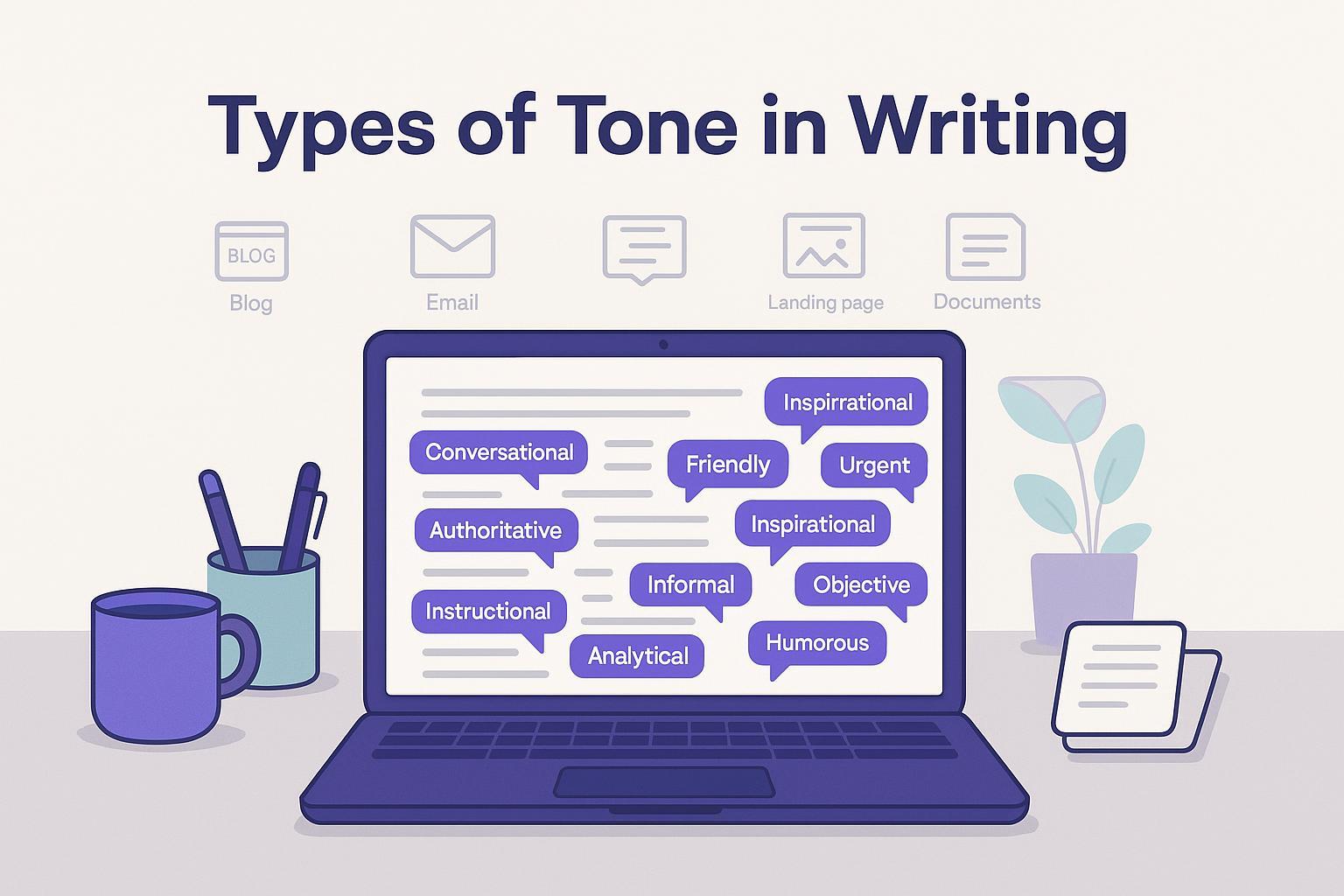
If you’re scaling content with AI across blogs, landing pages, emails, and docs, tone is one of the biggest levers you have for trust and conversions. Quick reminder: your brand voice is the stable personality; tone is the situational attitude that adapts to the channel, audience, and intent. As Grammarly explains in its 2024 primer on differences, voice is the fingerprint while tone shifts by message according to the Grammarly guide on tone vs voice. For practical planning, it helps to think of tone along dimensions like formality, humor, and enthusiasm—an approach discussed in Nielsen Norman Group’s ChatGPT and tone guidance (2023).
To go from theory to action, this guide defines 15 high‑impact tones, maps them to B2B/SMB marketing use cases and funnel stages, and shows short examples and AI prompt tips you can copy.
To deepen the distinction, see our concise brand voice vs tone guide.
How we chose these tones
We prioritized tones that are: 1) widely used in B2B/SMB marketing, 2) clearly distinguishable in practice, 3) applicable across common channels (blogs, landing pages, email, docs, product/comparison pages), 4) beneficial with known pitfalls, and 5) supported by credible guidance. We also considered E‑E‑A‑T and clarity standards; for a pragmatic scoring approach to quality signals, review our content quality score overview.
Quick mapping: tone → best channels and funnel stages
Tone | Best Channels | Funnel Stages |
|---|---|---|
Conversational | Blogs, FAQs, emails, social | TOFU/MOFU |
Authoritative | LPs, feature pages, whitepapers, comparisons | MOFU/BOFU |
Persuasive | PPC/LPs, sales emails, webinar signups | BOFU |
Instructional | Support docs, onboarding, in‑app tips, API docs | Adoption/Retention |
Analytical | Thought leadership, comparisons, research blogs | MOFU |
Empathetic | Support emails, onboarding nudges, status updates | Adoption/Retention |
Confident | LPs, product pages, executive summaries | MOFU/BOFU |
Friendly | Onboarding, nurture, in‑app UX microcopy | Adoption |
Inspirational | Founder letters, vision pages, case studies | All stages (esp. brand) |
Urgent (sparingly) | Promotions, event CTAs, sunsets | BOFU |
Formal | Whitepapers, RFPs, compliance/legal | MOFU/BOFU |
Informal | Social, brand storytelling, some blogs | TOFU |
Objective/Neutral | Comparisons, FAQs, release notes, docs | MOFU/BOFU |
Reflective | Postmortems, year‑in‑review, founder updates | Brand trust |
Humorous (light) | 404s, low‑stakes microcopy, social | TOFU |
1) Conversational
What it is: Natural, plain‑English cadence with contractions and “you.” Feels like a helpful colleague.
Best for: Blogs, FAQs, nurture emails, early LP sections (TOFU/MOFU).
Watch‑outs: Over‑casual can undercut credibility; keep it tight and purposeful.
Examples:
“Here’s the short version: you’ll launch in hours, not weeks.”
“If you’re new to this, start with the checklist and skip the jargon.”
AI prompt tip: “Write in a conversational yet professional tone, second person, short sentences, plain English, no slang.”
2) Authoritative
What it is: Evidence‑led clarity that signals expertise and reliability. Uses proofs, not puffery.
Best for: LPs, feature pages, comparison pages, whitepapers (MOFU/BOFU).
Why it matters: Google has emphasized experience, expertise, authoritativeness, and trust as quality signals; align claims with evidence per the Google E‑E‑A‑T update (2022).
Watch‑outs: Avoid jargon dumping or unsubstantiated superlatives.
Examples:
“Trusted by 1,200+ B2B teams and validated in a 90‑day pilot across three industries.”
“SOC 2 Type II and ISO 27001 compliance, audited annually.”
AI prompt tip: “Use an authoritative tone: state the claim, cite a proof point, and keep sentences precise and concise.”
3) Persuasive
What it is: Moves the reader to act using credible benefits, social proof, and clarity—without dark patterns. For ethical persuasion levers, see Cialdini’s principles summarized by CXL’s persuasion guide (2023).
Best for: BOFU pages, PPC landers, sales emails, webinar signups.
Watch‑outs: Don’t fake scarcity or manipulate; the FTC classifies “dark patterns” as deceptive. See the FTC 2022 Dark Patterns Report.
Examples:
“Join 3,000+ marketers who reduced time‑to‑publish by 40%—reserve your seat by Friday.”
“Compare plans side‑by‑side and lock in launch pricing before Oct 31.”
AI prompt tip: “Write a persuasive BOFU paragraph: lead with benefit, add a specific proof point, end with a clear, honest CTA.”
4) Instructional
What it is: Scannable, step‑by‑step, empathetic direction that helps users complete tasks. Microsoft’s style guidance champions clear, action‑focused instructions; see the Microsoft Writing Style Guide.
Best for: Support docs, onboarding flows, in‑app guidance, API docs (adoption/retention).
Watch‑outs: Overly technical or dense text slows users. Prefer short steps, active voice, and visuals where needed.
Examples:
“Go to Settings → Integrations → Connect HubSpot. Select ‘Sync contacts.’ You’re done.”
“If you see a 403 error, refresh your token and retry the request.”
AI prompt tip: “Write a numbered, step‑by‑step guide with brief sentences, active voice, and a one‑line ‘If this fails’ recovery note.”
5) Analytical
What it is: Objective, evidence‑based reasoning that interprets data and explains implications. Structure and brevity matter; see HBR’s 2022 advice on how to write concisely.
Best for: Thought leadership, research‑backed blogs, comparisons (MOFU).
Watch‑outs: Don’t dump charts without insights. Tie data to decisions.
Examples:
“Across 214 SMB sites, long‑tail rankings improved when SOPs standardized internal linking; the likely driver was crawl path consistency.”
“Option A reduces CAC by 11% at the cost of slower onboarding; Option B flips that tradeoff. Choose based on payback period targets.”
AI prompt tip: “Summarize the data in two insights and one recommendation; avoid adjectives; cite the metric, sample size, and timeframe.”
6) Empathetic
What it is: Validates the user’s context and emotions, then offers clear next steps. Particularly powerful in support and onboarding.
Best for: Support resolutions, recovery flows, onboarding nudges (adoption/retention).
Watch‑outs: Avoid scripted sympathy without action. Pair empathy with solution and timeline.
Examples:
“I can see how a failed import blocks your launch. I’ve queued a re‑run and will update you within 2 hours.”
“If you’re migrating from Sheets, start with our template—it catches the fields most teams miss.”
AI prompt tip: “Open with acknowledgment of the user’s situation, state the fix in plain English, and include a specific follow‑up time.”
Tools to keep tone consistent at scale
QuickCreator AI Blog Writer — supports repeatable tone, internal style guardrails, and SEO structure across blogs and landing pages. Disclosure: QuickCreator is our product.
Alternatives: Your CMS style rules + prompts; a shared team style guide; editorial checklists; or linters built into docs platforms.
7) Confident
What it is: Direct, assertive, and respectful. Avoids excessive hedging and backs statements with facts when needed.
Best for: LPs, product pages, sales emails, exec summaries (MOFU/BOFU).
Watch‑outs: Confidence without evidence reads as bluster; add proof points.
Examples:
“Ship your first optimized article today—no plugins or templates required.”
“Switch in under a week with our migration checklist.”
AI prompt tip: “Use confident language with strong verbs; remove hedging like ‘maybe’ or ‘might,’ unless uncertainty is required.”
8) Friendly
What it is: Warm and approachable without being unprofessional. Great for lowering friction in UX and onboarding.
Best for: Onboarding flows, nurture emails, in‑app microcopy (adoption).
Watch‑outs: Don’t get cute in high‑stakes moments (security, billing issues).
Examples:
“Welcome aboard! Let’s set up your first campaign together—it takes about 5 minutes.”
“Need a hand? Chat with us anytime; we’re happy to help.”
AI prompt tip: “Friendly, inclusive tone; short sentences; invite action gently; avoid slang and exclamation overuse.”
9) Inspirational/Motivational
What it is: Vision‑oriented, energizing language that connects effort to outcome and offers a next step.
Best for: Founder letters, vision pages, case studies, recruitment.
Watch‑outs: Avoid platitudes—tie inspiration to tangible progress.
Examples:
“Every team deserves a content engine that compounds. Start with one article, and watch your pipeline follow.”
“From launch to leadership: how a 3‑person team grew inbound by 8× in a year.”
AI prompt tip: “Write an uplifting paragraph grounded in one real accomplishment and one concrete next step.”
10) Urgent (use judiciously)
What it is: Time‑bound clarity that prompts action when urgency is real and documented. Use sparingly and ethically. NN/g and the FTC both warn against deceptive urgency patterns; see the FTC’s dark patterns report (2022).
Best for: Genuine deadlines—promotions, event registration, product sunsets (BOFU).
Watch‑outs: Never fake timers or stock; avoid anxiety triggers.
Examples:
“Enroll by 5 p.m. PT today to join the live Q&A.”
“Legacy plan support ends Nov 30. Migrate now to keep analytics history.”
AI prompt tip: “Craft a transparent, time‑bound CTA; state the deadline and consequence without hype.”
11) Formal
What it is: Objective, precise, often third‑person; avoids contractions and favors technical vocabulary when appropriate.
Best for: Whitepapers, RFPs, compliance docs, legal pages.
Watch‑outs: Over‑formal can feel dense; prioritize clarity and define terms.
Examples:
“The organization maintains SOC 2 Type II compliance, as verified by an independent auditor.”
“Participants were selected using stratified sampling across four industries.”
AI prompt tip: “Use a formal tone: third‑person, no contractions, precise terminology, and define specialized terms on first use.”
12) Informal
What it is: Relaxed and relatable; uses contractions and first/second person; still professional.
Best for: Social, brand storytelling, lighter blog posts (TOFU).
Watch‑outs: Slang ages quickly; avoid in high‑stakes content.
Examples:
“We tried five templates so you don’t have to—here’s what actually works.”
“Let’s peek behind the scenes of our launch.”
AI prompt tip: “Write in a friendly, informal tone with contractions; avoid idioms or region‑specific slang.”
13) Objective/Neutral
What it is: Fact‑forward, minimal emotion, crisp definitions; ideal for comparisons and documentation.
Best for: Comparison pages, FAQs, release notes, API docs.
Watch‑outs: Dryness isn’t a virtue; provide explanations and definitions.
Examples:
“Plan A includes SSO and audit logs; Plan B adds role‑based permissions.”
“In v2.4, we deprecated endpoint /v1/reports. Use /v2/analytics instead.”
AI prompt tip: “Present facts neutrally; define each feature in one sentence; avoid adjectives unless measurable.”
14) Reflective
What it is: Introspective, lesson‑oriented tone that candidly reviews outcomes and sets forward actions.
Best for: Postmortems, retrospectives, founder updates, year‑in‑review posts.
Watch‑outs: Keep it constructive; close with what changes next.
Examples:
“Our Q2 traffic dipped after we paused comparisons; we’ll restart with stricter evidence standards and clearer CTAs.”
“Launching too broadly slowed onboarding. We’ll pilot with two verticals before expanding.”
AI prompt tip: “Write a reflective summary: one honest insight, one root cause, and one explicit next action.”
15) Humorous (light/witty, no sarcasm)
What it is: A gentle touch of wit to humanize the brand and reduce friction—never at the user’s expense.
Best for: 404 pages, low‑stakes microcopy, select social posts.
Watch‑outs: Avoid sarcasm and cultural references that can misfire; never use humor in sensitive contexts.
Examples:
“404—this page took a day off. Let’s get you back to work.”
“Coffee break? Same. Your report will be ready in two minutes.”
AI prompt tip: “Add a light, friendly quip; keep it inclusive; avoid sarcasm and pop‑culture references.”
Operational tips for AI tone control
Calibrate with examples: Paste one or two on‑brand paragraphs and ask your AI to mirror their tone, sentence length, and formality.
Set guardrails: Specify banned phrases, jargon to avoid, and reading level.
Iterate variants: Request two tone options (e.g., authoritative vs friendly) and choose based on channel and funnel.
QA with style checks: For deeper calibration, see our short primer on writing style analysis.
For granular tone controls in prompts, this overview of ChatGPT tone customization for bloggers shows practical patterns.
Why tone shifts by context (and how to choose)
Channel: Support docs benefit from instructional/empathetic; LPs need authoritative/confident; comparisons work best objective/analytical.
Funnel stage: TOFU favors conversational/informal to reduce friction; BOFU leans authoritative/persuasive to reduce risk.
Trust and compliance: Regulated industries often require formal/objective language with rigorous definitions.
SERP context: If page‑one winners use analytical/objective tone, match the reader’s expectation and then differentiate with clarity.
As a grounding reference, remember that tone is situational while voice is steady—language authorities consistently make this distinction, including the Grammarly explainer on tone vs voice. For content teams using AI, NN/g’s 2023 notes on ChatGPT and tone reinforce defining tone upfront, providing examples, and iterating.
Next steps
Pick 3–5 tones that fit your core channels and create short “do/don’t” examples for your team.
Build a two‑column prompt library: “When to use” and “How to ask the AI.”
Add tone checks to your content QA. For a complete workflow overview, see our guide to content workflows with humans + AI.
If you’re standardizing tone across SEO content and landing pages, a unified workspace like QuickCreator can help you operationalize prompts, briefs, and QA while keeping the writing human.