Beyond Traditional SEO: Why Semantic Content Creation Is Dominating AI-Powered Search Rankings (2025)

The 2025 context: Search is now an AI-first reading experience
In 2024–2025, Google folded its “helpful content” systems into the core and expanded AI-driven experiences (AI Overviews/AI Mode). This shift makes methodology matter more than ever. Keyword lists and density hacks struggle to earn citations in AI answers, while entity-rich, well-structured content tends to be favored across AI surfaces. Google emphasized this direction in the March 2024 core update notes, where it integrated helpful content signals into core ranking systems (see Google Search Central’s explanation in the March 2024 core update announcement, 2024). In 2025, Google further reiterated that success in AI experiences comes from the same fundamentals—crawlability, helpfulness, and clear structure—rather than any special AI markup (see Google’s AI features and your website, 2025, and Google’s guidance on succeeding in AI search, 2025).
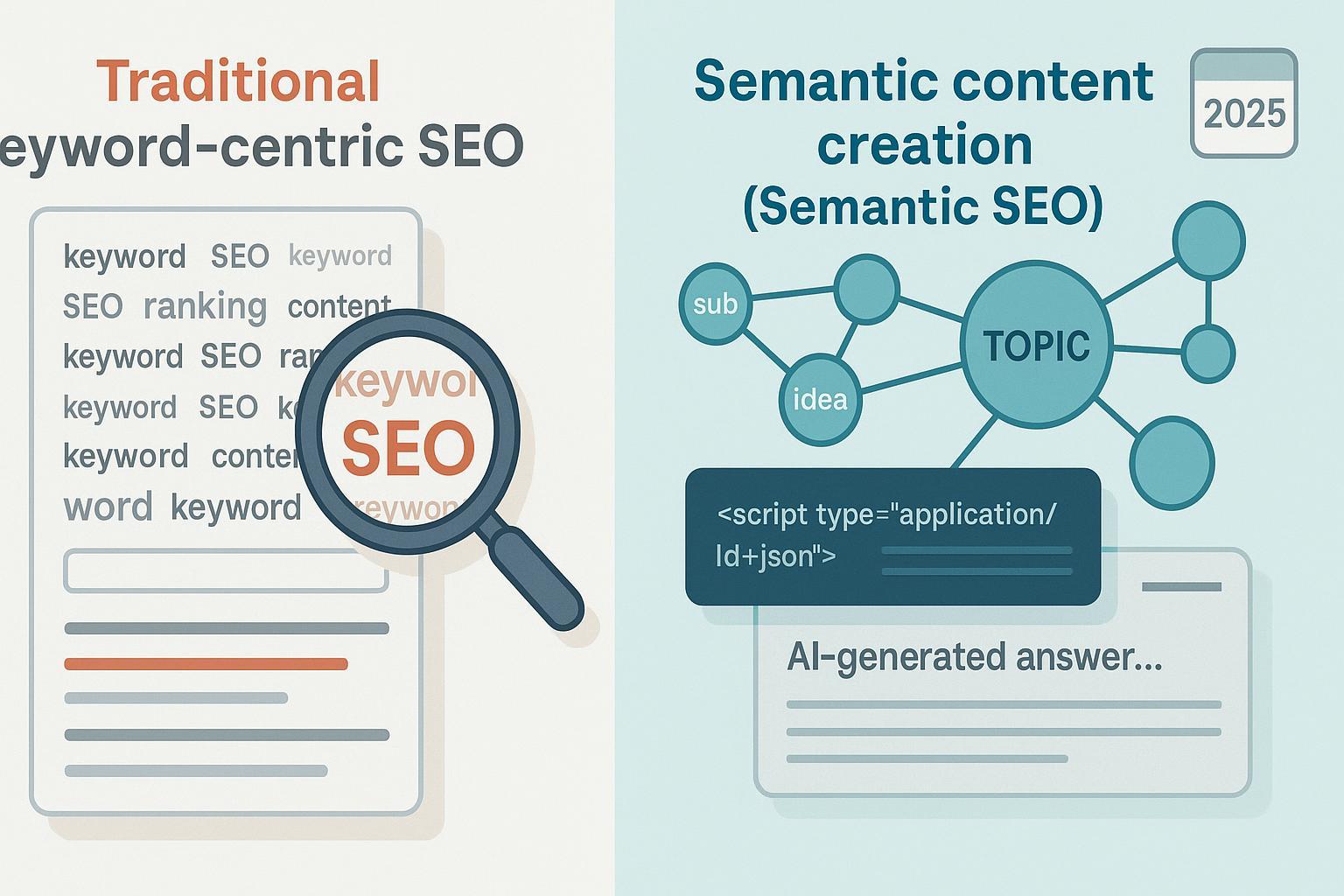
Below, we compare two approaches—traditional keyword-centric SEO and semantic content creation (semantic SEO)—and show where each fits in 2025.
At a glance: How the two approaches differ
| Dimension | Traditional keyword-centric SEO | Semantic content creation (Semantic SEO) |
|---|---|---|
| Core premise | Target exact-match keywords; one primary term per page | Model topics and entities; cover the full intent with clusters |
| Site architecture | Many thin pages; shallow interlinking | Pillar–cluster structure; dense, contextual interlinks |
| On-page signals | Keyword density, exact anchors, basic H1/H2 | Entities, synonyms, FAQs/HowTo, schema, answer-first formatting |
| Structured data | Minimal or none | JSON-LD markup aligned to visible content |
| Update resilience | Vulnerable to devaluations of thin/duplicative pages | More resilient when content is comprehensive and helpful |
| AI surfaces | Rarely cited in AI answers | More likely to be cited when content is authoritative and structured |
| KPIs | Ranking/CTR per page/keyword | Cluster-level coverage, AI citation rate, rich results eligibility |
Note on sources and scope: Google’s 2025 documentation states there’s no special markup for AI Overviews/Mode; eligibility stems from standard SEO best practices with helpful content and correct structured data. See Google’s AI features and your website (2025) and succeeding in AI search (2025).
Traditional keyword-centric SEO (what it is, where it still works)
Traditional SEO revolves around exact-match keywords, page-level targeting, and basic on-page optimization. It can still work for tightly bounded, transactional queries where users seek a quick answer or a specific product page.
Pros
- Simple to plan and ship; low upfront modeling cost
- Effective for narrow, commercial-intent terms
- Clear page-level measurement (rank/CTR per keyword)
Cons
- Fragile in 2025: thin or duplicative pages risk devaluation under core systems focused on helpfulness (see Google’s March 2024 core update explanation)
- Limited visibility in AI answers due to shallow coverage and weak entity context
- Poor internal link value and topical authority over time
Where it fits in 2025
- Local and niche cases where a single page can fully satisfy intent
- Product/category pages requiring focused commercial targeting
- Resource-constrained teams needing quick wins before a broader revamp
Semantic content creation (entity-first, cluster-based)
Semantic content creation models topics and entities first, then builds a pillar–cluster architecture that comprehensively covers user intents. Pages use answer-first formatting, rich internal links, and JSON-LD structured data aligned to visible content. This approach aligns with how AI systems parse and synthesize information. Google’s 2025 guidance underscores fundamentals—helpfulness, reliability, and technical accessibility—rather than secret AI tags (see succeeding in AI search, 2025).
Pros
- Higher odds of being cited in AI answers when coverage is authoritative and clearly structured
- Stronger topical authority and more resilient performance through core updates
- Enables rich results via valid structured data; better UX for readers
Cons
- Higher upfront planning effort (entity modeling, cluster mapping)
- Requires governance for internal linking and content updates
- Measurement is cluster-centric, which can feel less straightforward at first
Where it shines in 2025
- Informational/commercial investigation queries with layered sub-intents
- Competitive niches where topical authority drives trust and coverage
- Sites investing in durable, multi-URL assets instead of one-off pages
Why AI-powered search rewards semantic content
- Entities and intent coverage: AI answers benefit from sources that define concepts precisely and address related sub-questions. Clustered content provides that depth and context.
- Structured data that matches visible content: JSON-LD helps machines understand page type and key attributes; Google stresses alignment with on-page content in its structured data introduction (2025).
- Helpful, reliable presentation: Named authors, clear sourcing, and accurate summaries align with Google’s helpfulness focus (see March 2024 core update, 2024).
- Practical visibility note: Studies in 2025 show AI Overviews appear for a meaningful slice of queries; for example, Search Engine Land reported AI Overviews in about 13% of searches in mid-2025 samples. Even when not universal, being eligible for citations can influence discovery and brand impressions.
- Bing/Copilot citations: Microsoft explains that AI answers incorporate citations from credible, relevant sources. See Microsoft’s overview of how Bing delivers search results (accessed 2025).
For a friendly primer on shifting from keywords to topics and clusters, see this quick guide on what keywords and topics mean (and how they differ).
Migration playbook: From keyword pages to semantic clusters
- Pick a pillar topic and map intents
- Define the core entity/topic, then list sub-intents: definitions, comparisons, how-tos, troubleshooting, pricing, alternatives, integrations, etc.
- Audit existing pages; consolidate or redirect thin/overlapping content.
- Build a cluster architecture
- Create a pillar page that explains the topic comprehensively and links to clusters.
- Draft 8–20 supporting cluster pieces to cover sub-intents; ensure each adds unique value.
- Interlink pillar ↔ cluster, and cluster ↔ cluster where context overlaps.
- Implement structured data (JSON-LD)
- Mark up content types you actually show on page (Article, FAQPage, HowTo). Validate rigorously.
- Keep markup synchronized with visible content and page updates.
- Add named authors, reviewer roles where applicable, and citations to primary/authoritative sources.
- Maintain an editorial changelog and last updated dates, especially for YMYL-adjacent content.
- Measure cluster-level outcomes
- Track entity/topic coverage, cluster traffic/conversions, and AI citation presence.
- Refresh clusters based on gaps and new intents discovered from search queries and user feedback.
If you need a deeper walkthrough of how AI Overviews alter discovery and CTR—and how entity-rich clusters improve eligibility—see this explainer on AI Overviews’ CTR shifts and entity overlap patterns.
Minimal JSON-LD snippet (Article) to get you started
Below is a simplified Article schema example. Tailor properties to your page and keep them accurate to what readers see.
{
  "@context": "https://schema.org",
  "@type": "Article",
  "headline": "Semantic SEO vs Traditional SEO: 2025 Guide",
  "image": [
    "https://example.com/images/semantic-vs-traditional-2025.jpg"
  ],
  "datePublished": "2025-09-15",
  "dateModified": "2025-10-03",
  "author": {
    "@type": "Person",
    "name": "Your Author Name"
  },
  "publisher": {
    "@type": "Organization",
    "name": "Your Site Name",
    "logo": {
      "@type": "ImageObject",
      "url": "https://example.com/images/logo.png"
    }
  },
  "description": "A practical comparison of traditional keyword SEO and semantic content creation for AI-powered search in 2025."
}
Validation tips
- Use Google’s Rich Results Test and Schema Markup Validator to confirm eligibility and catch errors before publishing.
- Keep the JSON-LD in sync with visible content; misalignment can invalidate your markup.
- Favor JSON-LD over microdata for maintainability. See Google’s primer on structured data basics (2025).
Internal linking that AI (and humans) understand
- Within each cluster, reference sibling articles using descriptive anchors inside the main content—not just in footers.
- Link up to the pillar when a cluster post introduces or defines the core concept; link down from the pillar to the best cluster for each sub-intent.
- Avoid orphan pages. Ensure every new page has at least 2–3 contextual internal links.
For governance and editorial evidence signals tuned to 2025 expectations, this practitioner guide on building content authority for Google’s 2025 update covers authorship, reviewer roles, and quality workflows.
How to measure success in 2025 (beyond blue links)
Traditional keyword-centric SEO
- Page-level rankings and CTR for a handful of exact terms
- Organic clicks per page; bounce rate; conversions tied to head terms
Semantic content creation
- Cluster-level traffic, engagement depth, and conversions
- Entity/intent coverage score (proxy via audits); internal link graph health
- Rich results eligibility rate; FAQ/HowTo appearances when appropriate
- AI Overview/Copilot citation rate across a tracked query set; impressions where available
Practical measurement notes
- Start with Search Console. Track query groups likely to trigger AI answers and correlate traffic shifts with AI Mode/Overviews exposure. In 2025, Google reiterates focusing on helpful content and technical accessibility in its succeeding in AI search guidance.
- Periodically sample SERPs for your cluster queries and record if an AI box appears and whether your URL is cited.
- Validate structured data regularly after content updates to avoid silent eligibility losses.
Scenarios: Which approach is “best” depends on your constraints
If you’re recovering from volatile updates
- Prioritize semantic clusters to demonstrate depth and helpfulness. Consolidate thin pages into comprehensive resources.
If you’re a resource-limited team needing fast traction
- Ship essential transactional pages (traditional focus), then layer semantic clusters around the highest-ROI topics as capacity allows.
If you’re an agency standardizing delivery
- Adopt a cluster-first playbook with repeatable internal-linking templates, author/reviewer roles, and structured data QA.
If you’re in a sensitive niche (health/finance) or complex B2B
- Semantic content with named experts, citations, and precise entity treatment reduces risk and improves trust.
If you’re local or ecommerce
- Keep core product/category pages lean and focused; add supportive cluster content (comparisons, how-tos, troubleshooting) to expand visibility into AI answers.
Also consider: Platforms that support semantic workflows
- QuickCreator — AI-assisted blog creation, cluster-friendly outlining, structured data emphasis, multilingual publishing, and analytics for SEO performance. Disclosure: QuickCreator is our product.
Bottom line: Methodology is your moat
In 2025, there isn’t a secret AI tag that vaults you into AI Overviews or Copilot. What works is the same thing that has always worked—made stricter by AI: helpful, reliable, clearly structured content that comprehensively addresses user intent. Traditional keyword tactics can still win narrow, transactional terms. But for durable visibility—especially in AI-driven experiences—semantic content creation offers stronger alignment with how modern search systems parse, judge, and cite sources.
If you’re starting today: pick one pillar topic, map a cluster, implement clean JSON-LD, interlink thoughtfully, and measure at the cluster level. Iterate from there. The compound returns add up.