Shoppertainment 2.0: What It Is, How It Works, and How to Win

A quick definition
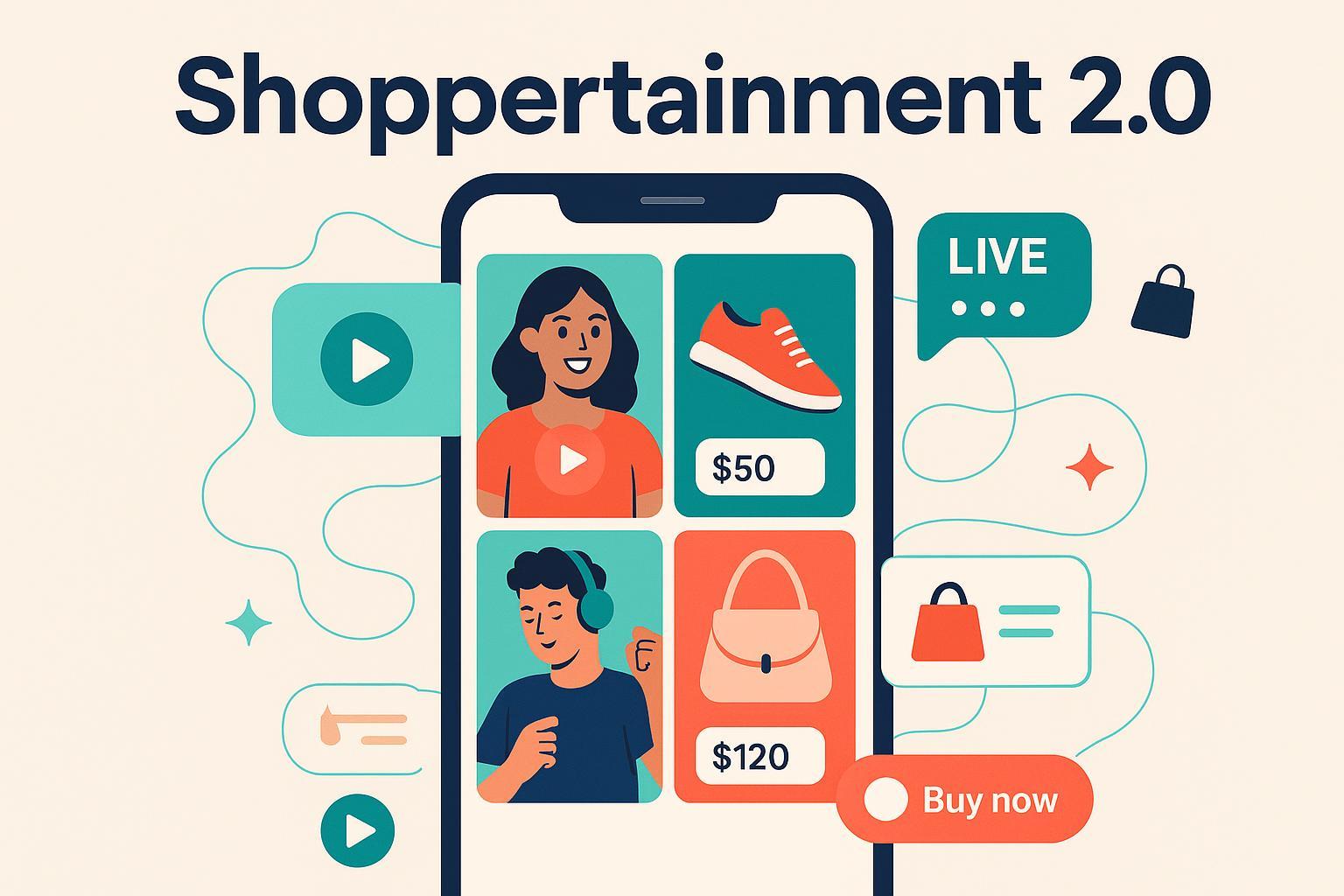
Shoppertainment 2.0 is the next stage of blending shopping and entertainment: purchase journeys are embedded inside short video, livestream, and creator content, with AI-driven personalization, native product tagging, and seamless in-app checkout—plus real-time community interaction. In other words, it’s the “digital street market” where every entertaining booth has a checkout lane.
What it is not: It’s not just QVC-style livestreams on social, not merely influencers dropping affiliate links, and not a separate ad layer bolted onto content. In 2.0, content and commerce are natively integrated end-to-end.
How we got here (from 1.0 to 2.0)
- 1.0: Episodic live shopping pilots and influencer posts drove bursts of sales but often forced users off-platform to finish checkout.
- 2.0: Always-on shoppable content, native checkout, creator–brand co-creation, and data/AI optimization across targeting, creative, and merchandising. Platforms now provide built-in catalogs, affiliate rails, and fulfillment, as seen in TikTok Shop’s unified stack and PACE execution framework described in the PACE your way to shoppertainment success (TikTok for Business, 2024) article.
The four pillars of Shoppertainment 2.0
- Content formats
- Short-form video, livestreams, episodic series, and UGC remixes. YouTube and TikTok have made shopping native across these surfaces—e.g., creators can tag products in Shorts and live. See the new YouTube Shopping features (YouTube Blog, Apr 2024).
- Creators and community
- Creators function as hosts, merchandisers, and community managers. Platforms are scaling match-making: Instagram expanded its Creator Marketplace to more countries with ML-powered recommendations in 2024, per Creator Marketplace expansion (Instagram for Business, 2024).
- Commerce infrastructure
- Native product tagging, in-app checkout, catalogs, and even fulfillment. TikTok’s stack includes in-video/LIVE tagging, an affiliate marketplace, and Fulfilled by TikTok warehousing, summarized on the TikTok Shop Business portal (2024–2025).
- AI and data
- AI helps select audiences and creators, rotate creatives, personalize feeds, and optimize bids. Google’s Performance Max and Demand Gen use product feeds and AI to drive discovery-to-conversion in shoppable video, described in the Merchant Center announcements (Google Help, 2024–2025).
Platform landscape (2024–2025 snapshot)
- TikTok: Shop integrates short video + live with in-app checkout and an affiliate marketplace. The business resources outline seller onboarding, catalogs, tagging, and affiliates in the TikTok Shop Business portal (2024–2025), with case highlights demonstrating ROAS and GMV growth in the UK and US (see examples below).
- YouTube: Shopping is native across videos, Shorts, and live; creators can tag products and curate collections, per the YouTube Shopping features update (YouTube Blog, Apr 2024). YouTube also expanded its Shopify integration in 2024 to bring more merchants into creator commerce, as noted in the Shopify expansion announcement (YouTube Blog, Aug 2024). For paid amplification, marketers often pair creator content with AI-driven campaigns like Performance Max.
- Instagram: Reels/Stories support product tagging and, in eligible markets, native checkout via Commerce Manager. See the Instagram Shopping setup overview (Instagram for Business) and the 2024 Creator Marketplace expansion (Instagram for Business).
- Additional surfaces: Pinterest continues to enhance native shopping and advertiser automation (see AI and automation features for advertisers (Pinterest Newsroom, 2024)). Amazon’s Inspire offers an in-app personalized shoppable video feed surfaced in 2024 Prime event communications, referenced in the Prime Big Deal Days 2024 announcement (About Amazon). Snap supports AR try-ons and shopping lenses via its camera platform, with business updates centralized on the Snap Business newsroom (2024–2025).
A practical playbook to launch and scale
Readiness checklist
- Catalog and inventory: Structured product data (titles, images, variants), accurate pricing, stock alerts, and promotions preloaded.
- Technical setup: Platform catalogs connected, product tagging enabled, pixels/Conversions API or Google/YouTube tracking configured.
- Creative operations: A repeatable pipeline for short videos and live shows (hooks, scripts, shot lists), plus editing and captioning SLAs.
- Creator pipeline: Sourcing criteria, contracts, brand briefing kits, and performance-based compensation.
- CX and moderation: Live chat guidelines, comment moderation, returns and customer service playbooks, and fraud/counterfeit checks.
Content strategy: the 70/20/10 mix
- 70% Value-first content: educational demos, routines, “how to choose” explainers, behind-the-scenes.
- 20% Community entertainment: challenges, collabs, UGC remixes, live Q&A.
- 10% Promotional bursts: limited drops, bundles, time-bound codes, and seasonal campaigns.
Creator strategy
- Selection: prioritize brand–audience fit, authentic use, and prior conversion signals (e.g., clicks-to-cart, affiliate sales). Use platform tools like the Instagram Creator Marketplace (2024) and YouTube’s affiliate capabilities outlined in the YouTube Shopping affiliate program overview (Google Ads Help, 2024).
- Compensation: hybrid models (base + performance) with clear attribution windows; define usage rights for ad extensions and cross-posting.
Conversion design (make it easy to buy)
- Product pinning: keep the hero SKU pinned; rotate complementary SKUs during live segments.
- Merchandising: bundles, starter kits, and limited drops to increase AOV and urgency.
- Frictionless checkout: enable native checkout where available (e.g., TikTok Shop; Instagram Checkout in supported markets), and make sure payment, shipping, and returns are clearly communicated.
Optimization rhythm
- Test systematically: hooks, lengths, posting times, hosts, and opening price points.
- Let AI help: use platform automation for creative rotation and bidding (e.g., Google’s AI-driven campaigns per the Merchant Center announcements, 2024–2025).
- Schedule live programming: anchor tentpole shows (weekly themes) and fill with daily short-form cuts.
Measurement that matters
Core sales metrics
- GMV, orders, conversion rate, ROAS, AOV, and repeat purchase rate. TikTok encourages connecting robust data sources to capture multi-touch and view-through impact, as outlined in its performance campaign measurement guidance (TikTok for Business, 2024).
Engagement and intent metrics
- Views, watch time, product views, CTR to product, add-to-cart rate, saves, follows, live chat interactions.
Funnel/attribution
- Combine platform analytics (e.g., YouTube Analytics and tagged shopping) with ads attribution. Think with Google reports strong ROI and long-term brand impact for YouTube; for example, an ANZ analysis found ROI up 52% YoY in 2024, as summarized in the YouTube Brandcast Sydney 2024 highlights (Think with Google, 2024).
Brand health
- Sentiment, creator credibility, share of voice, and content save/share rates. Track creator halo effects beyond last-click.
Incrementality
- Run geo or time-split lift tests around tentpole events; compare exposed vs. control geos to isolate impact.
Governance, compliance, and risk management
- Endorsement disclosures (US): The FTC’s updated Endorsement Guides require clear, conspicuous disclosures and remind brands that platform tools alone may be insufficient; see the FTC’s Endorsement Guides Q&A (2023). The agency also updated penalty amounts in 2025, noted in the FTC civil penalty adjustments (Feb 2025).
- EU marketplace and ad rules: The Digital Services Act (DSA) brings ad transparency, seller traceability, and notice-and-action obligations to platforms in 2024–2025. See the DSA questions and answers (European Commission, 2024–2025) and the harmonised transparency reporting rules (2025).
- Brand safety and counterfeit: Use platform policies and seller verification. For TikTok, align with Seller Center rules and community guidelines referenced from the TikTok Shop Business portal (2024–2025). Establish internal review processes and a takedown path for infringements.
- Operational pitfalls: Verify inventory and fulfillment capacity before major live events; avoid over-reliance on one platform; create escalation paths for creator misalignment or content crises.
Quick examples and inspiration (2024)
- TikTok Shop UK cases report that Puma’s April Deals achieved “$37.1k GMV with a 737% week-over-week increase, 60% via affiliates,” while Glow Hub reported “1236% ROAS and a 92% CPA decrease,” all in a UK market context according to the TikTok Shop Business UK case highlights (2024). Treat these as directional and test in your category and market.
- YouTube: Pair creator-tagged product videos with AI-driven campaigns to scale discovery to conversion; see the YouTube Shopping features update (YouTube Blog, Apr 2024) and retail feed integrations via the Shopify expansion (YouTube Blog, Aug 2024).
- Instagram: Use Creator Marketplace to find partners and co-create Reels with product tags; confirm Checkout availability via the Instagram Shopping setup page (Instagram for Business).
FAQs
- Is Shoppertainment 2.0 only for Gen Z? No. While younger audiences over-index on short video, product tagging and native checkout are becoming mainstream across age groups on YouTube and Instagram, as indicated by the platforms’ broad commerce rollouts in 2024.
- What budget do I need to start? Many brands pilot with a modest catalog and 2–3 creators. Use hybrid compensation (base + performance) and reinvest based on ROAS and payback.
- How fast can I see results? Expect signal within 2–4 weeks for short-form tests and 4–8 weeks for live programming patterns. Look beyond last-click to assisted conversions and repeat purchase.
- Do I need in-app checkout? Native checkout usually improves conversion and attribution clarity. Where not available, keep the handoff seamless and trackable.
Key takeaways
- Shoppertainment 2.0 means native, always-on shoppable content plus creators, community, and AI—no more bolted-on links.
- Start with operational readiness (catalogs, creators, CX), design for frictionless conversion, and let AI assist optimization.
- Measure full-funnel effects and build governance from the ground up to stay compliant and brand-safe.
Further reading and official resources
- TikTok’s strategy and measurement overviews: PACE framework (2024) and performance measurement guidance (2024)
- YouTube/Google updates: YouTube Shopping feature update (2024), Shopify expansion (2024), and Think with Google ROI highlights (2024)
- Instagram commerce and creators: Shopping setup and Creator Marketplace expansion (2024)
- Regulations: FTC Endorsement Guides Q&A (2023) and EU DSA Q&A (2024–2025)