SEO Strategy for Niche B2B Products (2025): An ROI-First Playbook

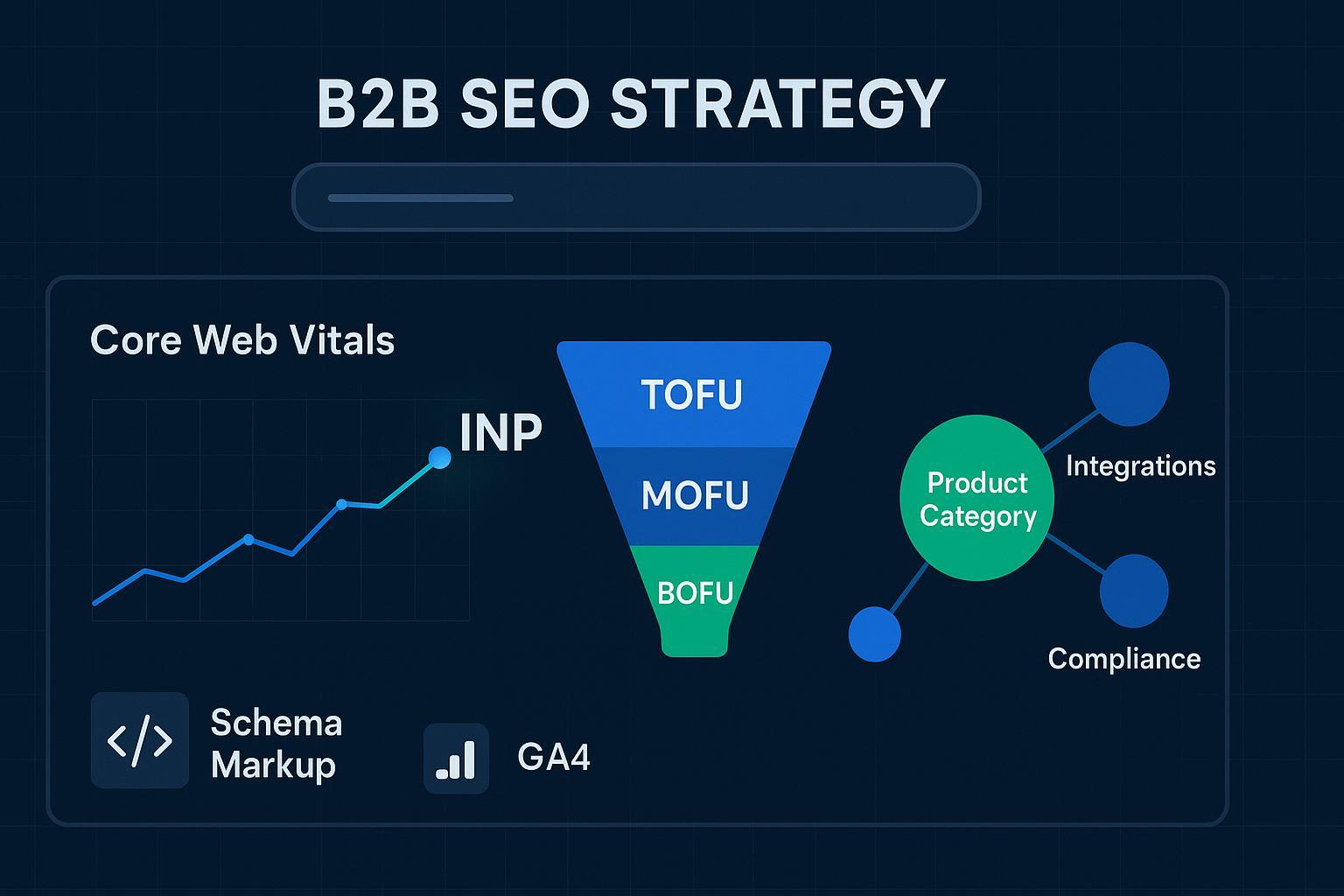
If you sell a niche B2B product, you don’t have a keyword buffet. You have a handful of high-intent queries, a long buying committee, and less real estate on the SERP thanks to AI Overviews. That’s not a problem—it’s a constraint you can design around. The goal isn’t traffic for traffic’s sake; it’s pipeline and revenue.
According to Google’s May 2024 announcement, AI Overviews began rolling out in the U.S., compressing above-the-fold space and changing click dynamics for many informational queries. The implication for B2B: emphasize high-intent pages that deserve a click, and make your brand/entity strong enough to be cited in Overviews. See Google’s note in “Generative AI in Search: May 2024 update”. On the technical side, Core Web Vitals now include Interaction to Next Paint (INP). Google defines “Good” performance as INP under 200 ms for at least 75% of page loads, which supports responsiveness on long-form B2B pages; details are in Google’s Core Web Vitals documentation and the web.dev INP guide.
1) Map intent to the buying committee
For niche markets, intent is specific and role-bound. CFOs search for TCO and payback periods. CISOs look for compliance guarantees and integration risks. Procurement asks for SLAs, RFPs, and vendor comparisons. Map queries to stages—problem, solution, vendor, validation—and to roles across your buying committee. Use sales call transcripts, CRM notes, and customer communities to extract language and objections. CXL outlines how mining customer insights informs B2B keyword research in “B2B keyword research with customer insights” (guide).
Build a simple intent grid:
- Role (CFO, CISO, VP Ops, Procurement, Architect)
- Stage (Problem, Solution, Vendor, Validation)
- Query patterns (“for [industry], compliance,” “integration with [system],” “ROI,” “pricing,” “SLA”)
- Asset type (primer, integration guide, comparison, ROI calculator, implementation plan)
One question to keep you honest: if a real stakeholder typed this query, would your page answer with the depth and proof they need to move forward?
2) Entity-first topic clusters and ABM alignment
Think of your site as a map of entities: your product category, sub-capabilities, integrations, standards (ISO 27001, SOC 2), and industries. Anchor a pillar page to the category with definitions, use cases, and ROI, then build clusters for integrations, compliance, alternatives, and implementation. Siteimprove explains the pillar–cluster approach in “Pillar and cluster content strategy”.
Align clusters with ABM. Mirror the language of target accounts and their industry contexts; create personalized landing paths (industry/role variants) and link them from clusters. Use intent data to prioritize what to publish and when. Demandbase summarizes intent-based tactics in “Intent-Based Marketing FAQ”.
3) Technical SEO that moves the needle in 2025
Performance and rendering
- Hit INP < 200 ms, LCP < 2.5 s, CLS < 0.1 at the 75th percentile. Reduce main-thread blocking, embrace code splitting, and use SSR/SSG when feasible to avoid hydration bottlenecks. Guidance is captured in Google’s CWV docs and the web.dev INP article.
Schema and rich results for B2B
- Implement Organization (logo, sameAs, contactPoint), WebSite (SearchAction), Product/Service (offers, brand, review), Breadcrumb, and HowTo/FAQPage when truly helpful. Validate with Rich Results tests. Google’s structured data gallery provides exact patterns in “Search Central: Structured data”.
Crawl management and large catalogs
- Even if crawl budget is rarely a constraint for smaller sites, log-file analysis reveals discoverability gaps and wasteful parameters. Prioritize core sections with internal links, canonicalization, and clean sitemaps. Google’s guidance is summed up in “Managing crawl budget for large sites”.
Internationalization and hreflang
- For multi-region catalogs, use correct language–region codes and reciprocal annotations tied to consistent canonicalization. See “Localized versions and hreflang” (Search Central).
4) Content formats that convert in niche B2B
Top-of-funnel content earns awareness, but mid- and bottom-of-funnel pages win deals. Prioritize:
- Alternatives and comparisons (X vs Y), with specs, integration paths, and trade-offs.
- Pricing and TCO/ROI explanations, with transparent assumptions and calculators.
- Implementation playbooks: security, compliance, integrations, migration plans.
- Stakeholder one-pagers (CFO, CISO, Procurement) tailored to objections and proof requirements.
Backlinko emphasizes full-funnel content in “SEO for B2B (2025)”. Draft.dev’s guide adds developer-led content nuances in “B2B SEO Strategy: Complete 2025 Guide”.
Signal trust everywhere. Publish author bios with credentials, cite standards and documentation, and surface data sheets and certifications. That’s how you strengthen E-E-A-T for complex purchases.
5) Link earning and digital PR for niche B2B
Earn links with assets people reference:
- Original research and benchmark reports (methodology clearly documented)
- Standards-mapping guides and integration matrices with named systems and versions
- ROI calculators or RFP templates that save teams real time
- Community explainers on new regulations or security practices
Pitch trade publications, analyst blogs, partner ecosystems, and relevant newsletters. Siege Media and AgencyJet offer strong content strategy perspectives; for case study inspiration, B2B Marketing World’s round-up is useful in “B2B SEO Case Study – 8 real-life examples” (examples).
6) Measurement and ROI modeling you can defend
Privacy-aware analytics
- Implement Consent Mode v2 to retain modeled measurement while honoring regional requirements. Google documents the model behavior in “Consent Mode developer guides” and GA4 details the conversion/behavioral modeling in “About modeled conversions”.
Closed-loop reporting
- Connect GSC and GA4 to your CRM (HubSpot/Salesforce) so you can attribute organic pages/keywords to opportunities and revenue. HubSpot’s multi-touch reporting is covered in “Multi-touch attribution models”, and GSC integration setup in “Connect Google Search Console”.
A simple pipeline impact calculator
| Input/Assumption | Value | Notes |
|---|---|---|
| Monthly qualified organic visits to BOFU pages | 800 | From GA4, segmented by content group |
| Visit-to-lead rate (BOFU) | 4% | Based on historical BOFU form/demo rates |
| Lead-to-opportunity rate | 35% | CRM average for qualified leads |
| Opportunity win rate | 22% | Segment average |
| Average deal value | $48,000 | Last 12-month average |
| Projected monthly pipeline from SEO | $295,680 | 800×0.04×0.35×0.22×$48,000 |
Use this table format with your own numbers. Then track changes monthly after publishing or optimizing specific clusters. If numbers improve, you have directional proof of ROI.
7) Brief case examples (directional, with caveats)
- Regulated, international travel services: after technical and content upgrades, qualified leads surged 60% and H1 2025 pipeline rose to $15.5M from $9.8M prior year, per AIS Media’s “SEO case study: Adelman Travel”.
- Manufacturing: commercial-page organic traffic +306% and lead inquiries +362%; rankings earned for “custom uniforms United States,” per B2B Marketing World’s case study compilation.
- Supply chain analytics software: #1 ranking generated 23% of qualified leads; organic traffic +287%; lead quality +42%; sales cycles 31% shorter, per the same B2B case study roundup.
Treat agency-reported outcomes as illustrative; triangulate against your own pipeline and attribution.
8) Your 90-day action plan
Weeks 1–3: Discovery and foundations
- Audit Core Web Vitals and rendering; prioritize INP and LCP fixes.
- Build the intent grid by role and stage using sales calls, CRM notes, and community research.
- Define your entity map (category, integrations, standards, industries) and draft pillar outlines.
Weeks 4–7: Publish high-intent assets
- Launch the pillar page and 3–5 BOFU pages (comparisons, pricing/TCO, implementation).
- Add schema: Organization, Product/Service, Breadcrumb, WebSite. Validate.
- Set up Consent Mode v2; ensure GA4 and GSC integrate with your CRM.
Weeks 8–10: Strengthen clusters and E-E-A-T
- Publish integration guides and compliance explainers; add SME bios and certifications.
- Secure 3–5 links via partners and trade publications with referenceable assets.
Weeks 11–13: Measure and iterate
- Attribute organic touches to opportunities; review the pipeline calculator with live data.
- Expand clusters based on intent signals; prune low-value pages and fix crawl traps.
- Internationalize priority pages with correct hreflang if applicable.
Here’s the deal: niche B2B SEO works when you focus on the few queries that matter, build entity-level authority, engineer performance, and prove impact in the CRM. Do that consistently, and your organic channel becomes a reliable source of revenue, not just a traffic line item.