SEO for Software Companies: The 2025 Playbook That Actually Moves Pipeline

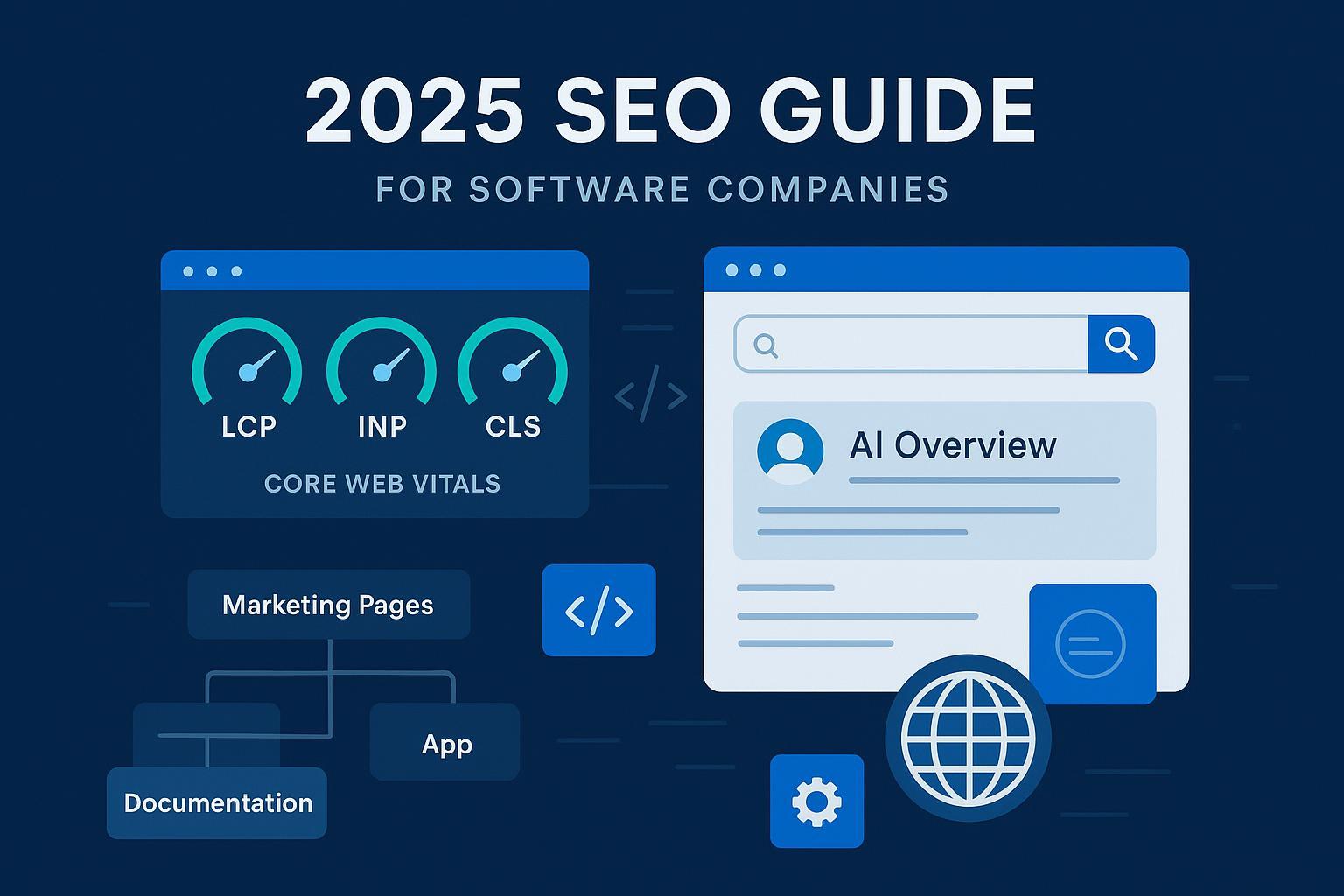
If you feel like the organic rules shifted under your feet this year, you’re not imagining it. AI Overviews now sit above classic blue links on a growing share of queries, Interaction to Next Paint (INP) replaced FID in Core Web Vitals, and Google trimmed several rich result types. The upside? Software companies that build fast, clear, well-structured experiences—and publish content mapped to real buyer needs—are still winning.
What changed, and where should your team focus next? Here’s the 2025 blueprint I use with SaaS and software orgs to turn search demand into qualified signups and revenue, not just traffic.
1) What’s different in 2025 (and why it matters)
- INP is now a Core Web Vital, replacing FID, and it captures actual interaction latency across a session. Google announced the switch in March 2024; it’s now table stakes for responsiveness. See the original note in the INP Core Web Vitals announcement (web.dev, 2024).
- AI Overviews rolled out broadly in the U.S. and continue to expand. Google’s guidance clarifies you can’t “opt in,” but you can increase citation eligibility by offering clear, trustworthy, well-structured answers. Read Google’s overview in Search appearance: AI features (Google, updated 2025).
- Traffic mix is shifting. Multiple studies show lower CTR when AI Overviews appear; for instance, Seer Interactive’s year-long study (3,119 queries; 25.1M impressions) reported steep CTR drops when AIOs were present, summarized by Search Engine Land in “AI Overviews drive drop in CTR” (2025). Meanwhile, seoClarity tracked rising AIO prevalence across U.S. desktop queries; see seoClarity’s AI Overviews impact research (2025).
- Structured data eligibility is slimmer. In June 2025, Google ended rich result support for several schema types and has restricted others like FAQ/HowTo to limited contexts. Details in Google’s “Simplifying the search results page” (June 2025).
Bottom line: you need exceptional page experience, unambiguous entities, and content that earns citations and clicks—even when fewer clicks are available.
2) Unshakeable foundations: speed, entities, and crawlable architecture
- Page experience still compounds. Optimize LCP/INP/CLS using Google’s Core Web Vitals documentation (2025) and ship meaningful improvements, not just marginal scores.
- Clarify your entity. Make sure Organization and Product/SoftwareApplication details are consistent across your site and profiles. Use JSON‑LD to help machines understand what you sell and to whom. Think of it as labeling every drawer so Google never guesses.
- Keep architecture boring—in a good way. Logical URL routes, server-rendered titles/canonicals, and discoverable internal links beat clever client-side hacks. If a crawler can fetch the HTML and “see” the main content and links without running heavy JavaScript, you’re on the right path.
3) Technical SEO for JS-heavy SaaS sites
JavaScript is fine; hiding your content behind it isn’t.
- Prefer SSR/SSG/hybrid. Ensure primary content, links, metadata, and JSON‑LD render in the initial HTML. Hydrate progressively so critical UI becomes interactive first. This stabilizes indexing and improves INP.
- Routing and discovery. Every significant view gets a stable URL; avoid fragment-only navigation. Use standard anchor links, not click handlers masquerading as links. Provide crawlable pagination and a clean sitemap.
- App vs. marketing split. Keep the authenticated app out of the index (robots + noindex) and concentrate crawl budget on docs, KB, and marketing content. Public changelogs and release notes can drive qualified intent if they explain concrete benefits.
- Versioned docs without duplication. Use versioned URLs (e.g., /docs/v2/…), make “latest” canonical, consider noindex on deprecated versions, and maintain 301s when removing pages. This keeps Search from indexing stale or duplicate content while preserving developer trust.
4) Content that maps to the SaaS funnel (including PLG plays)
Your editorial calendar should mirror how buyers decide—not how you brainstorm. Here’s a simple mapping you can adopt this quarter.
| Buyer stage | High-ROI assets | What to include | Primary success signal |
|---|---|---|---|
| Awareness (problem) | Pillars + clusters, industry use cases | Definitions, frameworks, short summaries; cite sources | Qualified organic sessions; newsletter subs |
| Consideration (solution) | Comparison pages, use-case deep dives | Honest pros/cons, pricing ranges, integrations, demos | Demo requests; time on page |
| Decision (vendor) | Integrations pages, ROI calculators, “vs” and alternatives | Setup steps, FAQs, performance proof, security | Trials/signups; influenced opportunities |
| Adoption/Expansion | Templates, playbooks, tutorials, KB | Embedded CTAs, in-product linkage, video/gifs | Feature adoption; expansion revenue |
A few proven SaaS plays:
- Integrations pages: “[Your product] + [Tool]” with benefits, setup, screenshots, and FAQs. Mirror listings in marketplaces and encourage reviews.
- Comparison/alternatives: Tackle “[Competitor] vs [You]” and “alternatives” honestly with side-by-side checklists and use-case fit. Readers smell spin a mile away.
- Templates and resource libraries: Ops checklists, calculators, and example datasets generate high-intent traffic in PLG motions. Add “try it” micro-experiences.
- Docs/KB SEO: Optimize answers to common tasks, link to onboarding flows, and add concise FAQs. Where eligible, apply appropriate schema types. Keep the taxonomy shared across docs and marketing to prevent dead ends.
5) Prepare for AI Overviews and more zero-click results
You can’t force inclusion, but you can earn it.
- Give concise, cited answers near the top of relevant pages. Summaries of 2–4 sentences, followed by depth, tend to be extracted and still invite clicks for details.
- Strengthen E‑E‑A‑T signals: author bios with credentials, clear sourcing, last updated notes, and transparent methodology on benchmarks. Here’s the deal: if an editor wouldn’t trust it, neither will a model.
- Use schema to disambiguate. Organization + Product/SoftwareApplication are table stakes; add Review where policy allows. Schema isn’t a ranking factor by itself, but it reduces ambiguity.
- Design for skimmability. Short paragraphs, descriptive subheads, and tables increase scannability for humans and machines alike.
6) Core Web Vitals engineering playbook (ship this, not fluff)
- LCP: Preload the hero image and critical fonts; serve AVIF/WebP with explicit dimensions; inline critical CSS and defer the rest; keep your hero under the render-blocking budget.
- INP: Break up long tasks; reduce third‑party script cost; ship smaller bundles with code-splitting; prioritize interactive components with selective hydration; move noncritical work to web workers.
- CLS: Reserve space for media/embeds; avoid layout-jumping banners; preload fonts to prevent late swaps; use CSS containment where it makes sense.
- Measure continuously: Use GSC’s Core Web Vitals report with CrUX field data for reality, and Lighthouse/PageSpeed for lab diagnostics. Alert on regressions so marketing launches don’t inadvertently tank performance. Practical tip: treat Web Vitals as a product KPI, not a quarterly cleanup.
For authoritative guidance, refer to Google’s Core Web Vitals documentation (2025).
7) International SaaS: do hreflang right, or don’t ship it yet
International rollouts fail when teams publish translations without signals that connect variants. Use absolute URLs, bidirectional annotations across all alternates, and self-canonicals for each locale. Include x‑default for the language selector page and make sure the localized content is genuinely localized (currency, examples, screenshots).
Google’s guide to annotations is the canonical reference: Creating valid hreflang annotations (Google, 2025).
8) Measurement in a privacy-first world (GA4 + Consent Mode v2)
Consent Mode v2 adds parameters for ad_user_data and ad_personalization, enabling more granular consent and better modeling—when implemented correctly. Fire consent signals before tags, choose Advanced mode where lawful, and expect modeled conversions when users deny consent. For SEO, triangulate performance with product analytics (signups, activation) and CRM (pipeline) to validate organic quality, especially in EEA cohorts.
For specifics, see Google’s primer: Consent Mode concepts and setup (Google Tag Platform, 2025).
9) A realistic quarterly roadmap (by role)
Start lean, then iterate. This assumes a small in‑house team plus fractional engineering support.
-
Week 1–2: Audit and plan
- SEO lead: Technical crawl, CWV baseline, content gap analysis against funnel. Prioritize INP/LCP fixes and 10 highest-intent topics.
- Eng lead: Scope SSR/SSG/hybrid changes; identify third‑party scripts to remove or defer.
- PMM/Content: Map integrations, comparison, and template pages. Outline 2 pillar hubs with clusters.
-
Week 3–6: Ship technical and first content wave
- Engineering: Implement critical CWV fixes, server-render titles/canonicals/JSON‑LD, clean routes, and sitemaps. Lock robots/noindex for app areas.
- Content: Publish 1 integrations page/week, 1 comparison or alternatives piece, and 2 cluster articles supporting a pillar. Add concise answer boxes and FAQs.
-
Week 7–10: Expand and instrument
- Docs team: Canonicalize “latest,” add crosslinks between tutorials and reference. Publish a changelog category page.
- Analytics: Deploy Consent Mode v2; set up GSC, CrUX dashboards, and KPI alerts. Define SEO → product activation checkpoints.
-
Week 11–12: Review and iterate
- Analyze early rankings, field performance, and funnel metrics. Refresh underperformers. Plan next quarter’s topics based on converting queries and AIO visibility.
10) What to do this week
- Pick three pages that already bring qualified traffic and add a 3–4 sentence, cited summary near the top. Track AIO citations and CTR deltas.
- Preload your hero image and fonts; measure LCP in the field after shipping.
- Draft your first integrations page and align it with the marketplace listing.
- Add or correct hreflang on your top two locales if you’re international.
Will this make you immune to algorithm changes? Of course not. But it will make your site faster, clearer, and more helpful—and that’s what both humans and search systems reward.