How to Scale Content Marketing Teams: The 6‑Pillar 2025 Playbook

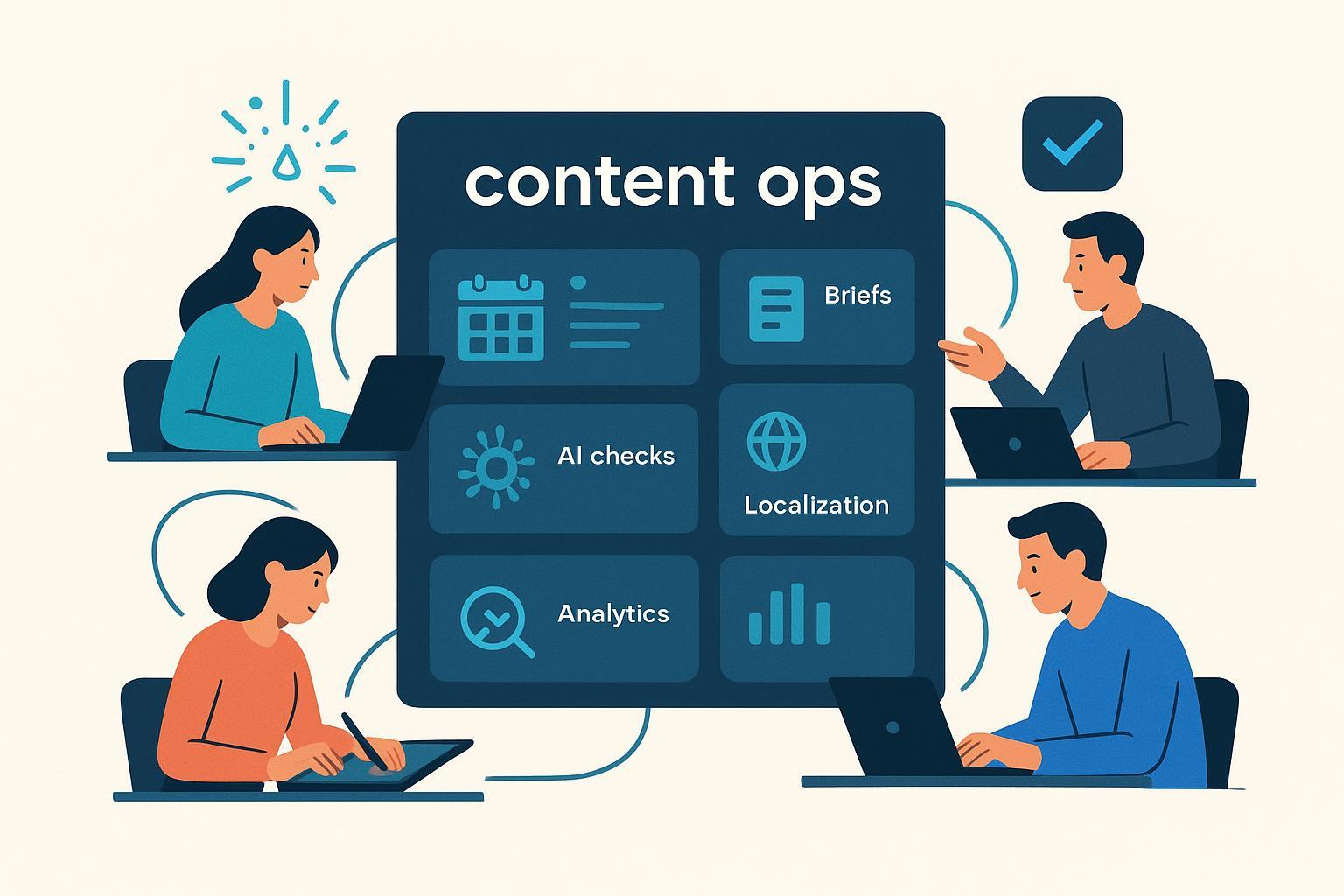
When the content request queue never ends, the real question isn’t “How do we make more?” It’s “How do we scale without breaking quality, brand, or our people?” This playbook lays out a six‑pillar operating system that senior marketers can implement in 90 days, grounded in 2025 standards for AI governance, global enablement, and measurable ROI.
Pillar 1: Team Architecture That Actually Scales
You don’t scale by hiring alone—you scale by structuring. The sweet spot for most mid‑to‑large organizations is a hybrid/federated model: a central Content Center of Excellence (CoE) sets strategy, standards, and governance, while cross‑functional pods execute against business priorities.
- Central hub (CoE): owns brand voice, editorial strategy, enablement, AI policy, and quality standards; runs the editorial portfolio and resource allocation.
- Cross‑functional pods: small “squads” (strategist, writer/editor, designer, SEO, analyst, and a stakeholder) ship content end‑to‑end for a segment, product line, or theme.
- Content council: senior representatives from marketing, product, sales, legal, and regions to set guardrails and resolve conflicts.
- RACI clarity: Responsible (pod creators), Accountable (Content Ops lead), Consulted (SEO, legal, brand), Informed (leadership/stakeholders).
If you’re evaluating structures and role mixes, the patterns here align with widely used models in guides like MarketerHire’s overview of content team structures, which breaks down growth‑stage options and role definitions in practical terms; see their context in the resource, Your Guide to Content Marketing Team Structure (no affiliation).
Why pods work
Pods keep decision cycles tight, reduce cross‑team bottlenecks, and concentrate expertise on the outcomes that matter—pipeline, activation, and retention. Think of each pod like a mini newsroom plus growth lab: autonomous in execution, aligned through shared standards.
Pillar 2: Process and Workflow (From Intake to Publish)
Scaling is just controlled repeatability. Standardize the path from idea to impact.
- Intake and prioritization: one front door with a short brief template and scoring (impact, audience fit, effort). Weekly triage sets a realistic WIP limit.
- Briefs that reduce rewrites: include POV, target reader, angle, sources, SME, distribution plan, SEO notes, and acceptance criteria.
- Editorial cadence: sprint planning (biweekly), standups for pods, and a monthly portfolio review to balance long‑form, multimedia, and repurposing.
- Approvals: lightweight “two‑gate” model—editorial sign‑off, then stakeholder review; reserve legal reviews for risk‑sensitive assets.
- Checklists: style, accessibility, brand voice, sourcing, originality, links and schema, and final “purpose check” before publish.
- Cycle‑time targets: set stage SLAs (brief-to-draft, draft-to-edit, edit-to-publish) and track them; shortening the longest stage often unlocks the biggest gains.
Pillar 3: AI and Automation—with Guardrails
Used well, AI scales thinking and throughput. Used poorly, it scales mistakes. Here’s how to do it right.
- High‑value use cases: research acceleration and synthesis; outlines and variant ideation; first‑draft support for low‑risk content; SEO metadata; transcription and summaries; repurposing across formats; QA aids for style and accessibility; and distribution variants by segment.
- Human in the loop: editors own factual accuracy, originality, and voice. No exceptions.
- Governance: adopt a written policy tied to recognized frameworks. The NIST Generative AI Profile (AI 600‑1, 2024) details practical actions across Govern/Map/Measure/Manage to manage risks like misinformation, IP, and safety; see the publication at NIST’s site in Artificial Intelligence Risk Management Framework — Generative Artificial Intelligence Profile (2024). For program‑level governance, align workflows with ISO/IEC 42001 (AI management systems) via accredited guidance; this adds audit‑ready structure without vendor lock‑in.
- Transparency and compliance: the EU AI Act entered into force in 2024 with phased obligations through 2026–2027; marketing teams should prepare for disclosure practices (e.g., indicating AI‑generated content) and documentation of AI use in processes. See the European Commission’s overview page, Regulatory framework for AI (EU AI Act), for milestone timing and scope.
- Evidence and expectations: Broad knowledge‑work data shows material productivity gains. In 2024, Microsoft’s Work Trend Index reported widespread AI usage among knowledge workers, with strong time‑saving and focus benefits; see the summary in AI at Work Is Here (Microsoft WorkLab, 2024). On the business impact side, McKinsey’s State of AI 2024 found the highest growth in generative AI adoption within marketing and sales, with many respondents reporting revenue contributions; see The State of AI 2024 (McKinsey).
Practical tip: Treat prompts and outputs like code. Version them, review them, and keep a short “prompt library” with examples that meet your brand’s standards.
Pillar 4: Quality at Velocity
Speed without standards is just noise. Codify what “good” looks like.
- Content scoring rubric: score concepts (originality, depth, audience fit), drafts (clarity, evidence, structure, E‑E‑A‑T indicators), and published pieces (engagement, conversion, and search performance).
- Editorial QA: mandate fact‑checking, link verification, and adherence to style and accessibility (alt text, headings, contrast, transcripts/captions). Automate checks where safe; keep final judgment human.
- Voice controls: keep a living style guide with examples; train models on approved tone samples and ban disallowed claims.
- Freshness and maintenance: review top‑performing assets quarterly; refresh with new data, examples, and internal links rather than constantly starting from scratch.
Pillar 5: Globalization and Localization at Scale
If you’re serious about growth, make localization a first‑class citizen of content ops.
- Standards: adopt ISO 17100‑aligned workflows—qualified linguists, multi‑step review (translation, revision, proofreading), and documented project management; see ISO 17100 for the official standard outline.
- Technology: integrate your CMS/DAM with a Translation Management System (translation memory, termbases, connectors) and define content models with reusable modules and locale variants.
- Service tiers: transcreation for flagship assets; human‑edited machine translation for medium‑risk assets; automation for low‑risk, internal content—all with SLAs for turnaround, error thresholds, and glossaries.
- Governance: central terminology and legal guidance; regions maintain nuance. Maintain privacy‑by‑design for prompts and source data.
Pillar 6: Measurement, Attribution, and ROI
What gets measured scales. Tie production to business outcomes and operations.
- Operational KPIs: cycle time (brief‑to‑publish), cost per asset, revision rate, localization throughput and defects, and percent of assets repurposed.
- Funnel mapping: connect assets to assisted conversions, influenced opportunities, activation, and retention. Use cohort or geo holdouts to reduce attribution bias.
- Content scoring to business results: correlate your rubric scores with engagement and pipeline influence to validate your quality model.
- Executive reporting: translate metrics into impact narratives—pipeline contribution, ACV uplift signals, sales‑cycle compression, activation/retention lift.
For market‑level context on budgets and team headcount expectations in 2025, review the CMI Enterprise Content Marketing research findings, which outline how teams anticipate resourcing and measurement challenges in the current cycle.
Scalable Team Models (At a Glance)
| Model | Strengths | Trade‑offs | Best for |
|---|---|---|---|
| Centralized (Hub‑and‑Spoke/CoE) | Strong brand governance, consistent quality, shared tooling and templates | Slower local responsiveness, risk of bottlenecks | Regulated industries; brand‑sensitive orgs |
| Decentralized | Speed, proximity to stakeholders, local relevance | Fragmented standards, duplicated effort, uneven quality | Early‑stage or highly autonomous BUs |
| Hybrid/Federated with Pods | Balance of governance and speed; pods own outcomes; scalable with clear guardrails | Requires mature ops and RACI discipline | Mid‑to‑large orgs seeking scale without chaos |
Templates and Quick‑Start Kit
- Content brief template with acceptance criteria and distribution plan
- Editorial RACI map (CoE, pods, SEO, brand, legal)
- Skills matrix by pod (strategy, writing, design, SEO, analytics, PM)
- Content scoring rubric and editorial QA checklist
- AI usage policy (NIST‑aligned) and prompt library with versioning
- Localization service tiers and SLAs (ISO 17100‑aligned)
- Executive KPI dashboard schema (ops + funnel metrics)
Troubleshooting: Common Failure Modes and Fixes
- Endless revisions: Strengthen briefs; set acceptance criteria; cap revision rounds; escalate scope creep via the council.
- Bottlenecked approvals: Move to two‑gate approvals; define risk‑based legal review; publish SLAs; track cycle‑time by stage.
- Quality dips at higher volume: Implement the scoring rubric; add pre‑publish checks; pair editors with pods on high‑impact pieces.
- AI sprawl and inconsistency: Centralize prompts; require human sign‑off; document data sources; audit outputs monthly against policy.
- Global content that underperforms: Localize intent, not just language; use regional SMEs; set locale‑specific KPIs and feedback loops.
A 90‑Day Roadmap to Scale
- Days 1–30: Stand up the Content Ops foundation. Define governance (council, RACI), pick pilot pods, finalize brief and QA templates, and publish an AI policy aligned to NIST guidance. Baseline cycle times and current KPIs.
- Days 31–60: Pilot two pods on one segment each. Run sprint cadences, enforce two‑gate approvals, and integrate a light TMS connection for one locale. Launch the executive dashboard and begin weekly portfolio triage.
- Days 61–90: Expand to three pods, introduce the scoring rubric, and formalize localization tiers. Optimize the longest stage in the workflow, tune prompts via a shared library, and run your first attribution experiment (e.g., cohort holdout). Report outcomes and adjust resourcing.
Scaling content isn’t about doing everything at once—it’s about doing the right things in the right order, with clear standards and feedback loops. Start with architecture and workflow, institutionalize responsible AI, make localization part of the system, and measure what matters. Ready to put this playbook to work?